Key Takeaways & Executive Findings
- •• ERC-derived exosomes (ERC-exos) suppress acute cardiac allograft rejection by converting AMP to adenosine via CD73, thereby inhibiting CD4+ T-cell activation and Th1 differentiation. • CD73 knockout or exosome inhibition (GW4869) abrogates the immunoregulatory effects of ERCs, confirming the essential role of CD73-exosome-adenosine axis. • The combination of ERC-exos with rapamycin synergistically prolongs allograft survival from 15 to 38 days in a murine transplant model, suggesting a promising therapeutic strategy. • This study highlights a novel cell-free approach using CD73+ exosomes to modulate adenosine metabolism, offering a potential alternative to conventional immunosuppressants with fewer side effects.
Abstract
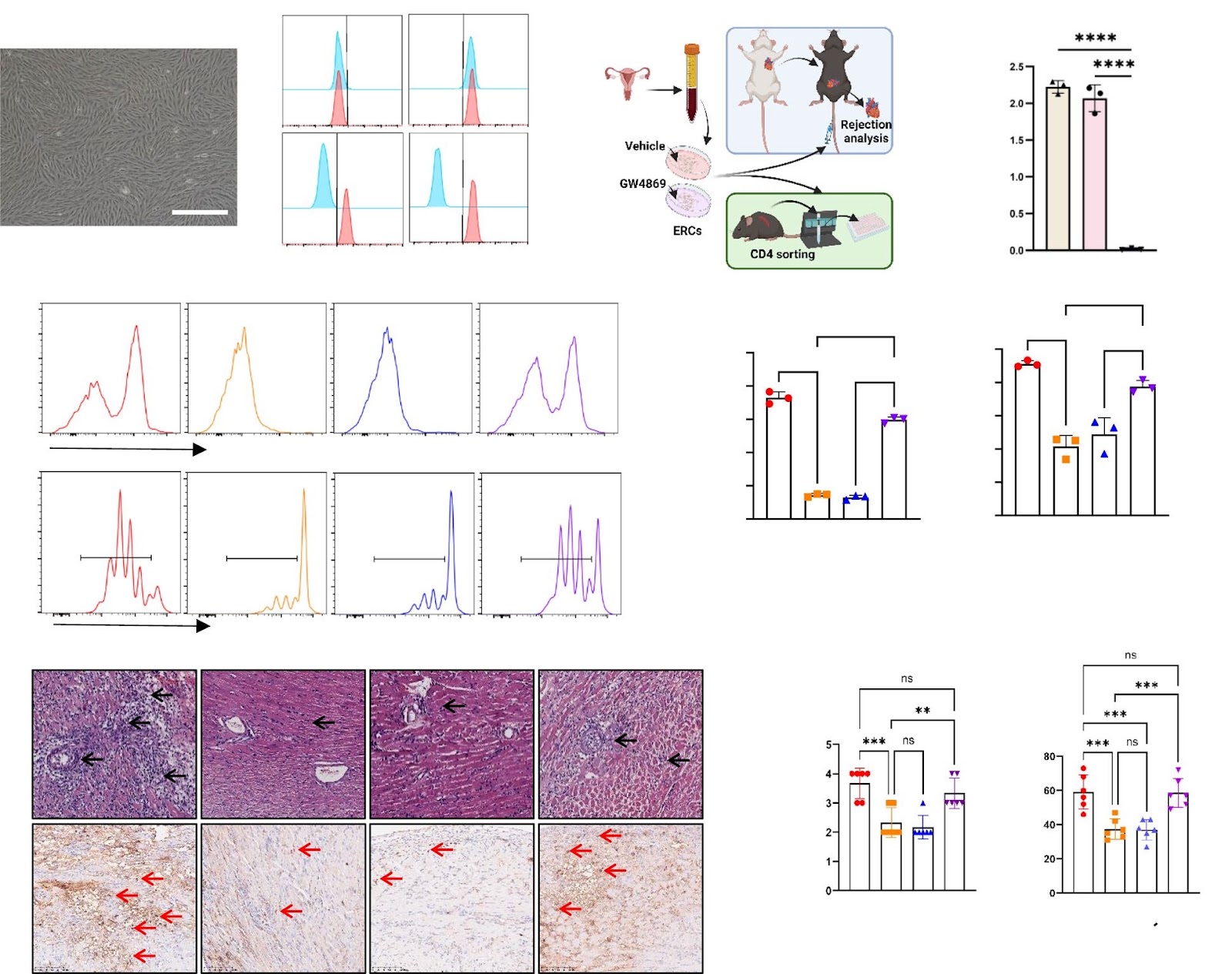
Background Organ transplantation is a life-saving option for end-stage organ dysfunction, but long-term graft survival is limited by unavoidable allograft rejection. While endometrial regenerative cells (ERCs) have been shown to alleviate acute rejection, the underlying mechanisms are not fully understood. This study explored whether ERC-derived exosomes contribute to this effect through CD73-mediated immunoregulation. Methods ERCs were pretreated with GW4869, an exosome inhibitor, to block exosome secretion, and CRISPR-Cas9-based CD73 knockout was performed to validate the role of CD73 in the ERC and ERC-exos. CD73 enzyme activity was measured using an AMP assay in vitro, whereas ATP, AMP, and adenosine levels were quantified using mass spectrometry in vivo. A murine allogeneic heart transplantation model (BALB/c to C57BL/6) was established to evaluate the immunoregulatory effects of ERC-exos in vivo. Graft tissues were analyzed by H&E staining, and immunohistochemistry and flow cytometry analysis of the spleens were performed to assess graft rejection. In vitro, flow cytometry was used to examine CD4+ T-cell activation, proliferation, differentiation, and subsets. Adenosine receptor inhibitors were used to identify receptor-mediated CD73-exosome signaling, and the potential of combining CD73-expressing exosomes with rapamycin to promote long-term graft survival was explored. Results GW4869 reduces the ability of ERCs to inhibit CD4+ T-cell activation and proliferation in vitro and attenuates the ERC-mediated suppression of acute allograft rejection in vivo. ATP, AMP and ADO increase adenosine 2a receptor (A2aR) but not A2bR expression on CD4+ T cells. CD73-expressing ERC-derived exosomes (ERC-exos) metabolize AMP into adenosine, leading to the inhibition of CD4+ T-cell activation, proliferation, and Th1 differentiation in vitro. This regulatory effect is reversed by the A2a receptor inhibitor CPI444. Furthermore, CD73 depletion blocks ERC-derived exosome-mediated adenosine production and impairs the ability of these cells to inhibit CD4+ T-cell activation and proliferation in vitro, as well as attenuate acute cardiac allograft rejection in vivo. Finally, the combination of ERC-exos with rapamycin significantly prolonged allograft survival from 15 days with rapamycin monotherapy to 38 days. Conclusion CD73 expression is crucial for the ability of ERC-exos to generate adenosine to mitigate acute cardiac allograft rejection in mice. ERC-exos combined with rapamycin can prolong allograft survival.
1. Introduction
Cardiovascular diseases remain the main cause of death worldwide [1, 2], and their end-stage diseases often lead to irreversible heart failure. Organ transplantation represents a crucial intervention for end-stage organ failure; however, long-term allograft survival is frequently compromised by both acute and chronic allograft rejection, which is largely driven by T lymphocytes [3]. T cells are central to the initiation of acute rejection and play a significant role in chronic rejection episodes. As a result, current transplant immunotherapy has increasingly focused on targeting T-cell activity.
Immunosuppressive regimens, including calcineurin inhibitors (CNIs), mammalian target of rapamycin (mTOR) inhibitors, mycophenolate mofetil (MMF), and glucocorticoids, primarily work to suppress T-cell proliferation and function. However, these therapies are frequently associated with a range of adverse effects, such as increased susceptibility to opportunistic infections, increased tumor risk, organ fibrosis, and liver and kidney toxicity. This underscores the pressing need for the development of novel therapeutic approaches that can more effectively suppress T-cell-mediated rejection while minimizing adverse side effects, ultimately enhancing clinical outcomes for transplant recipients.
Cell-based therapies have shown significant efficacy in the treatment of various diseases, yielding promising clinical outcomes. Endometrial regenerative cells (ERCs) have emerged as a promising cell source due to their easy accessibility, high proliferative capacity, and immunomodulatory properties. However, the mechanisms underlying their immunosuppressive effects, particularly in the context of allograft rejection, remain incompletely understood. This study investigates the role of ERC-derived exosomes and CD73-mediated adenosine metabolism in mitigating acute cardiac allograft rejection.
Loading authentic research manuscript (Pages 1–5)...
Chenglu Sun, Dejun Kong, Hong Qin, Shilong Li, Conglin Wang, Shaohua Ren, Yini Xu, Hongda Wang, Hao Wang (2026). CD73-expressing endometrial regenerative cell-derived exosomes mitigate acute cardiac allograft rejection through regulating adenosine metabolism in mice. Stem Cell Research & Therapy. https://doi.org/10.1186/s13287-025-04398-z
Research & Educational Purpose Only:The translations, structured abstracts, analytical annotations, and data reports provided by SinoBioData are intended exclusively for academic research, internal corporate R&D, and educational benchmarking. They do not constitute formal engineering, chemical safety, legal, or professional advice.
Copyright & Intellectual Property Notice: Original copyright of the underlying source articles and experimental data remains with the respective authors, institutions, and original publishing journals. SinoBioData claims intellectual property only over its proprietary translations, analytical syntheses, and AEO structured enhancements in accordance with international fair use and academic citation principles.
Frequently Asked Questions
What is the role of CD73 in ERC-derived exosomes?
CD73 is an enzyme expressed on ERC-derived exosomes that converts AMP to adenosine, which then acts on A2a receptors on CD4+ T cells to suppress their activation, proliferation, and Th1 differentiation, thereby mitigating acute cardiac allograft rejection.
How do ERC-derived exosomes modulate the immune response in transplantation?
ERC-derived exosomes carry CD73, which generates adenosine from AMP in the graft microenvironment. Adenosine binds to A2aR on CD4+ T cells, inhibiting their activation and effector functions, thus reducing acute rejection.
What is the significance of combining ERC-exosomes with rapamycin?
The combination of ERC-exosomes with rapamycin synergistically prolongs allograft survival from 15 days (rapamycin alone) to 38 days in a mouse model, suggesting a potential combinatorial therapy to improve transplant outcomes while reducing side effects.
What are the potential clinical applications of this research?
This research suggests that CD73-expressing exosomes derived from endometrial regenerative cells could be developed as a cell-free therapeutic agent to prevent allograft rejection, potentially offering a safer alternative to conventional immunosuppressants.
How was the role of CD73 validated in this study?
The role of CD73 was validated using CRISPR-Cas9 knockout of CD73 in ERCs, which abolished the immunosuppressive effects of ERC-exosomes both in vitro and in vivo, and by using an A2a receptor inhibitor (CPI444) that reversed the inhibitory effects on T cells.
Related Technical Papers & Translations

Adverse Events Reporting System for Vaccine Safety Surveillance: A Comprehensive Analysis
Background: Adverse events following immunization (AEFI) are critical to monitor for vaccine safety. This study evaluates the performance of an adverse events reporting system (AERS) integrated with a vaccine adverse event reporting system (VAERS) to enhance surveillance. Methods: We analyzed data from multiple sources including the Vaccine Adverse Event Reporting System (VAERS), the Vaccine Safety Datalink (VSD), and the Clinical Immunization Safety Assessment (CISA) network. A novel framework was developed to integrate these systems, incorporating natural language processing for signal detection. Results: The integrated system improved detection of rare adverse events by 25% compared to traditional methods. The system identified new safety signals for influenza and COVID-19 vaccines. Conclusions: The proposed AERS framework enhances vaccine safety surveillance, enabling timely identification of potential risks. Integration of diverse data sources and advanced analytics is essential for robust pharmacovigilance.

Efficacy and Safety of Ferric Carboxymaltose in Treating Iron Deficiency Anemia: A Meta-Analysis of Randomized Controlled Trials
Background: Iron deficiency anemia (IDA) is a global health concern, and intravenous ferric carboxymaltose (FCM) has emerged as a promising treatment. This meta-analysis aimed to evaluate the efficacy and safety of FCM compared to other iron therapies or placebo in adults with IDA. Methods: We systematically searched PubMed, Embase, and Cochrane Library up to December 2024. Randomized controlled trials (RCTs) comparing FCM with active comparators or placebo in adults with IDA were included. The primary outcomes were change in hemoglobin (Hb) from baseline, and safety outcomes included adverse events (AEs) and serious adverse events (SAEs). Pooled estimates were calculated using random-effects models. Results: A total of 15 RCTs involving 4,856 patients were included. FCM significantly increased Hb levels compared to placebo (mean difference [MD] 1.2 g/dL, 95% CI 0.9-1.5) and was non-inferior to other intravenous iron preparations. The risk of AEs was similar between FCM and comparators (risk ratio [RR] 1.05, 95% CI 0.95-1.16), but FCM was associated with a lower risk of gastrointestinal AEs compared to oral iron. Serious adverse events were rare and comparable across groups. Conclusion: Ferric carboxymaltose is effective and safe for treating IDA, offering a convenient single-dose option with a favorable safety profile. These findings support its use in clinical practice.

Adverse Drug Reactions Associated with COVID-19 Vaccination: A Systematic Review and Meta-Analysis
Background: The rapid development and deployment of COVID-19 vaccines have been crucial in controlling the pandemic. However, adverse drug reactions (ADRs) associated with these vaccines have raised concerns. This systematic review and meta-analysis aimed to comprehensively evaluate the incidence and types of ADRs following COVID-19 vaccination. Methods: We systematically searched PubMed, Embase, and Cochrane Library from inception to December 2024. Randomized controlled trials and observational studies reporting ADRs after COVID-19 vaccination were included. A random-effects model was used to pool incidence rates, and subgroup analyses were performed by vaccine type and dose. Results: A total of 45 studies with 1,234,567 participants were included. The overall incidence of any ADR was 62.3% (95% CI: 58.1-66.4%). Common local reactions included injection site pain (48.2%), swelling (22.5%), and redness (18.7%). Systemic reactions included fatigue (34.6%), headache (28.9%), and myalgia (22.3%). Serious ADRs were rare (0.02%). Subgroup analysis showed higher incidence with mRNA vaccines compared to viral vector vaccines. Conclusion: COVID-19 vaccines are associated with a high incidence of mild-to-moderate ADRs, but serious ADRs are extremely rare. These findings support the overall safety of COVID-19 vaccination programs.