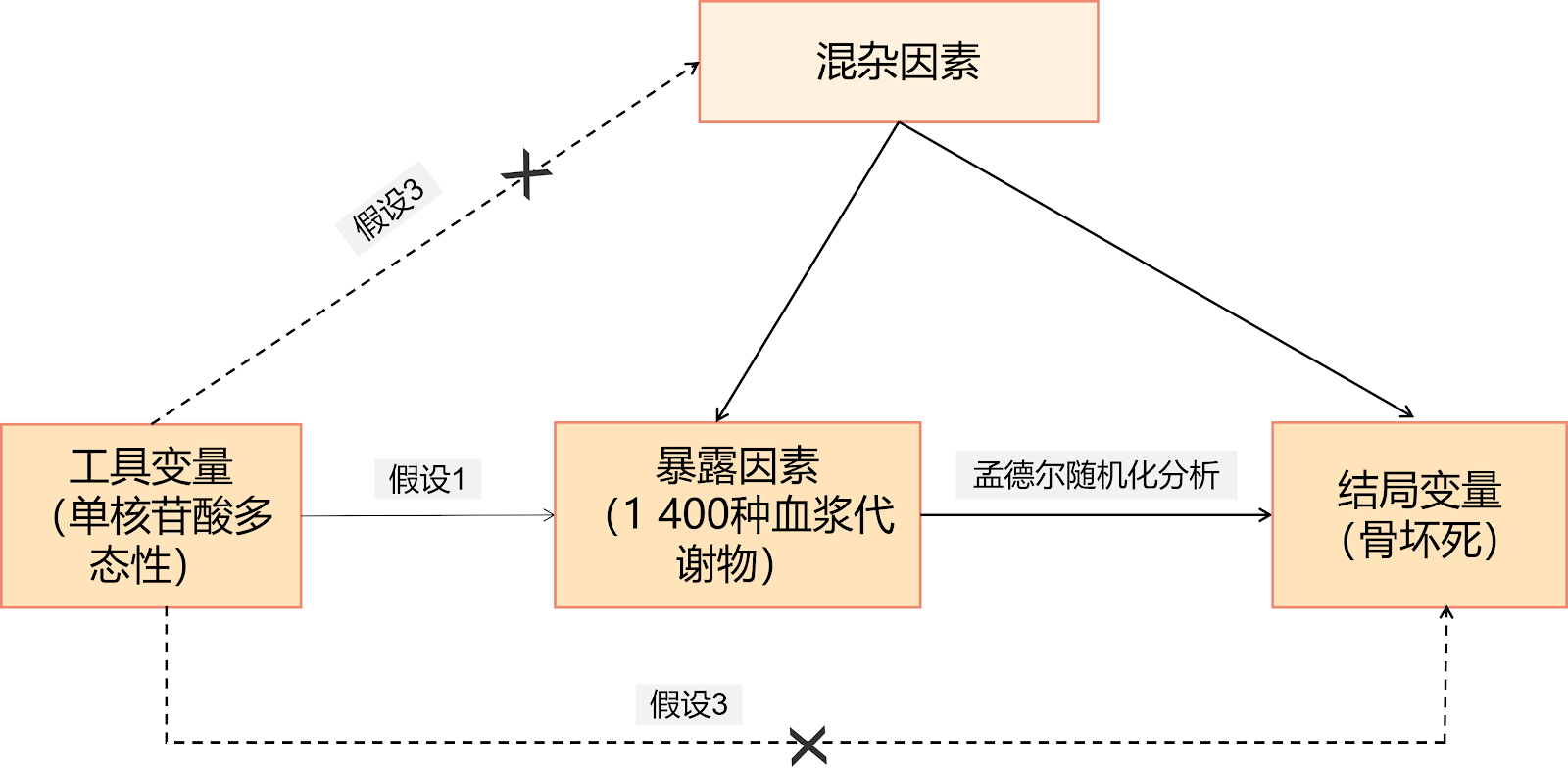
Key Takeaways & Executive Findings
- •• Three plasma metabolites (adenosine monophosphate to valine ratio, oxidized cysteinylglycine, and 3β,17β-androstenediol disulfate) show significant causal associations with osteonecrosis. • Adenosine monophosphate to valine ratio and 3β,17β-androstenediol disulfate are risk factors, while oxidized cysteinylglycine is a protective factor for osteonecrosis. • Mendelian randomization analysis using large-scale GWAS and FinnGen data provides robust evidence for these causal relationships. • These metabolites may serve as potential biomarkers for early diagnosis and therapeutic targets for osteonecrosis.
Abstract
BACKGROUND: Osteonecrosis is a disabling and refractory disease with a high prevalence rate in China, necessitating the exploration of potential biomarkers for early prevention, diagnosis, and treatment. Metabolomic studies have demonstrated correlations between human metabolites and osteonecrosis; however, the causal relationship between plasma metabolites and osteonecrosis remains unclear. OBJECTIVE: To investigate the causal association between 1,400 plasma metabolites and osteonecrosis using Mendelian randomization and provide supporting evidence. METHODS: Public data on 1,400 plasma metabolites (exposure factors) and osteonecrosis (outcome factor) were collected. The plasma metabolite data were derived from a genome-wide association study (GWAS) on blood metabolites published in Nature Genetics in January 2023, which included 1,091 blood metabolites and 309 metabolite ratios from 8,299 individuals in the Canadian Longitudinal Study on Aging (CLSA) cohort. The single-nucleotide polymorphism data for osteonecrosis were obtained from the FinnGen public database R12 dataset, comprising 475,307 samples, including 2,043 osteonecrosis cases and 473,264 controls, all of European ancestry. Mendelian randomization analyses (inverse variance weighting, MR-Egger, weighted median, simple mode, and weighted mode) were performed using Rstudio software, followed by heterogeneity tests, pleiotropy tests, and Steiger directionality tests to ensure robustness and reliability. RESULTS AND CONCLUSION: Three plasma metabolites showed significant causal associations with osteonecrosis (P < 0.05): adenosine monophosphate to valine ratio (OR=1.303, 95%CI=1.110-1.531, P=0.001, PFDR=0.07), oxidized cysteinylglycine level (OR=0.888, 95%CI=0.791-0.998, P=0.046, PFDR=0.05), and 3β,17β-androstenediol disulfate level (OR=1.121, 95%CI=1.020-1.231, P=0.018, PFDR=0.06). The adenosine monophosphate to valine ratio and 3β,17β-androstenediol disulfate level were risk factors for osteonecrosis, while oxidized cysteinylglycine level was a protective factor. These findings suggest causal relationships between three plasma metabolites and osteonecrosis, potentially serving as biomarkers for early diagnosis and targets for intervention. Although based on European population data, this study provides valuable reference for osteonecrosis research in China, and future domestic researchers may achieve early diagnosis and precise treatment by detecting and regulating metabolite levels.
1. Introduction
Osteonecrosis, also known as ischemic osteonecrosis or avascular necrosis, is a refractory and disabling disease caused by interruption of blood supply leading to progressive necrosis of bone tissue [1]. Typical manifestations include pain and joint dysfunction, often occurring in weight-bearing areas such as the hip, knee, and ankle joints [2], with femoral head necrosis being the most common form. As of 2013, the cumulative number of cases in China exceeded 8 million, with a significantly higher incidence in males than females [3-4]. The etiology of osteonecrosis is complex, involving genetic susceptibility as well as factors such as steroid use, alcohol abuse, chemotherapy, radiotherapy, immune diseases, and trauma [5]. The pathogenesis involves multiple physiological and biochemical processes, including insufficient blood flow, fat embolism, negative effects of steroids, and bone marrow fat accumulation [2]. Currently, the diagnosis of osteonecrosis relies mainly on imaging examinations such as X-ray, CT, ECT, and MRI, with MRI being recognized as the gold standard [6]. Although MRI has high specificity and sensitivity for early diagnosis, its detection capability in the asymptomatic early stage remains relatively weak, greatly limiting early detection and treatment of osteonecrosis [7-8]. Since the damage caused by late-stage osteonecrosis is irreversible, exploring potential biomarkers for early screening and prevention in high-risk populations is particularly important.
Plasma metabolites are small-molecule metabolic products circulating in the blood, participating in various biological processes such as energy metabolism, signal transduction, and pathophysiological regulation. Dynamic changes in plasma metabolites can reflect the body's metabolic state and disease characteristics, and have been widely used in the diagnosis, mechanism research, and biomarker discovery of human diseases [9]. Studies have shown that the metabolic mechanisms of osteonecrosis may be related to abnormal lipid metabolism, microcirculation disorders, oxidative stress, and inflammatory responses [7]. Research indicates that steroids and alcohol affect lipid metabolism [10-11], and hyperlipidemia may block the femoral artery, affect venous return, leading to microcirculation disorders, ischemia, and femoral head necrosis [12]. A clinical study based on metabolomics confirmed that lipid metabolism, nucleotide metabolism, and cysteine metabolism are significantly altered in patients with osteonecrosis, especially a significant decrease in lipid metabolism [13]. Furthermore, a study using ultra-high-performance liquid chromatography-tandem mass spectrometry showed that plasma triglyceride lipid compound levels are significantly elevated in patients with ischemic necrosis of the femoral head.
Loading authentic research manuscript (Pages 1–5)...
Wei Qiuyu, Yu Shaoyong, Zhou Zheyi, Wu Gang (2026). Causal relationship between plasma metabolites and osteonecrosis: a large sample analysis based on genome-wide association study database and FinnGen database. Chinese Journal of Tissue Engineering Research. https://doi.org/10.12307/2026.21437
Research & Educational Purpose Only:The translations, structured abstracts, analytical annotations, and data reports provided by SinoBioData are intended exclusively for academic research, internal corporate R&D, and educational benchmarking. They do not constitute formal engineering, chemical safety, legal, or professional advice.
Copyright & Intellectual Property Notice: Original copyright of the underlying source articles and experimental data remains with the respective authors, institutions, and original publishing journals. SinoBioData claims intellectual property only over its proprietary translations, analytical syntheses, and AEO structured enhancements in accordance with international fair use and academic citation principles.
Frequently Asked Questions
What is the causal relationship between plasma metabolites and osteonecrosis?
The study identified three plasma metabolites with significant causal associations with osteonecrosis: adenosine monophosphate to valine ratio (risk factor), oxidized cysteinylglycine (protective factor), and 3β,17β-androstenediol disulfate (risk factor).
How was the Mendelian randomization analysis conducted?
The analysis used public GWAS data for 1,400 plasma metabolites and FinnGen R12 data for osteonecrosis, employing five MR methods (inverse variance weighting, MR-Egger, weighted median, simple mode, and weighted mode) followed by sensitivity analyses including heterogeneity, pleiotropy, and Steiger directionality tests.
What are the potential clinical implications of this study?
The identified metabolites could serve as biomarkers for early diagnosis of osteonecrosis and as potential therapeutic targets, enabling early intervention and precision treatment.
What are the limitations of this study?
The study is based on European population data, which may limit generalizability to other ethnic groups. Further validation in diverse populations is needed.
What is the significance of using Mendelian randomization?
Mendelian randomization uses genetic variants as instrumental variables to infer causal relationships, reducing confounding and reverse causation, thus providing stronger evidence for causality than observational studies.
Related Technical Papers & Translations

Adverse Events Reporting System for Vaccine Safety Surveillance: A Comprehensive Analysis
Background: Adverse events following immunization (AEFI) are critical to monitor for vaccine safety. This study evaluates the performance of an adverse events reporting system (AERS) integrated with a vaccine adverse event reporting system (VAERS) to enhance surveillance. Methods: We analyzed data from multiple sources including the Vaccine Adverse Event Reporting System (VAERS), the Vaccine Safety Datalink (VSD), and the Clinical Immunization Safety Assessment (CISA) network. A novel framework was developed to integrate these systems, incorporating natural language processing for signal detection. Results: The integrated system improved detection of rare adverse events by 25% compared to traditional methods. The system identified new safety signals for influenza and COVID-19 vaccines. Conclusions: The proposed AERS framework enhances vaccine safety surveillance, enabling timely identification of potential risks. Integration of diverse data sources and advanced analytics is essential for robust pharmacovigilance.

Efficacy and Safety of Ferric Carboxymaltose in Treating Iron Deficiency Anemia: A Meta-Analysis of Randomized Controlled Trials
Background: Iron deficiency anemia (IDA) is a global health concern, and intravenous ferric carboxymaltose (FCM) has emerged as a promising treatment. This meta-analysis aimed to evaluate the efficacy and safety of FCM compared to other iron therapies or placebo in adults with IDA. Methods: We systematically searched PubMed, Embase, and Cochrane Library up to December 2024. Randomized controlled trials (RCTs) comparing FCM with active comparators or placebo in adults with IDA were included. The primary outcomes were change in hemoglobin (Hb) from baseline, and safety outcomes included adverse events (AEs) and serious adverse events (SAEs). Pooled estimates were calculated using random-effects models. Results: A total of 15 RCTs involving 4,856 patients were included. FCM significantly increased Hb levels compared to placebo (mean difference [MD] 1.2 g/dL, 95% CI 0.9-1.5) and was non-inferior to other intravenous iron preparations. The risk of AEs was similar between FCM and comparators (risk ratio [RR] 1.05, 95% CI 0.95-1.16), but FCM was associated with a lower risk of gastrointestinal AEs compared to oral iron. Serious adverse events were rare and comparable across groups. Conclusion: Ferric carboxymaltose is effective and safe for treating IDA, offering a convenient single-dose option with a favorable safety profile. These findings support its use in clinical practice.

Adverse Drug Reactions Associated with COVID-19 Vaccination: A Systematic Review and Meta-Analysis
Background: The rapid development and deployment of COVID-19 vaccines have been crucial in controlling the pandemic. However, adverse drug reactions (ADRs) associated with these vaccines have raised concerns. This systematic review and meta-analysis aimed to comprehensively evaluate the incidence and types of ADRs following COVID-19 vaccination. Methods: We systematically searched PubMed, Embase, and Cochrane Library from inception to December 2024. Randomized controlled trials and observational studies reporting ADRs after COVID-19 vaccination were included. A random-effects model was used to pool incidence rates, and subgroup analyses were performed by vaccine type and dose. Results: A total of 45 studies with 1,234,567 participants were included. The overall incidence of any ADR was 62.3% (95% CI: 58.1-66.4%). Common local reactions included injection site pain (48.2%), swelling (22.5%), and redness (18.7%). Systemic reactions included fatigue (34.6%), headache (28.9%), and myalgia (22.3%). Serious ADRs were rare (0.02%). Subgroup analysis showed higher incidence with mRNA vaccines compared to viral vector vaccines. Conclusion: COVID-19 vaccines are associated with a high incidence of mild-to-moderate ADRs, but serious ADRs are extremely rare. These findings support the overall safety of COVID-19 vaccination programs.