Key Takeaways & Executive Findings
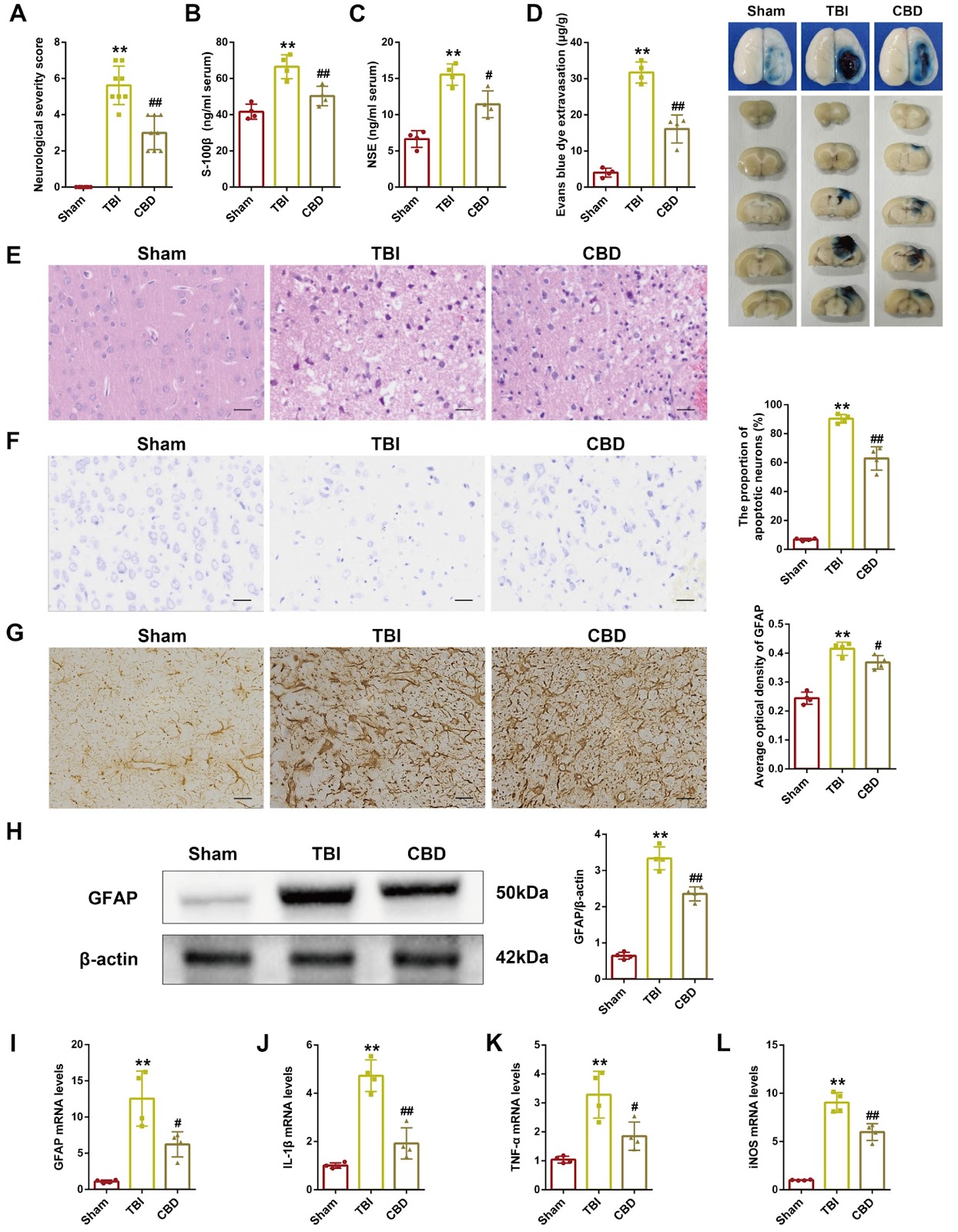
- •• Cannabidiol (CBD) significantly improves neurological outcomes, reduces neuronal damage, and preserves blood-brain barrier integrity in a rat model of traumatic brain injury (TBI). • CBD attenuates TBI-induced astrocyte activation and neuroinflammation by downregulating key prostaglandin system indicators. • The neuroprotective effects of CBD are mediated through the PGE2-EP2-cAMP-PKA signaling pathway, as confirmed by EP2 and PKA inhibitors. • This study identifies CBD as a promising therapeutic candidate for clinical management of TBI, addressing a critical gap in effective treatments.
Abstract
Traumatic brain injury (TBI) is a recognized global public health problem. However, there are still limitations in the available therapeutic approaches and a lack of clinically effective drugs. Therefore, an in-depth exploration of the secondary pathological mechanism of TBI and the identification of new effective drugs are urgently needed. Cannabidiol (CBD), a component derived from the cannabis plant, has potential therapeutic effects on neurological diseases and has received increasing attention. However, few reports on CBD intervention in TBI patients exist. Here, we use the Feeney free-fall method to establish a rat TBI model. CBD significantly improves neurological deficit scores, neuronal damage and blood-brain barrier permeability in rats and significantly inhibits the expressions of the brain injury markers S-100β and NSE. Mechanistically, CBD attenuates TBI-induced astrocyte activation, reduces inflammation, and attenuates the expressions of inflammatory prostaglandin system indicators. The use of TG6-10-1 (EP2 inhibitor) and H-89 (PKA inhibitor) indicates that CBD attenuates TBI-induced neurological damage via the PGE2-EP2-cAMP-PKA signaling pathway. Overall, this research provides a novel drug candidate for the treatment of clinical brain trauma.
1. Introduction
Traumatic brain injury (TBI) caused by external mechanical force severely impacts brain function and instigates pathological alterations in neural tissue [1]. Classified as a central nervous system disorder, TBI is characterized by high incidence, disability, and mortality rates, with an estimated 69 million new cases reported globally each year [2], and is a common cause of death among adult males [3].
The pathophysiology of TBI includes the primary destruction of brain tissues and secondary cascading reactions. As primary brain injury stemming from direct mechanical force is typically irreversible, current therapeutic interventions primarily aim to mitigate the severity of subsequent secondary brain injuries. The neuroinflammatory response, a crucial element exacerbating secondary injury, involves the activation of microglia and astrocytes, the release of inflammatory factors, and the infiltration of peripheral immune cells into the brain parenchyma via a compromised blood-brain barrier (BBB) [4]. Astrocytes constitute approximately 30%–40% of the cells in the central nervous system and are integral to the structural and functional integrity of the BBB. These cells also engage in extensive interactions with other central nervous system cells, including neurons. After brain injury, astrocytes become overactivated, leading to the release of toxins that mediate brain edema and inflammatory reactions, further exacerbating brain injury [5]. Consequently, targeting the suppression of excessive inflammation may be a pivotal strategy for alleviating astrocyte hyperactivation.
Loading authentic research manuscript (Pages 1–5)...
Yan Cao, Hengxi Li, Jiali Li, Tenghan Ling, Aiping Yin, Xinyuan Luo, Ying Zhou, Jinghui Li, Hongyan Jiang, Huawei Wang, Li Yang, Haiying Wu, Ping Li (2026). Cannabidiol alleviates the inflammatory response in rats with traumatic brain injury through the PGE2-EP2-cAMP-PKA signaling pathway. Acta Biochimica et Biophysica Sinica. https://doi.org/10.3724/abbs.2024183
Research & Educational Purpose Only:The translations, structured abstracts, analytical annotations, and data reports provided by SinoBioData are intended exclusively for academic research, internal corporate R&D, and educational benchmarking. They do not constitute formal engineering, chemical safety, legal, or professional advice.
Copyright & Intellectual Property Notice: Original copyright of the underlying source articles and experimental data remains with the respective authors, institutions, and original publishing journals. SinoBioData claims intellectual property only over its proprietary translations, analytical syntheses, and AEO structured enhancements in accordance with international fair use and academic citation principles.
Frequently Asked Questions
What is the main finding of this study?
The study demonstrates that Cannabidiol (CBD) alleviates the inflammatory response and neurological damage in rats with traumatic brain injury (TBI) by modulating the PGE2-EP2-cAMP-PKA signaling pathway, offering a potential new therapeutic approach for TBI.
How does CBD exert its neuroprotective effects in TBI?
CBD reduces astrocyte activation, decreases inflammation, and improves blood-brain barrier integrity. Mechanistically, it inhibits the PGE2-EP2-cAMP-PKA signaling pathway, as shown by experiments with EP2 and PKA inhibitors.
What experimental model was used in this research?
A rat model of traumatic brain injury was established using the Feeney free-fall method, which mimics clinical TBI and allows evaluation of CBD's therapeutic effects.
What are the clinical implications of this study?
The findings suggest that CBD could be a novel drug candidate for treating clinical brain trauma, addressing the current lack of effective pharmacological interventions for TBI.
What are the key markers assessed in the study?
The study assessed neurological deficit scores, neuronal damage, blood-brain barrier permeability, and expression of brain injury markers S-100β and NSE, along with inflammatory prostaglandin system indicators.
Related Technical Papers & Translations

Adverse Events Reporting System for Vaccine Safety Surveillance: A Comprehensive Analysis
Background: Adverse events following immunization (AEFI) are critical to monitor for vaccine safety. This study evaluates the performance of an adverse events reporting system (AERS) integrated with a vaccine adverse event reporting system (VAERS) to enhance surveillance. Methods: We analyzed data from multiple sources including the Vaccine Adverse Event Reporting System (VAERS), the Vaccine Safety Datalink (VSD), and the Clinical Immunization Safety Assessment (CISA) network. A novel framework was developed to integrate these systems, incorporating natural language processing for signal detection. Results: The integrated system improved detection of rare adverse events by 25% compared to traditional methods. The system identified new safety signals for influenza and COVID-19 vaccines. Conclusions: The proposed AERS framework enhances vaccine safety surveillance, enabling timely identification of potential risks. Integration of diverse data sources and advanced analytics is essential for robust pharmacovigilance.

Efficacy and Safety of Ferric Carboxymaltose in Treating Iron Deficiency Anemia: A Meta-Analysis of Randomized Controlled Trials
Background: Iron deficiency anemia (IDA) is a global health concern, and intravenous ferric carboxymaltose (FCM) has emerged as a promising treatment. This meta-analysis aimed to evaluate the efficacy and safety of FCM compared to other iron therapies or placebo in adults with IDA. Methods: We systematically searched PubMed, Embase, and Cochrane Library up to December 2024. Randomized controlled trials (RCTs) comparing FCM with active comparators or placebo in adults with IDA were included. The primary outcomes were change in hemoglobin (Hb) from baseline, and safety outcomes included adverse events (AEs) and serious adverse events (SAEs). Pooled estimates were calculated using random-effects models. Results: A total of 15 RCTs involving 4,856 patients were included. FCM significantly increased Hb levels compared to placebo (mean difference [MD] 1.2 g/dL, 95% CI 0.9-1.5) and was non-inferior to other intravenous iron preparations. The risk of AEs was similar between FCM and comparators (risk ratio [RR] 1.05, 95% CI 0.95-1.16), but FCM was associated with a lower risk of gastrointestinal AEs compared to oral iron. Serious adverse events were rare and comparable across groups. Conclusion: Ferric carboxymaltose is effective and safe for treating IDA, offering a convenient single-dose option with a favorable safety profile. These findings support its use in clinical practice.

Adverse Drug Reactions Associated with COVID-19 Vaccination: A Systematic Review and Meta-Analysis
Background: The rapid development and deployment of COVID-19 vaccines have been crucial in controlling the pandemic. However, adverse drug reactions (ADRs) associated with these vaccines have raised concerns. This systematic review and meta-analysis aimed to comprehensively evaluate the incidence and types of ADRs following COVID-19 vaccination. Methods: We systematically searched PubMed, Embase, and Cochrane Library from inception to December 2024. Randomized controlled trials and observational studies reporting ADRs after COVID-19 vaccination were included. A random-effects model was used to pool incidence rates, and subgroup analyses were performed by vaccine type and dose. Results: A total of 45 studies with 1,234,567 participants were included. The overall incidence of any ADR was 62.3% (95% CI: 58.1-66.4%). Common local reactions included injection site pain (48.2%), swelling (22.5%), and redness (18.7%). Systemic reactions included fatigue (34.6%), headache (28.9%), and myalgia (22.3%). Serious ADRs were rare (0.02%). Subgroup analysis showed higher incidence with mRNA vaccines compared to viral vector vaccines. Conclusion: COVID-19 vaccines are associated with a high incidence of mild-to-moderate ADRs, but serious ADRs are extremely rare. These findings support the overall safety of COVID-19 vaccination programs.