Key Takeaways & Executive Findings
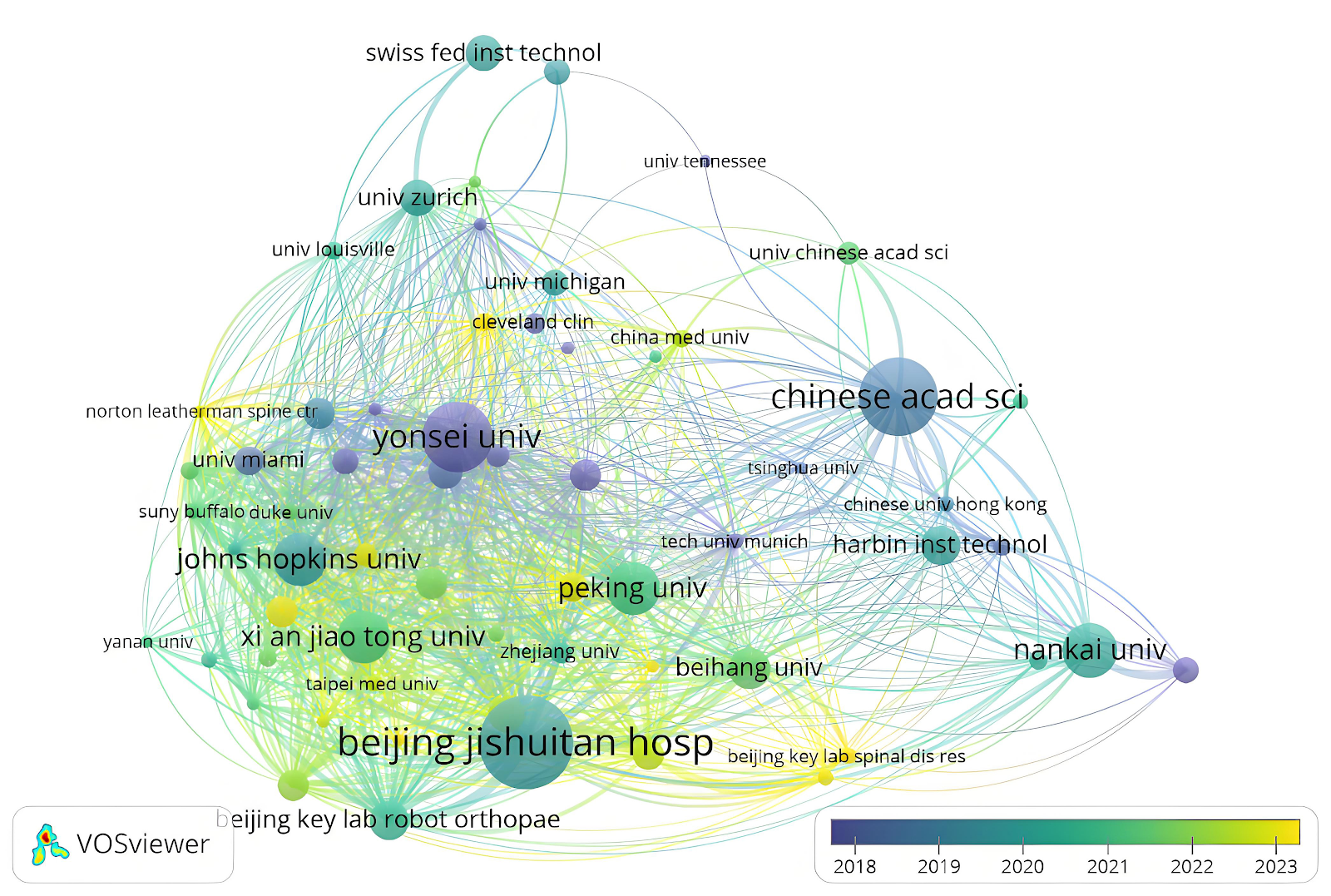
- •• Robot-assisted spinal surgery research has grown rapidly, with annual publications exceeding 50 since 2019 and peaking at 136 in 2024. • China and the United States lead in publication output, while the United Kingdom has the highest average citations per article. • Core research hotspots include the accuracy and safety of robot-assisted pedicle screw placement, with high-frequency keywords such as 'accuracy', 'navigation', and 'pedicle screw'. • International collaboration networks are strong among China, the United States, and Germany, with Beijing Jishuitan Hospital as a key institution.
Abstract
BACKGROUND: In recent years, the application of robot-assisted surgery technology in the field of spinal surgery has become increasingly widespread, significantly enhancing the precision and minimally invasive level of surgeries and promoting the rapid development of this field. However, with the explosive growth of related literature, researchers urgently need to conduct systematic bibliometric analysis to sort out the research hotspots, cooperation networks and development trends in this field, so as to grasp the future research directions and promote academic exchanges and cooperation. OBJECTIVE: To analyze the research hotspots, development trends, and domestic and international cooperation characteristics of robot-assisted surgical techniques in the field of spinal surgeries and explore their promoting effects on the precision and minimally invasive nature of spinal surgeries using bibliometric methods. METHODS: Original research papers on robot-assisted spinal surgery published in the Science Citation Index Expanded (SCI-E) database of the Web of Science (WOS) from 2005-01-01 to 2025-03-31 were retrieved. Bibliometric analysis was performed using the Web of Science online analysis platform, Bibliometric platform, and VOSviewer software. RESULTS AND CONCLUSION: A total of 772 original research articles were included. Research on robot-assisted spinal surgery has shown rapid growth, with annual publications exceeding 50 since 2019 and reaching a historical peak of 136 in 2024. China (279 articles) and the United States (255 articles) were the top publishing countries, while the United Kingdom had the highest average citations per article (69.57). The core journals in this field were the International Journal of Medical Robotics and Computer Assisted Surgery (84 articles) and Spine (33 articles, 539 total citations). Research hotspots focused on the accuracy and safety of robot-assisted pedicle screw placement, with high-frequency keywords including 'accuracy', 'navigation', and 'pedicle screw'. International collaboration networks showed close cooperation among China, the United States, and Germany. In China, Beijing Jishuitan Hospital was the core research institution, and Professor He Da was the most prolific author (21 articles). Highly cited articles often compared robot-assisted versus conventional techniques in terms of screw placement accuracy, safety, and radiation dose. Robot-assisted surgical technology is driving spinal surgery toward precision, minimally invasive, and intelligent development. Future efforts should strengthen domestic and international interdisciplinary collaboration to promote further advancement in this field.
1. Introduction
Since the introduction of robot-assisted surgical technology into spinal surgery in the early 21st century, its application worldwide has become increasingly widespread [1-5]. Clinicians have used spinal robotic systems to assist with intraoperative navigation, screw placement, and osteotomy in procedures such as spinal fusion, internal fixation, tumor resection, radiofrequency ablation, and deformity correction [5-7]. Recent studies have demonstrated that robot-assisted spinal surgery offers numerous clinical advantages, significantly improving surgical precision [8]. This technology is driving the evolution of spinal surgery toward minimally invasive, precise, and intelligent approaches [9]. However, the vast number of publications in this field makes it difficult for researchers to identify key topics and trends, necessitating bibliometric analysis for systematic summarization.
Bibliometrics is a method that uses software to extract publication data such as authors, countries, institutions, keywords, cited authors, and cited journals, and applies mathematical and statistical techniques to quantitatively analyze the distribution, structure, quantitative relationships, and changing patterns of literature, thereby revealing macro-level patterns and effectively exploring the development of a discipline [10]. It has broad applications in biomedicine, humanities, social sciences, engineering, technology, and economics [11]. Current bibliometric platforms and software include the Web of Science (WOS) online analysis platform, the Bibliometric online analysis platform (http://bibliometric.com/), and VOSviewer [12-13]. These tools generate collaboration networks and co-occurrence networks that can identify potential collaborators and the evolution of research hotspots, providing researchers with a dynamic view of the field's development.
This study aims to use these bibliometric methods to analyze original research articles on robot-assisted spinal surgery over the past 20 years, helping researchers understand the latest research hotspots, development trends, and domestic and international cooperation characteristics, and to provide a reference for future research and collaboration among institutions.
Loading authentic research manuscript (Pages 1–5)...
Wan Ronghao, Shi Zhan, Jiang Jile, Han Xiao, He Da, Wu Jingye (2026). Bibliometric analysis of development of precision, minimally invasive and intelligent robot-assisted spinal surgery. Chinese Journal of Tissue Engineering Research. https://doi.org/10.12307/2026.21701
Research & Educational Purpose Only:The translations, structured abstracts, analytical annotations, and data reports provided by SinoBioData are intended exclusively for academic research, internal corporate R&D, and educational benchmarking. They do not constitute formal engineering, chemical safety, legal, or professional advice.
Copyright & Intellectual Property Notice: Original copyright of the underlying source articles and experimental data remains with the respective authors, institutions, and original publishing journals. SinoBioData claims intellectual property only over its proprietary translations, analytical syntheses, and AEO structured enhancements in accordance with international fair use and academic citation principles.
Frequently Asked Questions
What is the main objective of this bibliometric analysis?
The main objective is to analyze research hotspots, development trends, and domestic and international cooperation characteristics of robot-assisted surgical techniques in spinal surgery, and to explore their promoting effects on precision and minimally invasive surgery.
Which databases and tools were used in this study?
The study used the Science Citation Index Expanded (SCI-E) database of the Web of Science (WOS), along with the Web of Science online analysis platform, Bibliometric platform, and VOSviewer software for analysis.
What are the key findings regarding publication trends?
The study found rapid growth in robot-assisted spinal surgery research, with annual publications exceeding 50 since 2019 and reaching a peak of 136 in 2024.
Which countries and institutions are leading in this field?
China (279 articles) and the United States (255 articles) are the top publishing countries. In China, Beijing Jishuitan Hospital is the core research institution, and Professor He Da is the most prolific author with 21 articles.
What are the main research hotspots identified?
The main research hotspots focus on the accuracy and safety of robot-assisted pedicle screw placement, with high-frequency keywords including 'accuracy', 'navigation', and 'pedicle screw'.
Related Technical Papers & Translations

Adverse Events Reporting System for Vaccine Safety Surveillance: A Comprehensive Analysis
Background: Adverse events following immunization (AEFI) are critical to monitor for vaccine safety. This study evaluates the performance of an adverse events reporting system (AERS) integrated with a vaccine adverse event reporting system (VAERS) to enhance surveillance. Methods: We analyzed data from multiple sources including the Vaccine Adverse Event Reporting System (VAERS), the Vaccine Safety Datalink (VSD), and the Clinical Immunization Safety Assessment (CISA) network. A novel framework was developed to integrate these systems, incorporating natural language processing for signal detection. Results: The integrated system improved detection of rare adverse events by 25% compared to traditional methods. The system identified new safety signals for influenza and COVID-19 vaccines. Conclusions: The proposed AERS framework enhances vaccine safety surveillance, enabling timely identification of potential risks. Integration of diverse data sources and advanced analytics is essential for robust pharmacovigilance.

Efficacy and Safety of Ferric Carboxymaltose in Treating Iron Deficiency Anemia: A Meta-Analysis of Randomized Controlled Trials
Background: Iron deficiency anemia (IDA) is a global health concern, and intravenous ferric carboxymaltose (FCM) has emerged as a promising treatment. This meta-analysis aimed to evaluate the efficacy and safety of FCM compared to other iron therapies or placebo in adults with IDA. Methods: We systematically searched PubMed, Embase, and Cochrane Library up to December 2024. Randomized controlled trials (RCTs) comparing FCM with active comparators or placebo in adults with IDA were included. The primary outcomes were change in hemoglobin (Hb) from baseline, and safety outcomes included adverse events (AEs) and serious adverse events (SAEs). Pooled estimates were calculated using random-effects models. Results: A total of 15 RCTs involving 4,856 patients were included. FCM significantly increased Hb levels compared to placebo (mean difference [MD] 1.2 g/dL, 95% CI 0.9-1.5) and was non-inferior to other intravenous iron preparations. The risk of AEs was similar between FCM and comparators (risk ratio [RR] 1.05, 95% CI 0.95-1.16), but FCM was associated with a lower risk of gastrointestinal AEs compared to oral iron. Serious adverse events were rare and comparable across groups. Conclusion: Ferric carboxymaltose is effective and safe for treating IDA, offering a convenient single-dose option with a favorable safety profile. These findings support its use in clinical practice.

Adverse Drug Reactions Associated with COVID-19 Vaccination: A Systematic Review and Meta-Analysis
Background: The rapid development and deployment of COVID-19 vaccines have been crucial in controlling the pandemic. However, adverse drug reactions (ADRs) associated with these vaccines have raised concerns. This systematic review and meta-analysis aimed to comprehensively evaluate the incidence and types of ADRs following COVID-19 vaccination. Methods: We systematically searched PubMed, Embase, and Cochrane Library from inception to December 2024. Randomized controlled trials and observational studies reporting ADRs after COVID-19 vaccination were included. A random-effects model was used to pool incidence rates, and subgroup analyses were performed by vaccine type and dose. Results: A total of 45 studies with 1,234,567 participants were included. The overall incidence of any ADR was 62.3% (95% CI: 58.1-66.4%). Common local reactions included injection site pain (48.2%), swelling (22.5%), and redness (18.7%). Systemic reactions included fatigue (34.6%), headache (28.9%), and myalgia (22.3%). Serious ADRs were rare (0.02%). Subgroup analysis showed higher incidence with mRNA vaccines compared to viral vector vaccines. Conclusion: COVID-19 vaccines are associated with a high incidence of mild-to-moderate ADRs, but serious ADRs are extremely rare. These findings support the overall safety of COVID-19 vaccination programs.