Key Takeaways & Executive Findings
- •• BACH1 directly binds to the Lifr enhancer and recruits STAT3 to drive Lifr transcription, revealing a novel transcriptional mechanism. • Bach1 knockout attenuates Lifr expression and impairs LIFR-STAT3 signaling, leading to reduced self-renewal of mouse embryonic stem cells. • Integrated scRNA-seq data show co-upregulation of Bach1 and Lifr in inner cell mass cells, suggesting a role in early embryonic pluripotency. • This study provides new insights into enhancer regulation and offers potential targets for improving stem cell culture and regenerative medicine.
Abstract
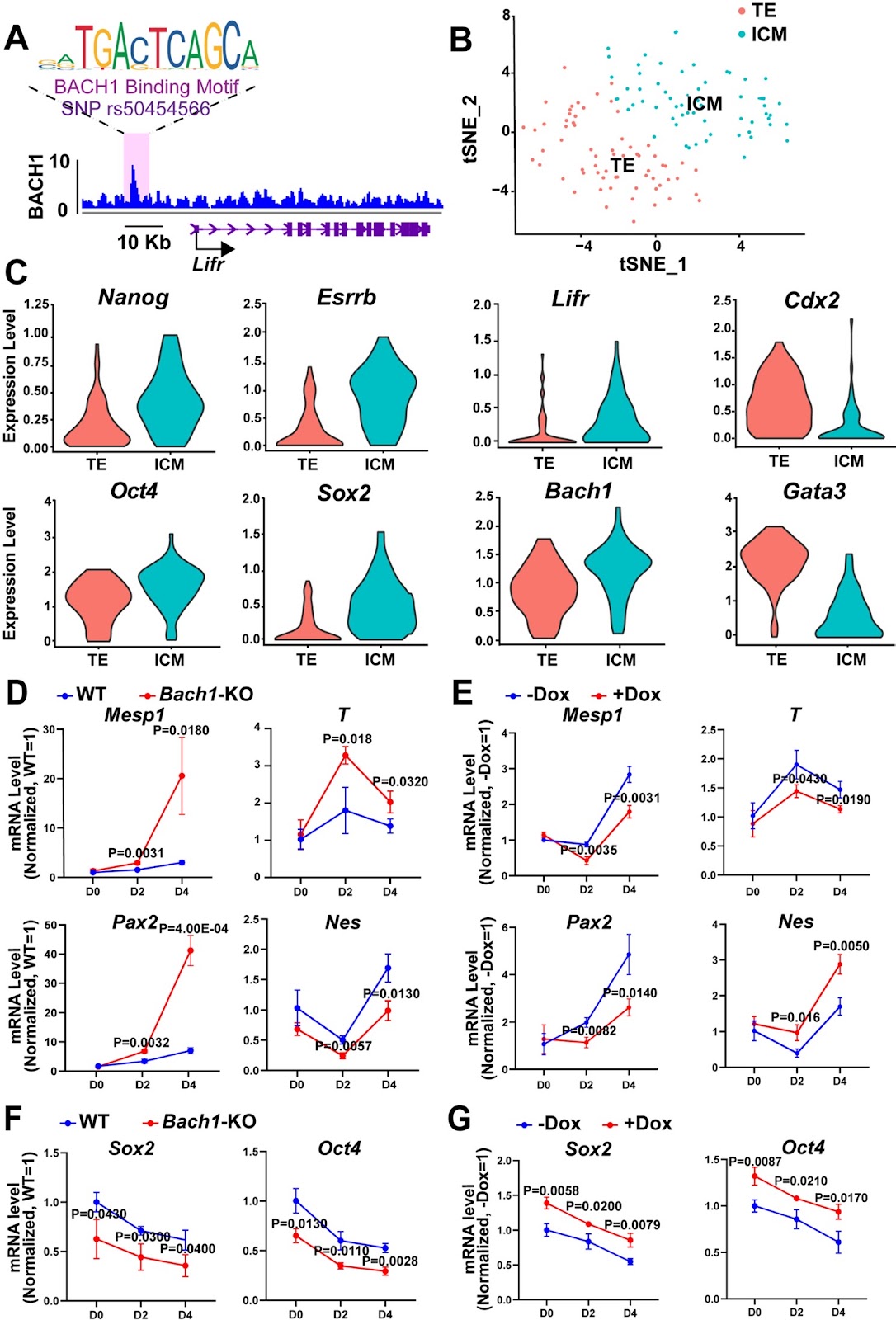
Background Genomic studies have linked single nucleotide variants in the enhancer region of the leukemia inhibitory factor receptor (Lifr) gene to chromatin accessibility and the regulation of self-renewal in mouse embryonic stem cells (mESCs). However, the underlying mechanisms remain unclear. This study investigates the role of the transcription factor BTB and CNC homology 1 (BACH1) in regulating the Lifr enhancer and its impact on mESC pluripotency. Methods We performed RNA-sequencing (RNA-seq) to assess the impact of Bach1 knockout on gene expression in mESCs. Additionally, chromatin immunoprecipitation (ChIP), co-immunoprecipitation (co-IP), and luciferase reporter gene analysis were employed to investigate the mechanism by which BACH1 regulates Lifr expression. Results Genomic analyses identified BACH1 binding at the Lifr enhancer proximal to rs50454566 in mESCs. Integrated single-cell RNA sequencing (scRNA-seq) data revealed co-upregulation of Bach1 and Lifr in inner cell mass (ICM) cells. RNA-seq analyses demonstrated that Bach1 depletion attenuated Lifr expression and impeded LIFR-signal transducer and activator of transcription 3 (STAT3) signaling. Mechanistically, BACH1 recruited STAT3 to the Lifr enhancer, driving Lifr transcription and facilitating the LIFR-STAT3 signaling pathway, thereby enhancing mESC self-renewal. Conclusion Our findings demonstrate that BACH1 enhances Lifr enhancer activity by recruiting STAT3 and activates the LIFR-STAT3 signaling pathway by promoting the LIFR expression, thereby maintaining mESC self-renewal.
1. Introduction
Embryonic stem cells (ESCs) are characterized by their ability to self-renew and differentiate into multiple cell lineages [1]. These cells are derived from the inner cell mass (ICM) of blastocysts—human ESCs (hESCs) from human blastocysts and mouse ESCs (mESCs) from mouse pre-implantation blastocysts [2]. The regulation of ESCs’ self-renewal is governed by a multitude of factors, including signaling pathways, transcription factors, epigenetic regulators, cytokines, and small molecular compounds [3]. Core transcription factors such as SRY-box transcription factor 2 (SOX2), octamer-binding transcription factor 4 (OCT4), and nanog homeobox (NANOG) are essential for maintaining pluripotency in both hESCs and mESCs. These transcription factors play a pivotal role in sustaining the ground state of ESCs [4, 5]. However, distinct signaling pathways regulate the pluripotency state and self-renewal in both mESCs and hESCs. Specifically, hESCs require fibroblast growth factor/extracellular signal-regulated kinase (FGF/ERK) and Activin/Nodal signaling for the maintenance of self-renewal and pluripotency [6]. Unlike hESCs, the self-renewal of mESCs is dependent on signaling from leukemia inhibitory factor (LIF) and bone morphogenetic protein-4 (BMP4) [7]. However, it is still little known how the pluripotency signaling is fine-tuned.
LIF, a critical member of the interleukin-6 (IL-6) cytokine family, stimulates downstream signaling pathways through binding to its heterodimeric receptor comprising leukemia inhibitory factor receptor (LIFR) and glycoprotein 130 (gp130) [8, 9]. As a transmembrane receptor, LIFR is implicated in cancer progression, angiogenesis, stem cell fate determination, and embryonic development [10]. Upon binding of LIF, the LIFR/gp130 receptor complex enhances the kinase activity of Janus kinases (JAK), leading to the phosphorylation of transcription factor signal transducer and activator of transcription 3 (STAT3). Phosphorylated STAT3 subsequently forms homodimers, translocates into the nucleus, and initiates the transcription of target genes [11, 12]. LIFR is also crucial for maintaining the pluripotency of mESCs. Prior studies have elucidated that the LIFR/STAT3 pathway directly modulates the expression of krüppel-like factor 4 (KLF4), which in turn promotes the transcription of SOX2 in mESCs [13]. Under hypoxic conditions, mESCs lose their self-renewal capacity and initiate differentiation due to the down-regulation of the LIFR-STAT3 pathway.
Loading authentic research manuscript (Pages 1–5)...
Jinghua Ma, Siyu Ma, Cong Niu, Siqing Wang, Xiangxiang Wei, Dan Meng, Xiuling Zhi, Jieyu Guo (2026). BACH1 recruits STAT3 to enhance leukemia inhibitory factor receptor activity and augments the self-renewal capacity of mouse embryonic stem cells. Stem Cell Research & Therapy. https://doi.org/10.1186/s13287-025-04578-x
Research & Educational Purpose Only:The translations, structured abstracts, analytical annotations, and data reports provided by SinoBioData are intended exclusively for academic research, internal corporate R&D, and educational benchmarking. They do not constitute formal engineering, chemical safety, legal, or professional advice.
Copyright & Intellectual Property Notice: Original copyright of the underlying source articles and experimental data remains with the respective authors, institutions, and original publishing journals. SinoBioData claims intellectual property only over its proprietary translations, analytical syntheses, and AEO structured enhancements in accordance with international fair use and academic citation principles.
Frequently Asked Questions
What is the role of BACH1 in mouse embryonic stem cells?
BACH1 enhances the activity of the Lifr enhancer by recruiting STAT3, thereby promoting LIFR expression and activating the LIFR-STAT3 signaling pathway, which is crucial for maintaining self-renewal in mouse embryonic stem cells.
How does BACH1 regulate Lifr expression?
BACH1 binds to the Lifr enhancer region and recruits STAT3 to drive Lifr transcription, as demonstrated by ChIP, co-IP, and luciferase reporter assays.
What is the significance of the LIFR-STAT3 pathway in stem cells?
The LIFR-STAT3 pathway is essential for the self-renewal of mouse embryonic stem cells, as it regulates the expression of key pluripotency factors like KLF4 and SOX2.
What methods were used in this study?
The study employed RNA-seq, ChIP, co-IP, luciferase reporter assays, and integrated scRNA-seq data to investigate the regulatory mechanism of BACH1 on Lifr expression.
What are the potential implications of this research?
Understanding the BACH1-LIFR-STAT3 axis provides insights into the fine-tuning of pluripotency signaling and may inform strategies for improving stem cell culture and regenerative medicine applications.
Related Technical Papers & Translations

Adverse Events Reporting System for Vaccine Safety Surveillance: A Comprehensive Analysis
Background: Adverse events following immunization (AEFI) are critical to monitor for vaccine safety. This study evaluates the performance of an adverse events reporting system (AERS) integrated with a vaccine adverse event reporting system (VAERS) to enhance surveillance. Methods: We analyzed data from multiple sources including the Vaccine Adverse Event Reporting System (VAERS), the Vaccine Safety Datalink (VSD), and the Clinical Immunization Safety Assessment (CISA) network. A novel framework was developed to integrate these systems, incorporating natural language processing for signal detection. Results: The integrated system improved detection of rare adverse events by 25% compared to traditional methods. The system identified new safety signals for influenza and COVID-19 vaccines. Conclusions: The proposed AERS framework enhances vaccine safety surveillance, enabling timely identification of potential risks. Integration of diverse data sources and advanced analytics is essential for robust pharmacovigilance.

Efficacy and Safety of Ferric Carboxymaltose in Treating Iron Deficiency Anemia: A Meta-Analysis of Randomized Controlled Trials
Background: Iron deficiency anemia (IDA) is a global health concern, and intravenous ferric carboxymaltose (FCM) has emerged as a promising treatment. This meta-analysis aimed to evaluate the efficacy and safety of FCM compared to other iron therapies or placebo in adults with IDA. Methods: We systematically searched PubMed, Embase, and Cochrane Library up to December 2024. Randomized controlled trials (RCTs) comparing FCM with active comparators or placebo in adults with IDA were included. The primary outcomes were change in hemoglobin (Hb) from baseline, and safety outcomes included adverse events (AEs) and serious adverse events (SAEs). Pooled estimates were calculated using random-effects models. Results: A total of 15 RCTs involving 4,856 patients were included. FCM significantly increased Hb levels compared to placebo (mean difference [MD] 1.2 g/dL, 95% CI 0.9-1.5) and was non-inferior to other intravenous iron preparations. The risk of AEs was similar between FCM and comparators (risk ratio [RR] 1.05, 95% CI 0.95-1.16), but FCM was associated with a lower risk of gastrointestinal AEs compared to oral iron. Serious adverse events were rare and comparable across groups. Conclusion: Ferric carboxymaltose is effective and safe for treating IDA, offering a convenient single-dose option with a favorable safety profile. These findings support its use in clinical practice.

Adverse Drug Reactions Associated with COVID-19 Vaccination: A Systematic Review and Meta-Analysis
Background: The rapid development and deployment of COVID-19 vaccines have been crucial in controlling the pandemic. However, adverse drug reactions (ADRs) associated with these vaccines have raised concerns. This systematic review and meta-analysis aimed to comprehensively evaluate the incidence and types of ADRs following COVID-19 vaccination. Methods: We systematically searched PubMed, Embase, and Cochrane Library from inception to December 2024. Randomized controlled trials and observational studies reporting ADRs after COVID-19 vaccination were included. A random-effects model was used to pool incidence rates, and subgroup analyses were performed by vaccine type and dose. Results: A total of 45 studies with 1,234,567 participants were included. The overall incidence of any ADR was 62.3% (95% CI: 58.1-66.4%). Common local reactions included injection site pain (48.2%), swelling (22.5%), and redness (18.7%). Systemic reactions included fatigue (34.6%), headache (28.9%), and myalgia (22.3%). Serious ADRs were rare (0.02%). Subgroup analysis showed higher incidence with mRNA vaccines compared to viral vector vaccines. Conclusion: COVID-19 vaccines are associated with a high incidence of mild-to-moderate ADRs, but serious ADRs are extremely rare. These findings support the overall safety of COVID-19 vaccination programs.