Key Takeaways & Executive Findings
- •• Salidroside activates the SIRT1/FOXO3 pathway to enhance mitophagy in NPMSCs, counteracting mitochondrial dysfunction and oxidative stress in intervertebral disc degeneration. • Network pharmacology and molecular dynamics identified SIRT1 as a direct target of salidroside, providing a mechanistic basis for its protective effects. • In vitro and in vivo experiments demonstrate that salidroside preserves disc height, reduces apoptosis, and promotes mitophagic flux, while SIRT1 knockdown or autophagy inhibition abolishes these benefits. • This study highlights salidroside as a promising therapeutic candidate for IVDD by awakening endogenous repair mechanisms in NPMSCs.
Abstract
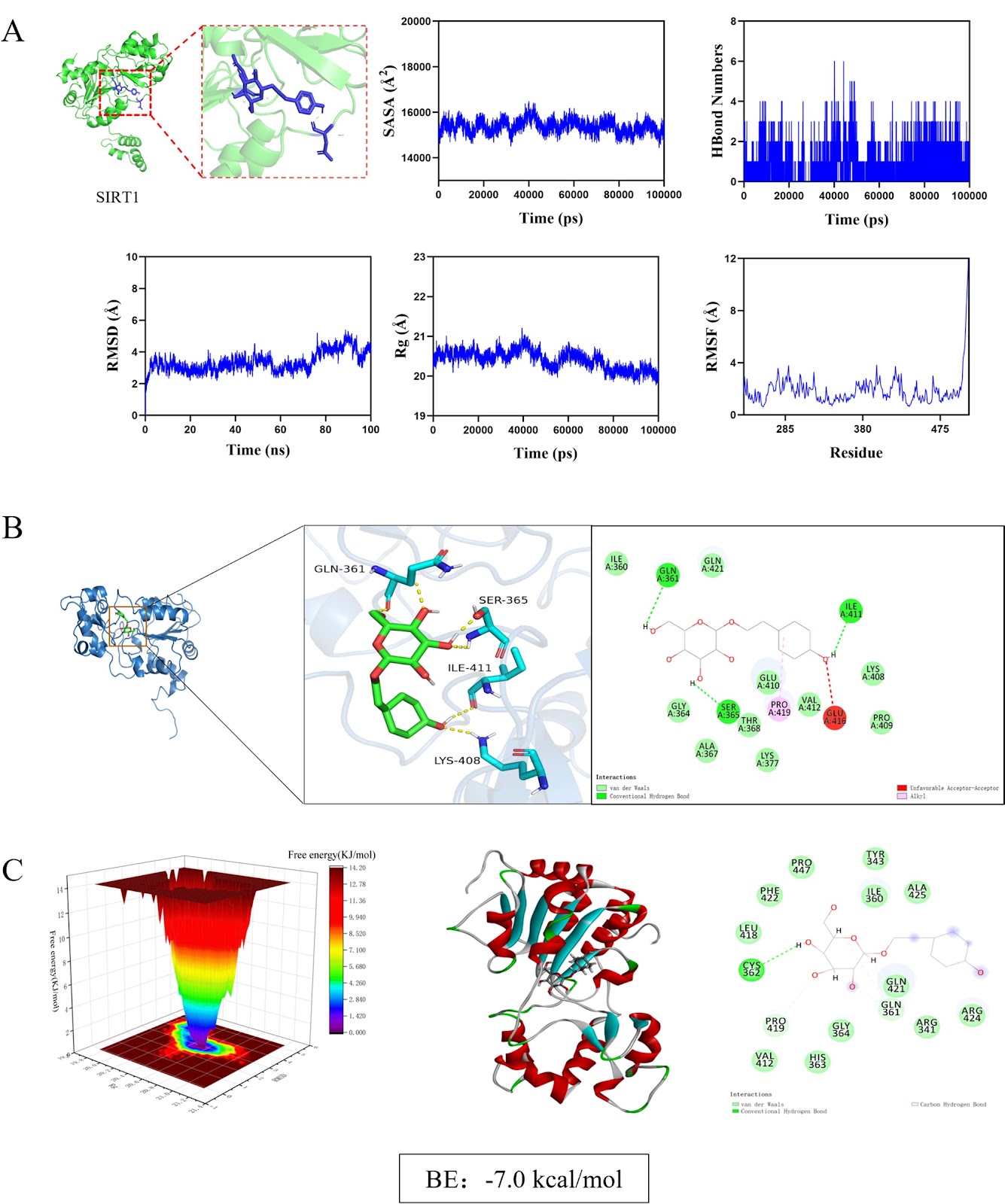
Background Intervertebral disc degeneration (IVDD) is a major cause of low back pain, characterized by mitochondrial dysfunction and impaired mitophagy in nucleus pulposus-derived mesenchymal stem cells (NPMSCs). Sirtuin 1 (SIRT1), a key regulator of mitochondrial quality control, is downregulated in degenerated discs. Salidroside (Sal), a natural compound from Rhodiola rosea, has shown potential in enhancing mitophagy, but its mechanism in IVDD remains unclear. Methods Using network pharmacology, molecular docking, and dynamics simulations, we identified SIRT1 as a key target of Sal. Human and rat NPMSCs were isolated and treated with tert-butyl hydroperoxide (TBHP) to induce degeneration. In vitro assays included CCK-8, EdU, SA-β-Gal, JC-1, Western blot, immunofluorescence, and transmission electron microscope (TEM). An in vivo rat IVDD model was established via needle puncture and treated with Sal and/or the autophagy inhibitor 3-MA. Histological, immunohistochemical, and imaging analyses were performed to evaluate IVDD. Results Sal bound stably to SIRT1 and activated SIRT1/FOXO3 pathway, promoting mitophagic flux, reducing reactive oxygen species accumulation, and suppressing apoptosis in NPMSCs. SIRT1 knockdown or 3-MA treatment abolished Sal’s protective effects. In vivo, Sal treatment preserved disc height, reduced apoptosis, and enhanced mitophagy, while 3-MA exacerbated degeneration.
1. Introduction
Intervertebral disc degeneration (IVDD) represents a primary underlying etiology of low back pain (LBP), a pervasive global health concern imposing substantial socioeconomic burdens through diminished productivity and escalating healthcare expenditures [1]. This progressive, multifactorial condition is characterized by a complex cascade of pathological alterations within the disc microenvironment. Key features include the progressive degradation of the extracellular matrix (ECM), notably loss of proteoglycans like aggrecan and the disorganization of collagen fibrils, coupled with aberrant cellular responses such as senescence, apoptosis, and a shift towards a pro-inflammatory phenotype [2]. Despite extensive research, the precise molecular mechanisms orchestrating the initiation and perpetuation of IVDD remain incompletely elucidated, particularly concerning the intricate interplay between mechanical stress, inflammatory cascades (e.g., Tumor Necrosis Factor-α (TNF-α) and Interleukin-1 β (IL-1β)), and abnormal autophagy process. Therefore, delving deeper into the fundamental pathobiological pathways driving IVDD is imperative for identifying novel therapeutic targets aimed at mitigating degeneration or promoting functional regeneration.
Mesenchymal stem cells (MSCs) can be harvested and expanded from various adult and perinatal tissues, including adipose tissue, bone marrow (BM), dental pulp, and umbilical cord (UC), exhibiting diverse pharmacological properties [3–5]. Currently, MSCs are widely investigated for therapeutic applications in IVDD; however, endogenous nucleus pulposus-derived mesenchymal stem cells (NPMSCs) offer distinct inherent advantages. Compared to exogenous MSCs, NPMSCs demonstrate superior adaptation to the unique intradiscal microenvironment, positioning them as critical targets for IVDD therapy [6, 7]. Consistent with our prior findings, NPMSCs reside within the nucleus pulposus (NP) tissue and possess intrinsic capacities for self-renewal and differentiation, thereby contributing to the mitigation of disc degeneration [8]. Notably, endogenous NPMSCs exhibit significant regenerative potential, primarily through differentiation into functional NP-like cells and inhibition of apoptosis [9]. Nevertheless, this functional capacity deteriorates with advancing age and IVDD progression, highlighting the necessity to preserve NPMSCs viability for effective endogenous repair strategies [10]. Our prior research confirmed the presence of endogenous NPMSCs within the NP tissue. Furthermore, we demonstrated
Loading authentic research manuscript (Pages 1–5)...
Zhengguang Li, Yiming Wu, Benkui Hua, Hua Sun, Huofeng Wu, Shuangjia Zai, Chen Liu, Yongbo Zhang, Zhaoyu Li, Xuan You, Yufeng Huang, Xuhua Lu, Guoyong Yin, Liang Zhang (2026). Awakening endogenous repair: salidroside boosts mitophagy in NPMSCs via SIRT1/FOXO3 to combat intervertebral disc degeneration. Stem Cell Research & Therapy. https://doi.org/10.1186/s13287-026-05051-z
Research & Educational Purpose Only:The translations, structured abstracts, analytical annotations, and data reports provided by SinoBioData are intended exclusively for academic research, internal corporate R&D, and educational benchmarking. They do not constitute formal engineering, chemical safety, legal, or professional advice.
Copyright & Intellectual Property Notice: Original copyright of the underlying source articles and experimental data remains with the respective authors, institutions, and original publishing journals. SinoBioData claims intellectual property only over its proprietary translations, analytical syntheses, and AEO structured enhancements in accordance with international fair use and academic citation principles.
Frequently Asked Questions
What is the role of salidroside in intervertebral disc degeneration?
Salidroside activates the SIRT1/FOXO3 pathway to enhance mitophagy in nucleus pulposus-derived mesenchymal stem cells (NPMSCs), reducing oxidative stress and apoptosis, thereby preserving disc integrity and mitigating degeneration.
How does salidroside exert its protective effects on NPMSCs?
Salidroside binds to SIRT1, activating the SIRT1/FOXO3 signaling axis, which promotes mitophagic flux, clears damaged mitochondria, and reduces reactive oxygen species accumulation, ultimately suppressing apoptosis in NPMSCs.
What experimental models were used in this study?
The study employed both in vitro models using human and rat NPMSCs treated with tert-butyl hydroperoxide (TBHP) to induce degeneration, and an in vivo rat model of IVDD induced by needle puncture, treated with salidroside and/or the autophagy inhibitor 3-MA.
What are the key findings regarding SIRT1 and autophagy in IVDD?
SIRT1 is downregulated in degenerated discs, and its activation by salidroside is crucial for enhancing mitophagy. Inhibition of SIRT1 (via knockdown) or autophagy (via 3-MA) abolishes the protective effects, underscoring the importance of the SIRT1/FOXO3-mitophagy axis.
What is the clinical significance of this research?
This research identifies salidroside as a potential therapeutic agent for IVDD by awakening endogenous repair mechanisms in NPMSCs, offering a novel strategy to combat disc degeneration and potentially reduce the need for invasive surgeries.
Related Technical Papers & Translations

Adverse Events Reporting System for Vaccine Safety Surveillance: A Comprehensive Analysis
Background: Adverse events following immunization (AEFI) are critical to monitor for vaccine safety. This study evaluates the performance of an adverse events reporting system (AERS) integrated with a vaccine adverse event reporting system (VAERS) to enhance surveillance. Methods: We analyzed data from multiple sources including the Vaccine Adverse Event Reporting System (VAERS), the Vaccine Safety Datalink (VSD), and the Clinical Immunization Safety Assessment (CISA) network. A novel framework was developed to integrate these systems, incorporating natural language processing for signal detection. Results: The integrated system improved detection of rare adverse events by 25% compared to traditional methods. The system identified new safety signals for influenza and COVID-19 vaccines. Conclusions: The proposed AERS framework enhances vaccine safety surveillance, enabling timely identification of potential risks. Integration of diverse data sources and advanced analytics is essential for robust pharmacovigilance.

Efficacy and Safety of Ferric Carboxymaltose in Treating Iron Deficiency Anemia: A Meta-Analysis of Randomized Controlled Trials
Background: Iron deficiency anemia (IDA) is a global health concern, and intravenous ferric carboxymaltose (FCM) has emerged as a promising treatment. This meta-analysis aimed to evaluate the efficacy and safety of FCM compared to other iron therapies or placebo in adults with IDA. Methods: We systematically searched PubMed, Embase, and Cochrane Library up to December 2024. Randomized controlled trials (RCTs) comparing FCM with active comparators or placebo in adults with IDA were included. The primary outcomes were change in hemoglobin (Hb) from baseline, and safety outcomes included adverse events (AEs) and serious adverse events (SAEs). Pooled estimates were calculated using random-effects models. Results: A total of 15 RCTs involving 4,856 patients were included. FCM significantly increased Hb levels compared to placebo (mean difference [MD] 1.2 g/dL, 95% CI 0.9-1.5) and was non-inferior to other intravenous iron preparations. The risk of AEs was similar between FCM and comparators (risk ratio [RR] 1.05, 95% CI 0.95-1.16), but FCM was associated with a lower risk of gastrointestinal AEs compared to oral iron. Serious adverse events were rare and comparable across groups. Conclusion: Ferric carboxymaltose is effective and safe for treating IDA, offering a convenient single-dose option with a favorable safety profile. These findings support its use in clinical practice.

Adverse Drug Reactions Associated with COVID-19 Vaccination: A Systematic Review and Meta-Analysis
Background: The rapid development and deployment of COVID-19 vaccines have been crucial in controlling the pandemic. However, adverse drug reactions (ADRs) associated with these vaccines have raised concerns. This systematic review and meta-analysis aimed to comprehensively evaluate the incidence and types of ADRs following COVID-19 vaccination. Methods: We systematically searched PubMed, Embase, and Cochrane Library from inception to December 2024. Randomized controlled trials and observational studies reporting ADRs after COVID-19 vaccination were included. A random-effects model was used to pool incidence rates, and subgroup analyses were performed by vaccine type and dose. Results: A total of 45 studies with 1,234,567 participants were included. The overall incidence of any ADR was 62.3% (95% CI: 58.1-66.4%). Common local reactions included injection site pain (48.2%), swelling (22.5%), and redness (18.7%). Systemic reactions included fatigue (34.6%), headache (28.9%), and myalgia (22.3%). Serious ADRs were rare (0.02%). Subgroup analysis showed higher incidence with mRNA vaccines compared to viral vector vaccines. Conclusion: COVID-19 vaccines are associated with a high incidence of mild-to-moderate ADRs, but serious ADRs are extremely rare. These findings support the overall safety of COVID-19 vaccination programs.