Key Takeaways & Executive Findings
- •• Olaparib significantly enhances radiosensitivity of recurrent nasopharyngeal carcinoma cells to both photon and carbon ion irradiation. • Carbon ion exposure induces an HR-deficient gene signature, increasing susceptibility to PARP inhibition. • Autophagic cell death is the dominant pathway mediating the synergistic cytotoxic effects of olaparib and radiation. • Inhibition of autophagy abolishes the radiosensitization effect, highlighting autophagy as a critical therapeutic target.
Abstract
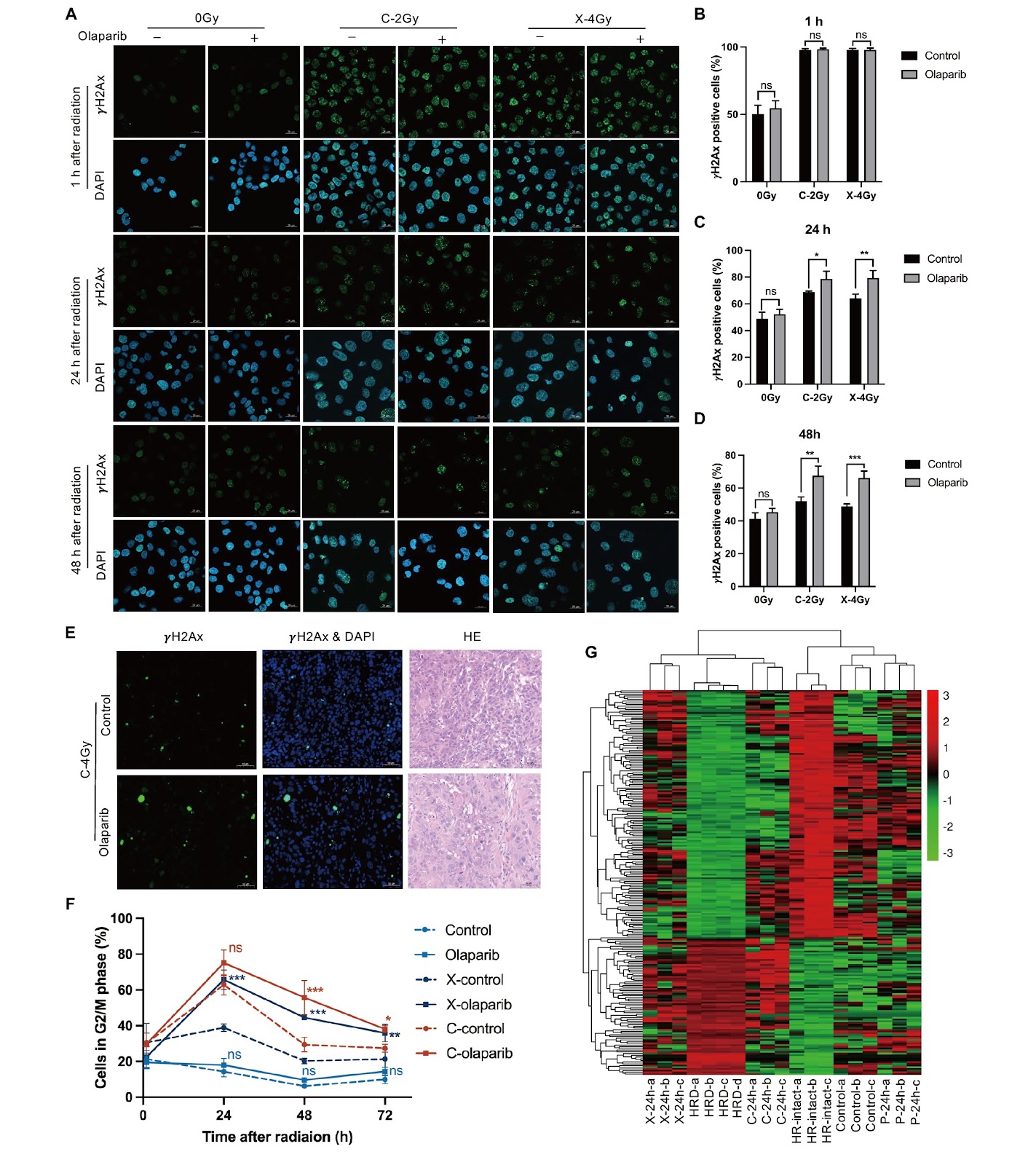
Tumor radioresistance and severe toxicity make reirradiation for recurrent nasopharyngeal carcinoma (NPC) a significant clinical challenge. This study aims to investigate the ability of the poly(ADP-ribose) polymerase (PARP) inhibitor olaparib to sensitize recurrent NPC cells irradiated with photon or carbon ion (C-ion), and to explore the underlying mechanism of the synergistic promotion of cell death by olaparib and ionizing radiation. The results show that olaparib has significant X-ray and C-ion radiosensitization effects on recurrent NPC cells and the associated HK-RR photon-resistant model. Radiation, particularly C-ion exposure, induces a homologous recombination (HR)-deficient gene signature in HR-proficient NPC cells, potentially increasing their sensitivity to PARP inhibition. C-ion and X-ray irradiation induces similar modes of cell death, and multiple cell death pathways [including apoptosis, necrosis, ferroptosis, senescence, and autophagic cell death (ACD)] contribute to the cytotoxic effects of radiation combined with olaparib, with ACD being the dominant pathway. Both the pharmacological and genetic inhibition of autophagy significantly attenuate the radiosensitization effect of olaparib. In conclusion, olaparib effectively sensitizes recurrent NPC cells to both X-ray irradiation and C-ion irradiation, with autophagy playing a central role in mediating this effect.
1. Introduction
Approximately 10%–15% of nasopharyngeal carcinoma (NPC) patients experience local recurrence after their primary treatment, for which reirradiation is the main approach [1]. Most local failures occur in the high-dose zone [2], indicating that these recurrences are largely resulted from radioresistance. However, because these radioresistant tumors are surrounded by critical organs at risk that have already absorbed near-tolerance radiation doses, reirradiation is a challenge and is typically associated with poor survival rates and severe toxicity.
Compared with conventional photon-based radiation, carbon ion radiotherapy (CIRT) has a better dose distribution, higher linear energy transfer (LET) and greater relative biological effectiveness (RBE), which enables better tumor killing with superior sparing of adjacent organs [3]. These dosimetric and radiobiological advantages make CIRT a promising treatment for local failure disease [4]. Hu et al. [5] reported that CIRT used as salvage therapy resulted in 83.7% 2-year overall survival, 58% local control, and 87.3% regional control among 206 patients with locoregionally recurrent NPC. Although the severe toxicities reported in that study were significantly lower than the historical results obtained for reirradiation with photons, 33 patients (16%) developed mucosal necrosis (including ten fatal hemorrhages). Additional efforts are needed to explore more effective and safer treatment strategies for recurrent NPC.
Loading authentic research manuscript (Pages 1–5)...
Ziyu Le, Haojiong Zhang, Li Chen, Wanzun Lin, Qingting Huang, Shikai Geng, Wei Hu, Huaiyuan Chen, Fangzhu Wan, Xingyu Liu, Jiyi Hu, Fengtao Su, Jiade J. Lu, Lin Kong (2026). Autophagy-dependent sensitization effects of PARP inhibitors on recurrent nasopharyngeal carcinoma treated with carbon ion and photon irradiation. Acta Biochimica et Biophysica Sinica. https://doi.org/10.3724/abbs.2025130
Research & Educational Purpose Only:The translations, structured abstracts, analytical annotations, and data reports provided by SinoBioData are intended exclusively for academic research, internal corporate R&D, and educational benchmarking. They do not constitute formal engineering, chemical safety, legal, or professional advice.
Copyright & Intellectual Property Notice: Original copyright of the underlying source articles and experimental data remains with the respective authors, institutions, and original publishing journals. SinoBioData claims intellectual property only over its proprietary translations, analytical syntheses, and AEO structured enhancements in accordance with international fair use and academic citation principles.
Frequently Asked Questions
What is the main finding of this study?
The study demonstrates that the PARP inhibitor olaparib effectively sensitizes recurrent nasopharyngeal carcinoma cells to both photon and carbon ion irradiation, with autophagy playing a central role in mediating this effect.
How does carbon ion irradiation affect homologous recombination (HR) status?
Carbon ion exposure induces an HR-deficient gene signature in HR-proficient NPC cells, potentially increasing their sensitivity to PARP inhibition.
What cell death pathways are involved in the combination treatment?
Multiple cell death pathways including apoptosis, necrosis, ferroptosis, senescence, and autophagic cell death contribute to the cytotoxic effects, with autophagic cell death being the dominant pathway.
What is the clinical significance of this research?
The findings suggest that combining PARP inhibitors with carbon ion radiotherapy could enhance treatment efficacy for recurrent NPC while potentially reducing toxicity, offering a promising strategy for this challenging clinical scenario.
How was autophagy inhibition tested?
Both pharmacological and genetic inhibition of autophagy significantly attenuated the radiosensitization effect of olaparib, confirming the essential role of autophagy in the synergistic effect.
Related Technical Papers & Translations

Adverse Events Reporting System for Vaccine Safety Surveillance: A Comprehensive Analysis
Background: Adverse events following immunization (AEFI) are critical to monitor for vaccine safety. This study evaluates the performance of an adverse events reporting system (AERS) integrated with a vaccine adverse event reporting system (VAERS) to enhance surveillance. Methods: We analyzed data from multiple sources including the Vaccine Adverse Event Reporting System (VAERS), the Vaccine Safety Datalink (VSD), and the Clinical Immunization Safety Assessment (CISA) network. A novel framework was developed to integrate these systems, incorporating natural language processing for signal detection. Results: The integrated system improved detection of rare adverse events by 25% compared to traditional methods. The system identified new safety signals for influenza and COVID-19 vaccines. Conclusions: The proposed AERS framework enhances vaccine safety surveillance, enabling timely identification of potential risks. Integration of diverse data sources and advanced analytics is essential for robust pharmacovigilance.

Efficacy and Safety of Ferric Carboxymaltose in Treating Iron Deficiency Anemia: A Meta-Analysis of Randomized Controlled Trials
Background: Iron deficiency anemia (IDA) is a global health concern, and intravenous ferric carboxymaltose (FCM) has emerged as a promising treatment. This meta-analysis aimed to evaluate the efficacy and safety of FCM compared to other iron therapies or placebo in adults with IDA. Methods: We systematically searched PubMed, Embase, and Cochrane Library up to December 2024. Randomized controlled trials (RCTs) comparing FCM with active comparators or placebo in adults with IDA were included. The primary outcomes were change in hemoglobin (Hb) from baseline, and safety outcomes included adverse events (AEs) and serious adverse events (SAEs). Pooled estimates were calculated using random-effects models. Results: A total of 15 RCTs involving 4,856 patients were included. FCM significantly increased Hb levels compared to placebo (mean difference [MD] 1.2 g/dL, 95% CI 0.9-1.5) and was non-inferior to other intravenous iron preparations. The risk of AEs was similar between FCM and comparators (risk ratio [RR] 1.05, 95% CI 0.95-1.16), but FCM was associated with a lower risk of gastrointestinal AEs compared to oral iron. Serious adverse events were rare and comparable across groups. Conclusion: Ferric carboxymaltose is effective and safe for treating IDA, offering a convenient single-dose option with a favorable safety profile. These findings support its use in clinical practice.

Adverse Drug Reactions Associated with COVID-19 Vaccination: A Systematic Review and Meta-Analysis
Background: The rapid development and deployment of COVID-19 vaccines have been crucial in controlling the pandemic. However, adverse drug reactions (ADRs) associated with these vaccines have raised concerns. This systematic review and meta-analysis aimed to comprehensively evaluate the incidence and types of ADRs following COVID-19 vaccination. Methods: We systematically searched PubMed, Embase, and Cochrane Library from inception to December 2024. Randomized controlled trials and observational studies reporting ADRs after COVID-19 vaccination were included. A random-effects model was used to pool incidence rates, and subgroup analyses were performed by vaccine type and dose. Results: A total of 45 studies with 1,234,567 participants were included. The overall incidence of any ADR was 62.3% (95% CI: 58.1-66.4%). Common local reactions included injection site pain (48.2%), swelling (22.5%), and redness (18.7%). Systemic reactions included fatigue (34.6%), headache (28.9%), and myalgia (22.3%). Serious ADRs were rare (0.02%). Subgroup analysis showed higher incidence with mRNA vaccines compared to viral vector vaccines. Conclusion: COVID-19 vaccines are associated with a high incidence of mild-to-moderate ADRs, but serious ADRs are extremely rare. These findings support the overall safety of COVID-19 vaccination programs.