Key Takeaways & Executive Findings
- •• Lipid metabolism reprogramming is a critical determinant of macrophage function and fate in various pathophysiological contexts. • Alterations in lipid subclasses, including fatty acyl composition and oxidative status, directly influence macrophage-mediated immune responses and disease outcomes. • Advanced lipidomics techniques (e.g., LC-MS/MS) have enabled comprehensive profiling of macrophage lipidomes, revealing context-specific lipid signatures. • Understanding lipid-regulated macrophage biology offers potential therapeutic targets for inflammatory diseases, cancer, and lipid nanoparticle-based interventions.
Abstract
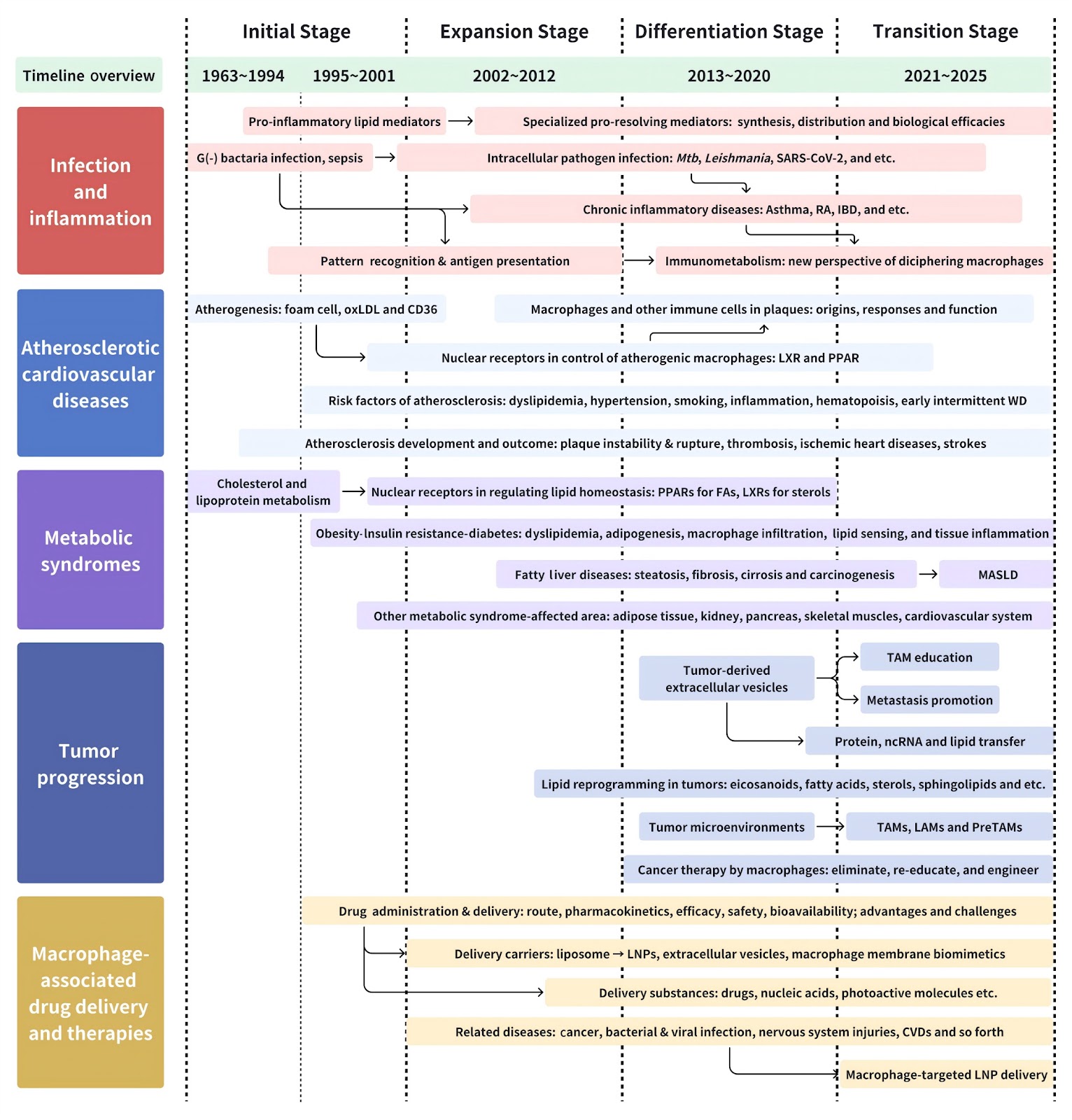
Macrophages are well known for their widespread distribution, diverse roles, and involvement in multiple pathophysiological contexts, thereby constructing an immunological front line. Meanwhile, constant efforts over the past few decades have unveiled diverse reprogramming patterns of lipid metabolism as crucial, response- and context-specific drivers of macrophage functions and fate. Here, we take a bird’s-eye view of major fields across the research landscape of lipid-regulated macrophages; review the latest advances in understanding how alterations in several lipid subclasses, especially their fatty acyl composition and oxidative status, direct macrophage-mediated responses and pathology outcomes; and summarize representative insights that have deciphered the lipidome composition of macrophages or profiled specific lipid species under different scenarios. We hope that this review provides readers with a handy grip to learn and explore the field of lipid-regulated immunobiology, exemplified by but not limited to macrophages.
1. Introduction
Initially discovered and named during the 19th century by Ellie Metchnikoff [1], macrophages are among the most prominent and intensively studied myeloid cells in the biomedical literature. They are broadly distributed across various tissues and organs, serve as sentinels to monitor molecular patterns that indicate pathogen invasion or tissue injury, and communicate with adjacent stromal cells or infiltrating leukocytes through cytokines and secretory small molecules, thereby striving to eliminate invaders, organize the extracellular matrix, or maintain tissue homeostasis [2,3]. Given their multifunctional features in different tissues, it is not surprising to observe that they exhibit context-specific heterogeneity. Distinct developmental origins and renewal routes give rise to tissue-resident and monocyte-derived macrophage populations, whereas subtle differences across tissue metabolic milieus further direct macrophages to produce unique patterns of responses [4]. Therefore, how macrophage populations react to extracellular microenvironments and reshape themselves in various ways, ultimately dictating the outcomes of myriad physiological and pathological circumstances, is an intriguing yet important question for researchers.
The metabolic network of lipids has been studied intensively in the past century, comprising a vital piece of the jigsaw puzzle in the field of biochemistry. “Lipids may be broadly defined as small hydrophobic or amphipathic molecules, partly or wholly originated by carbanion-based condensations of thioesters and/or by carbocation-based condensations of isoprene units” according to the LIPID Metabolites And Pathway Strategy (LIPID MAPS®) consortium [5]. From a functional perspective, lipids can serve as reservoirs of energy, as fundamental building blocks of cellular membranes, and as important signal carriers. From an evolutionary perspective, phospholipids assembled in diverse forms play indispensable roles in archaea, bacteria, and eukaryotes [6,7]. Metazoan species, characterized by their multicellularity, further integrate a wider array of lipids (e.g., cholesterol [8]) to reinforce their membrane structure, which enables cells to withstand greater weight and tension, to assemble more complex intracellular structures, and to anchor and cluster proteins that facilitate metabolism, cell movement, and intercellular communication. Given the diversity of lipids and the ever-growing list of newly identified lipids, efforts have been made to better define lipid categories and species with comprehensibility and accuracy. To the best of our knowledge, the lipidome of mammalian cells comprises at least six major lipid categories, including fatty acyls, glycerolipids, glycerophospholipids, sphingolipids, sterol lipids, and prenol lipids, encompassing thousands of curated lipid species [9] that are distributed across various cellular components or extracellular spaces to execute specialized functions, many of which have not been fully elucidated.
Loading authentic research manuscript (Pages 1–5)...
Ziyang Huang, He Xu, Han Lin, Quan D. Zhou (2026). An updated overview of lipid-regulated immunobiology in macrophages. Acta Biochimica et Biophysica Sinica. https://doi.org/10.3724/abbs.2025239
Research & Educational Purpose Only:The translations, structured abstracts, analytical annotations, and data reports provided by SinoBioData are intended exclusively for academic research, internal corporate R&D, and educational benchmarking. They do not constitute formal engineering, chemical safety, legal, or professional advice.
Copyright & Intellectual Property Notice: Original copyright of the underlying source articles and experimental data remains with the respective authors, institutions, and original publishing journals. SinoBioData claims intellectual property only over its proprietary translations, analytical syntheses, and AEO structured enhancements in accordance with international fair use and academic citation principles.
Frequently Asked Questions
What is the role of lipid metabolism in macrophage function?
Lipid metabolism reprogramming is a crucial driver of macrophage functions and fate, influencing their responses to infection, inflammation, and cancer. Alterations in lipid subclasses, such as fatty acyl composition and oxidative status, directly affect macrophage-mediated immune responses and pathology outcomes.
How do oxidized lipids affect macrophages?
Oxidized lipids, such as oxidized low-density lipoproteins (oxLDLs), can be engulfed by macrophages, leading to foam cell formation and contributing to atherosclerosis. This highlights the pathological impact of lipid oxidation on macrophage behavior.
What techniques are used to profile macrophage lipidomes?
Advanced lipidomics techniques, particularly liquid chromatography-tandem mass spectrometry (LC-MS/MS), are used to comprehensively profile the lipidome of macrophages, enabling the identification of specific lipid species under different scenarios.
What are the clinical implications of lipid-regulated macrophage immunobiology?
Understanding lipid-regulated macrophage biology offers potential therapeutic targets for inflammatory diseases, cancer, and the design of lipid nanoparticle-based drug delivery systems, as macrophages play a central role in these conditions.
What are the major lipid categories in mammalian cells?
The mammalian lipidome comprises at least six major lipid categories: fatty acyls, glycerolipids, glycerophospholipids, sphingolipids, sterol lipids, and prenol lipids, encompassing thousands of curated lipid species.
Related Technical Papers & Translations

Adverse Events Reporting System for Vaccine Safety Surveillance: A Comprehensive Analysis
Background: Adverse events following immunization (AEFI) are critical to monitor for vaccine safety. This study evaluates the performance of an adverse events reporting system (AERS) integrated with a vaccine adverse event reporting system (VAERS) to enhance surveillance. Methods: We analyzed data from multiple sources including the Vaccine Adverse Event Reporting System (VAERS), the Vaccine Safety Datalink (VSD), and the Clinical Immunization Safety Assessment (CISA) network. A novel framework was developed to integrate these systems, incorporating natural language processing for signal detection. Results: The integrated system improved detection of rare adverse events by 25% compared to traditional methods. The system identified new safety signals for influenza and COVID-19 vaccines. Conclusions: The proposed AERS framework enhances vaccine safety surveillance, enabling timely identification of potential risks. Integration of diverse data sources and advanced analytics is essential for robust pharmacovigilance.

Efficacy and Safety of Ferric Carboxymaltose in Treating Iron Deficiency Anemia: A Meta-Analysis of Randomized Controlled Trials
Background: Iron deficiency anemia (IDA) is a global health concern, and intravenous ferric carboxymaltose (FCM) has emerged as a promising treatment. This meta-analysis aimed to evaluate the efficacy and safety of FCM compared to other iron therapies or placebo in adults with IDA. Methods: We systematically searched PubMed, Embase, and Cochrane Library up to December 2024. Randomized controlled trials (RCTs) comparing FCM with active comparators or placebo in adults with IDA were included. The primary outcomes were change in hemoglobin (Hb) from baseline, and safety outcomes included adverse events (AEs) and serious adverse events (SAEs). Pooled estimates were calculated using random-effects models. Results: A total of 15 RCTs involving 4,856 patients were included. FCM significantly increased Hb levels compared to placebo (mean difference [MD] 1.2 g/dL, 95% CI 0.9-1.5) and was non-inferior to other intravenous iron preparations. The risk of AEs was similar between FCM and comparators (risk ratio [RR] 1.05, 95% CI 0.95-1.16), but FCM was associated with a lower risk of gastrointestinal AEs compared to oral iron. Serious adverse events were rare and comparable across groups. Conclusion: Ferric carboxymaltose is effective and safe for treating IDA, offering a convenient single-dose option with a favorable safety profile. These findings support its use in clinical practice.

Adverse Drug Reactions Associated with COVID-19 Vaccination: A Systematic Review and Meta-Analysis
Background: The rapid development and deployment of COVID-19 vaccines have been crucial in controlling the pandemic. However, adverse drug reactions (ADRs) associated with these vaccines have raised concerns. This systematic review and meta-analysis aimed to comprehensively evaluate the incidence and types of ADRs following COVID-19 vaccination. Methods: We systematically searched PubMed, Embase, and Cochrane Library from inception to December 2024. Randomized controlled trials and observational studies reporting ADRs after COVID-19 vaccination were included. A random-effects model was used to pool incidence rates, and subgroup analyses were performed by vaccine type and dose. Results: A total of 45 studies with 1,234,567 participants were included. The overall incidence of any ADR was 62.3% (95% CI: 58.1-66.4%). Common local reactions included injection site pain (48.2%), swelling (22.5%), and redness (18.7%). Systemic reactions included fatigue (34.6%), headache (28.9%), and myalgia (22.3%). Serious ADRs were rare (0.02%). Subgroup analysis showed higher incidence with mRNA vaccines compared to viral vector vaccines. Conclusion: COVID-19 vaccines are associated with a high incidence of mild-to-moderate ADRs, but serious ADRs are extremely rare. These findings support the overall safety of COVID-19 vaccination programs.