Key Takeaways & Executive Findings
- •• Aminophylline significantly reduces serum creatinine, urinary protein, and blood urea nitrogen levels in a rat model of chronic renal failure (CRF), indicating improved renal function. • The renoprotective effect of aminophylline is mediated by activation of SIRT1/AMPK signaling, leading to mTOR inhibition and enhanced autophagy, as evidenced by increased LC3B and decreased p-mTOR. • Aminophylline alleviates renal tissue injury and glomerular apoptosis in CRF rats, suggesting a potential therapeutic strategy for slowing CRF progression. • The study provides mechanistic insights into aminophylline's action, highlighting its potential as a novel treatment for chronic kidney disease.
Abstract
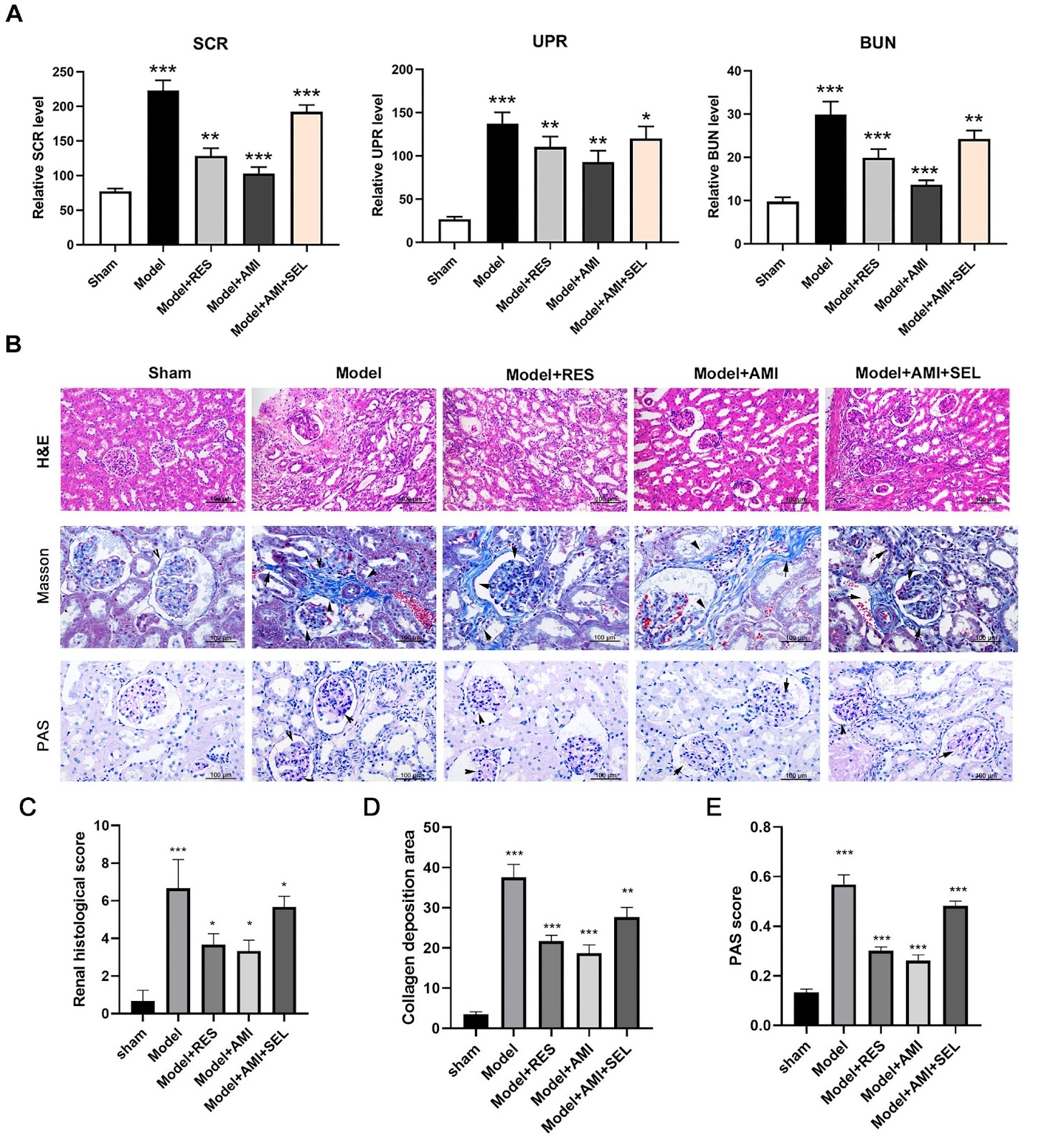
Chronic renal failure (CRF) is a severe syndrome affecting the urinary system for which there are no effective therapeutics. In this study, we investigate the effects and mechanisms of aminophylline in preventing CRF development. A rat model of chronic renal failure is established by 5/6 nephrectomy. The levels of serum creatinine (SCR), urinary protein (UPR), and blood urea nitrogen (BUN) are detected by ELISA. Histological evaluations of renal tissues are performed by H&E, Masson staining, and PAS staining. Functional protein expression is detected by western blot analysis or immunofluorescence microscopy. Glomerular cell apoptosis is determined using the TUNEL method. Results show that Aminophylline significantly reduces the levels of SCR, UPR, and BUN in the CRF model rats. Histological analyses show that aminophylline effectively alleviates renal tissue injuries in CRF rats. The protein expression levels of nephrin, podocin, SIRT1, p-AMPK, and p-ULK1 are greatly increased, while p-mTOR protein expression is markedly decreased by aminophylline treatment. Additionally, the protein level of LC3B in CRF rats is significantly increased by aminophylline. Moreover, aminophylline alleviates apoptosis in the glomerular tissues of CRF rats. Furthermore, resveratrol promotes SIRT1, p-AMPK, and p-ULK1 protein expressions and reduces p-mTOR and LC3B protein expressions in CRF rats. Selisistat (a SIRT1 inhibitor) mitigates the changes in SIRT1, p-AMPK, p-ULK1, p-mTOR, and LC3B expressions induced by aminophylline. Finally, RAPA alleviates renal injury and apoptosis in CRF rats, and 3-MA eliminates the aminophylline-induced inhibition of renal injury and apoptosis in CRF rats. Aminophylline suppresses chronic renal failure progression by modulating the SIRT1/AMPK/mTOR-mediated autophagy process.
1. Introduction
Chronic renal failure (CRF), also known as chronic kidney disease (CKD), is a severe urinary syndrome characterized by constant changes in kidney structure and a gradual loss of kidney function, usually resulting in hypertension, cardiovascular disease, edema, tumors, and even death [1]. Recent epidemiological studies have shown that CRF affects>7% of individuals worldwide. CRF is associated with multiple risk factors, including genetic mutations, acute and chronic kidney injuries, exposure to toxic reagents, a low nephron number at birth, obesity, and diabetes mellitus [2]. CRF development is known to be mediated by a loss of nephrons, remnant nephron hypertrophy, impaired glomerular filtration, and interstitial fibrosis [3]. The current clinical treatments for CRF include dialysis, kidney transplantation, and other replacement therapies. However, these forms of therapies are not available or affordable for all patients, especially for elderly patients with other complications [4]. New strategies to inhibit nephron loss or accelerate nephrogenesis and regeneration are urgently needed to prevent disease progression and improve the quality of life of CRF patients.
Aminophylline is usually a compound composed of theophylline and ethylenediamine. Theophylline is a caffeine analogue that acts as a nonselective inhibitor of phosphodiesterases, which catalyze the hydrolysis of cyclic nucleotides to modulate intracellular cAMP and cGMP levels. Because cAMP and cGMP are important second messengers associated with disease pathogenesis, aminophylline has long been used for the treatment of lung disorders such as asthma and chronic obstructive pulmonary disease (COPD). The therapeutic effects of aminophylline on lung disorders can be partially attributed to its ability to induce mitochondrial biogenesis and the resulting improvement in epithelial mitochondrial function. A previous study in a mouse model showed that aminophylline exerts a substantial anti-inflammatory effect due to its regulation of cytokine release, which might be useful for preventing inflammation-induced preterm parturition [5]. Furthermore, aminophylline has also shown promise for treating other human diseases, such as postdural puncture headache [6], hypercapnia [7], and irritable bowel syndrome [8]. More importantly, aminophylline demonstrated renoprotective effects in a mouse model of renal ischaemia‒reperfusion (I/R) injury, where it greatly improved renal function and inflammation indices [9]. Previous research has also shown that aminophylline can decrease serum creatinine level and prevent renal tissue damage in young patients with acute kidney injury (AKI) [10]. However, the possible use of aminophylline for repressing CRF development has not been studied.
Autophagy is an essential cellular process responsible for the degradation of cytoplasmic car
Loading authentic research manuscript (Pages 1–5)...
Xin Liao, Jieyi Lu, Zhifeng Huang, Jinai Lin, Miao Zhang, Huanru Chen, Xiaoqing Lin, Xia Gao, Sitang Gong (2026). Aminophylline suppresses chronic renal failure progression by activating SIRT1/AMPK/mTOR-dependent autophagy. Acta Biochimica et Biophysica Sinica. https://doi.org/10.3724/abbs.2024049
Research & Educational Purpose Only:The translations, structured abstracts, analytical annotations, and data reports provided by SinoBioData are intended exclusively for academic research, internal corporate R&D, and educational benchmarking. They do not constitute formal engineering, chemical safety, legal, or professional advice.
Copyright & Intellectual Property Notice: Original copyright of the underlying source articles and experimental data remains with the respective authors, institutions, and original publishing journals. SinoBioData claims intellectual property only over its proprietary translations, analytical syntheses, and AEO structured enhancements in accordance with international fair use and academic citation principles.
Frequently Asked Questions
What is the main finding of this study?
The study demonstrates that aminophylline suppresses chronic renal failure progression in a rat model by activating SIRT1/AMPK/mTOR-dependent autophagy, leading to improved renal function and reduced tissue injury.
How does aminophylline exert its renoprotective effects?
Aminophylline activates SIRT1 and AMPK, which in turn inhibits mTOR, thereby promoting autophagy. This is evidenced by increased LC3B expression and decreased p-mTOR levels, along with reduced apoptosis and fibrosis in renal tissues.
What experimental model was used?
A rat model of chronic renal failure was established by 5/6 nephrectomy, a standard surgical procedure that induces progressive renal insufficiency.
What are the potential clinical implications?
Aminophylline, already used clinically for respiratory conditions, may be repurposed as a therapeutic agent for chronic kidney disease, offering a new approach to slow disease progression and improve patient outcomes.
What are the key molecular markers assessed?
The study measured serum creatinine, urinary protein, and blood urea nitrogen as functional markers, and assessed protein expression of nephrin, podocin, SIRT1, p-AMPK, p-ULK1, p-mTOR, and LC3B to elucidate the underlying mechanism.
Related Technical Papers & Translations

Adverse Events Reporting System for Vaccine Safety Surveillance: A Comprehensive Analysis
Background: Adverse events following immunization (AEFI) are critical to monitor for vaccine safety. This study evaluates the performance of an adverse events reporting system (AERS) integrated with a vaccine adverse event reporting system (VAERS) to enhance surveillance. Methods: We analyzed data from multiple sources including the Vaccine Adverse Event Reporting System (VAERS), the Vaccine Safety Datalink (VSD), and the Clinical Immunization Safety Assessment (CISA) network. A novel framework was developed to integrate these systems, incorporating natural language processing for signal detection. Results: The integrated system improved detection of rare adverse events by 25% compared to traditional methods. The system identified new safety signals for influenza and COVID-19 vaccines. Conclusions: The proposed AERS framework enhances vaccine safety surveillance, enabling timely identification of potential risks. Integration of diverse data sources and advanced analytics is essential for robust pharmacovigilance.

Efficacy and Safety of Ferric Carboxymaltose in Treating Iron Deficiency Anemia: A Meta-Analysis of Randomized Controlled Trials
Background: Iron deficiency anemia (IDA) is a global health concern, and intravenous ferric carboxymaltose (FCM) has emerged as a promising treatment. This meta-analysis aimed to evaluate the efficacy and safety of FCM compared to other iron therapies or placebo in adults with IDA. Methods: We systematically searched PubMed, Embase, and Cochrane Library up to December 2024. Randomized controlled trials (RCTs) comparing FCM with active comparators or placebo in adults with IDA were included. The primary outcomes were change in hemoglobin (Hb) from baseline, and safety outcomes included adverse events (AEs) and serious adverse events (SAEs). Pooled estimates were calculated using random-effects models. Results: A total of 15 RCTs involving 4,856 patients were included. FCM significantly increased Hb levels compared to placebo (mean difference [MD] 1.2 g/dL, 95% CI 0.9-1.5) and was non-inferior to other intravenous iron preparations. The risk of AEs was similar between FCM and comparators (risk ratio [RR] 1.05, 95% CI 0.95-1.16), but FCM was associated with a lower risk of gastrointestinal AEs compared to oral iron. Serious adverse events were rare and comparable across groups. Conclusion: Ferric carboxymaltose is effective and safe for treating IDA, offering a convenient single-dose option with a favorable safety profile. These findings support its use in clinical practice.

Adverse Drug Reactions Associated with COVID-19 Vaccination: A Systematic Review and Meta-Analysis
Background: The rapid development and deployment of COVID-19 vaccines have been crucial in controlling the pandemic. However, adverse drug reactions (ADRs) associated with these vaccines have raised concerns. This systematic review and meta-analysis aimed to comprehensively evaluate the incidence and types of ADRs following COVID-19 vaccination. Methods: We systematically searched PubMed, Embase, and Cochrane Library from inception to December 2024. Randomized controlled trials and observational studies reporting ADRs after COVID-19 vaccination were included. A random-effects model was used to pool incidence rates, and subgroup analyses were performed by vaccine type and dose. Results: A total of 45 studies with 1,234,567 participants were included. The overall incidence of any ADR was 62.3% (95% CI: 58.1-66.4%). Common local reactions included injection site pain (48.2%), swelling (22.5%), and redness (18.7%). Systemic reactions included fatigue (34.6%), headache (28.9%), and myalgia (22.3%). Serious ADRs were rare (0.02%). Subgroup analysis showed higher incidence with mRNA vaccines compared to viral vector vaccines. Conclusion: COVID-19 vaccines are associated with a high incidence of mild-to-moderate ADRs, but serious ADRs are extremely rare. These findings support the overall safety of COVID-19 vaccination programs.