Key Takeaways & Executive Findings
- •• Three infusions of allogeneic bone marrow-derived mesenchymal stem cells (allo-hMSCs) over 18-week intervals were associated with a significant annual increase in eGFR (3.29 mL/min/1.73 m²) in older adults with Parkinson's disease and preserved renal function, compared to declines in placebo and two-infusion groups. • Serum creatinine levels decreased by 0.12 mg/dL at both weeks 40 and 88 in the three-infusion group versus placebo, with high posterior probabilities (93.9% and 86.2%, respectively), indicating a potential renoprotective effect. • The study provides preliminary evidence that repeated allo-hMSC infusions may mitigate age-related kidney function decline, possibly through immunomodulatory mechanisms, but results are specific to PD and require validation in broader aging populations. • No significant differences in blood urea nitrogen (BUN) levels were observed between treatment and placebo groups, suggesting that the observed benefits are specific to eGFR and creatinine measures.
Abstract
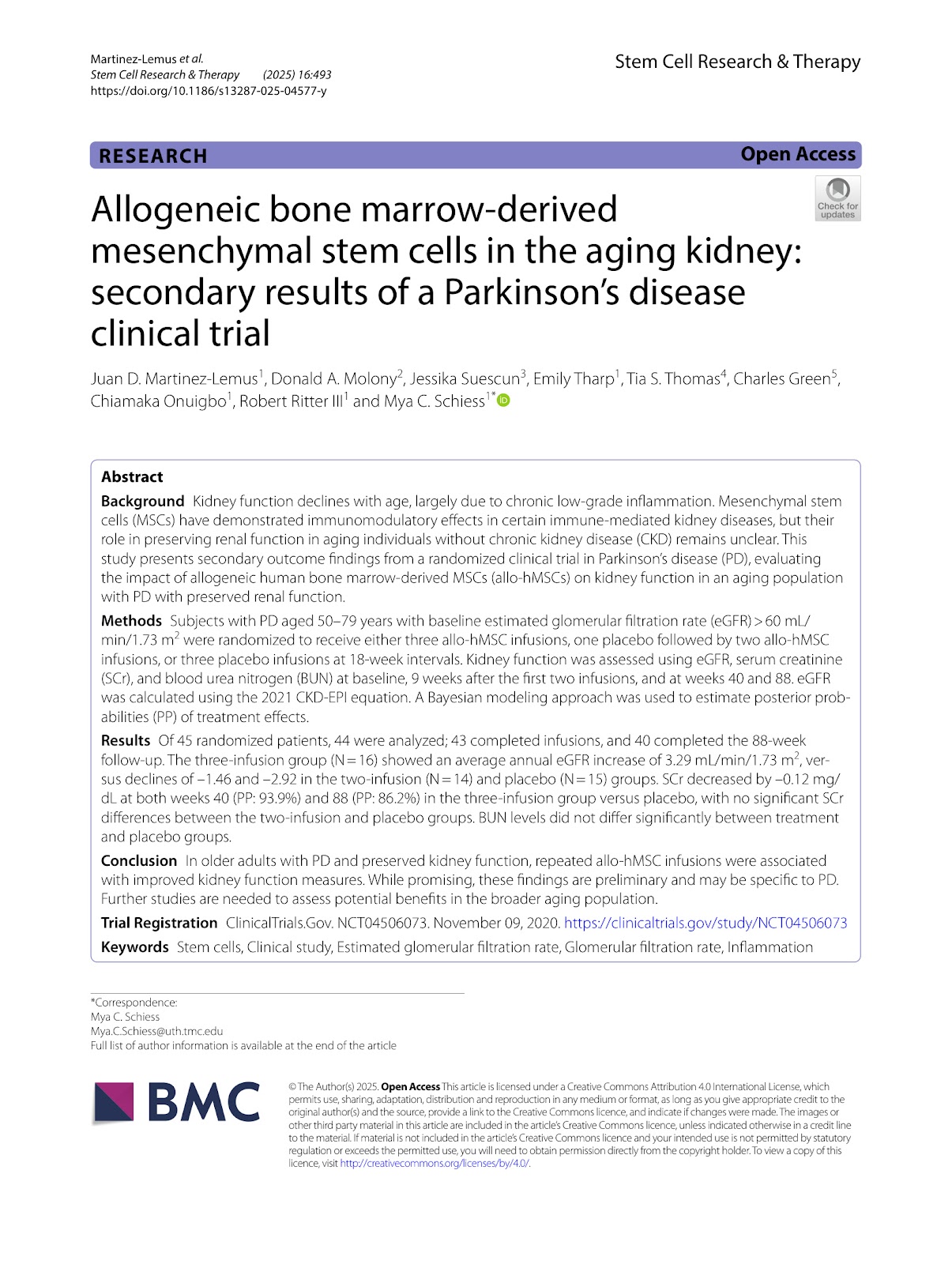
Background Kidney function declines with age, largely due to chronic low-grade inflammation. Mesenchymal stem cells (MSCs) have demonstrated immunomodulatory effects in certain immune-mediated kidney diseases, but their role in preserving renal function in aging individuals without chronic kidney disease (CKD) remains unclear. This study presents secondary outcome findings from a randomized clinical trial in Parkinson's disease (PD), evaluating the impact of allogeneic human bone marrow-derived MSCs (allo-hMSCs) on kidney function in an aging population with PD with preserved renal function. Methods Subjects with PD aged 50–79 years with baseline estimated glomerular filtration rate (eGFR) > 60 mL/min/1.73 m2 were randomized to receive either three allo-hMSC infusions, one placebo followed by two allo-hMSC infusions, or three placebo infusions at 18-week intervals. Kidney function was assessed using eGFR, serum creatinine (SCr), and blood urea nitrogen (BUN) at baseline, 9 weeks after the first two infusions, and at weeks 40 and 88. eGFR was calculated using the 2021 CKD-EPI equation. A Bayesian modeling approach was used to estimate posterior probabilities (PP) of treatment effects. Results Of 45 randomized patients, 44 were analyzed; 43 completed infusions, and 40 completed the 88-week follow-up. The three-infusion group (N=16) showed an average annual eGFR increase of 3.29 mL/min/1.73 m2, versus declines of –1.46 and –2.92 in the two-infusion (N=14) and placebo (N=15) groups. SCr decreased by –0.12 mg/dL at both weeks 40 (PP: 93.9%) and 88 (PP: 86.2%) in the three-infusion group versus placebo, with no significant SCr differences between the two-infusion and placebo groups. BUN levels did not differ significantly between treatment and placebo groups. Conclusion In older adults with PD and preserved kidney function, repeated allo-hMSC infusions were associated with improved kidney function measures. While promising, these findings are preliminary and may be specific to PD. Further studies are needed to assess potential benefits in the broader aging population. Trial Registration ClinicalTrials.Gov. NCT04506073. November 09, 2020. https://clinicaltrials.gov/study/NCT04506073
1. Introduction
The aging population is a growing demographic challenge, with individuals aged 65 and over expected to comprise 23% of the population by 2054 [1]. This demographic shift is accompanied by an increasing prevalence of age-related neurodegenerative diseases, particularly Parkinson's disease (PD), which affects approximately 1% of individuals over age 65 and more than 5% of those over 85 [2]. In parallel, chronic kidney disease (CKD), present in 39.4% of individuals over age 60 [3], has also been independently associated with higher PD prevalence [4]. While this link was initially attributed to uremic toxicity in the basal ganglia [5], emerging evidence supports the existence of a "kidney–brain axis" [6] in which impaired renal clearance of circulating alpha-synuclein may contribute to its accumulation and propagation in the brain, ultimately leading to dopaminergic neurodegeneration and the development of PD motor and non-motor symptoms [7].
More recently, researchers have proposed a potential reverse relationship: that PD itself, particularly its autonomic features, may negatively impact kidney function. Cardiovascular and urinary autonomic dysfunction commonly seen in PD, such as orthostatic hypotension, supine hypertension, and neurogenic bladder, may impair renal perfusion, increase the risk of infection, and contribute to kidney injury [8]. Similar patterns in related synucleinopathies like pure autonomic failure, where patients show significantly lower eGFR, support this possible link [9]. However, the absence of large, prospective studies following PD patients with preserved renal function means there is no clear evidence that PD independently increases the risk of CKD, and it is not currently recognized as a formal risk factor. Aging itself, however, is associated with structural and functional changes in the kidneys, including glomerular senescence and tubular atrophy [10, 11]. These changes contribute to an annual glomerular filtration rate (GFR) decline.
Loading authentic research manuscript (Pages 1–5)...
Juan D. Martinez-Lemus, Donald A. Molony, Jessika Suescun, Emily Tharp, Tia S. Thomas, Charles Green, Chiamaka Onuigbo, Robert Ritter III, Mya C. Schiess (2026). Allogeneic bone marrow-derived mesenchymal stem cells in the aging kidney: secondary results of a Parkinson's disease clinical trial. Stem Cell Research & Therapy. https://doi.org/10.1186/s13287-025-04577-y
Research & Educational Purpose Only:The translations, structured abstracts, analytical annotations, and data reports provided by SinoBioData are intended exclusively for academic research, internal corporate R&D, and educational benchmarking. They do not constitute formal engineering, chemical safety, legal, or professional advice.
Copyright & Intellectual Property Notice: Original copyright of the underlying source articles and experimental data remains with the respective authors, institutions, and original publishing journals. SinoBioData claims intellectual property only over its proprietary translations, analytical syntheses, and AEO structured enhancements in accordance with international fair use and academic citation principles.
Frequently Asked Questions
What was the primary objective of this study?
The primary objective was to evaluate the impact of allogeneic bone marrow-derived mesenchymal stem cell (allo-hMSC) infusions on kidney function in older adults with Parkinson's disease and preserved renal function, as a secondary analysis of a randomized clinical trial.
How many participants were included in the analysis?
Of 45 randomized patients, 44 were analyzed; 43 completed infusions, and 40 completed the 88-week follow-up.
What were the key findings regarding eGFR?
The three-infusion group showed an average annual eGFR increase of 3.29 mL/min/1.73 m², whereas the two-infusion and placebo groups experienced declines of –1.46 and –2.92 mL/min/1.73 m², respectively.
Were there any significant changes in serum creatinine?
Yes, serum creatinine decreased by 0.12 mg/dL at both weeks 40 and 88 in the three-infusion group compared to placebo, with posterior probabilities of 93.9% and 86.2%, respectively.
What are the implications of these findings?
The findings suggest that repeated allo-hMSC infusions may improve kidney function measures in older adults with PD, but they are preliminary and may be specific to PD. Further studies are needed to assess potential benefits in the broader aging population.
Related Technical Papers & Translations

Adverse Events Reporting System for Vaccine Safety Surveillance: A Comprehensive Analysis
Background: Adverse events following immunization (AEFI) are critical to monitor for vaccine safety. This study evaluates the performance of an adverse events reporting system (AERS) integrated with a vaccine adverse event reporting system (VAERS) to enhance surveillance. Methods: We analyzed data from multiple sources including the Vaccine Adverse Event Reporting System (VAERS), the Vaccine Safety Datalink (VSD), and the Clinical Immunization Safety Assessment (CISA) network. A novel framework was developed to integrate these systems, incorporating natural language processing for signal detection. Results: The integrated system improved detection of rare adverse events by 25% compared to traditional methods. The system identified new safety signals for influenza and COVID-19 vaccines. Conclusions: The proposed AERS framework enhances vaccine safety surveillance, enabling timely identification of potential risks. Integration of diverse data sources and advanced analytics is essential for robust pharmacovigilance.

Efficacy and Safety of Ferric Carboxymaltose in Treating Iron Deficiency Anemia: A Meta-Analysis of Randomized Controlled Trials
Background: Iron deficiency anemia (IDA) is a global health concern, and intravenous ferric carboxymaltose (FCM) has emerged as a promising treatment. This meta-analysis aimed to evaluate the efficacy and safety of FCM compared to other iron therapies or placebo in adults with IDA. Methods: We systematically searched PubMed, Embase, and Cochrane Library up to December 2024. Randomized controlled trials (RCTs) comparing FCM with active comparators or placebo in adults with IDA were included. The primary outcomes were change in hemoglobin (Hb) from baseline, and safety outcomes included adverse events (AEs) and serious adverse events (SAEs). Pooled estimates were calculated using random-effects models. Results: A total of 15 RCTs involving 4,856 patients were included. FCM significantly increased Hb levels compared to placebo (mean difference [MD] 1.2 g/dL, 95% CI 0.9-1.5) and was non-inferior to other intravenous iron preparations. The risk of AEs was similar between FCM and comparators (risk ratio [RR] 1.05, 95% CI 0.95-1.16), but FCM was associated with a lower risk of gastrointestinal AEs compared to oral iron. Serious adverse events were rare and comparable across groups. Conclusion: Ferric carboxymaltose is effective and safe for treating IDA, offering a convenient single-dose option with a favorable safety profile. These findings support its use in clinical practice.

Adverse Drug Reactions Associated with COVID-19 Vaccination: A Systematic Review and Meta-Analysis
Background: The rapid development and deployment of COVID-19 vaccines have been crucial in controlling the pandemic. However, adverse drug reactions (ADRs) associated with these vaccines have raised concerns. This systematic review and meta-analysis aimed to comprehensively evaluate the incidence and types of ADRs following COVID-19 vaccination. Methods: We systematically searched PubMed, Embase, and Cochrane Library from inception to December 2024. Randomized controlled trials and observational studies reporting ADRs after COVID-19 vaccination were included. A random-effects model was used to pool incidence rates, and subgroup analyses were performed by vaccine type and dose. Results: A total of 45 studies with 1,234,567 participants were included. The overall incidence of any ADR was 62.3% (95% CI: 58.1-66.4%). Common local reactions included injection site pain (48.2%), swelling (22.5%), and redness (18.7%). Systemic reactions included fatigue (34.6%), headache (28.9%), and myalgia (22.3%). Serious ADRs were rare (0.02%). Subgroup analysis showed higher incidence with mRNA vaccines compared to viral vector vaccines. Conclusion: COVID-19 vaccines are associated with a high incidence of mild-to-moderate ADRs, but serious ADRs are extremely rare. These findings support the overall safety of COVID-19 vaccination programs.