Key Takeaways & Executive Findings
- •• ADATs catalyze A-to-I and C-to-U deamination in tRNAs, crucial for wobble position modification and translational fidelity. • ADAT2/3 heterodimer functions in tRNA recognition, while bacterial TadA acts as a homodimer, highlighting evolutionary divergence. • Recent findings reveal ADAT2/3 dual role in RNA and DNA editing, expanding their functional repertoire beyond tRNA. • Mutations in ADAT3 are linked to intellectual disability, underscoring the clinical relevance of tRNA editing enzymes.
Abstract
Transfer RNAs (tRNAs) play central roles in protein biosynthesis. Post-transcriptional RNA modifications affect tRNA function and stability. Among these modifications, RNA editing is a widespread RNA modification in three domains of life. Proteins of the adenosine deaminase acting on tRNA (ADAT) family were discovered more than 20 years ago. They catalyze the deamination of adenosine to inosine (A-to-I) or cytidine to uridine (C-to-U) during tRNA maturation. The most studied example is the TadA- or ADAT2/3-mediated A-to-I conversion of the tRNA wobble position in the anticodon of prokaryotic or eukaryotic tRNAs, respectively. This review provides detailed information on A-to-I and C-to-U editing of tRNAs in different domains of life, presents recent new findings on ADATs for DNA editing, and finally comments on the association of mutations in the ADAT3 gene with intellectual disability.
1. Introduction
RNA is a critical biomolecule in genetic information decoding and undergoes a series of metabolic processes after transcription, such as modification, maturation, and degradation, for normal life activities. Modified RNA nucleotides other than the four standard nucleotides have fascinated scientists since the identification of pseudouridine (ψ) as the “fifth” ribonucleotide in 1951 [1]. To date, more than 170 different types of modified ribonucleosides have been identified in RNAs from all three domains of life [2,3], and the majority of modifications occur on transfer RNA (tRNA) molecules [4,5]. tRNAs are short, ubiquitous adaptor molecules that play a central role in connecting genetic information with the protein synthesizing machinery. RNA editing is a unique modification reaction that changes RNA fate and the genomic sequence. The most common type of RNA editing is the deamination of adenosine to inosine (A-to-I) or cytidine to uridine (C-to-U) in mRNAs and non-coding RNAs (Figure 1), which expands the genetic diversity beyond the DNA-encoded sequence or has other biological significance.
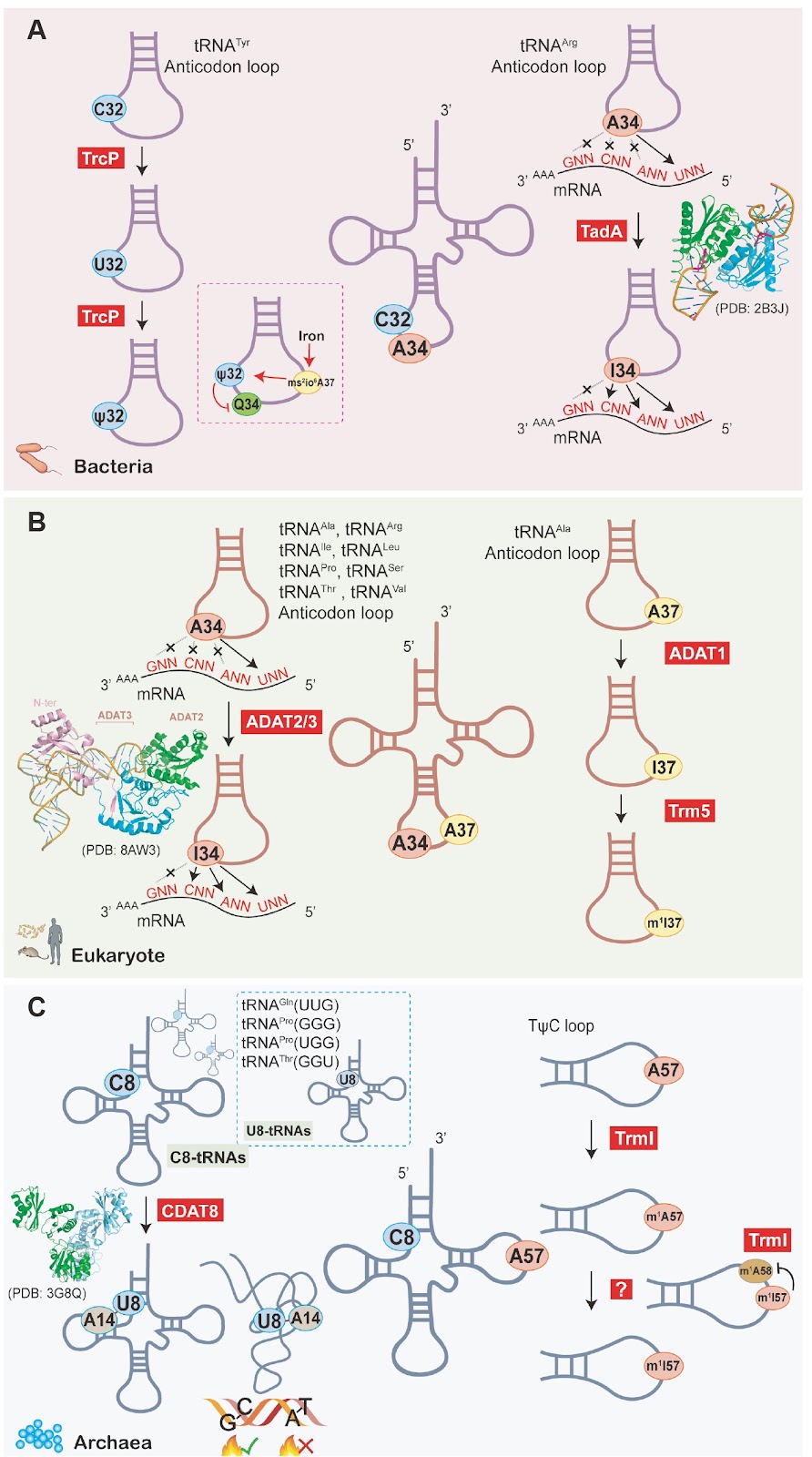
Inosine was discovered in tRNAAla as early as 1965 [6], but it was not until 1987 that an A-to-I RNA editing activity was observed as a double-stranded RNA (dsRNA) unwinding activity in Xenopus laevis oocytes and embryos [7]. The enzyme was subsequently identified as an RNA adenosine deaminase (ADAR) [8]. In addition to ADARs, adenosine deaminases, known as adenosine deaminases acting on tRNAs (ADATs), function on tRNAs. In addition to carrying out A-to-I editing of tRNAs, which includes 1-methylinosine (m1I) modifications in certain organisms, ADATs also catalyze C-to-U deamination (Figure 2). Both ADARs and ADATs belong to the cytidine deaminase superfamily and require zinc ions for their activities. Although ADARs are well documented due to their crucial role in mRNA and have been the focus of several related studies [9‒12], ADATs are comparatively less understood.
Loading authentic research manuscript (Pages 1–5)...
Xue-Ling Mao, Gilbert Eriani, Xiao-Long Zhou (2026). ADATs: roles in tRNA editing and relevance to disease. Acta Biochimica et Biophysica Sinica. https://doi.org/10.3724/abbs.2024125
Research & Educational Purpose Only:The translations, structured abstracts, analytical annotations, and data reports provided by SinoBioData are intended exclusively for academic research, internal corporate R&D, and educational benchmarking. They do not constitute formal engineering, chemical safety, legal, or professional advice.
Copyright & Intellectual Property Notice: Original copyright of the underlying source articles and experimental data remains with the respective authors, institutions, and original publishing journals. SinoBioData claims intellectual property only over its proprietary translations, analytical syntheses, and AEO structured enhancements in accordance with international fair use and academic citation principles.
Frequently Asked Questions
What are ADATs and what is their primary function?
ADATs (adenosine deaminases acting on tRNA) are enzymes that catalyze the deamination of adenosine to inosine (A-to-I) or cytidine to uridine (C-to-U) in tRNA molecules, playing a crucial role in tRNA maturation and function.
How do ADAT2 and ADAT3 function together?
ADAT2 and ADAT3 form a heterodimer where ADAT2 is the catalytic subunit and ADAT3 serves as an essential co-factor for tRNA substrate recognition in eukaryotes.
What is the significance of ADAT3 mutations in disease?
Mutations in the ADAT3 gene are associated with intellectual disability, highlighting the importance of tRNA editing in neurodevelopment and the clinical relevance of ADATs.
What recent findings about ADATs are highlighted in the review?
The review highlights recent discoveries that ADAT2/3 also participate in DNA editing, expanding their known functions beyond RNA modification.
How do ADATs differ between prokaryotes and eukaryotes?
In bacteria, TadA forms a homodimer to perform the editing function, while in eukaryotes, ADAT2 and ADAT3 form a heterodimer, with ADAT3 providing substrate recognition.
Related Technical Papers & Translations

Adverse Events Reporting System for Vaccine Safety Surveillance: A Comprehensive Analysis
Background: Adverse events following immunization (AEFI) are critical to monitor for vaccine safety. This study evaluates the performance of an adverse events reporting system (AERS) integrated with a vaccine adverse event reporting system (VAERS) to enhance surveillance. Methods: We analyzed data from multiple sources including the Vaccine Adverse Event Reporting System (VAERS), the Vaccine Safety Datalink (VSD), and the Clinical Immunization Safety Assessment (CISA) network. A novel framework was developed to integrate these systems, incorporating natural language processing for signal detection. Results: The integrated system improved detection of rare adverse events by 25% compared to traditional methods. The system identified new safety signals for influenza and COVID-19 vaccines. Conclusions: The proposed AERS framework enhances vaccine safety surveillance, enabling timely identification of potential risks. Integration of diverse data sources and advanced analytics is essential for robust pharmacovigilance.

Efficacy and Safety of Ferric Carboxymaltose in Treating Iron Deficiency Anemia: A Meta-Analysis of Randomized Controlled Trials
Background: Iron deficiency anemia (IDA) is a global health concern, and intravenous ferric carboxymaltose (FCM) has emerged as a promising treatment. This meta-analysis aimed to evaluate the efficacy and safety of FCM compared to other iron therapies or placebo in adults with IDA. Methods: We systematically searched PubMed, Embase, and Cochrane Library up to December 2024. Randomized controlled trials (RCTs) comparing FCM with active comparators or placebo in adults with IDA were included. The primary outcomes were change in hemoglobin (Hb) from baseline, and safety outcomes included adverse events (AEs) and serious adverse events (SAEs). Pooled estimates were calculated using random-effects models. Results: A total of 15 RCTs involving 4,856 patients were included. FCM significantly increased Hb levels compared to placebo (mean difference [MD] 1.2 g/dL, 95% CI 0.9-1.5) and was non-inferior to other intravenous iron preparations. The risk of AEs was similar between FCM and comparators (risk ratio [RR] 1.05, 95% CI 0.95-1.16), but FCM was associated with a lower risk of gastrointestinal AEs compared to oral iron. Serious adverse events were rare and comparable across groups. Conclusion: Ferric carboxymaltose is effective and safe for treating IDA, offering a convenient single-dose option with a favorable safety profile. These findings support its use in clinical practice.

Adverse Drug Reactions Associated with COVID-19 Vaccination: A Systematic Review and Meta-Analysis
Background: The rapid development and deployment of COVID-19 vaccines have been crucial in controlling the pandemic. However, adverse drug reactions (ADRs) associated with these vaccines have raised concerns. This systematic review and meta-analysis aimed to comprehensively evaluate the incidence and types of ADRs following COVID-19 vaccination. Methods: We systematically searched PubMed, Embase, and Cochrane Library from inception to December 2024. Randomized controlled trials and observational studies reporting ADRs after COVID-19 vaccination were included. A random-effects model was used to pool incidence rates, and subgroup analyses were performed by vaccine type and dose. Results: A total of 45 studies with 1,234,567 participants were included. The overall incidence of any ADR was 62.3% (95% CI: 58.1-66.4%). Common local reactions included injection site pain (48.2%), swelling (22.5%), and redness (18.7%). Systemic reactions included fatigue (34.6%), headache (28.9%), and myalgia (22.3%). Serious ADRs were rare (0.02%). Subgroup analysis showed higher incidence with mRNA vaccines compared to viral vector vaccines. Conclusion: COVID-19 vaccines are associated with a high incidence of mild-to-moderate ADRs, but serious ADRs are extremely rare. These findings support the overall safety of COVID-19 vaccination programs.