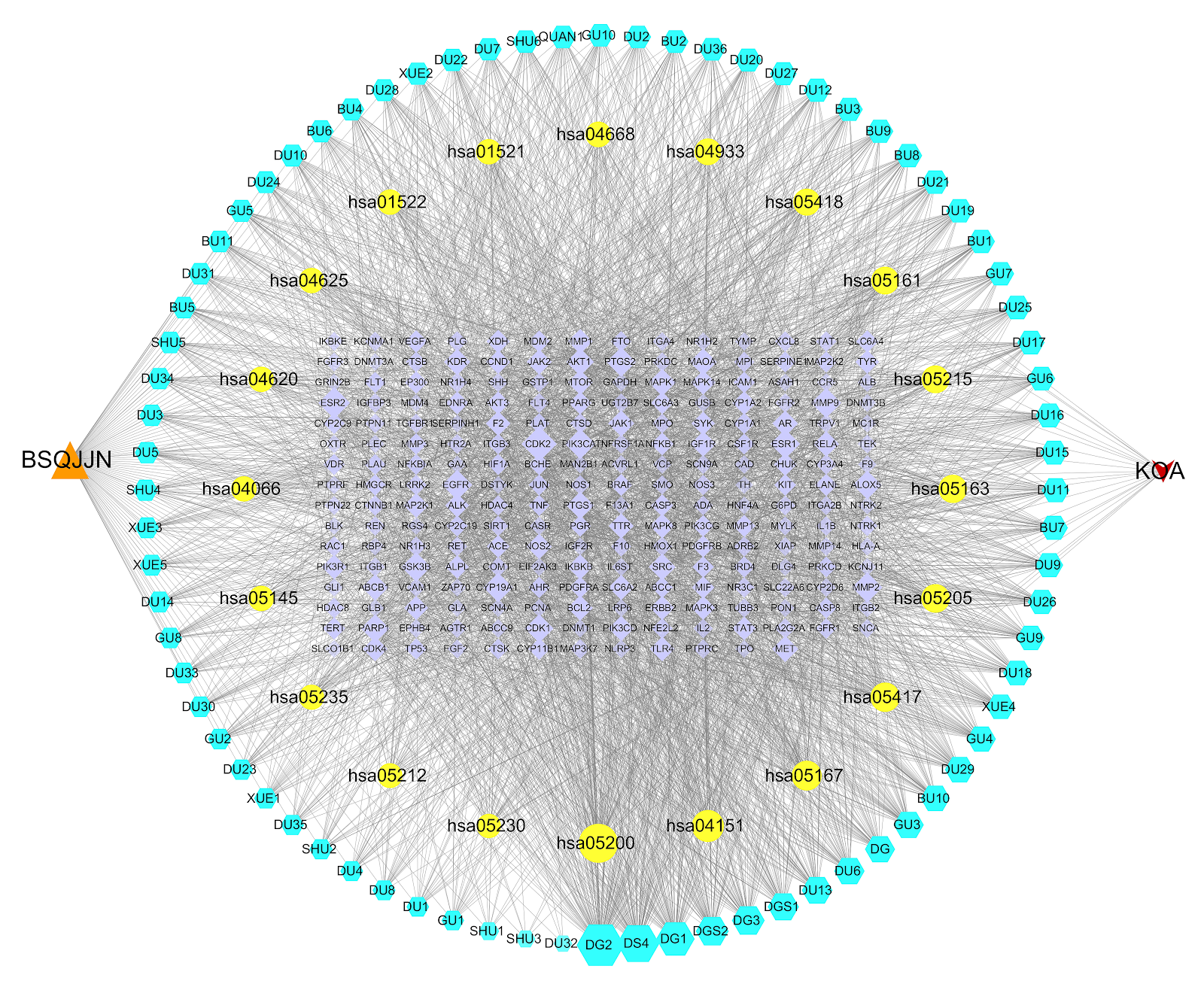
Key Takeaways & Executive Findings
- •• Bushen Qiangjin capsule contains 85 active components, with kaempferol and ferulic acid as key components, and core targets including AKT1 and PIK3CA. • Mendelian randomization analyses revealed a direct positive causal relationship between MAPK8 expression and knee osteoarthritis risk. • Molecular docking demonstrated strong binding affinity of kaempferol and ferulic acid to core targets, suggesting potential therapeutic interactions. • In vitro experiments confirmed that Bushen Qiangjin capsule promotes chondrocyte extracellular matrix synthesis and downregulates MAPK8 expression, supporting its anti-inflammatory and chondroprotective effects.
Abstract
BACKGROUND: Animal experiments have demonstrated that Bushen Qiangjin capsule can significantly improve subchondral bone metabolism and abnormal bone remodeling, and delay the progression of knee osteoarthritis, providing experimental evidence for elucidating the mechanism of action of this drug in treating knee osteoarthritis. OBJECTIVE: To systematically explore the mechanism of action of Bushen Qiangjin capsule in regulating inflammatory signaling pathways to improve knee osteoarthritis using network pharmacology, Mendelian randomization based on pooled data, two-sample Mendelian randomization, molecular docking, and cell experiments. METHODS: (1) Network pharmacology tools were used to obtain the active components, core targets, and signaling pathways of Bushen Qiangjin capsule in treating knee osteoarthritis. Potential targets were imported into the STRING platform to construct a protein-protein interaction network and further screen core targets. Mendelian randomization based on pooled data was conducted to evaluate the causal relationship between core targets and the risk of knee osteoarthritis. Two-sample Mendelian randomization was used to analyze the causal relationship between mitogen-activated protein kinase 8 (MAPK8) and knee osteoarthritis. GO function and KEGG pathway enrichment analyses were performed on potential targets of Bushen Qiangjin capsule intervention in knee osteoarthritis. Molecular docking was used to further clarify the interaction between key active components of Bushen Qiangjin capsule and core target proteins. (2) Five SD rats were given Bushen Qiangjin capsule by gavage at 0.243 g/(kg·d) for 7 consecutive days. After the last administration, venous blood was collected and serum was separated to obtain drug-containing serum. Rat knee chondrocytes were divided into three groups for culture: blank group (no treatment), model group (treated with interleukin-1β for 24 h to establish an osteoarthritis cell model), and drug-containing serum group (treated with interleukin-1β for 24 h, then treated with 10% drug-containing serum for 24 h). After treatment, Alcian blue and toluidine blue staining were used to observe chondrocyte morphology. RT-qPCR and western blot were used to detect the mRNA and protein expression of MAPK8 and type II collagen. RESULTS AND CONCLUSION: (1) A total of 85 active components related to Bushen Qiangjin capsule were obtained, among which kaempferol and ferulic acid were key components. Core targets included serine/threonine-protein kinase 1 (AKT1), phosphatidylinositol 3-kinase catalytic subunit alpha (PIK3CA), etc. Mendelian randomization based on pooled data and two-sample Mendelian randomization indicated that MAPK8 had a direct causal relationship with knee osteoarthritis and was positively correlated. GO enrichment results mainly involved biological processes such as phosphorylation, response to xenobiotic stimulus, and negative regulation of apoptotic process. KEGG pathways mainly included phosphatidylinositol 3-kinase-serine/threonine-protein kinase, tumor necrosis factor alpha, Toll-like receptor 4, hypoxia-inducible factor 1, and mechanosensory-related axes. Molecular docking results showed that kaempferol and ferulic acid had good binding activity with core targets such as AKT1, PIK3CA, tyrosine kinase C, signal transducer and activator of transcription 3, and tumor protein p53. (2) Alcian blue and toluidine blue staining showed that Bushen Qiangjin capsule could promote the synthesis of cartilage extracellular matrix in the osteoarthritis cell model. RT-qPCR and western blot showed that compared with the model group, the mRNA and protein expression of type II collagen increased (P < 0.05), while the mRNA and protein expression of MAPK8 decreased (P < 0.05) in the drug-containing serum group. (3) These results indicate that Bushen Qiangjin capsule may improve knee osteoarthritis-related damage through 'multi-component, multi-target, multi-pathway' synergistic regulation of inflammatory response and extracellular matrix homeostasis.
1. Introduction
Knee osteoarthritis is a degenerative disease characterized by articular cartilage degeneration, subchondral bone changes, osteophyte formation, and synovial lesions. Its clinical manifestations mainly include knee pain and tenderness, joint swelling, and stiffness, leading to decreased mobility and quality of life. Knee osteoarthritis has become one of the most common disabling diseases. Currently, non-steroidal anti-inflammatory drugs are mainly used to improve clinical symptoms in early and mid-stage knee osteoarthritis; however, they have significant gastrointestinal adverse effects and fail to fundamentally delay the progression of the disease. For advanced stages, total knee arthroplasty is often chosen, but surgical risks and treatment costs often deter patients. Traditional Chinese medicine (TCM) therapy has advantages such as fewer adverse reactions, high patient acceptance, high safety, and significant efficacy, playing an important role in the treatment of knee osteoarthritis.
In TCM, knee osteoarthritis is classified under the category of 'knee bi syndrome', with the pathogenesis considered as 'deficiency of liver and kidney as the root, and invasion of wind, cold, and dampness as the manifestation'. Bushen Qiangjin capsule, a TCM formula, has been used clinically for years. Animal experiments have shown that it can significantly improve subchondral bone metabolism and abnormal bone remodeling, and delay the progression of knee osteoarthritis. However, the underlying molecular mechanisms remain to be fully elucidated. This study aims to systematically explore the mechanism of Bushen Qiangjin capsule in regulating inflammatory signaling pathways to improve knee osteoarthritis, using network pharmacology, Mendelian randomization, molecular docking, and cell experiments, providing a scientific basis for its clinical application.
Loading authentic research manuscript (Pages 1–5)...
HE Wen-yang, CHEN Wei-jian, RAN Qing-zhi, HUANG Yi-die, LIN Xiao-dong, XU Xue-meng, GUO Mei-rong, LIU Wen-gang (2026). Action mechanisms of Bushen Qiangjin capsule in regulating inflammatory signaling pathways and improving knee osteoarthritis. Chinese Journal of Tissue Engineering Research. https://doi.org/10.12307/2026.21543
Research & Educational Purpose Only:The translations, structured abstracts, analytical annotations, and data reports provided by SinoBioData are intended exclusively for academic research, internal corporate R&D, and educational benchmarking. They do not constitute formal engineering, chemical safety, legal, or professional advice.
Copyright & Intellectual Property Notice: Original copyright of the underlying source articles and experimental data remains with the respective authors, institutions, and original publishing journals. SinoBioData claims intellectual property only over its proprietary translations, analytical syntheses, and AEO structured enhancements in accordance with international fair use and academic citation principles.
Frequently Asked Questions
What is the mechanism of Bushen Qiangjin capsule in treating knee osteoarthritis?
Bushen Qiangjin capsule improves knee osteoarthritis through a multi-component, multi-target, and multi-pathway approach, regulating inflammatory signaling pathways and extracellular matrix homeostasis. Key components like kaempferol and ferulic acid interact with core targets such as AKT1 and PIK3CA, and downregulate MAPK8 expression, thereby reducing inflammation and promoting cartilage repair.
How was the causal relationship between MAPK8 and knee osteoarthritis established?
The causal relationship was established using two-sample Mendelian randomization and Mendelian randomization based on pooled data, which showed a direct positive causal relationship between MAPK8 expression and the risk of knee osteoarthritis.
What experimental methods were used in this study?
The study employed network pharmacology, Mendelian randomization (both summary-data-based and two-sample), molecular docking, and in vitro cell experiments. Rat chondrocytes were treated with drug-containing serum, and the effects on MAPK8 and type II collagen expression were assessed via RT-qPCR and western blot.
What are the key active components of Bushen Qiangjin capsule identified in this study?
The study identified 85 active components, with kaempferol and ferulic acid as the key components, which showed good binding affinity to core targets in molecular docking.
What are the clinical implications of this research?
This research provides scientific evidence for the use of Bushen Qiangjin capsule in treating knee osteoarthritis, highlighting its potential as a disease-modifying drug. It also offers insights into the molecular mechanisms, which may guide future drug development and personalized treatment strategies.
Related Technical Papers & Translations

Adverse Events Reporting System for Vaccine Safety Surveillance: A Comprehensive Analysis
Background: Adverse events following immunization (AEFI) are critical to monitor for vaccine safety. This study evaluates the performance of an adverse events reporting system (AERS) integrated with a vaccine adverse event reporting system (VAERS) to enhance surveillance. Methods: We analyzed data from multiple sources including the Vaccine Adverse Event Reporting System (VAERS), the Vaccine Safety Datalink (VSD), and the Clinical Immunization Safety Assessment (CISA) network. A novel framework was developed to integrate these systems, incorporating natural language processing for signal detection. Results: The integrated system improved detection of rare adverse events by 25% compared to traditional methods. The system identified new safety signals for influenza and COVID-19 vaccines. Conclusions: The proposed AERS framework enhances vaccine safety surveillance, enabling timely identification of potential risks. Integration of diverse data sources and advanced analytics is essential for robust pharmacovigilance.

Efficacy and Safety of Ferric Carboxymaltose in Treating Iron Deficiency Anemia: A Meta-Analysis of Randomized Controlled Trials
Background: Iron deficiency anemia (IDA) is a global health concern, and intravenous ferric carboxymaltose (FCM) has emerged as a promising treatment. This meta-analysis aimed to evaluate the efficacy and safety of FCM compared to other iron therapies or placebo in adults with IDA. Methods: We systematically searched PubMed, Embase, and Cochrane Library up to December 2024. Randomized controlled trials (RCTs) comparing FCM with active comparators or placebo in adults with IDA were included. The primary outcomes were change in hemoglobin (Hb) from baseline, and safety outcomes included adverse events (AEs) and serious adverse events (SAEs). Pooled estimates were calculated using random-effects models. Results: A total of 15 RCTs involving 4,856 patients were included. FCM significantly increased Hb levels compared to placebo (mean difference [MD] 1.2 g/dL, 95% CI 0.9-1.5) and was non-inferior to other intravenous iron preparations. The risk of AEs was similar between FCM and comparators (risk ratio [RR] 1.05, 95% CI 0.95-1.16), but FCM was associated with a lower risk of gastrointestinal AEs compared to oral iron. Serious adverse events were rare and comparable across groups. Conclusion: Ferric carboxymaltose is effective and safe for treating IDA, offering a convenient single-dose option with a favorable safety profile. These findings support its use in clinical practice.

Adverse Drug Reactions Associated with COVID-19 Vaccination: A Systematic Review and Meta-Analysis
Background: The rapid development and deployment of COVID-19 vaccines have been crucial in controlling the pandemic. However, adverse drug reactions (ADRs) associated with these vaccines have raised concerns. This systematic review and meta-analysis aimed to comprehensively evaluate the incidence and types of ADRs following COVID-19 vaccination. Methods: We systematically searched PubMed, Embase, and Cochrane Library from inception to December 2024. Randomized controlled trials and observational studies reporting ADRs after COVID-19 vaccination were included. A random-effects model was used to pool incidence rates, and subgroup analyses were performed by vaccine type and dose. Results: A total of 45 studies with 1,234,567 participants were included. The overall incidence of any ADR was 62.3% (95% CI: 58.1-66.4%). Common local reactions included injection site pain (48.2%), swelling (22.5%), and redness (18.7%). Systemic reactions included fatigue (34.6%), headache (28.9%), and myalgia (22.3%). Serious ADRs were rare (0.02%). Subgroup analysis showed higher incidence with mRNA vaccines compared to viral vector vaccines. Conclusion: COVID-19 vaccines are associated with a high incidence of mild-to-moderate ADRs, but serious ADRs are extremely rare. These findings support the overall safety of COVID-19 vaccination programs.