Key Takeaways & Executive Findings
- •• Combined AAV-p65shRNA and AAV-BMP4 gene therapy synergistically enhances chondrocyte regeneration and treats osteoarthritis. • A 1:1 ratio of AAV-p65shRNA to AAV-BMP4 yields maximal extracellular matrix synthesis and cartilage repair in vitro and in vivo. • Both inhibition of inflammation (via p65shRNA) and promotion of regeneration (via BMP4) are equally critical for effective osteoarthritis treatment. • This dual-gene approach offers a novel strategy for early osteoarthritis by simultaneously targeting inflammation and promoting cartilage repair.
Abstract
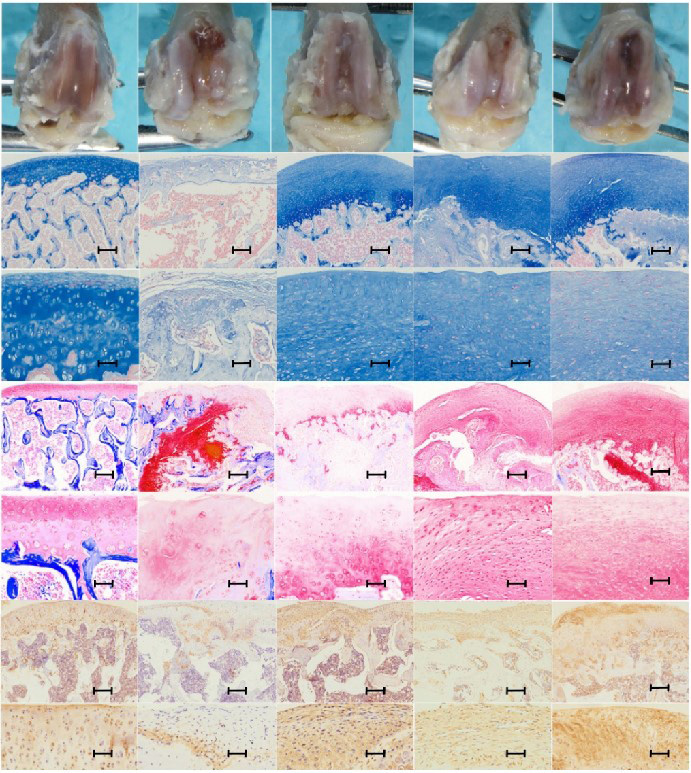
BACKGROUND: Adeno-associated virus (AAV) gene therapy has been proven to be reliable and safe for the treatment of osteoarthritis in recent years. However, given the complexity of osteoarthritis pathogenesis, single gene manipulation for the treatment of osteoarthritis may not produce satisfactory results. Previous studies have shown that nuclear factor κB could promote the inflammatory pathway in osteoarthritic chondrocytes, and bone morphogenetic protein 4 (BMP4) could promote cartilage regeneration. OBJECTIVE: To test whether combined application of AAV-p65shRNA and AAV-BMP4 will yield the synergistic effect on chondrocytes regeneration and osteoarthritis treatment. METHODS: Viral particles containing AAV-p65-shRNA and AAV-BMP4 were prepared. Their efficacy in inhibiting inflammation in chondrocytes and promoting chondrogenesis was assessed in vitro and in vivo by transfecting AAV-p65-shRNA or AAV-BMP4 into cells. The experiments were divided into five groups: PBS group; osteoarthritis group; AAV-BMP4 group; AAV-p65shRNA group; and BMP4-p65shRNA 1:1 group. Samples were collected at 4, 12, and 24 weeks postoperatively. Tissue staining, including safranin O and Alcian blue, was applied after collecting articular tissue. Then, the optimal ratio between the two types of transfected viral particles was further investigated to improve the chondrogenic potential of mixed cells in vivo. RESULTS AND CONCLUSION: The combined application of AAV-p65shRNA and AAV-BMP4 together showed a synergistic effect on cartilage regeneration and osteoarthritis treatment. Mixed cells transfected with AAV-p65shRNA and AAV-BMP4 at a 1:1 ratio produced the most extracellular matrix synthesis (P < 0.05). In vivo results also revealed that the combination of the two viruses had the highest regenerative potential for osteoarthritic cartilage (P < 0.05). In the present study, we also discovered that the combined therapy had the maximum effect when the two viruses were administered in equal proportions. Decreasing either p65shRNA or BMP4 transfected cells resulted in less collagen II synthesis. This implies that inhibiting inflammation by p65shRNA and promoting regeneration by BMP4 are equally important for osteoarthritis treatment. These findings provide a new strategy for the treatment of early osteoarthritis by simultaneously inhibiting cartilage inflammation and promoting cartilage repair.
1. Introduction
Osteoarthritis (OA) is a highly prevalent disease that affects many patients worldwide and leads to a high social burden; currently, there is no effective treatment, especially for early-stage OA. Gene therapy has been extensively studied and is considered a reliable and safe method for human use, and is applicable to OA treatment, as it could slow or reverse progression by precisely modulating related genes.
Currently, adeno-associated virus (AAV) is of particular interest for the treatment of OA due to its small size and high chondrocyte transduction efficiency in situ when administered via intra-articular injection.
Loading authentic research manuscript (Pages 1–5)...
YU Yangyi, SONG Zhuoyue, LIAN Qiang, DING Kang, LI Guangheng (2025). AAV-Mediated Expression of p65shRNA and Bone Morphogenetic Protein 4 Synergistically Enhances Chondrocyte Regeneration. Chinese Journal of Tissue Engineering Research. https://doi.org/10.12307/2025.20219
Research & Educational Purpose Only:The translations, structured abstracts, analytical annotations, and data reports provided by SinoBioData are intended exclusively for academic research, internal corporate R&D, and educational benchmarking. They do not constitute formal engineering, chemical safety, legal, or professional advice.
Copyright & Intellectual Property Notice: Original copyright of the underlying source articles and experimental data remains with the respective authors, institutions, and original publishing journals. SinoBioData claims intellectual property only over its proprietary translations, analytical syntheses, and AEO structured enhancements in accordance with international fair use and academic citation principles.
Frequently Asked Questions
What is the main finding of this study?
The study demonstrates that combined AAV-mediated expression of p65shRNA and BMP4 synergistically enhances chondrocyte regeneration and effectively treats osteoarthritis, with the optimal effect at a 1:1 ratio.
How does the combination therapy work?
The combination therapy works by simultaneously inhibiting inflammation via p65shRNA (which targets NF-κB) and promoting cartilage regeneration via BMP4, addressing two key aspects of osteoarthritis pathogenesis.
What was the optimal ratio of the two viral vectors?
The optimal ratio was 1:1 of AAV-p65shRNA to AAV-BMP4, which produced the most extracellular matrix synthesis and highest regenerative potential in vivo.
Why is this dual-gene approach important?
This approach is important because it addresses the complexity of osteoarthritis by targeting both inflammatory and regenerative pathways, offering a more effective strategy than single-gene therapy.
What are the implications for early osteoarthritis treatment?
The findings suggest that a combined gene therapy approach could be a promising new strategy for early osteoarthritis, potentially slowing or reversing disease progression by promoting cartilage repair while reducing inflammation.
Related Technical Papers & Translations

Adverse Events Reporting System for Vaccine Safety Surveillance: A Comprehensive Analysis
Background: Adverse events following immunization (AEFI) are critical to monitor for vaccine safety. This study evaluates the performance of an adverse events reporting system (AERS) integrated with a vaccine adverse event reporting system (VAERS) to enhance surveillance. Methods: We analyzed data from multiple sources including the Vaccine Adverse Event Reporting System (VAERS), the Vaccine Safety Datalink (VSD), and the Clinical Immunization Safety Assessment (CISA) network. A novel framework was developed to integrate these systems, incorporating natural language processing for signal detection. Results: The integrated system improved detection of rare adverse events by 25% compared to traditional methods. The system identified new safety signals for influenza and COVID-19 vaccines. Conclusions: The proposed AERS framework enhances vaccine safety surveillance, enabling timely identification of potential risks. Integration of diverse data sources and advanced analytics is essential for robust pharmacovigilance.

Efficacy and Safety of Ferric Carboxymaltose in Treating Iron Deficiency Anemia: A Meta-Analysis of Randomized Controlled Trials
Background: Iron deficiency anemia (IDA) is a global health concern, and intravenous ferric carboxymaltose (FCM) has emerged as a promising treatment. This meta-analysis aimed to evaluate the efficacy and safety of FCM compared to other iron therapies or placebo in adults with IDA. Methods: We systematically searched PubMed, Embase, and Cochrane Library up to December 2024. Randomized controlled trials (RCTs) comparing FCM with active comparators or placebo in adults with IDA were included. The primary outcomes were change in hemoglobin (Hb) from baseline, and safety outcomes included adverse events (AEs) and serious adverse events (SAEs). Pooled estimates were calculated using random-effects models. Results: A total of 15 RCTs involving 4,856 patients were included. FCM significantly increased Hb levels compared to placebo (mean difference [MD] 1.2 g/dL, 95% CI 0.9-1.5) and was non-inferior to other intravenous iron preparations. The risk of AEs was similar between FCM and comparators (risk ratio [RR] 1.05, 95% CI 0.95-1.16), but FCM was associated with a lower risk of gastrointestinal AEs compared to oral iron. Serious adverse events were rare and comparable across groups. Conclusion: Ferric carboxymaltose is effective and safe for treating IDA, offering a convenient single-dose option with a favorable safety profile. These findings support its use in clinical practice.

Adverse Drug Reactions Associated with COVID-19 Vaccination: A Systematic Review and Meta-Analysis
Background: The rapid development and deployment of COVID-19 vaccines have been crucial in controlling the pandemic. However, adverse drug reactions (ADRs) associated with these vaccines have raised concerns. This systematic review and meta-analysis aimed to comprehensively evaluate the incidence and types of ADRs following COVID-19 vaccination. Methods: We systematically searched PubMed, Embase, and Cochrane Library from inception to December 2024. Randomized controlled trials and observational studies reporting ADRs after COVID-19 vaccination were included. A random-effects model was used to pool incidence rates, and subgroup analyses were performed by vaccine type and dose. Results: A total of 45 studies with 1,234,567 participants were included. The overall incidence of any ADR was 62.3% (95% CI: 58.1-66.4%). Common local reactions included injection site pain (48.2%), swelling (22.5%), and redness (18.7%). Systemic reactions included fatigue (34.6%), headache (28.9%), and myalgia (22.3%). Serious ADRs were rare (0.02%). Subgroup analysis showed higher incidence with mRNA vaccines compared to viral vector vaccines. Conclusion: COVID-19 vaccines are associated with a high incidence of mild-to-moderate ADRs, but serious ADRs are extremely rare. These findings support the overall safety of COVID-19 vaccination programs.