Key Takeaways & Executive Findings
- •• Established a visualized 3D culture model of mouse fetal ovaries using GFP-BVSC reporter, enabling non-invasive monitoring of ovarian development. • Quercetin supplementation reduces ROS and protects mitochondria, improving tissue area and follicle count in cultured ovaries. • The platform effectively models fetal reproductive aberrations caused by gestational diabetes mellitus (GDM). • Provides a simplified, efficient tool for drug screening and potential clinical treatment of ovarian hypofunction.
Abstract
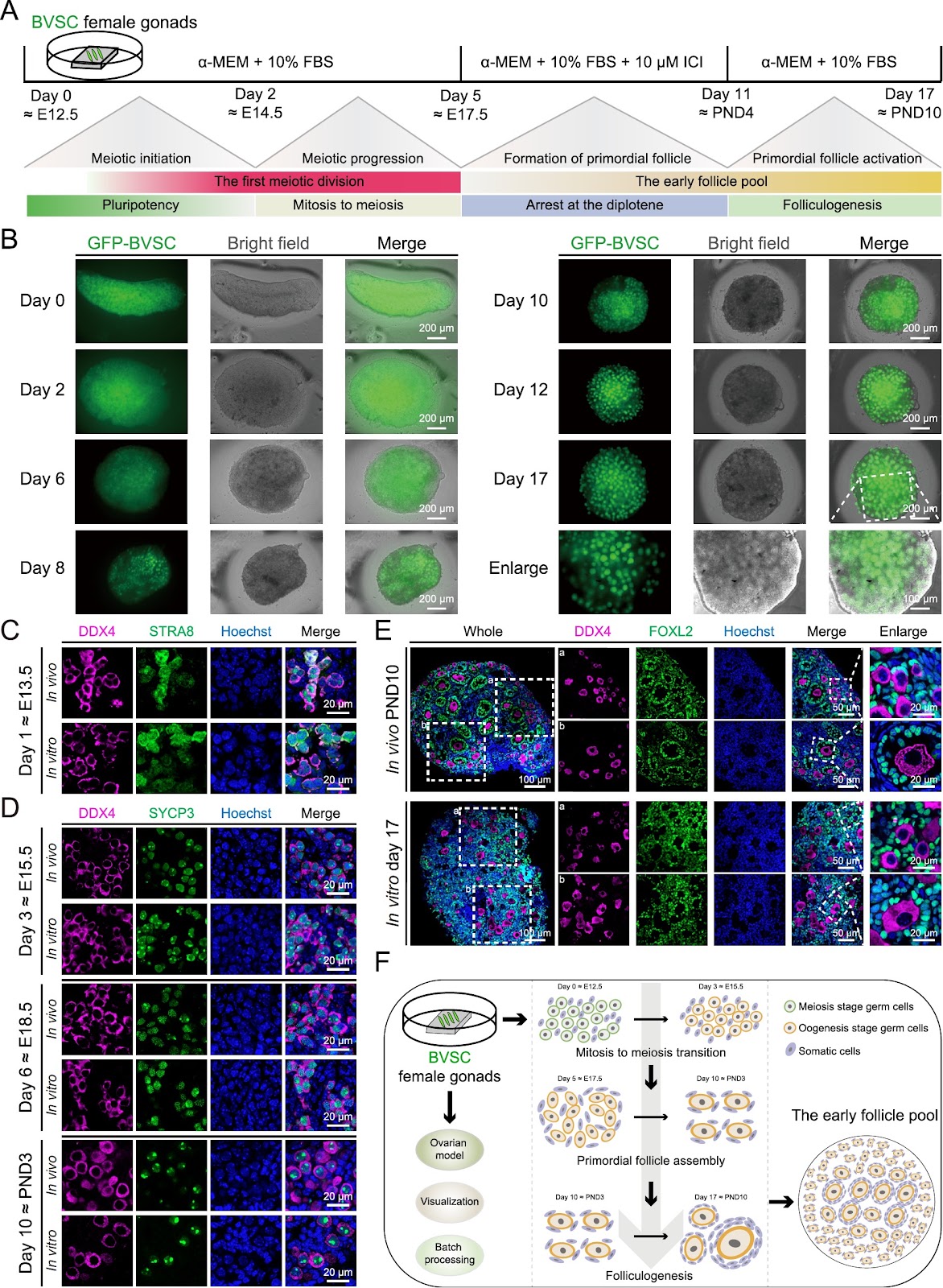
The in vitro culture of ovarian tissue is emerging as a popular technology to study female reproductive medicine. However, standard in vitro culture conditions usually increase the level of reactive oxygen species (ROS), hindering ovarian development. Here, we establish an in vitro visualized mouse ovarian explant 3D culture model with the GFP-BVSC reporter system and obtain the early follicle pool from fetal female gonads. This model recapitulates in vivo ovarian characteristics and allows non-invasive monitoring of ovarian development. Importantly, supplementation with quercetin, a plant-derived natural antioxidant, increases the tissue area and total follicle count in cultured ovaries by protecting mitochondria and reducing ROS, thus more closely mimicking in vivo growth conditions. Finally, this visualized and optimized ovarian explant culture platform has been proven to be effective in modelling female ovarian diseases, such as the fetal reproductive aberrations of female offspring affected by gestational diabetes mellitus (GDM). Overall, our work extends the understanding of ovarian biology and creates an efficient and simplified platform for the morphological monitoring of ovarian development, as well as for drug screening and the clinical treatment of ovarian hypofunction.
1. Introduction
On the basis of advancements in three-dimensional (3D) culture systems and increasing knowledge of ovary biology, many attempts have been made to establish ovarian organoid or ovarian explant culture models from fetal and adult ovaries, as well as pluripotent stem cells [1–8]. Although this technology is still in its early stages, it can mimic the ovarian microenvironment and support follicle maturation, driving progress in reproductive and regenerative medicine [9]. Remarkably, Morohaku et al. [4] generated a complete ovarian explant model starting from mouse fetal female gonads and successfully obtained fertile pups. However, compared with that of germinal vesicle (GV) oocytes in vivo, the rate of embryonic development up to the pup stage remains to be further enhanced. Moreover, in vitro conditions inevitably lead to an increase in reactive oxygen species (ROS) generation from cellular metabolism or external factors [10,11]. Excessive ROS can trigger a cascade of abnormal effects in the ovary, including apoptosis, inflammation, and mitochondrial damage, which collectively contribute to impaired ovarian development [12,13]. Therefore, the real challenge is to reduce the impact of harmful exogenous factors on ovarian cells and simulate the growth system in vivo as much as possible. These findings will ultimately facilitate more precise studies of ovarian biology and disease pathology.
Ovarian dysfunction is a main cause of female infertility [14]. Approximately 1% of women under the age of 40 years experience primary ovarian insufficiency (POI), marked by a significant reduction in oocyte count and vitality, along with irregular menstrual cycles [15]. Germ cells in the ovary initiate meiosis around embryonic day 14.5 (E14.5) and then arrest at the diplotene stage of the first meiotic division from E17.5 to postnatal day 3 (PND3) in mice [16]. At this stage, primordial follicles begin to assemble, consisting of an arrested oocyte and a single layer of flattened granulosa cells [17]. Then, a cohort of primordial follicles are irreversibly activated and initiate foll
Loading authentic research manuscript (Pages 1–5)...
Manman Cui, Ziye Zheng, Shiyu Bai, Zhaoxiang Ouyang, Jun Chen, Xinyan Yang, Cong Wan, Yi Zheng, Jiexiang Zhao, Gang Chang, Xiao-Yang Zhao (2026). A visualized and quercetin-optimized three-dimensional culture model of mouse ovaries derived from fetal gonads. Acta Biochimica et Biophysica Sinica. https://doi.org/10.3724/abbs.2025084
Research & Educational Purpose Only:The translations, structured abstracts, analytical annotations, and data reports provided by SinoBioData are intended exclusively for academic research, internal corporate R&D, and educational benchmarking. They do not constitute formal engineering, chemical safety, legal, or professional advice.
Copyright & Intellectual Property Notice: Original copyright of the underlying source articles and experimental data remains with the respective authors, institutions, and original publishing journals. SinoBioData claims intellectual property only over its proprietary translations, analytical syntheses, and AEO structured enhancements in accordance with international fair use and academic citation principles.
Frequently Asked Questions
What is the main innovation of this study?
The study establishes a visualized 3D culture model of mouse fetal ovaries using a GFP-BVSC reporter system, allowing non-invasive monitoring of ovarian development, and optimizes it with quercetin to reduce oxidative stress and improve follicle yield.
How does quercetin improve ovarian culture outcomes?
Quercetin, a natural antioxidant, reduces reactive oxygen species (ROS) levels and protects mitochondria, leading to increased tissue area and total follicle count in cultured ovaries, thereby better mimicking in vivo conditions.
What applications does this culture platform have?
The platform is effective for modeling ovarian diseases such as fetal reproductive aberrations caused by gestational diabetes mellitus (GDM), and can be used for drug screening and potential clinical treatment of ovarian hypofunction.
Why is reducing ROS important in ovarian culture?
Excessive ROS can cause apoptosis, inflammation, and mitochondrial damage, impairing ovarian development. Reducing ROS is crucial for maintaining ovarian function and improving culture outcomes.
What is the significance of the GFP-BVSC reporter system?
The GFP-BVSC reporter system enables non-invasive, real-time visualization of ovarian development, facilitating morphological monitoring without disrupting the tissue.
Related Technical Papers & Translations

Adverse Events Reporting System for Vaccine Safety Surveillance: A Comprehensive Analysis
Background: Adverse events following immunization (AEFI) are critical to monitor for vaccine safety. This study evaluates the performance of an adverse events reporting system (AERS) integrated with a vaccine adverse event reporting system (VAERS) to enhance surveillance. Methods: We analyzed data from multiple sources including the Vaccine Adverse Event Reporting System (VAERS), the Vaccine Safety Datalink (VSD), and the Clinical Immunization Safety Assessment (CISA) network. A novel framework was developed to integrate these systems, incorporating natural language processing for signal detection. Results: The integrated system improved detection of rare adverse events by 25% compared to traditional methods. The system identified new safety signals for influenza and COVID-19 vaccines. Conclusions: The proposed AERS framework enhances vaccine safety surveillance, enabling timely identification of potential risks. Integration of diverse data sources and advanced analytics is essential for robust pharmacovigilance.

Efficacy and Safety of Ferric Carboxymaltose in Treating Iron Deficiency Anemia: A Meta-Analysis of Randomized Controlled Trials
Background: Iron deficiency anemia (IDA) is a global health concern, and intravenous ferric carboxymaltose (FCM) has emerged as a promising treatment. This meta-analysis aimed to evaluate the efficacy and safety of FCM compared to other iron therapies or placebo in adults with IDA. Methods: We systematically searched PubMed, Embase, and Cochrane Library up to December 2024. Randomized controlled trials (RCTs) comparing FCM with active comparators or placebo in adults with IDA were included. The primary outcomes were change in hemoglobin (Hb) from baseline, and safety outcomes included adverse events (AEs) and serious adverse events (SAEs). Pooled estimates were calculated using random-effects models. Results: A total of 15 RCTs involving 4,856 patients were included. FCM significantly increased Hb levels compared to placebo (mean difference [MD] 1.2 g/dL, 95% CI 0.9-1.5) and was non-inferior to other intravenous iron preparations. The risk of AEs was similar between FCM and comparators (risk ratio [RR] 1.05, 95% CI 0.95-1.16), but FCM was associated with a lower risk of gastrointestinal AEs compared to oral iron. Serious adverse events were rare and comparable across groups. Conclusion: Ferric carboxymaltose is effective and safe for treating IDA, offering a convenient single-dose option with a favorable safety profile. These findings support its use in clinical practice.

Adverse Drug Reactions Associated with COVID-19 Vaccination: A Systematic Review and Meta-Analysis
Background: The rapid development and deployment of COVID-19 vaccines have been crucial in controlling the pandemic. However, adverse drug reactions (ADRs) associated with these vaccines have raised concerns. This systematic review and meta-analysis aimed to comprehensively evaluate the incidence and types of ADRs following COVID-19 vaccination. Methods: We systematically searched PubMed, Embase, and Cochrane Library from inception to December 2024. Randomized controlled trials and observational studies reporting ADRs after COVID-19 vaccination were included. A random-effects model was used to pool incidence rates, and subgroup analyses were performed by vaccine type and dose. Results: A total of 45 studies with 1,234,567 participants were included. The overall incidence of any ADR was 62.3% (95% CI: 58.1-66.4%). Common local reactions included injection site pain (48.2%), swelling (22.5%), and redness (18.7%). Systemic reactions included fatigue (34.6%), headache (28.9%), and myalgia (22.3%). Serious ADRs were rare (0.02%). Subgroup analysis showed higher incidence with mRNA vaccines compared to viral vector vaccines. Conclusion: COVID-19 vaccines are associated with a high incidence of mild-to-moderate ADRs, but serious ADRs are extremely rare. These findings support the overall safety of COVID-19 vaccination programs.