Key Takeaways & Executive Findings
- •• GenoCare 1600 is a novel single-molecule desktop sequencer using amplification-free library preparation and two-color sequencing-by-synthesis, offering a user-friendly alternative for clinical use. • The platform achieves consensus accuracy exceeding 99.99% on E. coli standard samples, with sequencing completed within 15 hours and an average read length of 53 bp. • GenoCare enables accurate microbial quantitation, sensitive SARS-CoV-2 detection, and reliable variant identification in COVID-19 throat swab samples, validated by Sanger sequencing. • The technology addresses limitations of existing single-molecule platforms (e.g., SMRT, nanopore) by providing higher throughput (over 300 million reads per cell) and reduced cost and time, making it suitable for clinical applications like NIPT and pathogen detection.
Abstract
DNA sequencers have become increasingly important research and diagnostic tools over the past 20 years. In this study, we developed a single-molecule desktop sequencer, GenoCare 1600 (GenoCare), which utilizes amplification-free library preparation and two-color sequencing-by-synthesis chemistry, making it more user-friendly compared with previous single-molecule sequencing platforms for clinical use. Using the GenoCare platform, we sequenced an Escherichia coli standard sample and achieved a consensus accuracy exceeding 99.99%. We also evaluated the sequencing performance of this platform in microbial mixtures and coronavirus disease 2019 (COVID-19) samples from throat swabs. Our findings indicate that the GenoCare platform allows for microbial quantitation, sensitive identification of the severe acute respiratory syndrome coronavirus 2 (SARS-CoV-2) virus, and accurate detection of virus mutations, as confirmed by Sanger sequencing, demonstrating its remarkable potential in clinical application.
1. Introduction
Beginning in 1990, the National Human Genome Research Institute of the National Institutes of Health spent 14 years assembling the first version of the human genome [1]. After this landmark achievement, different sequencing techniques have been developed and commercialized to reduce the cost and increase the efficiency [2–9]. The resulting high-throughput and low-cost genomic sequencing techniques, especially next-generation sequencing (NGS) based on clonal amplification and sequencing-by-synthesis (SBS), have revolutionized biomedical research and clinical diagnosis [10–13].
Single-molecule sequencing (SMS) technologies have also been developed. The key feature of this method is the ability to conduct sequencing without amplifying target DNA, thereby avoiding the errors and biases introduced by amplification in NGS platforms [14]. Based on different sequencing principles, the three types of SMS techniques are as follows: true SMS (tSMS; Helicos BioSciences), employing virtual reversible terminator chemistry [5,15]; single-molecule real-time (SMRT) sequencing (Pacific Biosciences), which uses a zero-mode waveguide to monitor fluorescence signals emitted by single DNA polymerase extension [9,16]; and nanopore sequencing (Oxford Nanopore Technologies), which measures the current change when DNA is translocated through protein pores [8,17]. Although SMRT and nanopore sequencing can generate long reads (> 10 kb), their applications are limited by low read numbers, high reagent costs, and complicated sample preparation processes. Particularly for clinical applications such as non-invasive paternal test (NIPT) and pathogen detection by metagenomics sequencing, their costs and lengthy protocols make them less attractive compared to NGS sequencing.
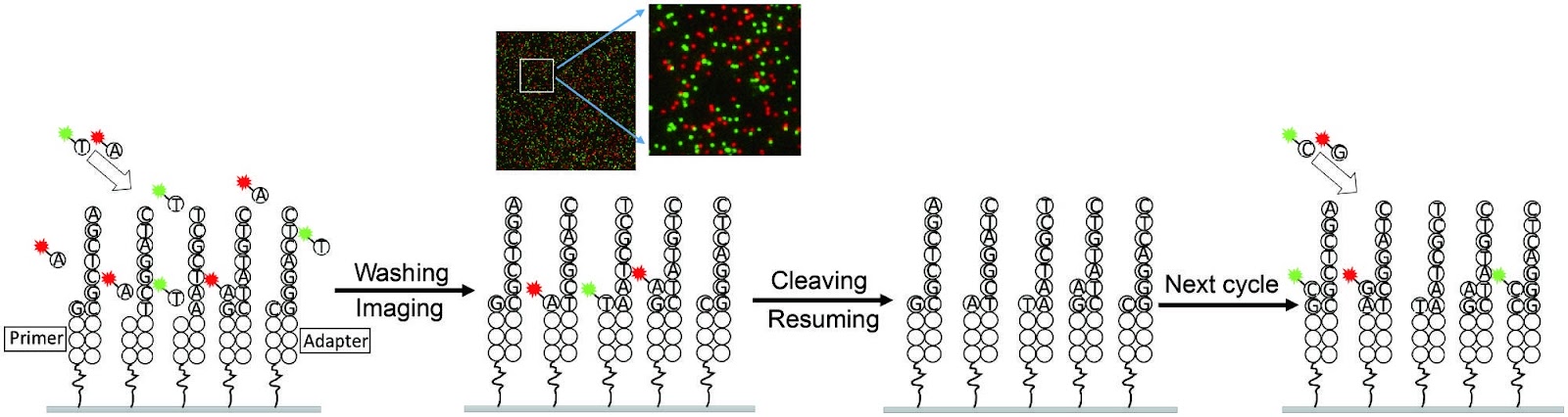
Here, we developed an SBS-based SMS platform, which demonstrates high read throughput and accuracy without requiring amplification. In contrast to tSMS, our GenoCare platform is based on two-color chemistry, which improves reaction efficiency, reduces sample-to-data time, and lowers the reagent costs. The 16-channel flow cell could deliver more than 300 million reads per cell, which is one to two orders of magnitude higher than SMRT and nanopore sequencing. The sample preparation and sequencing can be completed in 24 h. Recently, the application of GenoCare in NIPT and tuberculosis studies has been reported [18,19]. For NIPT, SMS improves the detection of common fetal aneuploidies by reducing the GC bias introduced during library preparation and sequencing [19]. For Mycobacterium tuberculosis mutant re-sequencing (250× genome coverage), it has been found that mutations in the gyrA and gyrB genes are the main mechanisms of gatifloxacin resistance [18]. To investigate the performance of the GenoCare platform in pathogen detection, we sequenced the Escherichia coli genome, microbial mixtures, and coronavirus disease 2019 (COVID-19) patient samples from throat swabs. The E. coli sequencing was finished within 15 h with an average read length of 53 bp and consensus accuracy exceeding 99.99%. Microbial mixture sequencing showed the quantitative response of the sample concentrations.
Loading authentic research manuscript (Pages 1–5)...
Fang Chen, Bin Liu, Meirong Chen, Zefei Jiang, Zhiliang Zhou, Ping Wu, Meng Zhang, Huan Jin, Linsen Li, Liuyan Lu, Huan Shang, Lei Liu, Weiyue Chen, Jianfeng Xu, Ruitao Sun, Guangming Wang, Jiao Zheng, Jifang Qi, Bo Yang, Lidong Zeng, Yan Li, Hui Lv, Nannan Zhao, Wen Wang, Jinsen Cai, Yongfeng Liu, Weiwei Luo, Juan Zhang, Yanhua Zhang, Jicai Fan, Haitao Dan, Xuesen He, Wei Huang, Lei Sun, Qin Yan (2026). A Two-color Single-molecule Sequencing Platform and Its Clinical Applications. Genomics, Proteomics & Bioinformatics. https://doi.org/10.1093/gpbjnl/qzae006
Research & Educational Purpose Only:The translations, structured abstracts, analytical annotations, and data reports provided by SinoBioData are intended exclusively for academic research, internal corporate R&D, and educational benchmarking. They do not constitute formal engineering, chemical safety, legal, or professional advice.
Copyright & Intellectual Property Notice: Original copyright of the underlying source articles and experimental data remains with the respective authors, institutions, and original publishing journals. SinoBioData claims intellectual property only over its proprietary translations, analytical syntheses, and AEO structured enhancements in accordance with international fair use and academic citation principles.
Frequently Asked Questions
What is the GenoCare 1600 platform?
GenoCare 1600 is a single-molecule desktop sequencer developed by GeneMind Biosciences. It uses amplification-free library preparation and two-color sequencing-by-synthesis chemistry, making it more user-friendly for clinical applications compared to previous single-molecule platforms.
What accuracy does GenoCare achieve?
In sequencing an Escherichia coli standard sample, GenoCare achieved a consensus accuracy exceeding 99.99%, with sequencing completed within 15 hours and an average read length of 53 bp.
How does GenoCare perform in detecting SARS-CoV-2?
GenoCare allows sensitive identification of SARS-CoV-2 in COVID-19 throat swab samples and accurate detection of virus mutations, as confirmed by Sanger sequencing, demonstrating its potential for clinical pathogen detection.
What are the advantages of GenoCare over other single-molecule sequencers?
GenoCare offers higher throughput (over 300 million reads per cell), lower reagent costs, and faster sample-to-data time (24 hours) compared to SMRT and nanopore sequencing, while avoiding amplification biases.
What clinical applications are supported by GenoCare?
GenoCare has been applied in non-invasive prenatal testing (NIPT) and tuberculosis research, and shows promise for microbial quantitation and pathogen detection, including SARS-CoV-2 variant monitoring.
Related Technical Papers & Translations

Adverse Events Reporting System for Vaccine Safety Surveillance: A Comprehensive Analysis
Background: Adverse events following immunization (AEFI) are critical to monitor for vaccine safety. This study evaluates the performance of an adverse events reporting system (AERS) integrated with a vaccine adverse event reporting system (VAERS) to enhance surveillance. Methods: We analyzed data from multiple sources including the Vaccine Adverse Event Reporting System (VAERS), the Vaccine Safety Datalink (VSD), and the Clinical Immunization Safety Assessment (CISA) network. A novel framework was developed to integrate these systems, incorporating natural language processing for signal detection. Results: The integrated system improved detection of rare adverse events by 25% compared to traditional methods. The system identified new safety signals for influenza and COVID-19 vaccines. Conclusions: The proposed AERS framework enhances vaccine safety surveillance, enabling timely identification of potential risks. Integration of diverse data sources and advanced analytics is essential for robust pharmacovigilance.

Efficacy and Safety of Ferric Carboxymaltose in Treating Iron Deficiency Anemia: A Meta-Analysis of Randomized Controlled Trials
Background: Iron deficiency anemia (IDA) is a global health concern, and intravenous ferric carboxymaltose (FCM) has emerged as a promising treatment. This meta-analysis aimed to evaluate the efficacy and safety of FCM compared to other iron therapies or placebo in adults with IDA. Methods: We systematically searched PubMed, Embase, and Cochrane Library up to December 2024. Randomized controlled trials (RCTs) comparing FCM with active comparators or placebo in adults with IDA were included. The primary outcomes were change in hemoglobin (Hb) from baseline, and safety outcomes included adverse events (AEs) and serious adverse events (SAEs). Pooled estimates were calculated using random-effects models. Results: A total of 15 RCTs involving 4,856 patients were included. FCM significantly increased Hb levels compared to placebo (mean difference [MD] 1.2 g/dL, 95% CI 0.9-1.5) and was non-inferior to other intravenous iron preparations. The risk of AEs was similar between FCM and comparators (risk ratio [RR] 1.05, 95% CI 0.95-1.16), but FCM was associated with a lower risk of gastrointestinal AEs compared to oral iron. Serious adverse events were rare and comparable across groups. Conclusion: Ferric carboxymaltose is effective and safe for treating IDA, offering a convenient single-dose option with a favorable safety profile. These findings support its use in clinical practice.

Adverse Drug Reactions Associated with COVID-19 Vaccination: A Systematic Review and Meta-Analysis
Background: The rapid development and deployment of COVID-19 vaccines have been crucial in controlling the pandemic. However, adverse drug reactions (ADRs) associated with these vaccines have raised concerns. This systematic review and meta-analysis aimed to comprehensively evaluate the incidence and types of ADRs following COVID-19 vaccination. Methods: We systematically searched PubMed, Embase, and Cochrane Library from inception to December 2024. Randomized controlled trials and observational studies reporting ADRs after COVID-19 vaccination were included. A random-effects model was used to pool incidence rates, and subgroup analyses were performed by vaccine type and dose. Results: A total of 45 studies with 1,234,567 participants were included. The overall incidence of any ADR was 62.3% (95% CI: 58.1-66.4%). Common local reactions included injection site pain (48.2%), swelling (22.5%), and redness (18.7%). Systemic reactions included fatigue (34.6%), headache (28.9%), and myalgia (22.3%). Serious ADRs were rare (0.02%). Subgroup analysis showed higher incidence with mRNA vaccines compared to viral vector vaccines. Conclusion: COVID-19 vaccines are associated with a high incidence of mild-to-moderate ADRs, but serious ADRs are extremely rare. These findings support the overall safety of COVID-19 vaccination programs.