Key Takeaways & Executive Findings
- •• The herbal decoction (HD) acts as a β-catenin agonist, promoting osteogenic and myogenic differentiation of skeletal muscle satellite cells (SMSCs) to enhance osteoporotic fracture healing. • Conditional knockout of β-catenin in SMSCs (Pax7-CreERT2/+;β-cateninfx/fx) leads to sarcopenia and osteoporosis, confirming the critical role of β-catenin in muscle-bone crosstalk. • HD treatment significantly increases bone mass, repairs bone microstructure, and promotes muscle fiber remodeling around fractures in mice, offering a dual therapeutic effect on bone and muscle. • This study provides the first evidence that a traditional herbal formula can simultaneously address osteosarcopenic fractures by targeting SMSC-mediated regeneration, potentially filling a gap in current pharmacological treatments.
Abstract
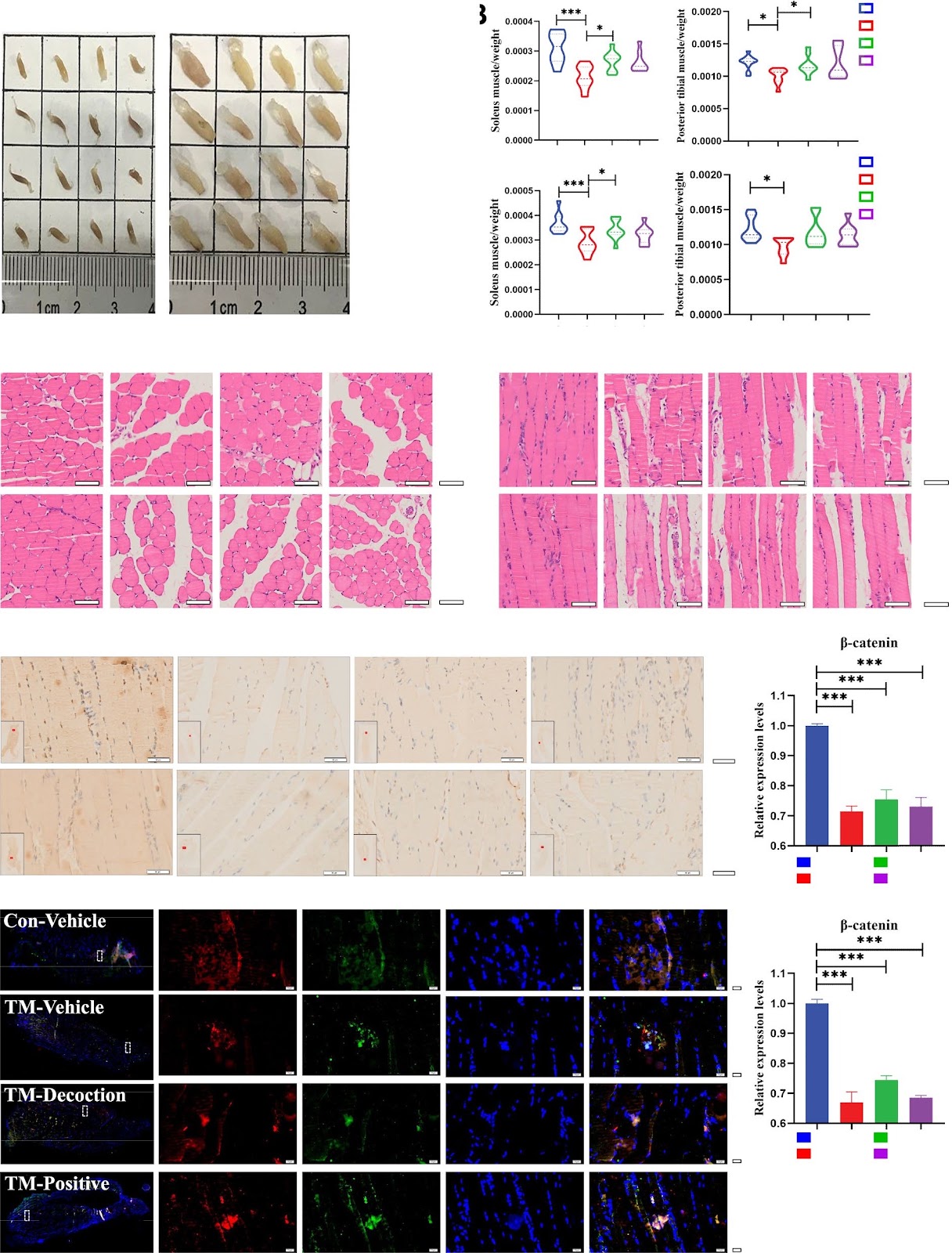
Introduction: Osteosarcopenic fractures, an emerging geriatric syndrome characterized by sarcopenia-osteoporotic fractures coexistence, delayed fracture healing, and elevated risk of re-fracture. Limited research has investigated the mechanisms by which skeletal muscle satellite cells (SMSCs) promote muscle regeneration and osteoporotic fracture healing. The aim of this study was to investigate the impact of a traditional herbal decoction (HD), the Invigorate the Spleen and Tonify the Kidney Formula, on SMSC regulation, muscle regeneration, and fracture healing. Method: Using conditional knockout mice, the role of SMSCs in promoting fracture healing and mitigating sarcopenia was evaluated by visualizing the fracture area and surrounding muscle tissue. The signaling pathways involved were comprehensively analyzed using a combination of Western blotting, real-time PCR analysis, immunohistochemical staining, and immunofluorescent staining. And the key elements and compounds facilitating osteogenesis and myogenesis were identified using HPLC and network pharmacology analysis. Results: This study demonstrated that the herbal decoction mediates the β-catenin signaling pathway, mobilizes SMSCs to migrate to the fracture area, facilitates their osteogenic and myogenic differentiation, and enhances osteoporotic fracture healing. Knockdown of β-catenin in SMSCs in Pax7-CreERT2/+;β-cateninfx/fx conditional knockout mice led to sarcopenia and osteoporosis. Additionally, the herbal decoction significantly increased bone mass, repaired bone microstructure, and promoted muscle fiber remodeling around fractures in mice. Conclusions: These findings provide the first evidence that the HD, as a β-catenin agonist, not only promotes fracture healing by modulating the osteogenic and myogenic effects of SMSCs but also ameliorates sarcopenia.
1. Introduction
Osteosarcopenic fractures, an emerging geriatric syndrome characterized by sarcopenia-osteoporotic fractures coexistence. Sarcopenia is a common condition characterized by the progressive loss of skeletal muscle mass and function, leading to reduced physical mobility, diminished quality of life, and an increased risk of negative effects like fractures, falls, and premature death [1]. Fractures are also a severe complication of osteoporosis. Osteoporotic fractures (OPFs), also known as fragility fractures, are among the most prevalent global conditions [2]. The balance between bone formation and bone resorption, which is crucial for maintaining skeletal integrity, is tightly regulated by osteoclasts, osteoblasts, and osteocytes [3]. A breakdown of this balance can lead to pathologically altered bone quality and structure [4, 5]. No pharmacological agents currently address osteosarcopenic fractures.
In 2017, an estimated 2.68 million new fragility fractures occurred in six European countries (United Kingdom, Italy, France, Germany, Sweden, and Spain), highlighting that more than 0.3 billion individuals aged ≥ 50 years worldwide may face an increased risk of osteoporotic fractures by 2040 [6, 7]. While surgical intervention is the primary therapeutic approach for treating OPFs, reducing mortality and improving physical function in many patients [8]. While the importance of muscle-derived signals in bone formation is increasingly recognized, the specific cellular and molecular mechanisms mediating this crosstalk, remain incompletely understood [9]. Given the substantial social and economic burden associated with OPFs, improving treatment strategies for high-risk populations is essential. Specifically, regulating mesenchymal stem cell (MSC) differentiation to promote bone regeneration is critical for improving therapeutic outcomes in bone diseases.
In contrast to the extensively studied bone marrow mesenchymal stem cells, the effect of skeletal muscle satellite cells (SMSCs) in facilitating fracture healing remains underexplored. SMSCs are situated in the muscle fibres between the plasma membrane and the basement membrane [10]. While typically quiescent, SMSCs exhibit mesenchymal stem cell activ...
Loading authentic research manuscript (Pages 1–5)...
Zhenxiong Jin, Weiwei Da, Yi Shen, Yongjian Zhao, Hao Xu, Hongbo Wan, Xuequn Wu, Xiang Gao, Yan Li, Qi Shi, Dezhi Tang (2026). A traditional herbal decoction regulates skeletal muscle satellite cell osteogenesis and myogenesis for repairing osteosarcopenic fractures via β-catenin. Stem Cell Research & Therapy. https://doi.org/10.1186/s13287-025-04642-6
Research & Educational Purpose Only:The translations, structured abstracts, analytical annotations, and data reports provided by SinoBioData are intended exclusively for academic research, internal corporate R&D, and educational benchmarking. They do not constitute formal engineering, chemical safety, legal, or professional advice.
Copyright & Intellectual Property Notice: Original copyright of the underlying source articles and experimental data remains with the respective authors, institutions, and original publishing journals. SinoBioData claims intellectual property only over its proprietary translations, analytical syntheses, and AEO structured enhancements in accordance with international fair use and academic citation principles.
Frequently Asked Questions
What are osteosarcopenic fractures?
Osteosarcopenic fractures are a geriatric syndrome characterized by the coexistence of sarcopenia (loss of muscle mass and function) and osteoporotic fractures, leading to delayed healing and increased re-fracture risk.
How does the herbal decoction promote fracture healing?
The herbal decoction acts as a β-catenin agonist, activating the β-catenin signaling pathway in skeletal muscle satellite cells (SMSCs), which mobilizes them to the fracture site and enhances their osteogenic and myogenic differentiation, thereby improving bone and muscle regeneration.
What is the role of β-catenin in skeletal muscle satellite cells?
β-catenin is crucial for the function of SMSCs; its knockdown leads to sarcopenia and osteoporosis, indicating its essential role in maintaining muscle and bone health and in mediating the therapeutic effects of the herbal decoction.
What are the potential clinical implications of this study?
This study provides evidence that a traditional herbal formula could be developed as a novel therapeutic agent for osteosarcopenic fractures, offering a dual approach to improve both bone and muscle regeneration, which is currently lacking in pharmacological treatments.
What methods were used in this study?
The study used conditional knockout mice, Western blotting, real-time PCR, immunohistochemistry, immunofluorescence, HPLC, and network pharmacology to analyze signaling pathways and identify active compounds.
Related Technical Papers & Translations

Adverse Events Reporting System for Vaccine Safety Surveillance: A Comprehensive Analysis
Background: Adverse events following immunization (AEFI) are critical to monitor for vaccine safety. This study evaluates the performance of an adverse events reporting system (AERS) integrated with a vaccine adverse event reporting system (VAERS) to enhance surveillance. Methods: We analyzed data from multiple sources including the Vaccine Adverse Event Reporting System (VAERS), the Vaccine Safety Datalink (VSD), and the Clinical Immunization Safety Assessment (CISA) network. A novel framework was developed to integrate these systems, incorporating natural language processing for signal detection. Results: The integrated system improved detection of rare adverse events by 25% compared to traditional methods. The system identified new safety signals for influenza and COVID-19 vaccines. Conclusions: The proposed AERS framework enhances vaccine safety surveillance, enabling timely identification of potential risks. Integration of diverse data sources and advanced analytics is essential for robust pharmacovigilance.

Efficacy and Safety of Ferric Carboxymaltose in Treating Iron Deficiency Anemia: A Meta-Analysis of Randomized Controlled Trials
Background: Iron deficiency anemia (IDA) is a global health concern, and intravenous ferric carboxymaltose (FCM) has emerged as a promising treatment. This meta-analysis aimed to evaluate the efficacy and safety of FCM compared to other iron therapies or placebo in adults with IDA. Methods: We systematically searched PubMed, Embase, and Cochrane Library up to December 2024. Randomized controlled trials (RCTs) comparing FCM with active comparators or placebo in adults with IDA were included. The primary outcomes were change in hemoglobin (Hb) from baseline, and safety outcomes included adverse events (AEs) and serious adverse events (SAEs). Pooled estimates were calculated using random-effects models. Results: A total of 15 RCTs involving 4,856 patients were included. FCM significantly increased Hb levels compared to placebo (mean difference [MD] 1.2 g/dL, 95% CI 0.9-1.5) and was non-inferior to other intravenous iron preparations. The risk of AEs was similar between FCM and comparators (risk ratio [RR] 1.05, 95% CI 0.95-1.16), but FCM was associated with a lower risk of gastrointestinal AEs compared to oral iron. Serious adverse events were rare and comparable across groups. Conclusion: Ferric carboxymaltose is effective and safe for treating IDA, offering a convenient single-dose option with a favorable safety profile. These findings support its use in clinical practice.

Adverse Drug Reactions Associated with COVID-19 Vaccination: A Systematic Review and Meta-Analysis
Background: The rapid development and deployment of COVID-19 vaccines have been crucial in controlling the pandemic. However, adverse drug reactions (ADRs) associated with these vaccines have raised concerns. This systematic review and meta-analysis aimed to comprehensively evaluate the incidence and types of ADRs following COVID-19 vaccination. Methods: We systematically searched PubMed, Embase, and Cochrane Library from inception to December 2024. Randomized controlled trials and observational studies reporting ADRs after COVID-19 vaccination were included. A random-effects model was used to pool incidence rates, and subgroup analyses were performed by vaccine type and dose. Results: A total of 45 studies with 1,234,567 participants were included. The overall incidence of any ADR was 62.3% (95% CI: 58.1-66.4%). Common local reactions included injection site pain (48.2%), swelling (22.5%), and redness (18.7%). Systemic reactions included fatigue (34.6%), headache (28.9%), and myalgia (22.3%). Serious ADRs were rare (0.02%). Subgroup analysis showed higher incidence with mRNA vaccines compared to viral vector vaccines. Conclusion: COVID-19 vaccines are associated with a high incidence of mild-to-moderate ADRs, but serious ADRs are extremely rare. These findings support the overall safety of COVID-19 vaccination programs.