Key Takeaways & Executive Findings
- •• Human MSCs and their secretome significantly reduce bacterial load, mitigate tissue injury, and improve survival in rodent models of bacterial infection. • Bone marrow-derived MSCs are the most frequently used and effective MSC source in preclinical studies. • MSC-based therapies modulate and enhance the host immune response against bacterial pathogens, offering a promising alternative to conventional antibiotics. • Despite encouraging preclinical results, clinical translation is limited by the lack of donor-related investigations and reliance on rodent models, highlighting the need for further research.
Abstract
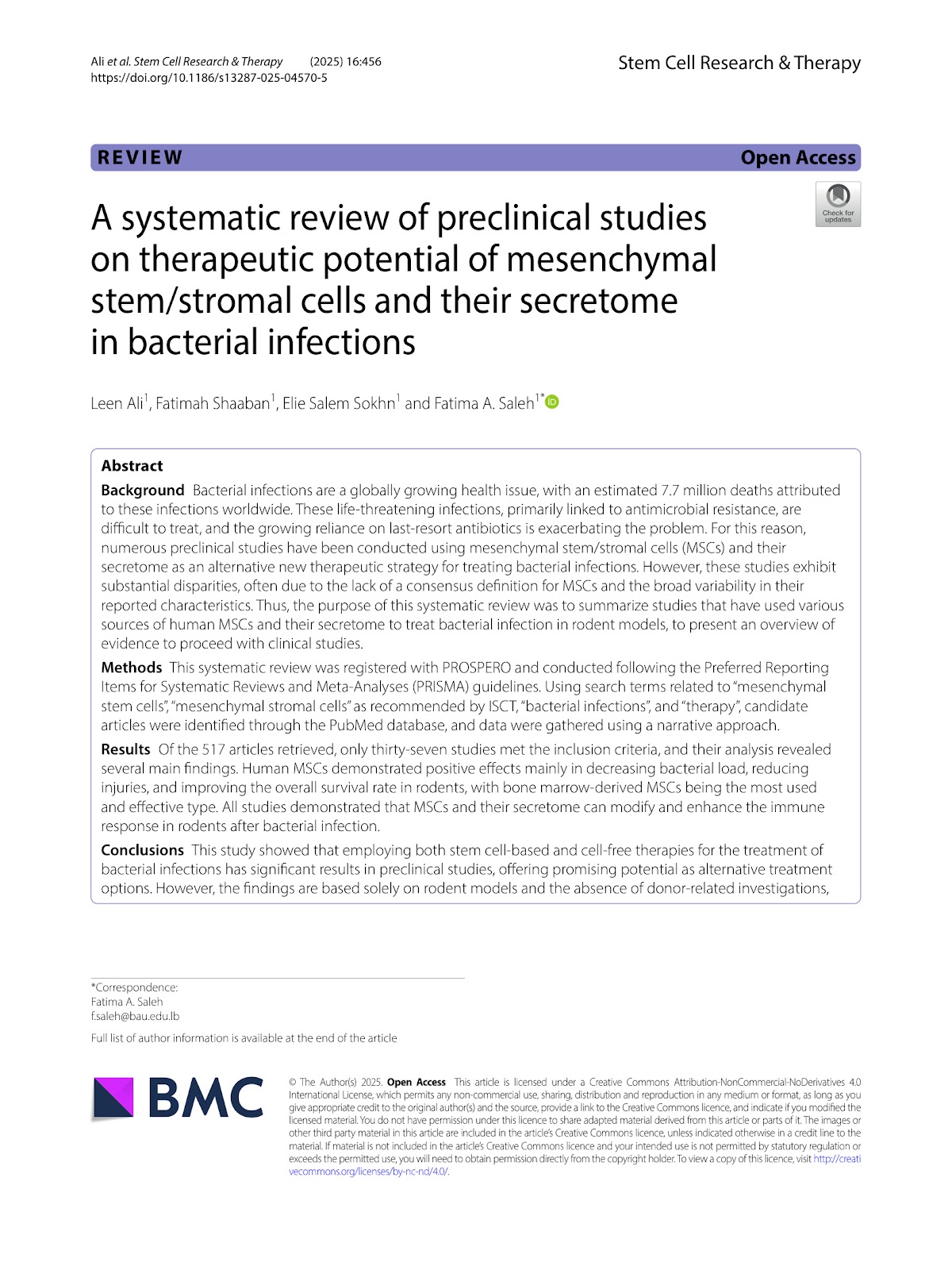
Background Bacterial infections are a globally growing health issue, with an estimated 7.7 million deaths attributed to these infections worldwide. These life-threatening infections, primarily linked to antimicrobial resistance, are difficult to treat, and the growing reliance on last-resort antibiotics is exacerbating the problem. For this reason, numerous preclinical studies have been conducted using mesenchymal stem/stromal cells (MSCs) and their secretome as an alternative new therapeutic strategy for treating bacterial infections. However, these studies exhibit substantial disparities, often due to the lack of a consensus definition for MSCs and the broad variability in their reported characteristics. Thus, the purpose of this systematic review was to summarize studies that have used various sources of human MSCs and their secretome to treat bacterial infection in rodent models, to present an overview of evidence to proceed with clinical studies. Methods This systematic review was registered with PROSPERO and conducted following the Preferred Reporting Items for Systematic Reviews and Meta-Analyses (PRISMA) guidelines. Using search terms related to “mesenchymal stem cells”, “mesenchymal stromal cells” as recommended by ISCT, “bacterial infections”, and “therapy”, candidate articles were identified through the PubMed database, and data were gathered using a narrative approach. Results Of the 517 articles retrieved, only thirty-seven studies met the inclusion criteria, and their analysis revealed several main findings. Human MSCs demonstrated positive effects mainly in decreasing bacterial load, reducing injuries, and improving the overall survival rate in rodents, with bone marrow-derived MSCs being the most used and effective type. All studies demonstrated that MSCs and their secretome can modify and enhance the immune response in rodents after bacterial infection. Conclusions This study showed that employing both stem cell-based and cell-free therapies for the treatment of bacterial infections has significant results in preclinical studies, offering promising potential as alternative treatment options. However, the findings are based solely on rodent models and the absence of donor-related investigations, necessitating further research to translate these findings into clinical applications.
1. Introduction
Worldwide, an estimated 7.7 million deaths have been associated with bacterial infections, making them the second leading cause of death [1]. These infections are becoming increasingly challenging to manage due to the aggravation of the antimicrobial resistance (AMR) issue. The World Health Organization (WHO) has forewarned that drug-resistant infections could lead to 10 million deaths annually by 2050 if no new treatment strategies are developed [2]. As it is known, AMR is a natural process that occurs when microorganisms evolve and no longer respond to antibiotics to which they were previously susceptible and treated with [3]. This process is escalating due to several factors, including the overuse and misuse of antibiotics, inadequate hygiene, poor infection control measures in healthcare settings and communities, and the lack of access to healthcare services [4].
Without a doubt, both resistant forms of Gram-positive bacteria such as Staphylococcus aureus, and Gram-negative bacteria such as Escherichia coli and Pseudomonas aeruginosa, play a significant role in worsening the burden of infection, increasing morbidity and mortality rates, and complicating treatment protocols within communities and healthcare facilities. Despite advances in pharmacotherapy for bacterial infections, antibiotics remain associated with adverse side effects, necessitating an urgent need for novel therapeutic strategies that can combat bacterial infections without contributing to resistance. A wide variety of candidate therapies have been proposed, including bacteriophage therapy, immunotherapies, antimicrobial peptides, nanotechnology-based approaches, nutraceuticals, and cellular therapies [5–9].
Mesenchymal stromal cells (MSCs) are adult multipotent cells that have attracted considerable interest as a potential treatment for a wide range of diseases including bacterial infections [10]. MSCs were first isolated from the bone marrow and have since been found in a diverse range of tissues.
Loading authentic research manuscript (Pages 1–5)...
Leen Ali, Fatimah Shaaban, Elie Salem Sokhn, Fatima A. Saleh (2026). A systematic review of preclinical studies on therapeutic potential of mesenchymal stem/stromal cells and their secretome in bacterial infections. Stem Cell Research & Therapy. https://doi.org/10.1186/s13287-025-04570-5
Research & Educational Purpose Only:The translations, structured abstracts, analytical annotations, and data reports provided by SinoBioData are intended exclusively for academic research, internal corporate R&D, and educational benchmarking. They do not constitute formal engineering, chemical safety, legal, or professional advice.
Copyright & Intellectual Property Notice: Original copyright of the underlying source articles and experimental data remains with the respective authors, institutions, and original publishing journals. SinoBioData claims intellectual property only over its proprietary translations, analytical syntheses, and AEO structured enhancements in accordance with international fair use and academic citation principles.
Frequently Asked Questions
What is the therapeutic potential of mesenchymal stem cells (MSCs) in bacterial infections?
MSCs and their secretome have shown significant potential in preclinical studies to reduce bacterial load, mitigate tissue injury, and improve survival rates in rodent models of bacterial infections, primarily by modulating the immune response.
Which MSC source is most effective for treating bacterial infections?
Bone marrow-derived MSCs are the most commonly used and have demonstrated the highest efficacy in preclinical studies for treating bacterial infections.
Are MSC-based therapies a viable alternative to antibiotics?
MSC-based therapies offer a promising alternative to antibiotics, especially in the context of antimicrobial resistance, as they can enhance the host immune response without contributing to resistance. However, further research is needed to translate these findings into clinical practice.
What are the limitations of current preclinical studies on MSCs for bacterial infections?
Current studies are limited to rodent models and often lack donor-related investigations, which may affect the generalizability of the results. More comprehensive research is required to address these gaps.
What is the scope of this systematic review?
This systematic review summarizes preclinical studies that used human MSCs and their secretome to treat bacterial infections in rodent models, providing an overview of the evidence to support future clinical studies.
Related Technical Papers & Translations

Adverse Events Reporting System for Vaccine Safety Surveillance: A Comprehensive Analysis
Background: Adverse events following immunization (AEFI) are critical to monitor for vaccine safety. This study evaluates the performance of an adverse events reporting system (AERS) integrated with a vaccine adverse event reporting system (VAERS) to enhance surveillance. Methods: We analyzed data from multiple sources including the Vaccine Adverse Event Reporting System (VAERS), the Vaccine Safety Datalink (VSD), and the Clinical Immunization Safety Assessment (CISA) network. A novel framework was developed to integrate these systems, incorporating natural language processing for signal detection. Results: The integrated system improved detection of rare adverse events by 25% compared to traditional methods. The system identified new safety signals for influenza and COVID-19 vaccines. Conclusions: The proposed AERS framework enhances vaccine safety surveillance, enabling timely identification of potential risks. Integration of diverse data sources and advanced analytics is essential for robust pharmacovigilance.

Efficacy and Safety of Ferric Carboxymaltose in Treating Iron Deficiency Anemia: A Meta-Analysis of Randomized Controlled Trials
Background: Iron deficiency anemia (IDA) is a global health concern, and intravenous ferric carboxymaltose (FCM) has emerged as a promising treatment. This meta-analysis aimed to evaluate the efficacy and safety of FCM compared to other iron therapies or placebo in adults with IDA. Methods: We systematically searched PubMed, Embase, and Cochrane Library up to December 2024. Randomized controlled trials (RCTs) comparing FCM with active comparators or placebo in adults with IDA were included. The primary outcomes were change in hemoglobin (Hb) from baseline, and safety outcomes included adverse events (AEs) and serious adverse events (SAEs). Pooled estimates were calculated using random-effects models. Results: A total of 15 RCTs involving 4,856 patients were included. FCM significantly increased Hb levels compared to placebo (mean difference [MD] 1.2 g/dL, 95% CI 0.9-1.5) and was non-inferior to other intravenous iron preparations. The risk of AEs was similar between FCM and comparators (risk ratio [RR] 1.05, 95% CI 0.95-1.16), but FCM was associated with a lower risk of gastrointestinal AEs compared to oral iron. Serious adverse events were rare and comparable across groups. Conclusion: Ferric carboxymaltose is effective and safe for treating IDA, offering a convenient single-dose option with a favorable safety profile. These findings support its use in clinical practice.

Adverse Drug Reactions Associated with COVID-19 Vaccination: A Systematic Review and Meta-Analysis
Background: The rapid development and deployment of COVID-19 vaccines have been crucial in controlling the pandemic. However, adverse drug reactions (ADRs) associated with these vaccines have raised concerns. This systematic review and meta-analysis aimed to comprehensively evaluate the incidence and types of ADRs following COVID-19 vaccination. Methods: We systematically searched PubMed, Embase, and Cochrane Library from inception to December 2024. Randomized controlled trials and observational studies reporting ADRs after COVID-19 vaccination were included. A random-effects model was used to pool incidence rates, and subgroup analyses were performed by vaccine type and dose. Results: A total of 45 studies with 1,234,567 participants were included. The overall incidence of any ADR was 62.3% (95% CI: 58.1-66.4%). Common local reactions included injection site pain (48.2%), swelling (22.5%), and redness (18.7%). Systemic reactions included fatigue (34.6%), headache (28.9%), and myalgia (22.3%). Serious ADRs were rare (0.02%). Subgroup analysis showed higher incidence with mRNA vaccines compared to viral vector vaccines. Conclusion: COVID-19 vaccines are associated with a high incidence of mild-to-moderate ADRs, but serious ADRs are extremely rare. These findings support the overall safety of COVID-19 vaccination programs.