Key Takeaways & Executive Findings
- •• Single-cell RNA sequencing of urine-derived stem cells (USCs) reveals heterogeneous differentiation trajectories toward cartilage-like states, with only a minority of cells achieving confident transcriptional similarity to mature cartilage. • Chondrogenic induction of USCs leads to reproducible cartilage-associated features, including glycosaminoglycan deposition, SOX9 upregulation, and aggrecan-positive spheroid formation. • A candidate transient transcriptional state characterized by elevated CDH1 expression and epithelial-like aggregation features is identified along the inferred differentiation trajectory. • The study is a single-donor proof-of-concept, emphasizing the need for multi-donor validation before translational conclusions can be drawn for cartilage regeneration. • Xeno-free culture conditions using human serum were evaluated, but their impact on differentiation trajectories remains insufficiently characterized.
Abstract
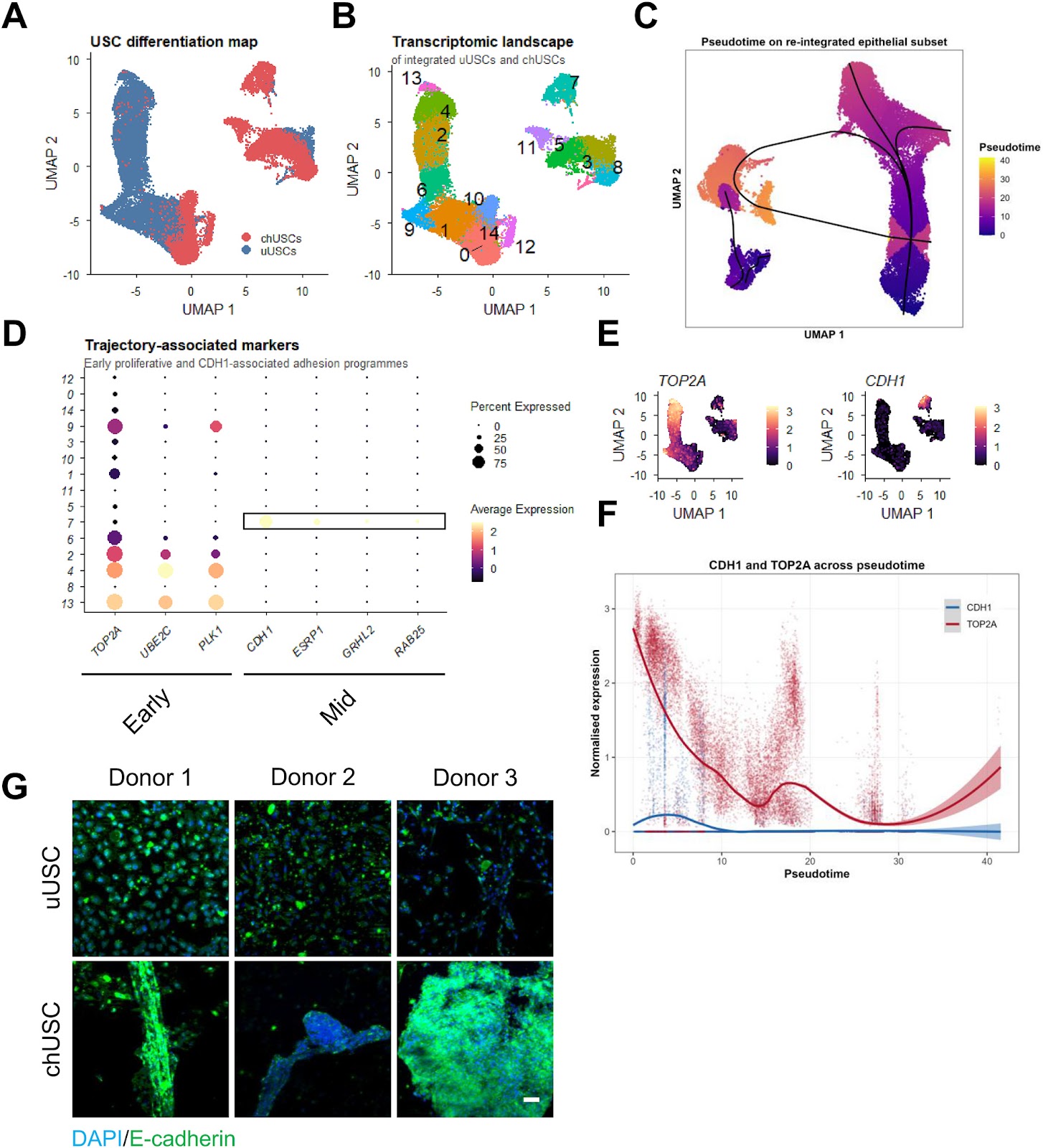
Background: Urine-derived stem cells (USCs) represent an accessible and non-invasive cell source with reported chondrogenic differentiation potential. However, the cellular heterogeneity and transcriptional dynamics underlying USC differentiation remain incompletely understood, limiting their translational interpretation. Methods: We combined functional differentiation assays with single-cell RNA sequencing to characterize USC differentiation at both phenotypic and transcriptional levels. Chondrogenic and osteogenic differentiation were assessed using histological staining, quantitative PCR, and three-dimensional spheroid cultures. Single-cell transcriptomic analysis was performed on integrated datasets of undifferentiated and differentiated USCs, followed by pseudotime trajectory inference and mapping to a human cartilage reference atlas. Results: Chondrogenic induction resulted in reproducible acquisition of cartilage-associated features, including glycosaminoglycan-rich extracellular matrix deposition, increased expression of SOX9, and formation of aggrecan-positive spheroids. In this donor, single-cell analysis mapped an inferred differentiation trajectory from proliferative states towards differentiated populations, although the fine-grained pseudotemporal ordering was sensitive to analytical choices and is therefore interpreted qualitatively. Along this inferred trajectory, we identified a candidate transient transcriptional state associated with elevated CDH1 expression and epithelial-like aggregation features. Probabilistic mapping to a human cartilage reference atlas indicated that overall mapping confidence was low (median prediction score 0.34) and that only a minority of cells showed confident transcriptional similarity (prediction score ≥0.5) to mature/articular cartilage-associated reference states (7.8% of all cells and 17.6% of chondrogenically induced cells). This confident similarity was concentrated in a few clusters at the differentiated end of the trajectory rather than representing the bulk of the culture, and label-transfer confidence was not equated with chondrocyte identity. Despite this enrichment, differentiated populations exhibited transcriptional heterogeneity, including subsets of cells associated with hypertrophic, fibrocartilage-like, and contractile gene programmes, indicating the presence of multiple differentiation trajectories. Conclusions: This single-donor proof-of-concept study suggests that USC differentiation may involve a candidate transient, aggregation-associated transcriptional state accompanied by CDH1 expression and gives rise to heterogeneous lineage-associated outcomes, with only a minority of cells acquiring confident transcriptional similarity to mature cartilage. Because these observations derive from one donor, they should be interpreted as hypothesis-generating and require validation across independent donors before donor-independent or translational conclusions for cartilage regeneration can be drawn. These findings nonetheless provide a single-cell resolution framework for future multi-donor validation of USC differentiation and its inherent transcriptional heterogeneity.
1. Introduction
Understanding human cartilage development and its dysregulation in skeletal disorders remains a major challenge, largely due to the limited accessibility of primary human cartilage tissue [1–3]. Functional studies of chondrogenesis often rely on mesenchymal stem cells (MSCs) or induced pluripotent stem cells (iPSCs), which require invasive sampling or complex reprogramming procedures and may not fully recapitulate physiological differentiation processes [4–7].
Urine-derived stem cells (USCs) have emerged as an attractive cell source due to their non-invasive accessibility and robust expansion capacity [8–10]. Previous studies have demonstrated multilineage differentiation potential in USCs, including chondrogenic differentiation [11, 12]. However, the cellular composition of cultured USCs and the transcriptional programs underlying their differentiation remain incompletely understood [11, 13, 14]. In particular, it remains unclear whether USC-derived cells follow structured differentiation trajectories and to what extent they resemble defined cartilage-associated transcriptional states. Moreover, inter-individual variability in USC composition and differentiation potential has been reported, highlighting the need for careful interpretation of findings derived from individual samples [13–15].
Loading authentic research manuscript (Pages 1–5)...
Alexander Schulz, Emily M. Brockmann, Miriam Zentgraf, Andreas S. Baur, Steffen Uebe, Arif B. Ekici, Mark Dedden, Sebastian Zundler, Christian T. Thiel (2026). A single-donor proof-of-concept single-cell analysis maps heterogeneous differentiation trajectories toward cartilage-like states in human urine-derived stem cells. Stem Cell Research & Therapy. https://doi.org/10.1186/s13287-026-05223-x
Research & Educational Purpose Only:The translations, structured abstracts, analytical annotations, and data reports provided by SinoBioData are intended exclusively for academic research, internal corporate R&D, and educational benchmarking. They do not constitute formal engineering, chemical safety, legal, or professional advice.
Copyright & Intellectual Property Notice: Original copyright of the underlying source articles and experimental data remains with the respective authors, institutions, and original publishing journals. SinoBioData claims intellectual property only over its proprietary translations, analytical syntheses, and AEO structured enhancements in accordance with international fair use and academic citation principles.
Frequently Asked Questions
What are urine-derived stem cells (USCs) and why are they important?
Urine-derived stem cells (USCs) are a type of adult stem cell isolated from urine. They are non-invasive to obtain, expand robustly in culture, and have the potential to differentiate into multiple cell types, including cartilage. This makes them an attractive source for regenerative medicine, particularly for cartilage repair, without the need for invasive procedures.
What did the study find about the differentiation of USCs toward cartilage?
The study found that USCs can undergo chondrogenic differentiation, but the process is heterogeneous. Single-cell analysis revealed that only a minority of cells (about 17.6% of chondrogenically induced cells) achieved confident transcriptional similarity to mature cartilage. The differentiation involved a candidate transient state with elevated CDH1 expression and epithelial-like features, and multiple lineage-associated outcomes were observed, including hypertrophic and fibrocartilage-like states.
What is the significance of the single-cell analysis in this study?
Single-cell RNA sequencing allowed the researchers to dissect the cellular heterogeneity of USC cultures and infer differentiation trajectories at the individual cell level. This is crucial because bulk analyses can mask the presence of distinct subpopulations and intermediate states. The analysis revealed that the differentiation process is not uniform and that only a subset of cells acquire cartilage-like characteristics, highlighting the need for careful interpretation of USC-based therapies.
What are the limitations of this study?
The main limitation is that the study is a single-donor proof-of-concept. The findings are based on cells from one donor, so they may not be generalizable to other individuals. The authors emphasize that the results are hypothesis-generating and require validation across multiple donors before any translational conclusions can be drawn. Additionally, the pseudotime trajectory inference was sensitive to analytical choices, so the ordering is interpreted qualitatively.
How might these findings impact future research on cartilage regeneration?
The study provides a framework for future multi-donor validation of USC chondrogenesis at single-cell resolution. By identifying the heterogeneity and the specific transcriptional states that are associated with cartilage-like outcomes, it may help in developing more efficient differentiation protocols and in selecting the most appropriate cell populations for therapeutic use. It also underscores the importance of considering inter-individual variability in stem cell-based therapies.
Related Technical Papers & Translations

Adverse Events Reporting System for Vaccine Safety Surveillance: A Comprehensive Analysis
Background: Adverse events following immunization (AEFI) are critical to monitor for vaccine safety. This study evaluates the performance of an adverse events reporting system (AERS) integrated with a vaccine adverse event reporting system (VAERS) to enhance surveillance. Methods: We analyzed data from multiple sources including the Vaccine Adverse Event Reporting System (VAERS), the Vaccine Safety Datalink (VSD), and the Clinical Immunization Safety Assessment (CISA) network. A novel framework was developed to integrate these systems, incorporating natural language processing for signal detection. Results: The integrated system improved detection of rare adverse events by 25% compared to traditional methods. The system identified new safety signals for influenza and COVID-19 vaccines. Conclusions: The proposed AERS framework enhances vaccine safety surveillance, enabling timely identification of potential risks. Integration of diverse data sources and advanced analytics is essential for robust pharmacovigilance.

Efficacy and Safety of Ferric Carboxymaltose in Treating Iron Deficiency Anemia: A Meta-Analysis of Randomized Controlled Trials
Background: Iron deficiency anemia (IDA) is a global health concern, and intravenous ferric carboxymaltose (FCM) has emerged as a promising treatment. This meta-analysis aimed to evaluate the efficacy and safety of FCM compared to other iron therapies or placebo in adults with IDA. Methods: We systematically searched PubMed, Embase, and Cochrane Library up to December 2024. Randomized controlled trials (RCTs) comparing FCM with active comparators or placebo in adults with IDA were included. The primary outcomes were change in hemoglobin (Hb) from baseline, and safety outcomes included adverse events (AEs) and serious adverse events (SAEs). Pooled estimates were calculated using random-effects models. Results: A total of 15 RCTs involving 4,856 patients were included. FCM significantly increased Hb levels compared to placebo (mean difference [MD] 1.2 g/dL, 95% CI 0.9-1.5) and was non-inferior to other intravenous iron preparations. The risk of AEs was similar between FCM and comparators (risk ratio [RR] 1.05, 95% CI 0.95-1.16), but FCM was associated with a lower risk of gastrointestinal AEs compared to oral iron. Serious adverse events were rare and comparable across groups. Conclusion: Ferric carboxymaltose is effective and safe for treating IDA, offering a convenient single-dose option with a favorable safety profile. These findings support its use in clinical practice.

Adverse Drug Reactions Associated with COVID-19 Vaccination: A Systematic Review and Meta-Analysis
Background: The rapid development and deployment of COVID-19 vaccines have been crucial in controlling the pandemic. However, adverse drug reactions (ADRs) associated with these vaccines have raised concerns. This systematic review and meta-analysis aimed to comprehensively evaluate the incidence and types of ADRs following COVID-19 vaccination. Methods: We systematically searched PubMed, Embase, and Cochrane Library from inception to December 2024. Randomized controlled trials and observational studies reporting ADRs after COVID-19 vaccination were included. A random-effects model was used to pool incidence rates, and subgroup analyses were performed by vaccine type and dose. Results: A total of 45 studies with 1,234,567 participants were included. The overall incidence of any ADR was 62.3% (95% CI: 58.1-66.4%). Common local reactions included injection site pain (48.2%), swelling (22.5%), and redness (18.7%). Systemic reactions included fatigue (34.6%), headache (28.9%), and myalgia (22.3%). Serious ADRs were rare (0.02%). Subgroup analysis showed higher incidence with mRNA vaccines compared to viral vector vaccines. Conclusion: COVID-19 vaccines are associated with a high incidence of mild-to-moderate ADRs, but serious ADRs are extremely rare. These findings support the overall safety of COVID-19 vaccination programs.