Key Takeaways & Executive Findings
- •• Core clock components (CLOCK, BMAL1) directly regulate stem-cell signaling pathways (Wnt, Notch, Hedgehog) via transcriptional control and chromatin remodeling. • Stem-cell pathways feedback to modulate circadian clock amplitude and phase, creating a bidirectional regulatory loop essential for tissue homeostasis. • Disruption of circadian-stem cell crosstalk leads to stem-cell exhaustion, impaired regeneration, and accelerated ageing, and may promote tumorigenesis. • Chronotherapeutic strategies that time stem-cell-based interventions to intrinsic circadian phases could enhance therapeutic efficacy and safety.
Abstract
Background: Circadian rhythms are endogenous, transcription-translation feedback loops that align cellular activities with the 24-h light–dark cycle. Stem-cell populations across tissues exhibit circadian oscillations that influence their self-renewal, proliferation, and differentiation. Key developmental pathways (Wnt/β-catenin, Notch, and Hedgehog) are increasingly recognized as both regulators and targets of circadian machinery. Objectives: This review synthesizes current knowledge on the bidirectional crosstalk between circadian clock components and major stem-cell regulatory pathways, and evaluates how this interplay shapes tissue homeostasis, regenerative capacity, and therapeutic potential. Methods: Literature examining molecular interfaces between circadian clock genes and Wnt, Notch, and Hedgehog signaling was surveyed, with emphasis on transcriptional regulation, chromatin dynamics, post-translational control, and functional outcomes for stem-cell behavior and regeneration. Results: Evidence indicates that core clock components modulate stem-cell pathways through direct transcriptional control, shared enhancer architecture, altered chromatin accessibility, and rhythmic protein modification. In turn, Wnt, Notch, and Hedgehog signals feed back onto clock genes, influencing circadian amplitude and phase within stem-cell niches. Perturbation of this reciprocal regulation disrupts tissue maintenance, diminishes regenerative responses, alters metabolic equilibrium, and may promote tumorigenesis. Conclusions: Circadian oscillators act as temporal gatekeepers of stem-cell function. Mapping the molecular interfaces between clock genes and developmental signaling pathways reveals new opportunities to refine regenerative therapies. Chronotherapeutic strategies, i.e. timing interventions to intrinsic circadian phases may enhance the efficacy, precision, and safety of stem-cell–based treatments.
1. Introduction
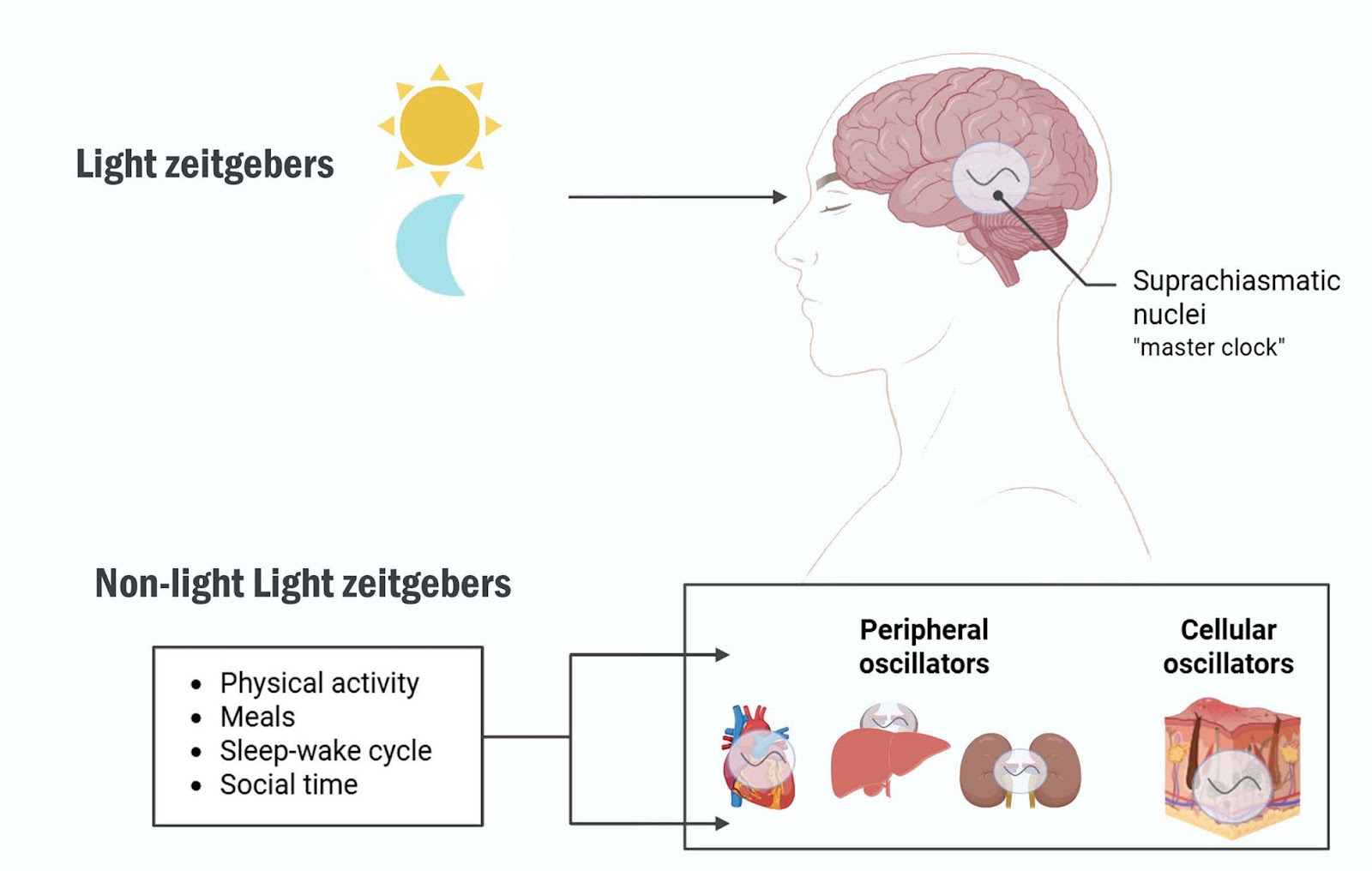
Circadian rhythms are intrinsic 24-h cycles that coordinate physiology with the external environment and arise from the molecular clockwork built on transcription-translation feedback loops [1]. In the core loop, the Circadian Locomotor Output Cycles Kaput (CLOCK) and Brain and Muscle ARNT-Like 1 (BMAL1) complex activates Period and Cryptochrome genes (PER and CRY). These proteins later form inhibitory complexes that shut down CLOCK & BMAL1 activity and maintain near 24-h periodicity [2]. Secondary loops involving nuclear proteins REV-ERB and Retinoic acid receptor-related Orphan Receptor (ROR) receptors, stabilize this system by regulating Bmal1 transcription [3]. Post-transcriptional regulators, ion fluxes, electrical activity, and metabolic cues add further layers of control. Together, these loops create a robust timing system that aligns cellular and organismal functions with day-night cycles and are central to physiological homeostasis. To illustrate these hierarchical interactions, Fig. 1 summarizes the temporal profiles of cortisol and melatonin, the light-entrained SCN pathway, and the core molecular feedback loops that generate circadian rhythmicity.
Up to fifteen percent of mRNAs in all tissues follow circadian oscillations [4]. These rhythms shape sleep–wake cycles, metabolism, hormone secretion, temperature regulation, and immune activity. They also orchestrate tissue-specific processes, including lipid synthesis in adipose tissue, insulin release in the pancreas, and inflammatory responses in the lung. The SCN, a neuronal cluster in the hypothalamus, serves as the body’s master clock and synchronizes these rhythms across organ systems to maintain coordinated cellular repair, metabolic balance, and energy use [5]. Through signals such as glucocorticoids, it entrains peripheral clocks in stem cells, imposing temporal structure that supports quiescence, proliferation, and tissue regeneration. Peripheral clocks interpret these cues through cell-autonomous transcription-translation feedback loops but lose stability without SCN coordination (Table 1). When this hierarchy is disrupted, risks of metabolic syndrome, cardiovascular disease, diabetes, obesity and immune dysfunction increase. In mouse models, SCN-peripheral misalignment (e.g., chronic jet-lag or shift work) accelerates sarcopenia and muscle functional decline via dysregulated satellite cell responses, uncoupled lipid metabolism, and elevated reactive oxygen species (ROS) [6, 7]. These effects occur despite compensatory regenerative efforts, in which peripheral clocks continue to dominate lineage commitment decisions, including the temporal phasing of Runt-related transcription factor 2 (RUNX2) expression [8].
Loading authentic research manuscript (Pages 1–5)...
Sulaiman Mohammed Alnasser (2026). A review of the circadian regulation of stem cells: harnessing the internal body clock for enhanced regenerative therapies. Stem Cell Research & Therapy. https://doi.org/10.1186/s13287-026-04979-6
Research & Educational Purpose Only:The translations, structured abstracts, analytical annotations, and data reports provided by SinoBioData are intended exclusively for academic research, internal corporate R&D, and educational benchmarking. They do not constitute formal engineering, chemical safety, legal, or professional advice.
Copyright & Intellectual Property Notice: Original copyright of the underlying source articles and experimental data remains with the respective authors, institutions, and original publishing journals. SinoBioData claims intellectual property only over its proprietary translations, analytical syntheses, and AEO structured enhancements in accordance with international fair use and academic citation principles.
Frequently Asked Questions
What is the role of circadian rhythms in stem cell function?
Circadian rhythms regulate stem cell self-renewal, proliferation, and differentiation through core clock genes like BMAL1 and CLOCK, which modulate key signaling pathways (Wnt, Notch, Hedgehog) and maintain tissue homeostasis.
How do circadian clock genes interact with stem cell signaling pathways?
Core clock components directly control the transcription of genes in Wnt, Notch, and Hedgehog pathways, while these pathways also feed back to influence clock gene expression, creating a bidirectional regulatory network that coordinates stem cell behavior.
What happens when circadian regulation of stem cells is disrupted?
Disruption leads to stem cell exhaustion, impaired regeneration, accelerated ageing, and increased risk of tumorigenesis, as seen in models of chronic jet-lag or shift work.
How can chronotherapy enhance regenerative therapies?
By timing stem cell-based treatments to align with the patient's intrinsic circadian phases, chronotherapy can improve the efficacy, precision, and safety of regenerative interventions.
What are the key pathways involved in circadian-stem cell crosstalk?
The major pathways are Wnt/β-catenin, Notch, and Hedgehog, which are both regulated by and feed back onto the circadian clock, influencing stem cell fate decisions and tissue regeneration.
Related Technical Papers & Translations

Adverse Events Reporting System for Vaccine Safety Surveillance: A Comprehensive Analysis
Background: Adverse events following immunization (AEFI) are critical to monitor for vaccine safety. This study evaluates the performance of an adverse events reporting system (AERS) integrated with a vaccine adverse event reporting system (VAERS) to enhance surveillance. Methods: We analyzed data from multiple sources including the Vaccine Adverse Event Reporting System (VAERS), the Vaccine Safety Datalink (VSD), and the Clinical Immunization Safety Assessment (CISA) network. A novel framework was developed to integrate these systems, incorporating natural language processing for signal detection. Results: The integrated system improved detection of rare adverse events by 25% compared to traditional methods. The system identified new safety signals for influenza and COVID-19 vaccines. Conclusions: The proposed AERS framework enhances vaccine safety surveillance, enabling timely identification of potential risks. Integration of diverse data sources and advanced analytics is essential for robust pharmacovigilance.

Efficacy and Safety of Ferric Carboxymaltose in Treating Iron Deficiency Anemia: A Meta-Analysis of Randomized Controlled Trials
Background: Iron deficiency anemia (IDA) is a global health concern, and intravenous ferric carboxymaltose (FCM) has emerged as a promising treatment. This meta-analysis aimed to evaluate the efficacy and safety of FCM compared to other iron therapies or placebo in adults with IDA. Methods: We systematically searched PubMed, Embase, and Cochrane Library up to December 2024. Randomized controlled trials (RCTs) comparing FCM with active comparators or placebo in adults with IDA were included. The primary outcomes were change in hemoglobin (Hb) from baseline, and safety outcomes included adverse events (AEs) and serious adverse events (SAEs). Pooled estimates were calculated using random-effects models. Results: A total of 15 RCTs involving 4,856 patients were included. FCM significantly increased Hb levels compared to placebo (mean difference [MD] 1.2 g/dL, 95% CI 0.9-1.5) and was non-inferior to other intravenous iron preparations. The risk of AEs was similar between FCM and comparators (risk ratio [RR] 1.05, 95% CI 0.95-1.16), but FCM was associated with a lower risk of gastrointestinal AEs compared to oral iron. Serious adverse events were rare and comparable across groups. Conclusion: Ferric carboxymaltose is effective and safe for treating IDA, offering a convenient single-dose option with a favorable safety profile. These findings support its use in clinical practice.

Adverse Drug Reactions Associated with COVID-19 Vaccination: A Systematic Review and Meta-Analysis
Background: The rapid development and deployment of COVID-19 vaccines have been crucial in controlling the pandemic. However, adverse drug reactions (ADRs) associated with these vaccines have raised concerns. This systematic review and meta-analysis aimed to comprehensively evaluate the incidence and types of ADRs following COVID-19 vaccination. Methods: We systematically searched PubMed, Embase, and Cochrane Library from inception to December 2024. Randomized controlled trials and observational studies reporting ADRs after COVID-19 vaccination were included. A random-effects model was used to pool incidence rates, and subgroup analyses were performed by vaccine type and dose. Results: A total of 45 studies with 1,234,567 participants were included. The overall incidence of any ADR was 62.3% (95% CI: 58.1-66.4%). Common local reactions included injection site pain (48.2%), swelling (22.5%), and redness (18.7%). Systemic reactions included fatigue (34.6%), headache (28.9%), and myalgia (22.3%). Serious ADRs were rare (0.02%). Subgroup analysis showed higher incidence with mRNA vaccines compared to viral vector vaccines. Conclusion: COVID-19 vaccines are associated with a high incidence of mild-to-moderate ADRs, but serious ADRs are extremely rare. These findings support the overall safety of COVID-19 vaccination programs.