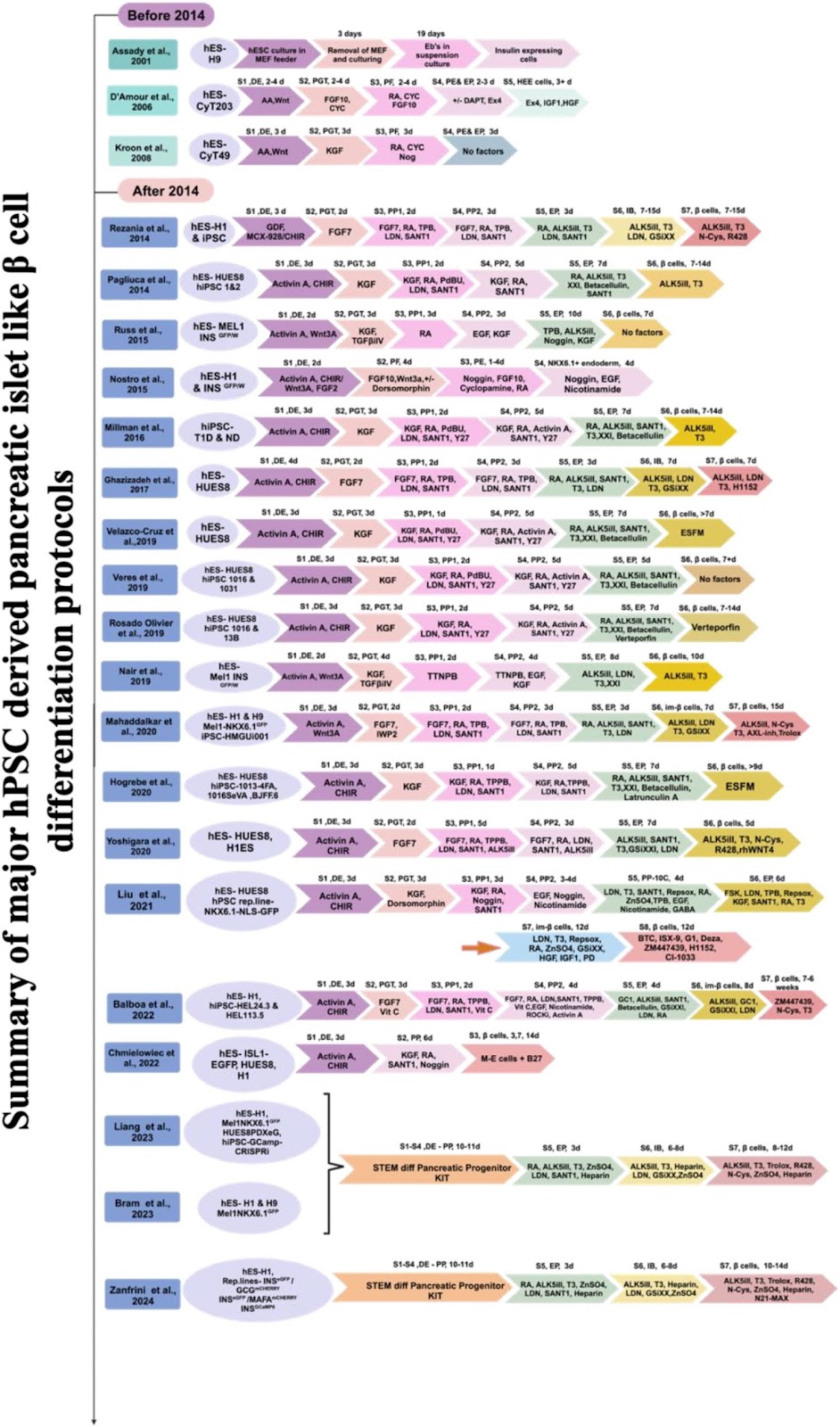
Key Takeaways & Executive Findings
- •• hPSC-derived pancreatic islets offer a promising alternative to donor islets for diabetes cell replacement therapy, addressing the shortage of cadaveric donors. • Current differentiation protocols vary in efficiency across hESC and hiPSC lines, posing a significant challenge for generating patient-specific β cells. • Emulating pancreatic embryogenesis with specific growth factors and signaling molecules is key to guiding hPSCs toward mature, glucose-responsive insulin-secreting β cells. • Further optimization of protocols and characterization methods is essential to ensure the safety and efficacy of hPSC-derived islets before clinical translation.
Abstract
The search for an effective cell replacement therapy for diabetes has driven the development of “perfect” pancreatic islets from human pluripotent stem cells (hPSCs). These hPSC-derived pancreatic islet-like β cells can overcome the limitations for disease modelling, drug development and transplantation therapies in diabetes. Nevertheless, challenges remain in generating fully functional and mature β cells from hPSCs. This review underscores the significant efforts made by researchers to optimize various differentiation protocols aimed at enhancing the efficiency and quality of hPSC-derived pancreatic islets and proposes methods for their improvement. By emulating the natural developmental processes of pancreatic embryogenesis, specific growth factors, signaling molecules and culture conditions are employed to guide hPSCs towards the formation of mature β cells capable of secreting insulin in response to glucose. However, the efficiency of these protocols varies greatly among different human embryonic stem cell (hESC) and induced pluripotent stem cell (hiPSC) lines. This variability poses a particular challenge for generating patient-specific β cells. Despite recent advancements, the ultimate goal remains to develop a highly efficient directed differentiation protocol that is applicable across all genetic backgrounds of hPSCs. Although progress has been made, further research is required to optimize the protocols and characterization methods that could ensure the safety and efficacy of hPSC-derived pancreatic islets before they can be utilized in clinical settings.
1. Introduction
Diabetes mellitus (DM) is a highly common chronic metabolic disorder, primarily characterized by hyperglycemia, affecting millions of the population worldwide with an exponential projected growth from 463 million in 2019 to 700 million in 2045 [1]. Type 1 DM (T1D) and Type 2 DM (T2D) are the most prevalent forms of diabetes observed in clinical practice [1]. In T1D, pancreatic islet β cells undergo autoimmune destruction leading to a lack of insulin production. For that reason, optimal treatment of TID is vital, and lack of proper management can result in severe complications. In the case of T2D, there is insufficient insulin production due to β cell loss through apoptosis, together with impaired insulin sensitivity in peripheral tissues resulting in chronic secondary complications [2].
The current treatment strategies for DM include the continuous routine administration of exogenous insulin which is the only economical mode of treatment available for T1D, and also a common mainstay treatment for T2D alongside pharmaceutical agents and bariatric surgery [2]. Pancreatic islet transplantation, a standout treatment option particularly used in the management of T1D, has been shown to have clinical benefits, providing sustained glucose-sensitive insulin production together with a significantly reduced need for exogenous insulin [3]. However, given the scarcity of obtaining cadaveric donor islets and the life-long dependence on immunosuppressive medications, islet transplantation is viewed as an impractical option for clinical implementation. Therefore, an unmet need exists for effective alternative therapies that offer long-term relapse-free disease remission with minimum adverse effects [4].
Emerging reports highlight the use of stem cell-derived pancreatic β cells (SC-β cells) and islets (SC-islets) as a promising alternative to overcome the shortage of donor islets [5, 6]. Over the past few decades, many investigators have focused on generating protocols that delineate the differentiation of functional pancreatic islets from human pluripotent stem cells.
Loading authentic research manuscript (Pages 1–5)...
Sujitha Sali, Leen Azzam, Taraf Jaro, Ahmed Ali Gebril Ali, Ali Mardini, Omar Al-Dajani, Shahryar Khattak, Alexandra E. Butler, Juberiya M. Azeez, Manjula Nandakumar (2026). A perfect islet: reviewing recent protocol developments and proposing strategies for stem cell derived functional pancreatic islets. Stem Cell Research & Therapy. https://doi.org/10.1186/s13287-025-04293-7
Research & Educational Purpose Only:The translations, structured abstracts, analytical annotations, and data reports provided by SinoBioData are intended exclusively for academic research, internal corporate R&D, and educational benchmarking. They do not constitute formal engineering, chemical safety, legal, or professional advice.
Copyright & Intellectual Property Notice: Original copyright of the underlying source articles and experimental data remains with the respective authors, institutions, and original publishing journals. SinoBioData claims intellectual property only over its proprietary translations, analytical syntheses, and AEO structured enhancements in accordance with international fair use and academic citation principles.
Frequently Asked Questions
What is the main focus of this review?
The review focuses on recent protocol developments for generating functional pancreatic islets from human pluripotent stem cells (hPSCs), highlighting challenges and proposing strategies for improvement.
Why are hPSC-derived pancreatic islets considered promising for diabetes treatment?
They offer a potential alternative to donor islets, overcoming the shortage of cadaveric donors and the need for lifelong immunosuppression, and can be used for disease modeling, drug development, and transplantation.
What are the major challenges in generating mature β cells from hPSCs?
The efficiency of differentiation protocols varies greatly among different hESC and hiPSC lines, making it difficult to generate patient-specific β cells consistently. Achieving full functionality and maturity remains a hurdle.
How do researchers guide hPSCs to become insulin-secreting β cells?
By mimicking pancreatic embryogenesis using specific growth factors, signaling molecules, and culture conditions to direct differentiation toward mature β cells that respond to glucose.
What is needed before hPSC-derived islets can be used clinically?
Further research to optimize differentiation protocols and characterization methods to ensure safety and efficacy, including consistent functionality across genetic backgrounds.
Related Technical Papers & Translations

Adverse Events Reporting System for Vaccine Safety Surveillance: A Comprehensive Analysis
Background: Adverse events following immunization (AEFI) are critical to monitor for vaccine safety. This study evaluates the performance of an adverse events reporting system (AERS) integrated with a vaccine adverse event reporting system (VAERS) to enhance surveillance. Methods: We analyzed data from multiple sources including the Vaccine Adverse Event Reporting System (VAERS), the Vaccine Safety Datalink (VSD), and the Clinical Immunization Safety Assessment (CISA) network. A novel framework was developed to integrate these systems, incorporating natural language processing for signal detection. Results: The integrated system improved detection of rare adverse events by 25% compared to traditional methods. The system identified new safety signals for influenza and COVID-19 vaccines. Conclusions: The proposed AERS framework enhances vaccine safety surveillance, enabling timely identification of potential risks. Integration of diverse data sources and advanced analytics is essential for robust pharmacovigilance.

Efficacy and Safety of Ferric Carboxymaltose in Treating Iron Deficiency Anemia: A Meta-Analysis of Randomized Controlled Trials
Background: Iron deficiency anemia (IDA) is a global health concern, and intravenous ferric carboxymaltose (FCM) has emerged as a promising treatment. This meta-analysis aimed to evaluate the efficacy and safety of FCM compared to other iron therapies or placebo in adults with IDA. Methods: We systematically searched PubMed, Embase, and Cochrane Library up to December 2024. Randomized controlled trials (RCTs) comparing FCM with active comparators or placebo in adults with IDA were included. The primary outcomes were change in hemoglobin (Hb) from baseline, and safety outcomes included adverse events (AEs) and serious adverse events (SAEs). Pooled estimates were calculated using random-effects models. Results: A total of 15 RCTs involving 4,856 patients were included. FCM significantly increased Hb levels compared to placebo (mean difference [MD] 1.2 g/dL, 95% CI 0.9-1.5) and was non-inferior to other intravenous iron preparations. The risk of AEs was similar between FCM and comparators (risk ratio [RR] 1.05, 95% CI 0.95-1.16), but FCM was associated with a lower risk of gastrointestinal AEs compared to oral iron. Serious adverse events were rare and comparable across groups. Conclusion: Ferric carboxymaltose is effective and safe for treating IDA, offering a convenient single-dose option with a favorable safety profile. These findings support its use in clinical practice.

Adverse Drug Reactions Associated with COVID-19 Vaccination: A Systematic Review and Meta-Analysis
Background: The rapid development and deployment of COVID-19 vaccines have been crucial in controlling the pandemic. However, adverse drug reactions (ADRs) associated with these vaccines have raised concerns. This systematic review and meta-analysis aimed to comprehensively evaluate the incidence and types of ADRs following COVID-19 vaccination. Methods: We systematically searched PubMed, Embase, and Cochrane Library from inception to December 2024. Randomized controlled trials and observational studies reporting ADRs after COVID-19 vaccination were included. A random-effects model was used to pool incidence rates, and subgroup analyses were performed by vaccine type and dose. Results: A total of 45 studies with 1,234,567 participants were included. The overall incidence of any ADR was 62.3% (95% CI: 58.1-66.4%). Common local reactions included injection site pain (48.2%), swelling (22.5%), and redness (18.7%). Systemic reactions included fatigue (34.6%), headache (28.9%), and myalgia (22.3%). Serious ADRs were rare (0.02%). Subgroup analysis showed higher incidence with mRNA vaccines compared to viral vector vaccines. Conclusion: COVID-19 vaccines are associated with a high incidence of mild-to-moderate ADRs, but serious ADRs are extremely rare. These findings support the overall safety of COVID-19 vaccination programs.