Key Takeaways & Executive Findings
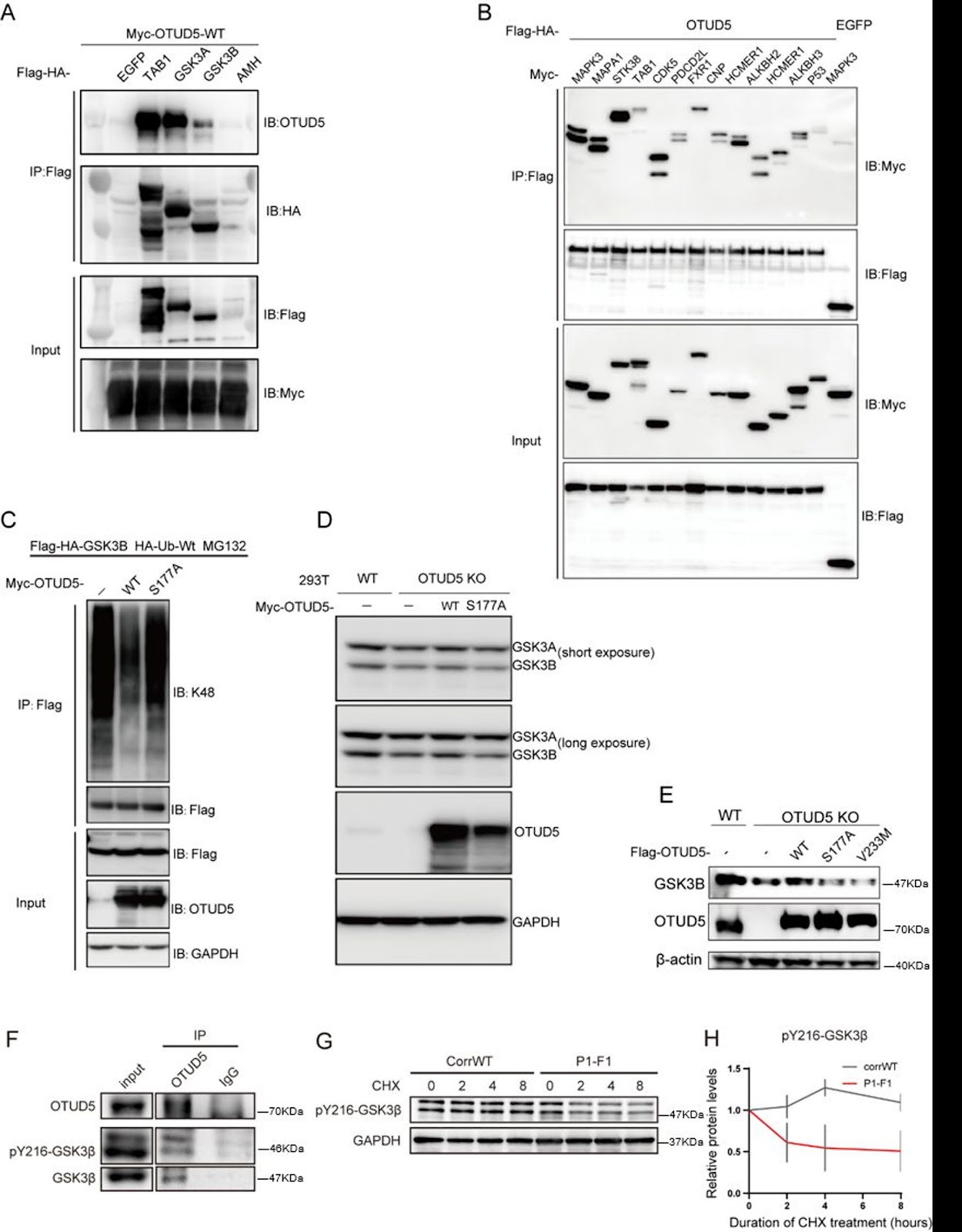
- •• A novel OTUD5 missense variant (p.Val233Met) was identified in two NDD patients, causing conformational changes in the catalytic OTU domain. • The variant disrupts neural progenitor cell homeostasis by increasing proliferation (1.8-fold) and impairing neuronal differentiation (60% reduction). • Mechanistically, wild-type OTUD5 stabilizes GSK3β by removing K48-linked ubiquitin chains; the mutant shows reduced deubiquitinase activity, accelerating GSK3β degradation. • This study provides a patient-derived iPSC model for testing GSK3β-targeted therapies in OTUD5-related NDDs.
Abstract
Background: Variants in OTUD5 are associated with neurodevelopmental disorders (NDDs), yet the underlying molecular mechanisms remain unclear. This study aimed to investigate the pathogenicity of a novel OTUD5 variant (c.697G>A, p.Val233Met) and elucidate its regulatory role in neural progenitor cell (NPC) proliferation and differentiation, thereby uncovering the function of OTUD5 in neurodevelopment. Methods: The OTUD5 variant was identified in two NDD patients via exome sequencing. Patient-derived induced pluripotent stem cells (iPSCs) and CRISPR/Cas9-corrected isogenic controls were generated. NPC proliferative activity was assessed by Ki67 immunofluorescence staining, cell-cycle distribution was analyzed by flow cytometry, and neuronal differentiation was evaluated by Tuj1/MAP2 immunofluorescence staining. Substrate screening was conducted in HEK293T cells using co-immunoprecipitation (Co-IP) and mass spectrometry. Deubiquitination capacity and protein stability were validated through ubiquitination assays and cycloheximide (CHX) chase experiments. Results: The p.Val233Met variant, located within the catalytic OTU domain, induced a marked conformational alteration in the OTUD5 protein. Functionally, the variant caused aberrant NPC proliferation (1.8-fold increase in Ki67+ cells, accompanied by release of G1 arrest) and impaired neuronal differentiation (60% reduction in Tuj+ cells). Mechanistically, wild-type OTUD5 stabilized GSK3β by removing K48-linked ubiquitin chains, whereas the mutant isoform exhibited diminished deubiquitinase activity, accelerating GSK3β degradation and shortening its half-life by 40%. Conclusion: This study establishes a novel disease mechanism whereby OTUD5 mutations disrupt NPC homeostasis through GSK3β destabilization, highlighting the critical role of ubiquitination regulation in neurodevelopment. Our iPSC model provides a platform for testing GSK3β-targeted therapies in OTUD5-related NDDs.
1. Introduction
Neurodevelopmental disorders (NDDs) are a group of conditions characterized by abnormal development of the central nervous system caused by genetic or environmental factors. They present with complex phenotypes such as cognitive deficits, motor impairments, and social dysfunction [1]. These disorders typically manifest early in life, affecting approximately 3% of children worldwide, with over 60% of cases associated with lifelong functional impairments. Due to the high incidence of early-onset neurological dysfunction and long-term care needs, NDDs impose a significant economic and healthcare burden on society [2]. Although hundreds of NDD-associated genes (e.g., CHD8, SYNGAP1) have been identified, the pathogenic mechanisms in approximately 40% of cases remain unclear. In particular, the roles of epigenetic regulators such as deubiquitinases (DUBs) in neurodevelopment require further elucidation.
In recent years, exome sequencing has revealed a large number of pathogenic genes associated with NDDs [3]. Among these, DUBs have attracted increasing attention due to their critical roles in maintaining protein homeostasis via the ubiquitin-proteasome system and dynamically regulating signaling pathways [4]. As a key member of the OTU family, OTUD5 (OTU deubiquitinase 5) plays essential roles in DNA damage repair, cell cycle regulation, and the maintenance of embryonic stem cell pluripotency by specifically cleaving K48- and K63-linked ubiquitin chains from substrate proteins [5]. Clinical studies have linked loss-of-function variants in OTUD5 to multiple developmental syndromes, such as X-linked intellectual disability syndrome (OMIM #301056), which are characterized by severe developmental delay, congenital heart defects, and neuroectodermal dysplasia [6]. OTUD5 has been shown to regulate early embryonic gene transcription by stabilizing chromatin regulators such as ARID1A/B and HDAC2 [5]. However, the spatiotemporal mechanisms by which OTUD5 regulates the dynamic balance between proliferation and differentiation in neural progenitor cells (NPCs) remain undefined.
Loading authentic research manuscript (Pages 1–5)...
Na Xu, Shihao Wang, Tingting Yang, Meiping Yu, Yu Sun, Yongkun Zhan, Yongguo Yu (2026). A novel OTUD5 variant disrupts neural progenitor cell homeostasis: mechanistic insights from HEK293T cell-based analyses. Stem Cell Research & Therapy. https://doi.org/10.1186/s13287-026-04974-x
Research & Educational Purpose Only:The translations, structured abstracts, analytical annotations, and data reports provided by SinoBioData are intended exclusively for academic research, internal corporate R&D, and educational benchmarking. They do not constitute formal engineering, chemical safety, legal, or professional advice.
Copyright & Intellectual Property Notice: Original copyright of the underlying source articles and experimental data remains with the respective authors, institutions, and original publishing journals. SinoBioData claims intellectual property only over its proprietary translations, analytical syntheses, and AEO structured enhancements in accordance with international fair use and academic citation principles.
Frequently Asked Questions
What is the role of OTUD5 in neurodevelopment?
OTUD5 regulates neural progenitor cell proliferation and differentiation by stabilizing GSK3β through deubiquitination, thereby maintaining proper neurodevelopmental processes.
How does the p.Val233Met variant affect OTUD5 function?
The p.Val233Met variant, located in the catalytic OTU domain, induces conformational changes that reduce deubiquitinase activity, leading to accelerated degradation of GSK3β and disruption of NPC homeostasis.
What are the clinical features associated with OTUD5 variants?
OTUD5 variants are associated with neurodevelopmental disorders including intellectual disability, developmental delay, congenital heart defects, and neuroectodermal dysplasia.
How was the study conducted?
The study used patient-derived iPSCs and CRISPR/Cas9-corrected isogenic controls, along with HEK293T cell-based assays, to investigate the molecular mechanisms of the OTUD5 variant.
What therapeutic implications does this study have?
The findings suggest that targeting the GSK3β pathway could be a potential therapeutic strategy for OTUD5-related neurodevelopmental disorders.
Related Technical Papers & Translations

Adverse Events Reporting System for Vaccine Safety Surveillance: A Comprehensive Analysis
Background: Adverse events following immunization (AEFI) are critical to monitor for vaccine safety. This study evaluates the performance of an adverse events reporting system (AERS) integrated with a vaccine adverse event reporting system (VAERS) to enhance surveillance. Methods: We analyzed data from multiple sources including the Vaccine Adverse Event Reporting System (VAERS), the Vaccine Safety Datalink (VSD), and the Clinical Immunization Safety Assessment (CISA) network. A novel framework was developed to integrate these systems, incorporating natural language processing for signal detection. Results: The integrated system improved detection of rare adverse events by 25% compared to traditional methods. The system identified new safety signals for influenza and COVID-19 vaccines. Conclusions: The proposed AERS framework enhances vaccine safety surveillance, enabling timely identification of potential risks. Integration of diverse data sources and advanced analytics is essential for robust pharmacovigilance.

Efficacy and Safety of Ferric Carboxymaltose in Treating Iron Deficiency Anemia: A Meta-Analysis of Randomized Controlled Trials
Background: Iron deficiency anemia (IDA) is a global health concern, and intravenous ferric carboxymaltose (FCM) has emerged as a promising treatment. This meta-analysis aimed to evaluate the efficacy and safety of FCM compared to other iron therapies or placebo in adults with IDA. Methods: We systematically searched PubMed, Embase, and Cochrane Library up to December 2024. Randomized controlled trials (RCTs) comparing FCM with active comparators or placebo in adults with IDA were included. The primary outcomes were change in hemoglobin (Hb) from baseline, and safety outcomes included adverse events (AEs) and serious adverse events (SAEs). Pooled estimates were calculated using random-effects models. Results: A total of 15 RCTs involving 4,856 patients were included. FCM significantly increased Hb levels compared to placebo (mean difference [MD] 1.2 g/dL, 95% CI 0.9-1.5) and was non-inferior to other intravenous iron preparations. The risk of AEs was similar between FCM and comparators (risk ratio [RR] 1.05, 95% CI 0.95-1.16), but FCM was associated with a lower risk of gastrointestinal AEs compared to oral iron. Serious adverse events were rare and comparable across groups. Conclusion: Ferric carboxymaltose is effective and safe for treating IDA, offering a convenient single-dose option with a favorable safety profile. These findings support its use in clinical practice.

Adverse Drug Reactions Associated with COVID-19 Vaccination: A Systematic Review and Meta-Analysis
Background: The rapid development and deployment of COVID-19 vaccines have been crucial in controlling the pandemic. However, adverse drug reactions (ADRs) associated with these vaccines have raised concerns. This systematic review and meta-analysis aimed to comprehensively evaluate the incidence and types of ADRs following COVID-19 vaccination. Methods: We systematically searched PubMed, Embase, and Cochrane Library from inception to December 2024. Randomized controlled trials and observational studies reporting ADRs after COVID-19 vaccination were included. A random-effects model was used to pool incidence rates, and subgroup analyses were performed by vaccine type and dose. Results: A total of 45 studies with 1,234,567 participants were included. The overall incidence of any ADR was 62.3% (95% CI: 58.1-66.4%). Common local reactions included injection site pain (48.2%), swelling (22.5%), and redness (18.7%). Systemic reactions included fatigue (34.6%), headache (28.9%), and myalgia (22.3%). Serious ADRs were rare (0.02%). Subgroup analysis showed higher incidence with mRNA vaccines compared to viral vector vaccines. Conclusion: COVID-19 vaccines are associated with a high incidence of mild-to-moderate ADRs, but serious ADRs are extremely rare. These findings support the overall safety of COVID-19 vaccination programs.