Key Takeaways & Executive Findings
- •• SNHG11 is identified as a methylation-associated lncRNA significantly correlated with poor prognosis in clear cell renal cell carcinoma (KIRC). • Functional assays demonstrate that SNHG11 promotes tumor proliferation and progression in vitro and in vivo. • Mechanistically, SNHG11 enhances oxidative phosphorylation, evidenced by increased ATP production, disrupted mitochondrial membrane potential, and altered NAD+/NADH ratios. • SNHG11 expression is associated with somatic mutations in BAP1 and PBRM1, suggesting crosstalk between epigenetic regulation and genetic alterations.
Abstract
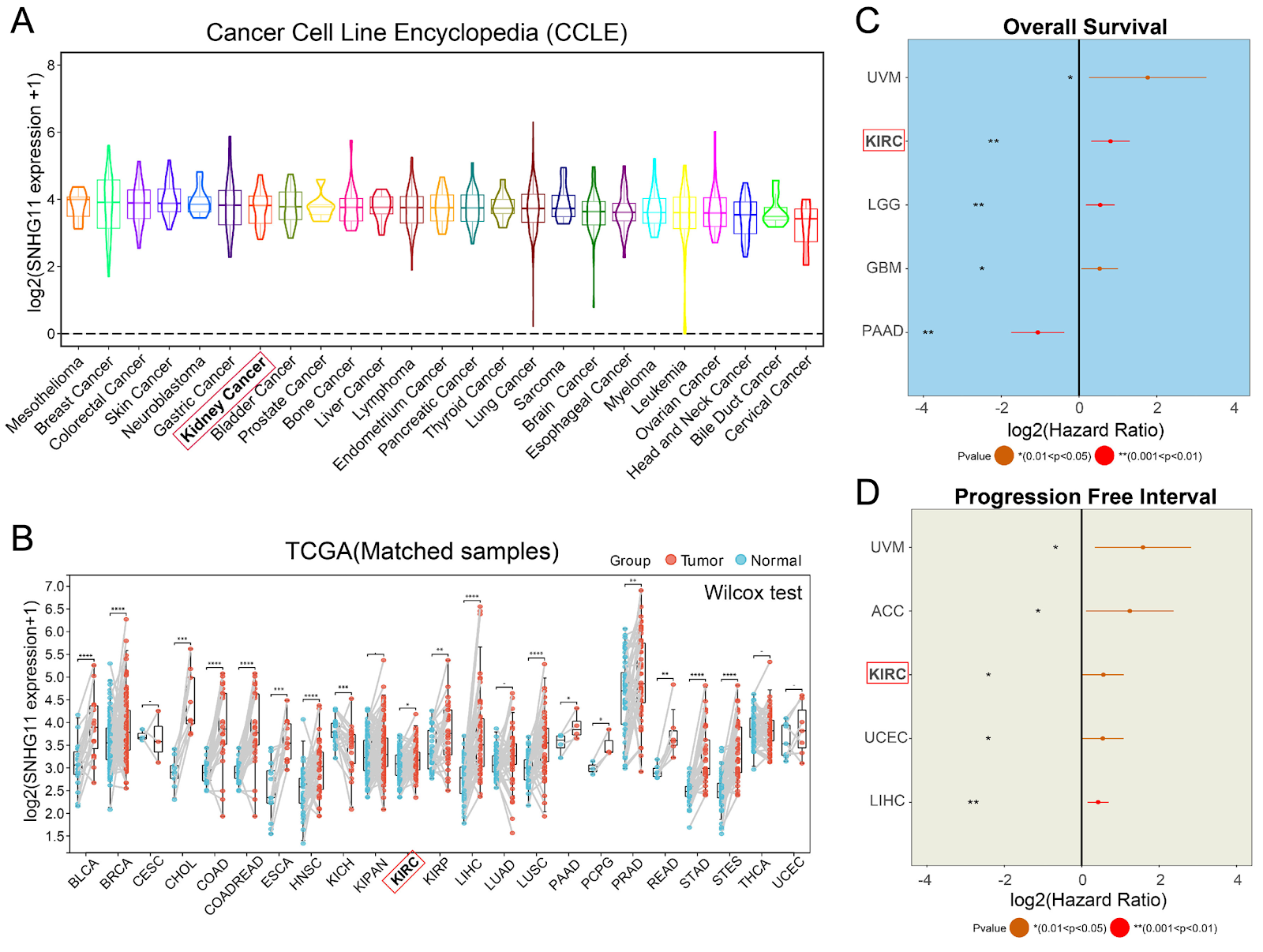
Kidney renal clear cell carcinoma (KIRC) is the most common and aggressive subtype of renal cell carcinoma and is characterized by poor prognosis and high molecular heterogeneity. Long noncoding RNAs (lncRNAs) have emerged as crucial regulators in cancer, yet the functional role of SNHG11 in KIRC remains unclear. In this study, we perform integrated multiomics analysis using data from the TCGA and ICGC cohorts and reveal that SNHG11, a methylation-associated lncRNA, is significantly correlated with poor clinical outcomes. In vitro and in vivo assays demonstrate that SNHG11 promotes tumor proliferation and progression. Mechanistically, SNHG11 enhances oxidative phosphorylation, as evidenced by increased ATP production, disrupted mitochondrial membrane potential, and altered NAD+/NADH ratios. Furthermore, SNHG11 expression is associated with somatic mutation patterns, particularly those involving BAP1 and PBRM1, indicating potential crosstalk between epigenetic regulation and genetic alterations. These findings reveal that SNHG11 is a novel biomarker in KIRC and a potential therapeutic target.
1. Introduction
Renal cell carcinoma (RCC) ranks among the most prevalent malignant neoplasms worldwide and is characterized by significant morbidity and mortality [1]. Recent epidemiological data indicate that kidney cancer is among the six leading cancers with persistently increasing incidence rates [1]. The primary histological subtypes of RCC include kidney renal clear cell carcinoma (KIRC), chromophobe renal cell carcinoma, and papillary renal cell carcinoma, with KIRC constituting approximately 80% of all RCC cases [2]. KIRC, the predominant subtype, exhibits marked biological aggressiveness, with a propensity for postoperative metastasis and limited responsiveness to conventional therapies such as radiotherapy and chemotherapy [3]. This often leads to the development of therapeutic resistance and, consequently, poor clinical outcomes [2]. Given the pronounced heterogeneity of KIRC, there is an urgent need to identify novel prognostic biomarkers to stratify patients effectively and to discover targeted therapeutic agents to address the demands of personalized medicine.
Over 98% of the human genome is transcribed into RNA molecules with minimal or no protein-coding capacity, among which long noncoding RNAs (lncRNAs) play pivotal roles as epigenetic modulators of gene expression [4]. lncRNAs constitute a diverse group of RNA molecules exceeding 200 nucleotides in length. Despite the identification of more than 170,000 lncRNAs in the human genome, the functional roles and annotations of them remain largely unexplored [5,6]. Increasing evidence highlights the pivotal role of lncRNAs in cancer progression [7]. For example, recent studies have demonstrated that the lncRNA WDR11-DT enhances radiosensitivity in non-small cell lung cancer by promoting PARP1 degradation and inducing homologous recombination deficiency [8]. Similarly, the lncRNA LRTOR has been shown to drive osimertinib resistance in non-small cell lung cancer by amplifying the YAP-positive feedback loop [5]. The lncRNA LIMD1-AS1 enhances TGF-β/SMAD signaling through a positive feedback loop by promoting the formation of the SMAD3/p300 transcriptional complex, thereby increasing the migration and invasion abilities of breast cancer cells [9]. In the context of KIRC, lncRNAs also play significant roles. Notably, an ultraconserved snoRNA-like element within the lncRNA CRNDE has been found to promote ribosome biogenesis and cellular proliferation [6,10]. Recent advances have significantly expanded our understanding of lncRNAs in the context of KIRC [11,12]. Several lncRNAs have emerged as promising candidates for diagnostic and prognostic biomarkers in KIRC. For example, lncARSR has been identified as a potential indicator of sunitinib resistance and a candidate therapeutic target [13]. Similarly, LINC00926 shows promise as a novel biomarker for predicting responses to immune checkpoint blockade (ICB) immunotherapy in RCC while also serving as a potential therapeutic target [14]. Mechanistically, lncRNAs exert regulatory effects by interacting with various cellular components, including proteins, DNA, RNA, and chromatin remodeling complexes, thereby modulating the expression of target genes [11]. Additionally, a subset of lncRNAs has been found to encode functional peptides, further expanding their biological roles [12].
Loading authentic research manuscript (Pages 1–5)...
LIN Zhuoyuan, CHEN Chaojiang, LI Jianxin, ZHAO Jun, XU Jia, ZHANG Le, ZHONG Chuanfan, MO Shanshan, LU Jianming, ZHENG Yu (2026). A Novel Biomarker SNHG11 Promotes Tumor Progression and Oxidative Phosphorylation in Clear Cell Renal Cell Carcinoma. Acta Biochimica et Biophysica Sinica. https://doi.org/10.3724/abbs.2025253
Research & Educational Purpose Only:The translations, structured abstracts, analytical annotations, and data reports provided by SinoBioData are intended exclusively for academic research, internal corporate R&D, and educational benchmarking. They do not constitute formal engineering, chemical safety, legal, or professional advice.
Copyright & Intellectual Property Notice: Original copyright of the underlying source articles and experimental data remains with the respective authors, institutions, and original publishing journals. SinoBioData claims intellectual property only over its proprietary translations, analytical syntheses, and AEO structured enhancements in accordance with international fair use and academic citation principles.
Frequently Asked Questions
What is the role of SNHG11 in clear cell renal cell carcinoma?
SNHG11 is a methylation-associated lncRNA that promotes tumor proliferation and progression in KIRC. It enhances oxidative phosphorylation, leading to increased ATP production and altered mitochondrial function, and is associated with poor clinical outcomes.
How does SNHG11 affect oxidative phosphorylation?
SNHG11 enhances oxidative phosphorylation by increasing ATP production, disrupting mitochondrial membrane potential, and altering NAD+/NADH ratios, thereby promoting tumor cell metabolism and growth.
What is the clinical significance of SNHG11 in KIRC?
SNHG11 expression is significantly correlated with poor prognosis in KIRC patients, making it a potential prognostic biomarker and therapeutic target.
What is the relationship between SNHG11 and DNA methylation?
SNHG11 is a methylation-associated lncRNA, and its expression is linked to aberrant DNA methylation profiles in KIRC, suggesting a role in epigenetic regulation of tumor progression.
What are the implications of SNHG11 for KIRC treatment?
Targeting SNHG11 may provide a novel therapeutic strategy for KIRC, as it plays a crucial role in tumor progression and oxidative phosphorylation, and its expression is associated with specific somatic mutations.
Related Technical Papers & Translations

Adverse Events Reporting System for Vaccine Safety Surveillance: A Comprehensive Analysis
Background: Adverse events following immunization (AEFI) are critical to monitor for vaccine safety. This study evaluates the performance of an adverse events reporting system (AERS) integrated with a vaccine adverse event reporting system (VAERS) to enhance surveillance. Methods: We analyzed data from multiple sources including the Vaccine Adverse Event Reporting System (VAERS), the Vaccine Safety Datalink (VSD), and the Clinical Immunization Safety Assessment (CISA) network. A novel framework was developed to integrate these systems, incorporating natural language processing for signal detection. Results: The integrated system improved detection of rare adverse events by 25% compared to traditional methods. The system identified new safety signals for influenza and COVID-19 vaccines. Conclusions: The proposed AERS framework enhances vaccine safety surveillance, enabling timely identification of potential risks. Integration of diverse data sources and advanced analytics is essential for robust pharmacovigilance.

Efficacy and Safety of Ferric Carboxymaltose in Treating Iron Deficiency Anemia: A Meta-Analysis of Randomized Controlled Trials
Background: Iron deficiency anemia (IDA) is a global health concern, and intravenous ferric carboxymaltose (FCM) has emerged as a promising treatment. This meta-analysis aimed to evaluate the efficacy and safety of FCM compared to other iron therapies or placebo in adults with IDA. Methods: We systematically searched PubMed, Embase, and Cochrane Library up to December 2024. Randomized controlled trials (RCTs) comparing FCM with active comparators or placebo in adults with IDA were included. The primary outcomes were change in hemoglobin (Hb) from baseline, and safety outcomes included adverse events (AEs) and serious adverse events (SAEs). Pooled estimates were calculated using random-effects models. Results: A total of 15 RCTs involving 4,856 patients were included. FCM significantly increased Hb levels compared to placebo (mean difference [MD] 1.2 g/dL, 95% CI 0.9-1.5) and was non-inferior to other intravenous iron preparations. The risk of AEs was similar between FCM and comparators (risk ratio [RR] 1.05, 95% CI 0.95-1.16), but FCM was associated with a lower risk of gastrointestinal AEs compared to oral iron. Serious adverse events were rare and comparable across groups. Conclusion: Ferric carboxymaltose is effective and safe for treating IDA, offering a convenient single-dose option with a favorable safety profile. These findings support its use in clinical practice.

Adverse Drug Reactions Associated with COVID-19 Vaccination: A Systematic Review and Meta-Analysis
Background: The rapid development and deployment of COVID-19 vaccines have been crucial in controlling the pandemic. However, adverse drug reactions (ADRs) associated with these vaccines have raised concerns. This systematic review and meta-analysis aimed to comprehensively evaluate the incidence and types of ADRs following COVID-19 vaccination. Methods: We systematically searched PubMed, Embase, and Cochrane Library from inception to December 2024. Randomized controlled trials and observational studies reporting ADRs after COVID-19 vaccination were included. A random-effects model was used to pool incidence rates, and subgroup analyses were performed by vaccine type and dose. Results: A total of 45 studies with 1,234,567 participants were included. The overall incidence of any ADR was 62.3% (95% CI: 58.1-66.4%). Common local reactions included injection site pain (48.2%), swelling (22.5%), and redness (18.7%). Systemic reactions included fatigue (34.6%), headache (28.9%), and myalgia (22.3%). Serious ADRs were rare (0.02%). Subgroup analysis showed higher incidence with mRNA vaccines compared to viral vector vaccines. Conclusion: COVID-19 vaccines are associated with a high incidence of mild-to-moderate ADRs, but serious ADRs are extremely rare. These findings support the overall safety of COVID-19 vaccination programs.