Mechanism of protopanaxatriol attenuating paclitaxel resistance in MDA-MB-231 cells
Authors: LI Lingyu, YE Qianyun, LI Yan, HAN Li, WANG Panpan, ZHANG Ronghua
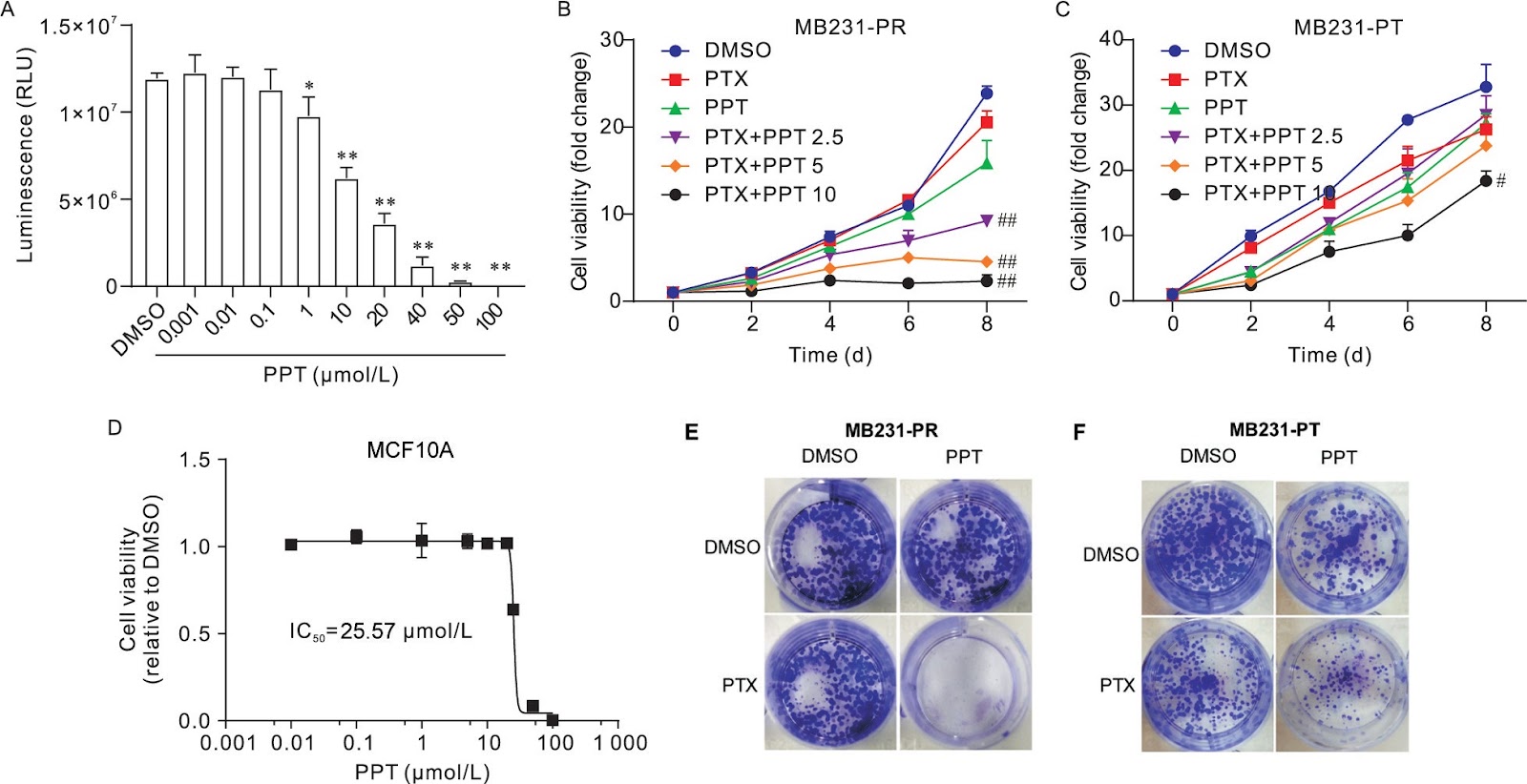
AIM: To investigate the effect of protopanaxatriol (PPT) on the drug resistance of paclitaxel (PTX)-resistant human breast cancer MDA-MB-231 cells (MB231-PR cells). METHODS: The MB231-PR cells were constructed as cell models. They were treated with PPT, and incubated for a certain period of time according to the experimental settings. CellTiter-Glo was used to determine the viability of MB231-PR cells and MDA-MB-231 parental cells (MB231-PT cells). The change of sub-G1 phase was detected by flow cytometry. Western blot was used to evaluate the apoptosis-related proteins, such as cleaved caspase-3, cleaved poly(ADP-ribose) polymerase (PARP), B-cell lymphoma-2 (Bcl-2), Bcl-2-associated X protein (Bax) and survivin. The activity of nuclear factor-κB (NF-κB) was detected by luciferase reporter assay and immunofluorescence assay. The mRNA expression levels of interleukin-6 (IL-6), IL-8, chemokine CXC motif ligand 1 (CXCL1), chemokine CC motif ligand 2 (CCL2), CD44, NANOG, octamer-binding transcription factor 4 (OCT4), sex-determining region Y-box 2 (SOX2) and aldehyde dehydrogenase 1 (ALDH1) were detected by qPCR. The protein levels of IL-6 and IL-8 were measured by ELISA. Tumor sphere formation assay was used to evaluate the characteristics of stem cells. RESULTS: (1) The viability of MB231-PR cells was suppressed by PPT treatment in a dose-dependent manner compared with MB231-PT cells (P<0.01). Besides, the viability of MB231-PR cells was decreased after combined treatment with PPT and PTX (P<0.01), the accumulation of sub-G1 phase was induced (P<0.01), the ratio of Bax/Bcl-2 was elevated (P<0.01), and the protein levels of survivin, cleaved PARP and cleaved caspase-3 were increased (P<0.05). (2) After PPT treatment combined with PTX, the mRNA expression of inflammatory cytokines (IL-6, IL-8, CXCL1 and CCL2) and cancer stem cell-related markers (OCT4, SOX2, NANOG, ALDH1 and CD44) was reduced (P<0.05), and the protein levels of IL-6 and IL-8 were decreased (P<0.01). The activity of NF-κB in MB231-PR cells was suppressed (P<0.05), and the growth of tumor spheres from MB231-PR cells was damaged (P<0.05). (3) Immunofluorescence assay showed that PTX induced nuclear p-p65 expression, but this effect was attenuated by PPT. CONCLUSION: Combined treatment with PPT and PTX could attenuate PTX resistance of MB231-PR cells by inhibiting inflammatory cytokines and cancer stem cells.