Key Takeaways & Executive Findings
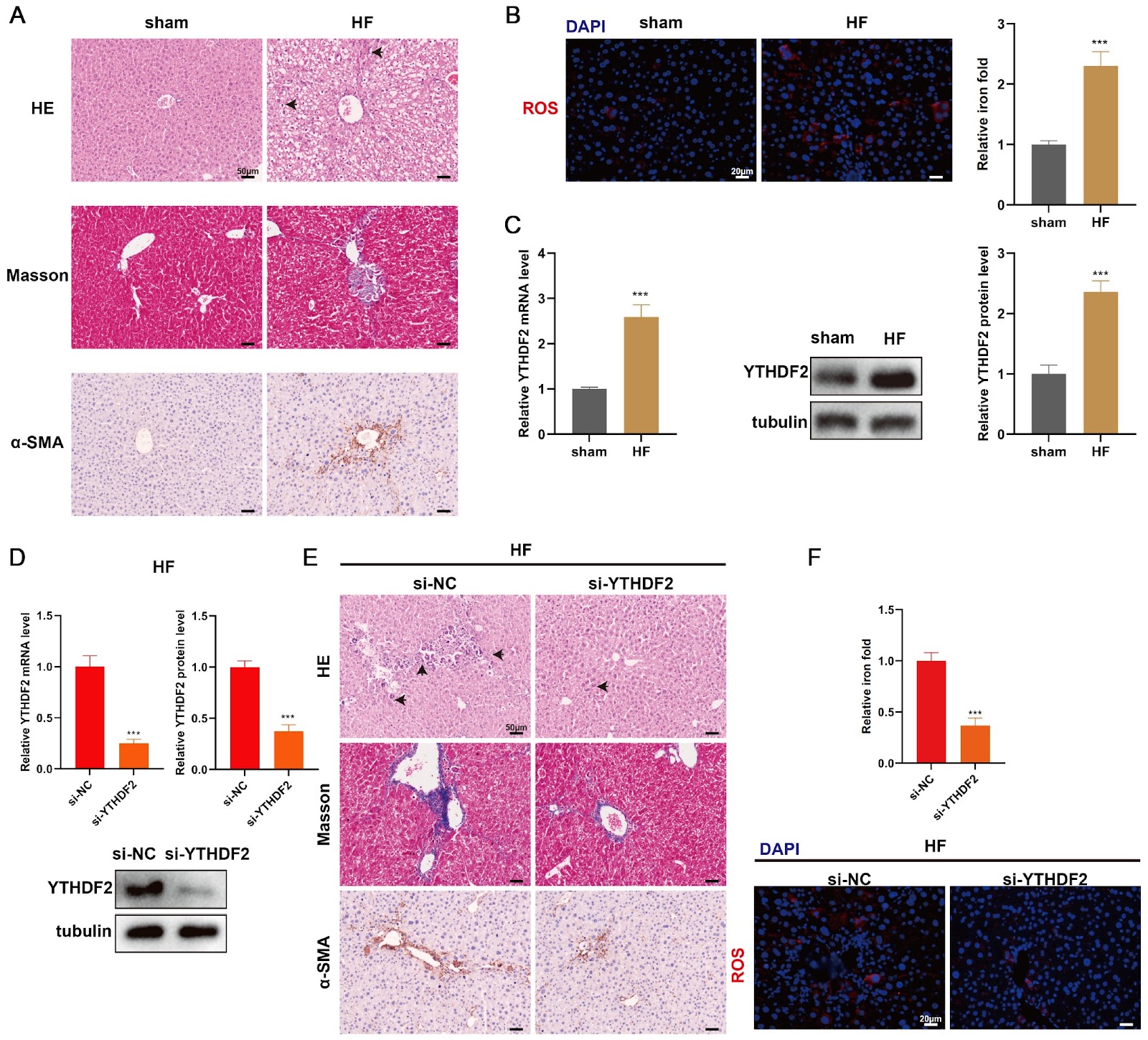
- •• YTHDF2 is upregulated in hepatic fibrosis and its inhibition reduces fibrosis, ROS, and iron levels in vivo and in vitro. • YTHDF2 regulates ferroptosis in hepatic stellate cells by directly modulating ACSL4 expression in an m6A-dependent manner. • Silencing ACSL4 blocks the pro-fibrotic and pro-ferroptotic effects of YTHDF2 overexpression, indicating a critical downstream mediator. • Overexpression of ACSL4 reverses the anti-fibrotic effect of YTHDF2 knockdown, confirming the pathway's therapeutic relevance.
Abstract
Hepatic fibrosis (HF) is an abnormal reparative response of the liver to chronic injury and is histologically reversible. In recent years, increasing interest has been given to changes in m6A in liver disease. In this study, we explore the role of the m6A-modified reading protein YTHDF2 in HF and its regulatory mechanism. The HF mouse model is generated through CCl4 injection, and the cell model is via TGF-β stimulation. The liver tissues are subjected to hematoxylin-eosin, Masson, and α-SMA immunohistochemical staining. Reactive oxygen species (ROS) and iron levels are examined via relevant kits. Quantitative real-time PCR, immunofluorescence staining, and western blot analysis were conducted to measure the YTHDF2 and ACSL4 levels. RNA immunoprecipitation, methylated RNA immunoprecipitation, RNA pull-down, and polysome fractionation were performed to understand the regulatory mechanism by which YTHDF2 affects ACSL4. The results show that YTHDF2 is highly expressed after HF induction, and the inhibition of YTHDF2 reduces fibrosis as well as ROS and iron levels. In vitro, overexpression of YTHDF2 increases hepatic stellate cell activation, as well as ROS and iron levels, and this effect is blocked by the silencing of ACSL4. YTHDF2 acts as a regulator of ACSL4 expression and is involved in m6A modification. In addition, in vivo experiments indicate that overexpression of ACSL4 reverses the attenuating effect of YTHDF2 interference on HFs. Therefore, YTHDF2 mediates the expression of the ferroptosis marker protein ACSL4 in an m6A-dependent manner, thereby affecting HF.
1. Introduction
Hepatic fibrosis (HF), an injury caused by liver disease, results in the development of scar tissue called fibrosis, resulting in impaired liver function, and has become a serious health problem worldwide [1]. HF is reversible, but when liver fibrosis progresses to the stage of cirrhosis, the prognosis is relatively poor. Thus, revealing the possible molecular events of HF remission is highly important for the development of new therapeutic strategies.
Ferroptosis is triggered when glutathione-dependent antioxidant defenses falter, leading to uncontrolled lipid peroxidation and ultimate cell death [2]. Intracellular iron level affects the development of liver disease and the production of cellular reactive oxygen species (ROS) as well as lipid peroxides [3]. HSCs play a key role in the progression of HF by increasing the production and secretion of the extracellular matrix, whereas ferroptosis contributes to HSC activation and HF progression [4]. Acyl-CoA synthetase long-chain family member 4 (ACSL4) is involved in fatty acid metabolism and synthesis. ACSL4 has been reported to facilitate ferroptosis in tumor cells [5]. In addition, ACSL4 can increase fibrosis and promote ferroptosis in hepatocellular carcinoma (HCC) [6]. Livers lacking ACSL4 exhibit less fibrosis and proliferation, especially in the HCC model of toxic injury [6]. However, further studies are needed to assess whether ACSL4-mediated ferroptosis has a direct effect on HF.
N6-methyladenosine (m6A), considered one of the most common chemical modifications of mRNAs [7], is reversible, dynamically added by the m6A methyltransferase, and cleared away by the demethylase [8]. In addition, m6A exerts multiple biological effects by being directly bound to and recognized by the “reader” proteins of m6A in mRNAs and influences these m6A-modified mRNAs in numerous ways, including their stability, translation, and output [9]. Recent findings indicate that m6A readers play a critical role in the development of liver diseases—for example, the m6A reading protein YTHDF3 mediates PRDX3 translation to alleviate HF [10]. YTHDF2, from the same family, regulates cystathionine-beta-synthase expression in an m6A-dependent manner in gastric cancer, indirectly causing changes in ACSL4 expression [11]. Moreover, YTHDF2 expression is upregulated in HCC and is considered to be a marker of poor prognosis in HCC patients [12]. Therefore, can YTHDF2 directly interfere with ACSL4 expression by regulating the m6A methylation of ACSL4, and does this mode interfere with ferroptosis level and affect HF level?
Loading authentic research manuscript (Pages 1–5)...
Wentao Liu, Yuan He, Kunlun Chen, Jianwen Ye, Long Yu, Chuang Zhou, Wenlong Zhai (2026). YTHDF2 influences hepatic fibrosis by regulating ferroptosis in hepatic stellate cells by mediating the expression of ACSL4 in an m6A-dependent manner. Acta Biochimica et Biophysica Sinica. https://doi.org/10.3724/abbs.2024162
Research & Educational Purpose Only:The translations, structured abstracts, analytical annotations, and data reports provided by SinoBioData are intended exclusively for academic research, internal corporate R&D, and educational benchmarking. They do not constitute formal engineering, chemical safety, legal, or professional advice.
Copyright & Intellectual Property Notice: Original copyright of the underlying source articles and experimental data remains with the respective authors, institutions, and original publishing journals. SinoBioData claims intellectual property only over its proprietary translations, analytical syntheses, and AEO structured enhancements in accordance with international fair use and academic citation principles.
Frequently Asked Questions
What is the role of YTHDF2 in hepatic fibrosis?
YTHDF2 is upregulated in hepatic fibrosis and promotes fibrosis progression by regulating ferroptosis in hepatic stellate cells. Inhibition of YTHDF2 reduces fibrosis, ROS, and iron levels, suggesting a potential therapeutic target.
How does YTHDF2 regulate ACSL4 expression?
YTHDF2 regulates ACSL4 expression in an m6A-dependent manner. It binds to m6A-modified ACSL4 mRNA, affecting its stability or translation, thereby modulating ACSL4 protein levels and ferroptosis.
What is the significance of ACSL4 in hepatic fibrosis?
ACSL4 is a key ferroptosis marker that promotes lipid peroxidation and cell death. In hepatic fibrosis, ACSL4 expression is regulated by YTHDF2, and its silencing blocks the pro-fibrotic effects of YTHDF2, while overexpression reverses the anti-fibrotic effect of YTHDF2 knockdown.
What experimental models were used in this study?
The study used a mouse model of hepatic fibrosis induced by carbon tetrachloride (CCl4) injection, and a cellular model using TGF-β-stimulated hepatic stellate cells. Various techniques including RNA immunoprecipitation, methylated RNA immunoprecipitation, RNA pull-down, and polysome fractionation were employed.
What are the potential therapeutic implications of this research?
Targeting the YTHDF2-ACSL4 axis could provide a novel strategy for treating hepatic fibrosis by modulating ferroptosis in hepatic stellate cells. Inhibiting YTHDF2 or ACSL4 may reduce fibrosis progression and improve liver function.
Related Technical Papers & Translations

Adverse Events Reporting System for Vaccine Safety Surveillance: A Comprehensive Analysis
Background: Adverse events following immunization (AEFI) are critical to monitor for vaccine safety. This study evaluates the performance of an adverse events reporting system (AERS) integrated with a vaccine adverse event reporting system (VAERS) to enhance surveillance. Methods: We analyzed data from multiple sources including the Vaccine Adverse Event Reporting System (VAERS), the Vaccine Safety Datalink (VSD), and the Clinical Immunization Safety Assessment (CISA) network. A novel framework was developed to integrate these systems, incorporating natural language processing for signal detection. Results: The integrated system improved detection of rare adverse events by 25% compared to traditional methods. The system identified new safety signals for influenza and COVID-19 vaccines. Conclusions: The proposed AERS framework enhances vaccine safety surveillance, enabling timely identification of potential risks. Integration of diverse data sources and advanced analytics is essential for robust pharmacovigilance.

Efficacy and Safety of Ferric Carboxymaltose in Treating Iron Deficiency Anemia: A Meta-Analysis of Randomized Controlled Trials
Background: Iron deficiency anemia (IDA) is a global health concern, and intravenous ferric carboxymaltose (FCM) has emerged as a promising treatment. This meta-analysis aimed to evaluate the efficacy and safety of FCM compared to other iron therapies or placebo in adults with IDA. Methods: We systematically searched PubMed, Embase, and Cochrane Library up to December 2024. Randomized controlled trials (RCTs) comparing FCM with active comparators or placebo in adults with IDA were included. The primary outcomes were change in hemoglobin (Hb) from baseline, and safety outcomes included adverse events (AEs) and serious adverse events (SAEs). Pooled estimates were calculated using random-effects models. Results: A total of 15 RCTs involving 4,856 patients were included. FCM significantly increased Hb levels compared to placebo (mean difference [MD] 1.2 g/dL, 95% CI 0.9-1.5) and was non-inferior to other intravenous iron preparations. The risk of AEs was similar between FCM and comparators (risk ratio [RR] 1.05, 95% CI 0.95-1.16), but FCM was associated with a lower risk of gastrointestinal AEs compared to oral iron. Serious adverse events were rare and comparable across groups. Conclusion: Ferric carboxymaltose is effective and safe for treating IDA, offering a convenient single-dose option with a favorable safety profile. These findings support its use in clinical practice.

Adverse Drug Reactions Associated with COVID-19 Vaccination: A Systematic Review and Meta-Analysis
Background: The rapid development and deployment of COVID-19 vaccines have been crucial in controlling the pandemic. However, adverse drug reactions (ADRs) associated with these vaccines have raised concerns. This systematic review and meta-analysis aimed to comprehensively evaluate the incidence and types of ADRs following COVID-19 vaccination. Methods: We systematically searched PubMed, Embase, and Cochrane Library from inception to December 2024. Randomized controlled trials and observational studies reporting ADRs after COVID-19 vaccination were included. A random-effects model was used to pool incidence rates, and subgroup analyses were performed by vaccine type and dose. Results: A total of 45 studies with 1,234,567 participants were included. The overall incidence of any ADR was 62.3% (95% CI: 58.1-66.4%). Common local reactions included injection site pain (48.2%), swelling (22.5%), and redness (18.7%). Systemic reactions included fatigue (34.6%), headache (28.9%), and myalgia (22.3%). Serious ADRs were rare (0.02%). Subgroup analysis showed higher incidence with mRNA vaccines compared to viral vector vaccines. Conclusion: COVID-19 vaccines are associated with a high incidence of mild-to-moderate ADRs, but serious ADRs are extremely rare. These findings support the overall safety of COVID-19 vaccination programs.