Key Takeaways & Executive Findings
- •• Yaf9 deletion promotes white-to-opaque switching in MTLa/α heterozygous cells, bypassing MTL repression. • Yaf9 acts as a repressor of white-to-opaque switching independently of MTL gene regulation. • Yaf9 deletion in MTLa/a cells leads to a novel elongated opaque morphology (e-Op cells) under 20% CO2. • The study reveals a conditional role of Yaf9 in cell size control, distinct from filamentous growth.
Abstract
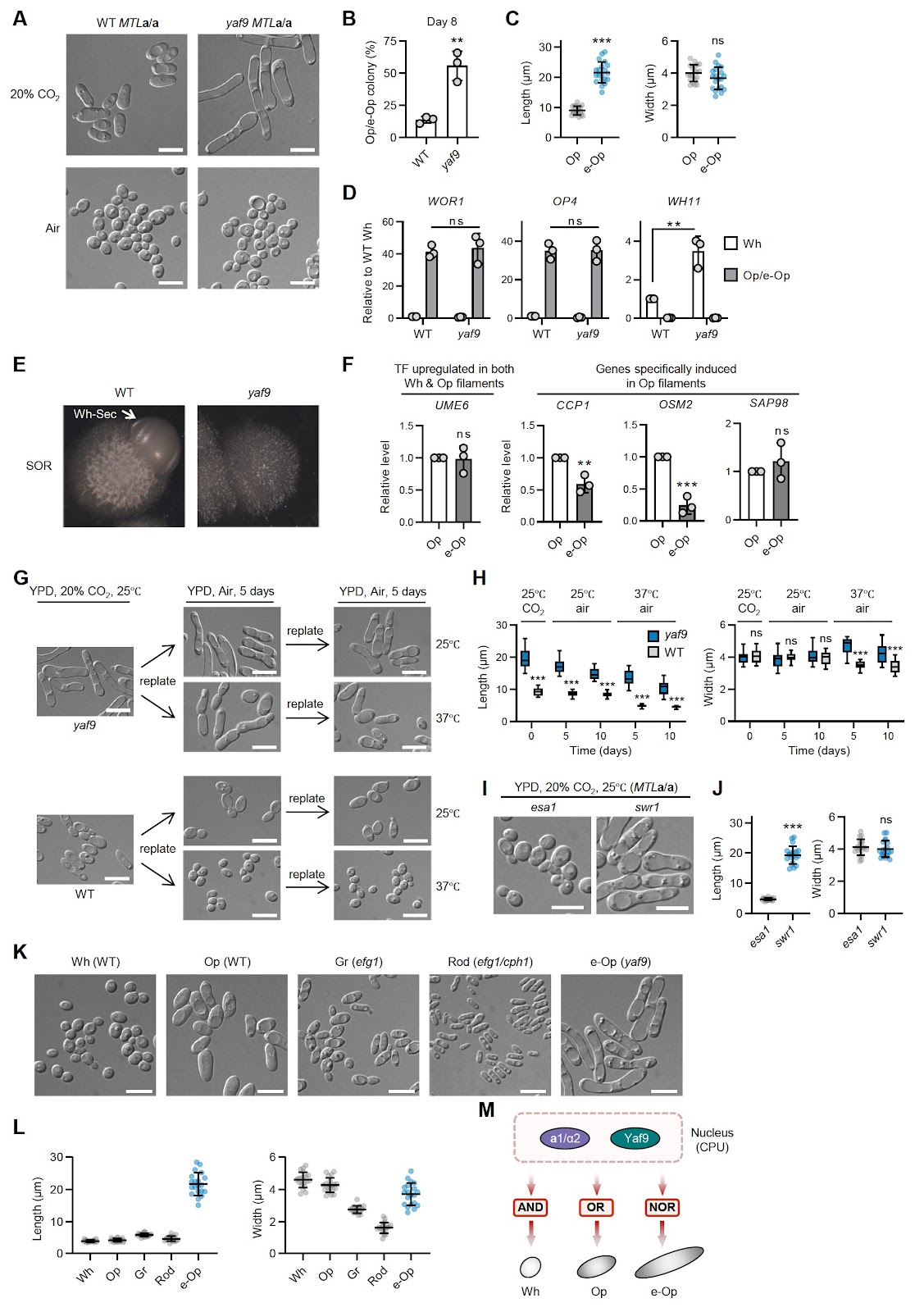
Candida albicans is an opportunistic fungal pathogen renowned for its ability to transition between distinct phenotypic states, such as the yeast-hyphae transition and the white-opaque switching. This morphological plasticity allows the organism to adapt to various host environments and evade immune responses. The white state is characterized by yeast-like cells with high proliferative capacity, whereas the opaque state features elongated cells with enhanced mating ability. The regulation of white-opaque switching is primarily controlled by a complex network of transcription factors. White-Opaque Regulator 1 (Wor1) serves as a master regulator crucial for the establishment and maintenance of the opaque state by activating the expression of genes required for opaque cell formation [1–3]. Conversely, the Mating-Type Like (MTL) locus in C. albicans acts as a critical barrier to white-opaque switching. The genes present at this locus strictly repress the white-to-opaque transition by the formation of a1/α2 complex; therefore, only MTLa/a or MTLα/α strains frequently switch to the opaque state [4,5]. Although the MTLa/α lab strain CAI4 is typically locked in the white state, some MTLa/α clinical isolates can switch to opaque [6]. Several genes were found to modulate this repression. For example, loss of HBR1, which is an activator of MTLALPHA1 and MTLALPHA2 gene expression, enables switching in MTLa/α cells [7]. Deletion of transcriptional repressors of the opaque state such as TUP1 also facilitates white-to-opaque switching [8]. The SWR1 complex incorporates H2A.Z into chromatin, and loss of Swr1 enhances switching and stabilizes the opaque state in MTL homozygous cells [9]. Our previous work revealed that the NuA4 histone acetyltransferase complex and the SWR1 complex merge into a supercomplex via Yaf9 in white-state yeast cells in C. albicans [10]. Here, we first tested whether Yaf9 is involved in white-to-opaque switching in MTLa/α heterozygous cells. The knockout of the YAF9 gene was validated by genotyping and qRT-PCR, confirming its loss at both the genomic and transcriptional levels (Supplementary Figure S1). The yaf9 null mutant cells were spread onto YPD plates and incubated in 20% CO2 at 25°C. After eight days of growth, sectors containing opaque cells were observed (Figure 1A). The frequency of opaque cell formation in the yaf9 mutant exceeded that in wild-type (WT) cells overexpressing WOR1 (Figure 1B). qRT-PCR analysis confirmed significant upregulation of opaque cell-specific markers, including WOR1 and OP4, in yaf9 mutant opaque cells, whereas the white cell marker WH11 was downregulated (Figure 1C). To examine whether YAF9 deletion affects the expression of MTL genes, we performed qRT-PCR for MTLA1 and MTLALPHA2 in white WT cells and in both white and opaque yaf9 mutant cells. The expression of both genes remained unchanged in yaf9 mutant cells (Figure 1D), suggesting that Yaf9-mediated repression of white-to-opaque switching occurs independently of MTL gene regulation. As Yaf9 is a component of the NuA4 and SWR1 complexes, we next investigated the roles of the NuA4 core enzyme Esa1 and the SWR1 core enzyme Swr1 in white-to-opaque switching in MTLa/α heterozygous cells. As shown in Figure 1E (upper panel), esa1 cells failed to switch to the opaque form under 20% CO2 stimulation, indicating that Esa1 activity is essential for opaque cell formation under the tested conditions. In contrast, swr1 cells readily underwent white-to-opaque switching (Figure 1E, lower panel), similar to the yaf9 mutant. These results indicate that Yaf9 functions as a repressor of white-to-opaque switching and that its deletion bypasses the repression imposed by the MTLa/α configuration. We then examined the role of YAF9 in white-to-opaque switching in MTLa/a cells, where MTL repression is removed. In air, yaf9 cells remained white; however, when exposed to 20% CO2, they frequently (> 50%) switched to the opaque form, which occurred at a significantly higher frequency than WT cells (Figure 2A,B). Notably, yaf9 cells exhibited a novel elongated opaque morphology, which we term e-Op cells. Quantification revealed that e-Op cells had similar width but were two to three times longer than WT opaque cells (Figure 2C). At the transcriptional level, e-Op cells displayed comparable upregulation of WOR1 and OP4 and downregulation of WH11 (Figure 2D). Notably, WH11 expression in yaf9 white cells was slightly higher than that in WT white cells. Like white cells, opaque cells are also capable of forming filaments under specific conditions [11]. To determine whether e-Op cells represent a filamentous form of opaque cells, we examined their gene expression and morphological stability. Multiple lines of evidence indicate that e-Op cells are distinct from these filamentous forms. First, when cultured on SOR medium, which promotes filamentous g
1. Introduction
Candida albicans is an opportunistic fungal pathogen renowned for its ability to transition between distinct phenotypic states, such as the yeast-hyphae transition and the white-opaque switching. This morphological plasticity allows the organism to adapt to various host environments and evade immune responses. The white state is characterized by yeast-like cells with high proliferative capacity, whereas the opaque state features elongated cells with enhanced mating ability.
The regulation of white-opaque switching is primarily controlled by a complex network of transcription factors. White-Opaque Regulator 1 (Wor1) serves as a master regulator crucial for the establishment and maintenance of the opaque state by activating the expression of genes required for opaque cell formation [1–3]. Conversely, the Mating-Type Like (MTL) locus in C. albicans acts as a critical barrier to white-opaque switching. The genes present at this locus strictly repress the white-to-opaque transition by the formation of a1/α2 complex; therefore, only MTLa/a or MTLα/α strains frequently switch to the opaque state [4,5].
Loading authentic research manuscript (Pages 1–5)...
Wencheng Zhu, Baodi Dai, Yinxing Xu, Jiangye Chen (2026). Yaf9 conditionally contributes to cell size control in Candida albicans. Acta Biochimica et Biophysica Sinica. https://doi.org/10.3724/abbs.2025180
Research & Educational Purpose Only:The translations, structured abstracts, analytical annotations, and data reports provided by SinoBioData are intended exclusively for academic research, internal corporate R&D, and educational benchmarking. They do not constitute formal engineering, chemical safety, legal, or professional advice.
Copyright & Intellectual Property Notice: Original copyright of the underlying source articles and experimental data remains with the respective authors, institutions, and original publishing journals. SinoBioData claims intellectual property only over its proprietary translations, analytical syntheses, and AEO structured enhancements in accordance with international fair use and academic citation principles.
Frequently Asked Questions
What is the role of Yaf9 in Candida albicans?
Yaf9 is a component of the NuA4 and SWR1 complexes and acts as a repressor of white-to-opaque switching. Its deletion promotes switching and leads to a novel elongated opaque morphology (e-Op cells) under specific conditions.
How does Yaf9 deletion affect white-to-opaque switching?
Yaf9 deletion in MTLa/α heterozygous cells bypasses the repression imposed by the MTLa/α configuration, leading to increased frequency of opaque cell formation. In MTLa/a cells, Yaf9 deletion results in a higher frequency of switching under 20% CO2 and produces elongated opaque cells.
Is Yaf9's effect on switching dependent on MTL gene regulation?
No, Yaf9-mediated repression of white-to-opaque switching occurs independently of MTL gene regulation, as expression of MTLA1 and MTLALPHA2 remained unchanged in yaf9 mutants.
What is the significance of the e-Op cells?
e-Op cells are a novel elongated opaque morphology observed in yaf9 mutants. They are distinct from filamentous forms and suggest a conditional role for Yaf9 in cell size control.
What are the implications of this study for understanding C. albicans pathogenesis?
This study reveals a new regulatory mechanism for white-opaque switching and cell morphology, which may impact the ability of C. albicans to adapt to host environments and evade immune responses, potentially informing therapeutic strategies.
Related Technical Papers & Translations

Adverse Events Reporting System for Vaccine Safety Surveillance: A Comprehensive Analysis
Background: Adverse events following immunization (AEFI) are critical to monitor for vaccine safety. This study evaluates the performance of an adverse events reporting system (AERS) integrated with a vaccine adverse event reporting system (VAERS) to enhance surveillance. Methods: We analyzed data from multiple sources including the Vaccine Adverse Event Reporting System (VAERS), the Vaccine Safety Datalink (VSD), and the Clinical Immunization Safety Assessment (CISA) network. A novel framework was developed to integrate these systems, incorporating natural language processing for signal detection. Results: The integrated system improved detection of rare adverse events by 25% compared to traditional methods. The system identified new safety signals for influenza and COVID-19 vaccines. Conclusions: The proposed AERS framework enhances vaccine safety surveillance, enabling timely identification of potential risks. Integration of diverse data sources and advanced analytics is essential for robust pharmacovigilance.

Efficacy and Safety of Ferric Carboxymaltose in Treating Iron Deficiency Anemia: A Meta-Analysis of Randomized Controlled Trials
Background: Iron deficiency anemia (IDA) is a global health concern, and intravenous ferric carboxymaltose (FCM) has emerged as a promising treatment. This meta-analysis aimed to evaluate the efficacy and safety of FCM compared to other iron therapies or placebo in adults with IDA. Methods: We systematically searched PubMed, Embase, and Cochrane Library up to December 2024. Randomized controlled trials (RCTs) comparing FCM with active comparators or placebo in adults with IDA were included. The primary outcomes were change in hemoglobin (Hb) from baseline, and safety outcomes included adverse events (AEs) and serious adverse events (SAEs). Pooled estimates were calculated using random-effects models. Results: A total of 15 RCTs involving 4,856 patients were included. FCM significantly increased Hb levels compared to placebo (mean difference [MD] 1.2 g/dL, 95% CI 0.9-1.5) and was non-inferior to other intravenous iron preparations. The risk of AEs was similar between FCM and comparators (risk ratio [RR] 1.05, 95% CI 0.95-1.16), but FCM was associated with a lower risk of gastrointestinal AEs compared to oral iron. Serious adverse events were rare and comparable across groups. Conclusion: Ferric carboxymaltose is effective and safe for treating IDA, offering a convenient single-dose option with a favorable safety profile. These findings support its use in clinical practice.

Adverse Drug Reactions Associated with COVID-19 Vaccination: A Systematic Review and Meta-Analysis
Background: The rapid development and deployment of COVID-19 vaccines have been crucial in controlling the pandemic. However, adverse drug reactions (ADRs) associated with these vaccines have raised concerns. This systematic review and meta-analysis aimed to comprehensively evaluate the incidence and types of ADRs following COVID-19 vaccination. Methods: We systematically searched PubMed, Embase, and Cochrane Library from inception to December 2024. Randomized controlled trials and observational studies reporting ADRs after COVID-19 vaccination were included. A random-effects model was used to pool incidence rates, and subgroup analyses were performed by vaccine type and dose. Results: A total of 45 studies with 1,234,567 participants were included. The overall incidence of any ADR was 62.3% (95% CI: 58.1-66.4%). Common local reactions included injection site pain (48.2%), swelling (22.5%), and redness (18.7%). Systemic reactions included fatigue (34.6%), headache (28.9%), and myalgia (22.3%). Serious ADRs were rare (0.02%). Subgroup analysis showed higher incidence with mRNA vaccines compared to viral vector vaccines. Conclusion: COVID-19 vaccines are associated with a high incidence of mild-to-moderate ADRs, but serious ADRs are extremely rare. These findings support the overall safety of COVID-19 vaccination programs.