Key Takeaways & Executive Findings
- •• VSIG2 is significantly downregulated in gastric cancer tissues and correlates with poor prognosis, tumor size, lymph node metastasis, TNM stage, and vascular invasion. • VSIG2 suppresses gastric cancer cell proliferation, migration, and metastasis in vitro and in vivo. • Mechanistically, VSIG2 competes with FBXW10 for binding to ANXA2, promoting K63-linked polyubiquitination of ANXA2 and its membrane localization, thereby inactivating the NF-κB pathway. • This study identifies the VSIG2/ANXA2/NF-κB axis as a novel therapeutic target and potential biomarker for gastric cancer.
Abstract
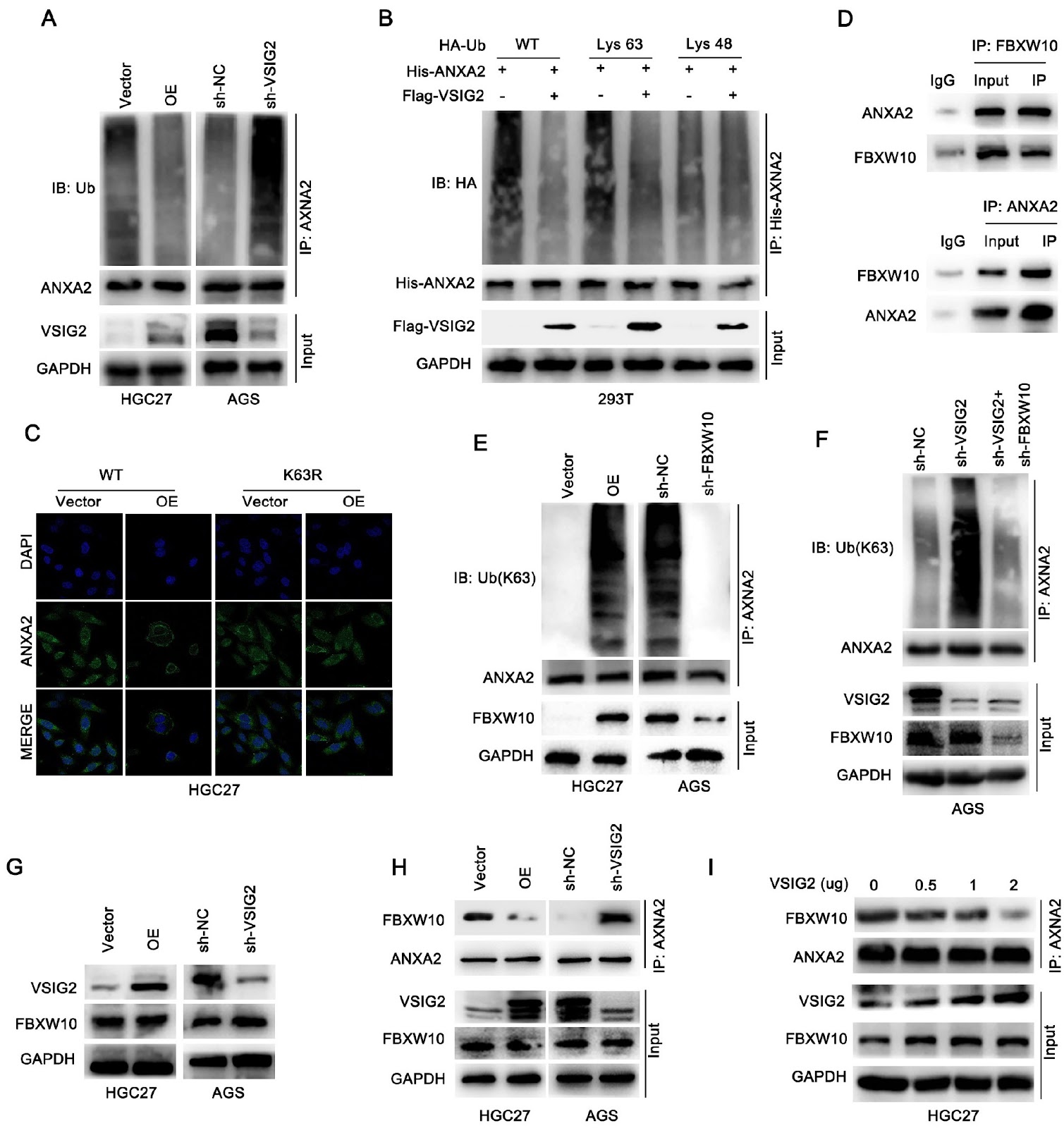
As the fifth most common cancer and the third leading cause of cancer death worldwide, gastric cancer (GC) has long been a serious global health challenge. The purpose of this study was to explore the expression of V-set and immunoglobulin domain containing 2 (VSIG2) in GC and to elucidate its role in GC progression and related mechanisms. Western blot analysis, qRT-PCR and immunohistochemical (IHC) staining are used to detect the expression of VSIG2 in GC cells and tissues. Kaplan-Meier survival curve analysis is performed. The effects of VSIG2 on biological effects related to GC progression in vitro are detected by CCK-8, EdU, Transwell and wound healing assays and in vivo by a nude mouse subcutaneous tumor model and a liver metastasis model. Mechanistically, co-immunoprecipitation, immunofluorescence and ubiquitination experiments are used to explore the regulatory effect of VSIG2 on ANXA2 and the regulatory effect between FBXW10 and ANXA2. VSIG2 is abnormally expressed at low levels in patients with GC and is associated with patient prognosis. Low VSIG2 expression is closely related to tumor size, lymph node metastasis, TNM stage and vascular invasion in GC patients. Functionally, in vitro and in vivo experiments reveal that VSIG2 could inhibit the growth, proliferation and metastasis of GC. Mechanistically, VSIG2 and ANXA2 interact directly in GCs and co-localize at the cell membrane. Further exploration reveals that highly expressed VSIG2 competes with FBXW10 for binding to ANXA2 and relies on FBXW10-mediated K63 polyubiquitination of ANXA2 to induce membrane localization of ANXA2 and further inactivate NF-κB, thereby suppressing GC progression. In summary, VSIG2 is expressed at abnormally low levels in patients with GC, and its low expression is associated with poor patient prognosis. VSIG2 can inhibit the proliferation and migration of GC via the ANXA2/NF-κB pathway. This study elucidates a new mechanism by which VSIG2 inhibits GC progression, which may provide a new perspective for the diagnosis and treatment of GC patients.
1. Introduction
Gastric cancer is the fifth most common malignant tumor in the world and the third leading cause of cancer-related death. In 2020, there were 1.09 million new cases and 769,000 deaths worldwide, of which more than 60% occurred in East Asia [1]. Helicobacter pylori (H. pylori) chronic infection accounts for approximately 78% of all cases and is classified by the WHO as a class I carcinogenic factor. It is expected that 11.9 million gastric cancer cases will be attributed to H. pylori infection in the cohort born from 2008 to 2017 [2]. Although endoscopic screening, radical surgery and perioperative FLOT regimens have significantly improved the prognosis of patients with resectable disease, the 5-year survival rate of patients with advanced or metastatic gastric cancer is still less than 20% [3]. Molecular mapping studies (TCGA & ACRG) have revealed four subtypes, namely, EBV-positive, microsatellite instability, chromosome instability, and genomic stability, providing a precise framework for the targeting and immunotherapy of HER2, claudin 18.2, VEGFR2, and PD-1/PD-L1. However, tumor microenvironment-mediated immune escape and targeted drug resistance are still the biggest challenges [4]. Therefore, in-depth analysis of the molecular network of gastric cancer development and the development of new joint strategies are urgently needed to improve the survival rate of patients.
V-set and immunoglobulin domain-containing 2 (VSIG2) is an emerging B7-like immune checkpoint whose expression topography has quietly shifted from a “thymocyte relic” to a decisive regulator of tumor–immune crosstalk [5]. First cloned as the Xenopus cortical thymocyte marker CTXL, human VSIG2 maps to 11q24.2 and encodes a 283-aa type-I glycoprotein that pairs a membrane-distal IgV with a juxtamembrane IgC2 domain [6]. Transcriptomic atlases now reveal that VSIG2 is not confined to the thymus but is highly enriched in gastric and colonic epithelia, renal tubules, and critically tumour-associated macrophages and B cells [7]. Functionally, VSIG2 behaves as a Janus-faced rheostat: in pancreatic ductal adenocarcinoma, VSIG2 partners with LAMTOR2 to hyperactivate mTOR, fuelling glycolytic reprogramming and aggressive invasion; conversely, in colorectal cancer, VSIG2 loss is linked to reduced M1 macrophage and B-cell infiltration, dampened antigen presentation, and shortened survival [8,9]. Single-cell interrogations further revealed that VSIG2 expression inversely correlates with cytotoxic CD8⁺ T-cell programs and synergizes with tumour-derived lactate to enforce an immunosuppressive niche [10]. However, whether VSIG2 plays a critical role in GC progression and is a tractable target for next-generation precision immunotherapy remain to be probed.
Loading authentic research manuscript (Pages 1–5)...
Qingfeng Ni, Yang Wang, Xinyue Bian, Qiuchan Qu, Boyuan Shen, Yuanjie Niu, Jiawei Yu, Jianwei Zhu (2026). VSIG2 hinders gastric cancer progression by suppressing ANXA2-mediated NF-κB pathway activation. Acta Biochimica et Biophysica Sinica. https://doi.org/10.3724/abbs.2025202
Research & Educational Purpose Only:The translations, structured abstracts, analytical annotations, and data reports provided by SinoBioData are intended exclusively for academic research, internal corporate R&D, and educational benchmarking. They do not constitute formal engineering, chemical safety, legal, or professional advice.
Copyright & Intellectual Property Notice: Original copyright of the underlying source articles and experimental data remains with the respective authors, institutions, and original publishing journals. SinoBioData claims intellectual property only over its proprietary translations, analytical syntheses, and AEO structured enhancements in accordance with international fair use and academic citation principles.
Frequently Asked Questions
What is the role of VSIG2 in gastric cancer?
VSIG2 is downregulated in gastric cancer and acts as a tumor suppressor by inhibiting proliferation, migration, and metastasis through the ANXA2/NF-κB pathway.
How does VSIG2 regulate the NF-κB pathway?
VSIG2 competes with FBXW10 for binding to ANXA2, promoting K63-linked polyubiquitination of ANXA2 and its membrane localization, which inactivates NF-κB signaling.
What is the clinical significance of VSIG2 expression?
Low VSIG2 expression is associated with poor prognosis, larger tumor size, lymph node metastasis, advanced TNM stage, and vascular invasion in gastric cancer patients.
Could VSIG2 be a therapeutic target?
Yes, the study suggests that restoring VSIG2 expression or targeting the VSIG2/ANXA2/NF-κB axis may offer new therapeutic strategies for gastric cancer.
What methods were used in this study?
The study employed Western blot, qRT-PCR, immunohistochemistry, CCK-8, EdU, Transwell, wound healing assays, in vivo mouse models, co-immunoprecipitation, immunofluorescence, and ubiquitination experiments.
Related Technical Papers & Translations

Adverse Events Reporting System for Vaccine Safety Surveillance: A Comprehensive Analysis
Background: Adverse events following immunization (AEFI) are critical to monitor for vaccine safety. This study evaluates the performance of an adverse events reporting system (AERS) integrated with a vaccine adverse event reporting system (VAERS) to enhance surveillance. Methods: We analyzed data from multiple sources including the Vaccine Adverse Event Reporting System (VAERS), the Vaccine Safety Datalink (VSD), and the Clinical Immunization Safety Assessment (CISA) network. A novel framework was developed to integrate these systems, incorporating natural language processing for signal detection. Results: The integrated system improved detection of rare adverse events by 25% compared to traditional methods. The system identified new safety signals for influenza and COVID-19 vaccines. Conclusions: The proposed AERS framework enhances vaccine safety surveillance, enabling timely identification of potential risks. Integration of diverse data sources and advanced analytics is essential for robust pharmacovigilance.

Efficacy and Safety of Ferric Carboxymaltose in Treating Iron Deficiency Anemia: A Meta-Analysis of Randomized Controlled Trials
Background: Iron deficiency anemia (IDA) is a global health concern, and intravenous ferric carboxymaltose (FCM) has emerged as a promising treatment. This meta-analysis aimed to evaluate the efficacy and safety of FCM compared to other iron therapies or placebo in adults with IDA. Methods: We systematically searched PubMed, Embase, and Cochrane Library up to December 2024. Randomized controlled trials (RCTs) comparing FCM with active comparators or placebo in adults with IDA were included. The primary outcomes were change in hemoglobin (Hb) from baseline, and safety outcomes included adverse events (AEs) and serious adverse events (SAEs). Pooled estimates were calculated using random-effects models. Results: A total of 15 RCTs involving 4,856 patients were included. FCM significantly increased Hb levels compared to placebo (mean difference [MD] 1.2 g/dL, 95% CI 0.9-1.5) and was non-inferior to other intravenous iron preparations. The risk of AEs was similar between FCM and comparators (risk ratio [RR] 1.05, 95% CI 0.95-1.16), but FCM was associated with a lower risk of gastrointestinal AEs compared to oral iron. Serious adverse events were rare and comparable across groups. Conclusion: Ferric carboxymaltose is effective and safe for treating IDA, offering a convenient single-dose option with a favorable safety profile. These findings support its use in clinical practice.

Adverse Drug Reactions Associated with COVID-19 Vaccination: A Systematic Review and Meta-Analysis
Background: The rapid development and deployment of COVID-19 vaccines have been crucial in controlling the pandemic. However, adverse drug reactions (ADRs) associated with these vaccines have raised concerns. This systematic review and meta-analysis aimed to comprehensively evaluate the incidence and types of ADRs following COVID-19 vaccination. Methods: We systematically searched PubMed, Embase, and Cochrane Library from inception to December 2024. Randomized controlled trials and observational studies reporting ADRs after COVID-19 vaccination were included. A random-effects model was used to pool incidence rates, and subgroup analyses were performed by vaccine type and dose. Results: A total of 45 studies with 1,234,567 participants were included. The overall incidence of any ADR was 62.3% (95% CI: 58.1-66.4%). Common local reactions included injection site pain (48.2%), swelling (22.5%), and redness (18.7%). Systemic reactions included fatigue (34.6%), headache (28.9%), and myalgia (22.3%). Serious ADRs were rare (0.02%). Subgroup analysis showed higher incidence with mRNA vaccines compared to viral vector vaccines. Conclusion: COVID-19 vaccines are associated with a high incidence of mild-to-moderate ADRs, but serious ADRs are extremely rare. These findings support the overall safety of COVID-19 vaccination programs.