Key Takeaways & Executive Findings
- •• Vaccarin (VAC) improves renal function and mitigates histological damage in a mouse model of type 2 diabetic nephropathy (DN). • VAC inhibits renal fibrosis, inflammation, oxidative stress, and epithelial-mesenchymal transition (EMT) in diabetic kidneys and high glucose-induced HK-2 cells. • Network pharmacology and molecular docking identify EGFR as a direct target of VAC, with binding mediated by Lys-879, Ile-918, and Ala-920. • VAC suppresses the EGFR/ERK1/2 signaling pathway, and blocking either EGFR or ERK1/2 mimics its renal benefits, suggesting a novel therapeutic strategy for DN.
Abstract
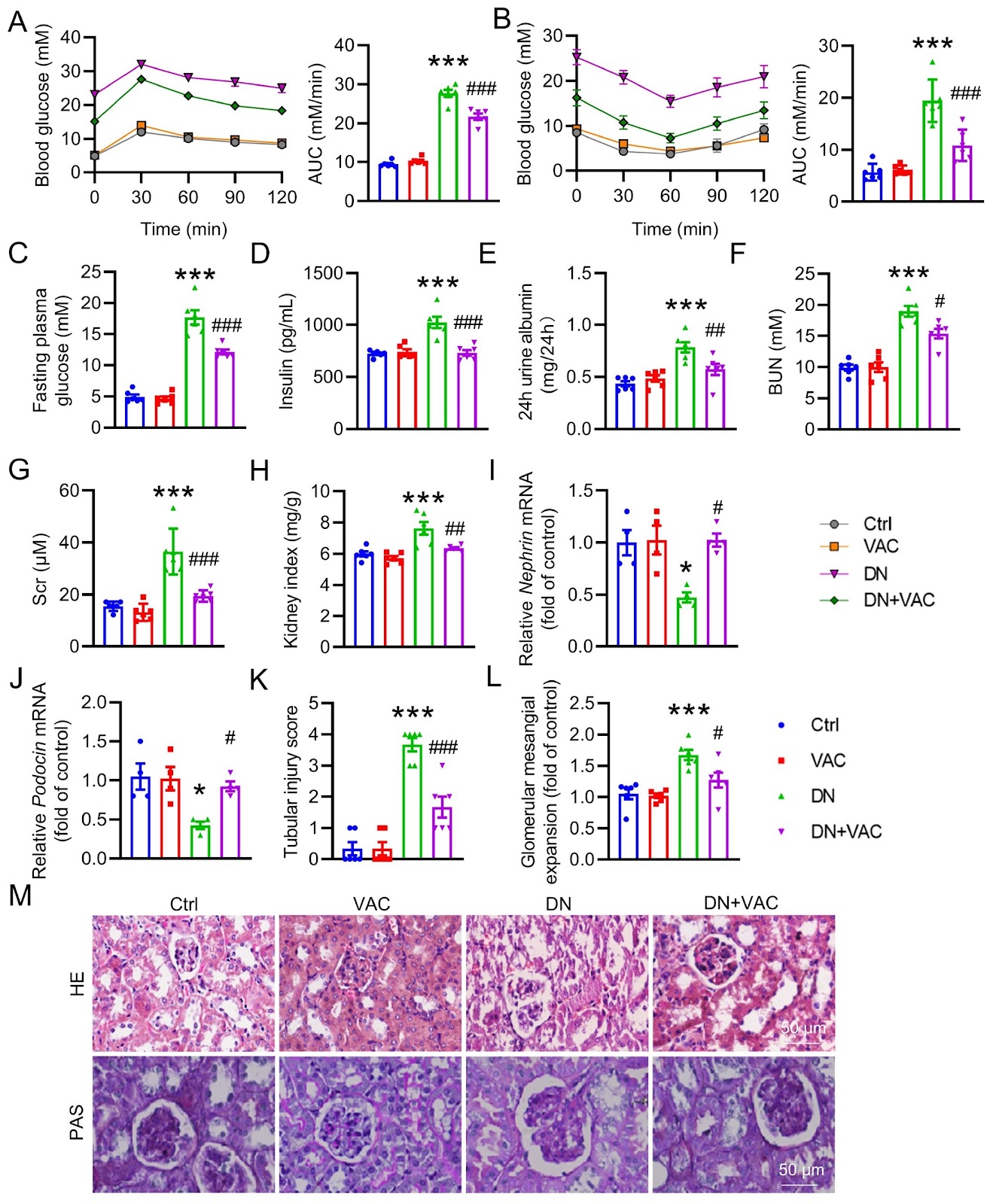
Diabetic nephropathy (DN) is recognized as one of the primary causes of chronic kidney disease and end-stage renal disease. Vaccarin (VAC) confers favorable effects on cardiovascular and metabolic diseases, including type 2 diabetes mellitus (T2DM). Nonetheless, the potential role and mechanism of VAC in the etiology of DN have yet to be completely elucidated. In this study, a classical mouse model of T2DM is experimentally induced via a high-fat diet (HFD)/streptozocin (STZ) regimen. Renal histological changes are assessed via H&E staining. Masson staining and immunohistochemistry (IHC) are employed to assess renal fibrosis. RT-PCR is utilized to quantify the mRNA levels of renal fibrosis, oxidative stress and inflammation markers. The levels of malondialdehyde (MDA) and reactive oxygen species (ROS), as well as the content of glutathione peroxidase (GSH-Px), are measured. The protein expressions of collagen I, TGF-β1, α-SMA, E-cadherin, Nrf2, catalase, SOD3, SOD2, SOD1, p-ERK, p-EGFR (Y845), p-EGFR (Y1173), p-NFκB P65, t-ERK, t-EGFR and t-NFκB P65 are detected by western blot analysis. Our results reveal that VAC has a beneficial effect on DN mice by improving renal function and mitigating histological damage. This is achieved through its inhibition of renal fibrosis, inflammatory cytokine overproduction, and ROS generation. Moreover, VAC treatment effectively suppresses the process of epithelial-mesenchymal transition (EMT), a crucial characteristic of renal fibrosis, in high glucose (HG)-induced HK-2 cells. Network pharmacology analysis and molecular docking identify epidermal growth factor receptor (EGFR) as a potential target for VAC. Amino acid site mutations reveal that Lys-879, Ile-918, and Ala-920 of EGFR may mediate the direct binding of VAC to EGFR. In support of these findings, VAC reduces the phosphorylation levels of both EGFR and its downstream mediator, extracellular signal-regulated kinase 1/2 (ERK1/2), in diabetic kidneys and HG-treated HK-2 cells. Notably, blocking either EGFR or ERK1/2 yields renal benefits similar to those observed with VAC treatment. Therefore, this study reveals that VAC attenuates renal damage via inactivation of the EGFR/ERK1/2 signaling axis in T2DM patients.
1. Introduction
For several decades, diabetic nephropathy (DN) has been considered a leading cause of chronic kidney disease and end-stage renal disease [1,2]. Recently, it has been estimated that 550 million people worldwide will suffer from diabetes by 2030, and approximately 50% of patients with type 2 diabetes will develop DN [3,4]. DN is characterized by proteinuria, excessive mesangial matrix formation and renal fibrosis [5,6]. Renal fibrosis is the main pathological event in the development of DN [7]. Renal fibrosis usually manifests as overproduction of the extracellular matrix (ECM), including collagen I, in the renal tubulointerstitium [8].
Renal tubular epithelial cells are damaged in the early stage of DN [9]. Long-term exposure to hyperglycemia leads to the transformation of tubular structure to renal interstitial structure, which is also known as epithelial-to-mesenchymal transition (EMT). Once the process of EMT occurs, the ECM is dispersed around tubular structures, causing irreversible damage to the renal structure [10,11]. Accumulating evidence suggests that transforming growth factor-β1 (TGF-β1) plays a pivotal role in DN progression by triggering the TGF-β1/Smad signaling pathway, a significant fibrogenic pathway [12,13].
Epidermal growth factor receptor (EGFR) is generally expressed in renal epithelial cells [14,15]. EGFR binding to ligands leads to activation of the intrinsic kinase domain at Y1173 [14,16]. In addition, EGFR can be phosphorylated at Y845 via a nonligand pathway mediated by oxidative stress [17]. Mounting evidence indicates that EGFR is a pivotal mediator in the process of renal fibrosis [18,19]. High glucose (HG)-mediated EGFR phosphorylation and ERK1/2 activation promote TGF-β expression and induce renal fibrosis [17]. Despite the increasing understanding of its pathology, DN remains a leading cause of mortality in diabetic patients. Therefore, the development of novel effective drugs to prevent or treat DN is imperative.
Loading authentic research manuscript (Pages 1–5)...
Xuexue Zhu, Xinyu Meng, Xinyao Du, Chenyang Zhao, Xinyu Ma, Yuanyuan Wen, Shijie Zhang, Bao Hou, Weiwei Cai, Bin Du, Zhijun Han, Fei Xu, Liying Qiu, Haijian Sun (2026). Vaccarin suppresses diabetic nephropathy through inhibiting the EGFR/ERK1/2 signaling pathway. Acta Biochimica et Biophysica Sinica. https://doi.org/10.3724/abbs.2024141
Research & Educational Purpose Only:The translations, structured abstracts, analytical annotations, and data reports provided by SinoBioData are intended exclusively for academic research, internal corporate R&D, and educational benchmarking. They do not constitute formal engineering, chemical safety, legal, or professional advice.
Copyright & Intellectual Property Notice: Original copyright of the underlying source articles and experimental data remains with the respective authors, institutions, and original publishing journals. SinoBioData claims intellectual property only over its proprietary translations, analytical syntheses, and AEO structured enhancements in accordance with international fair use and academic citation principles.
Frequently Asked Questions
What is the main finding of this study?
The study demonstrates that Vaccarin (VAC) suppresses diabetic nephropathy by inhibiting the EGFR/ERK1/2 signaling pathway, thereby reducing renal fibrosis, inflammation, and oxidative stress.
How does Vaccarin exert its protective effects on the kidney?
Vaccarin directly binds to EGFR at specific amino acid residues (Lys-879, Ile-918, Ala-920), reducing EGFR phosphorylation and downstream ERK1/2 activation, which in turn inhibits epithelial-mesenchymal transition and renal fibrosis.
What experimental models were used in this study?
The study used a high-fat diet/streptozocin-induced mouse model of type 2 diabetes and high glucose-treated HK-2 cells (human kidney proximal tubular epithelial cells).
What are the clinical implications of this research?
The findings suggest that Vaccarin could be developed as a novel therapeutic agent for diabetic nephropathy, offering a targeted approach to modulate the EGFR/ERK1/2 pathway.
What is the significance of the EGFR/ERK1/2 pathway in diabetic nephropathy?
The EGFR/ERK1/2 pathway is a key mediator of renal fibrosis and inflammation in diabetic nephropathy. Inhibiting this pathway with Vaccarin provides renal protection, highlighting its potential as a drug target.
Related Technical Papers & Translations

Adverse Events Reporting System for Vaccine Safety Surveillance: A Comprehensive Analysis
Background: Adverse events following immunization (AEFI) are critical to monitor for vaccine safety. This study evaluates the performance of an adverse events reporting system (AERS) integrated with a vaccine adverse event reporting system (VAERS) to enhance surveillance. Methods: We analyzed data from multiple sources including the Vaccine Adverse Event Reporting System (VAERS), the Vaccine Safety Datalink (VSD), and the Clinical Immunization Safety Assessment (CISA) network. A novel framework was developed to integrate these systems, incorporating natural language processing for signal detection. Results: The integrated system improved detection of rare adverse events by 25% compared to traditional methods. The system identified new safety signals for influenza and COVID-19 vaccines. Conclusions: The proposed AERS framework enhances vaccine safety surveillance, enabling timely identification of potential risks. Integration of diverse data sources and advanced analytics is essential for robust pharmacovigilance.

Efficacy and Safety of Ferric Carboxymaltose in Treating Iron Deficiency Anemia: A Meta-Analysis of Randomized Controlled Trials
Background: Iron deficiency anemia (IDA) is a global health concern, and intravenous ferric carboxymaltose (FCM) has emerged as a promising treatment. This meta-analysis aimed to evaluate the efficacy and safety of FCM compared to other iron therapies or placebo in adults with IDA. Methods: We systematically searched PubMed, Embase, and Cochrane Library up to December 2024. Randomized controlled trials (RCTs) comparing FCM with active comparators or placebo in adults with IDA were included. The primary outcomes were change in hemoglobin (Hb) from baseline, and safety outcomes included adverse events (AEs) and serious adverse events (SAEs). Pooled estimates were calculated using random-effects models. Results: A total of 15 RCTs involving 4,856 patients were included. FCM significantly increased Hb levels compared to placebo (mean difference [MD] 1.2 g/dL, 95% CI 0.9-1.5) and was non-inferior to other intravenous iron preparations. The risk of AEs was similar between FCM and comparators (risk ratio [RR] 1.05, 95% CI 0.95-1.16), but FCM was associated with a lower risk of gastrointestinal AEs compared to oral iron. Serious adverse events were rare and comparable across groups. Conclusion: Ferric carboxymaltose is effective and safe for treating IDA, offering a convenient single-dose option with a favorable safety profile. These findings support its use in clinical practice.

Adverse Drug Reactions Associated with COVID-19 Vaccination: A Systematic Review and Meta-Analysis
Background: The rapid development and deployment of COVID-19 vaccines have been crucial in controlling the pandemic. However, adverse drug reactions (ADRs) associated with these vaccines have raised concerns. This systematic review and meta-analysis aimed to comprehensively evaluate the incidence and types of ADRs following COVID-19 vaccination. Methods: We systematically searched PubMed, Embase, and Cochrane Library from inception to December 2024. Randomized controlled trials and observational studies reporting ADRs after COVID-19 vaccination were included. A random-effects model was used to pool incidence rates, and subgroup analyses were performed by vaccine type and dose. Results: A total of 45 studies with 1,234,567 participants were included. The overall incidence of any ADR was 62.3% (95% CI: 58.1-66.4%). Common local reactions included injection site pain (48.2%), swelling (22.5%), and redness (18.7%). Systemic reactions included fatigue (34.6%), headache (28.9%), and myalgia (22.3%). Serious ADRs were rare (0.02%). Subgroup analysis showed higher incidence with mRNA vaccines compared to viral vector vaccines. Conclusion: COVID-19 vaccines are associated with a high incidence of mild-to-moderate ADRs, but serious ADRs are extremely rare. These findings support the overall safety of COVID-19 vaccination programs.