Key Takeaways & Executive Findings
- •• EVs are versatile nanocarriers of biomolecules, playing dual roles in tumor promotion and antitumor immunity. • Molecular imaging and tracing technologies enable real-time monitoring of EV dynamics in vivo, enhancing cancer theranostics. • Engineered EVs serve as both therapeutic vehicles and imaging probes, offering precision in tumor targeting. • EV-based strategies hold promise for improving the precision and efficacy of tumor therapies, paving the way for clinical translation.
Abstract
Extracellular vesicles (EVs), a class of nanoscale, membrane-bound vesicles secreted by various cell types, have emerged as rapidly advancing fields of research in recent years. This heterogeneous vesicle is a versatile carrier system for a variety of biomolecules, including proteins, nucleic acids, and metabolites. EVs play pivotal roles in intercellular communication, immune regulation, and disease pathogenesis, with particular implications for cancer biology. On the one hand, EVs promote tumor progression and metastasis by facilitating communication between cancer cells and their microenvironment. On the other hand, EVs carry noncoding RNAs, such as miRNAs and other regulatory RNAs, which directly modulate immune cell function or exert antitumor effects by influencing cancer cell proliferation and apoptosis. In addition to their biological roles, EVs show great potential as drug delivery systems because of their ability to be effectively taken up by target cells and stably deliver therapeutic payloads. In the context of cancer therapy, natural EVs demonstrate inherent therapeutic potential, particularly in targeting highly metabolically active organs. Furthermore, engineered EVs, which serve as both therapeutic vehicles and molecular imaging probes, have demonstrated significant potential for cancer theranostics. This review focuses on elucidating the dynamic changes and biological functions of EVs in vivo, with the aim of exploring the translational potential of EV-based molecular imaging and tracing technologies in cancer treatment. This work seeks to provide critical insights that may enhance the precision and efficacy of tumor therapies, offering a foundation for future clinical applications.
1. Introduction
Extracellular vesicles (EVs) represent a heterogeneous population of membrane-bound nanostructures that are actively secreted into various biological fluids. These evolutionarily conserved nanovesicles are ubiquitously produced by virtually all cell types and are naturally present in physiological fluids, including blood, saliva, urine, and breast milk. On the basis of their biogenesis pathways and size distribution, EVs can be classified into two primary schemes: size-based categorization and biogenesis-dependent subtyping. On the basis of their dimensional parameters, EVs can be broadly divided into small EVs (< 200 nm) and large EVs (> 200 nm). The biogenesis classification yields distinct subtypes, including exosomes (derived from multivesicular bodies), ectosomes (plasma membrane-derived), migrasomes (migration-dependent release), and apoptotic bodies (cell death-associated), among others [1]. In particular, small EVs, the smallest subtype characterized by their endosomal origin, serve as natural nanocarriers of diverse biomolecular cargo, including proteins, nucleic acids (e.g., mRNAs, microRNAs, lncRNAs, circRNAs), and metabolites. The intricate combination of these biomolecular components confers dual functionality to EVs, serving as both crucial biological messengers in cellular communication networks and efficient natural carriers for targeted therapeutic applications.
The biogenesis of EVs is initiated by invagination of the plasma membrane, which results in the formation of specialized microdomains that selectively incorporate extracellular components and membrane-associated molecules, thereby generating early endosomes. These early endosomes subsequently undergo a maturation process involving complex biochemical modifications and structural remodeling, ultimately transforming into multivesicular bodies (MVBs). During MVB formation, the limiting membrane of late endosomes buds inwardly, giving rise to intraluminal vesicles (ILVs) through a tightly regulated process. This crucial step is governed primarily by the endosomal sorting complex required for transport (ESCRT) machinery. The ESCRT system orchestrates the precise sorting and packaging of proteins, nucleic acids, and other biomolecules into ILVs, which constitute the fundamental cargo of future EVs. Notably, MVBs can undergo distinct trafficking fates: they may either fuse with the plasma membrane to release ILVs as EVs into the extracellular space or, alternatively, merge with lysosomes, leading to the degradation of their intraluminal contents through lysosomal enzymatic activity. This dual fate underscores the dynamic regulation of EV biogenesis and secretion (Figure 1).
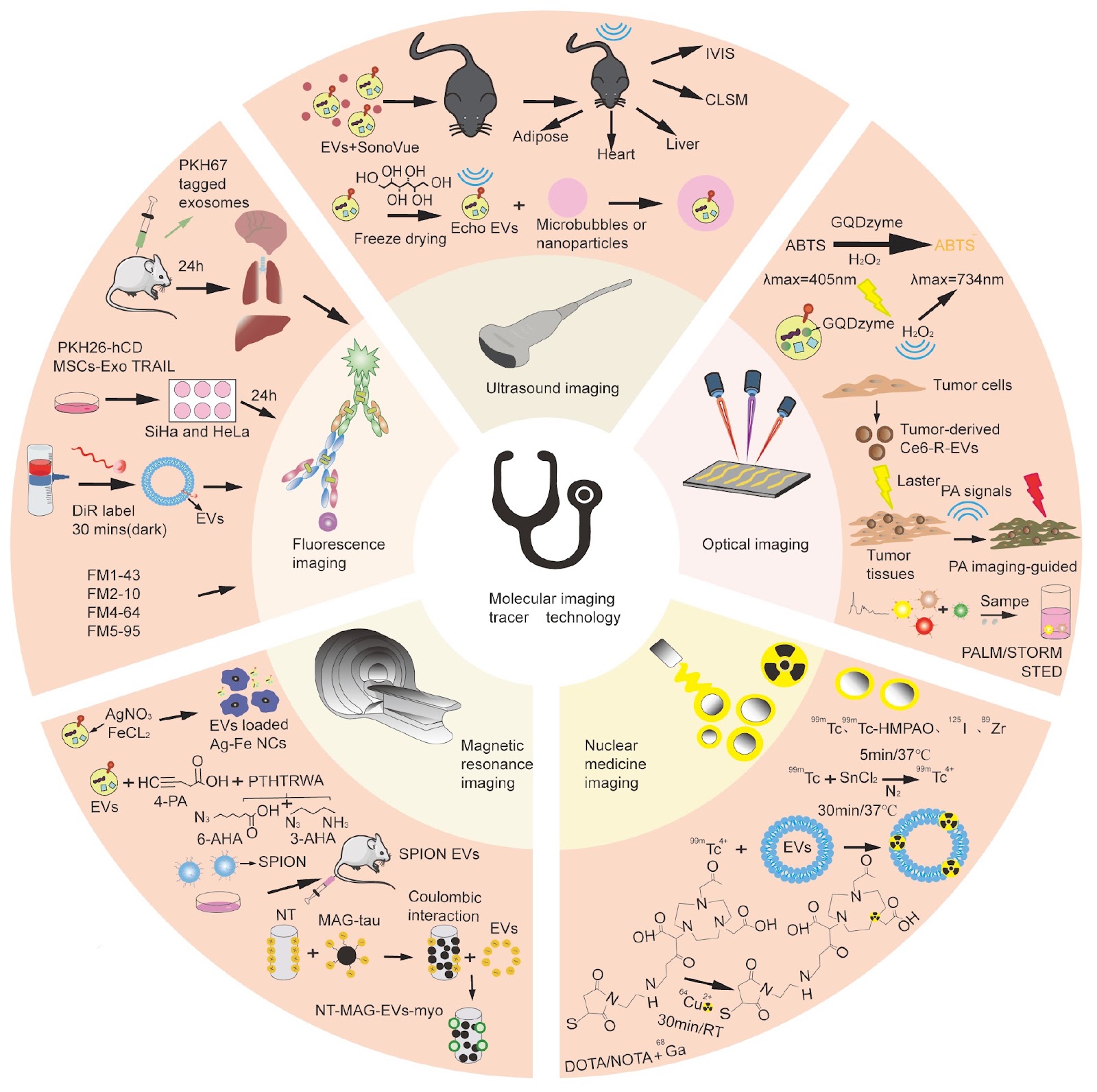
This review focuses on the analysis of the dynamic changes in EVs in vivo and explores the application value of EV molecular imaging tracer technology in tumor treatment in detail, aiming to lay a foundation for providing more accurate information on the effects of tumor treatment and important information.
Loading authentic research manuscript (Pages 1–5)...
Yuqin Teng, Gang Huang, Hao Yang (2026). Unveiling the multifaceted roles of extracellular vesicles in cancer: insights from molecular imaging and engineering strategies. Acta Biochimica et Biophysica Sinica. https://doi.org/10.3724/abbs.2025123
Research & Educational Purpose Only:The translations, structured abstracts, analytical annotations, and data reports provided by SinoBioData are intended exclusively for academic research, internal corporate R&D, and educational benchmarking. They do not constitute formal engineering, chemical safety, legal, or professional advice.
Copyright & Intellectual Property Notice: Original copyright of the underlying source articles and experimental data remains with the respective authors, institutions, and original publishing journals. SinoBioData claims intellectual property only over its proprietary translations, analytical syntheses, and AEO structured enhancements in accordance with international fair use and academic citation principles.
Frequently Asked Questions
What are extracellular vesicles (EVs) and why are they important in cancer?
Extracellular vesicles are nanoscale membrane-bound particles secreted by cells, carrying proteins, nucleic acids, and metabolites. In cancer, they mediate intercellular communication, influencing tumor progression, metastasis, and immune modulation, making them crucial for understanding cancer biology and developing novel therapies.
How can molecular imaging and engineering strategies enhance EV-based cancer therapy?
Molecular imaging allows real-time tracking of EVs in vivo, providing insights into their biodistribution and tumor targeting. Engineering EVs with imaging probes and therapeutic payloads enables theranostics, combining diagnosis and treatment, thereby improving precision and efficacy of cancer therapy.
What are the dual roles of EVs in tumor development?
EVs can promote tumor progression by facilitating communication between cancer cells and the microenvironment, but they also carry noncoding RNAs that can modulate immune function and exert antitumor effects, highlighting their context-dependent roles.
What is the clinical potential of engineered EVs?
Engineered EVs can serve as targeted drug delivery vehicles and molecular imaging probes, offering a biocompatible and stable platform for cancer theranostics. They hold promise for improving treatment precision and reducing side effects, with potential for clinical translation.
What are the key challenges in translating EV-based therapies to clinical practice?
Challenges include standardizing EV isolation and characterization, ensuring scalability and reproducibility, understanding in vivo biodistribution and long-term safety, and developing robust imaging techniques for tracking. Addressing these is essential for clinical adoption.
Related Technical Papers & Translations

Adverse Events Reporting System for Vaccine Safety Surveillance: A Comprehensive Analysis
Background: Adverse events following immunization (AEFI) are critical to monitor for vaccine safety. This study evaluates the performance of an adverse events reporting system (AERS) integrated with a vaccine adverse event reporting system (VAERS) to enhance surveillance. Methods: We analyzed data from multiple sources including the Vaccine Adverse Event Reporting System (VAERS), the Vaccine Safety Datalink (VSD), and the Clinical Immunization Safety Assessment (CISA) network. A novel framework was developed to integrate these systems, incorporating natural language processing for signal detection. Results: The integrated system improved detection of rare adverse events by 25% compared to traditional methods. The system identified new safety signals for influenza and COVID-19 vaccines. Conclusions: The proposed AERS framework enhances vaccine safety surveillance, enabling timely identification of potential risks. Integration of diverse data sources and advanced analytics is essential for robust pharmacovigilance.

Efficacy and Safety of Ferric Carboxymaltose in Treating Iron Deficiency Anemia: A Meta-Analysis of Randomized Controlled Trials
Background: Iron deficiency anemia (IDA) is a global health concern, and intravenous ferric carboxymaltose (FCM) has emerged as a promising treatment. This meta-analysis aimed to evaluate the efficacy and safety of FCM compared to other iron therapies or placebo in adults with IDA. Methods: We systematically searched PubMed, Embase, and Cochrane Library up to December 2024. Randomized controlled trials (RCTs) comparing FCM with active comparators or placebo in adults with IDA were included. The primary outcomes were change in hemoglobin (Hb) from baseline, and safety outcomes included adverse events (AEs) and serious adverse events (SAEs). Pooled estimates were calculated using random-effects models. Results: A total of 15 RCTs involving 4,856 patients were included. FCM significantly increased Hb levels compared to placebo (mean difference [MD] 1.2 g/dL, 95% CI 0.9-1.5) and was non-inferior to other intravenous iron preparations. The risk of AEs was similar between FCM and comparators (risk ratio [RR] 1.05, 95% CI 0.95-1.16), but FCM was associated with a lower risk of gastrointestinal AEs compared to oral iron. Serious adverse events were rare and comparable across groups. Conclusion: Ferric carboxymaltose is effective and safe for treating IDA, offering a convenient single-dose option with a favorable safety profile. These findings support its use in clinical practice.

Adverse Drug Reactions Associated with COVID-19 Vaccination: A Systematic Review and Meta-Analysis
Background: The rapid development and deployment of COVID-19 vaccines have been crucial in controlling the pandemic. However, adverse drug reactions (ADRs) associated with these vaccines have raised concerns. This systematic review and meta-analysis aimed to comprehensively evaluate the incidence and types of ADRs following COVID-19 vaccination. Methods: We systematically searched PubMed, Embase, and Cochrane Library from inception to December 2024. Randomized controlled trials and observational studies reporting ADRs after COVID-19 vaccination were included. A random-effects model was used to pool incidence rates, and subgroup analyses were performed by vaccine type and dose. Results: A total of 45 studies with 1,234,567 participants were included. The overall incidence of any ADR was 62.3% (95% CI: 58.1-66.4%). Common local reactions included injection site pain (48.2%), swelling (22.5%), and redness (18.7%). Systemic reactions included fatigue (34.6%), headache (28.9%), and myalgia (22.3%). Serious ADRs were rare (0.02%). Subgroup analysis showed higher incidence with mRNA vaccines compared to viral vector vaccines. Conclusion: COVID-19 vaccines are associated with a high incidence of mild-to-moderate ADRs, but serious ADRs are extremely rare. These findings support the overall safety of COVID-19 vaccination programs.