Key Takeaways & Executive Findings
- •• UBA3 is highly expressed in intrahepatic cholangiocarcinoma (ICC) and promotes tumor proliferation, invasion, and migration via the MAPK signaling pathway. • Mechanistically, UBA3 exerts its oncogenic effects by modulating ANXA2 through the MAPK pathway, revealing a novel regulatory axis in ICC. • Bufalin, a natural compound, targets UBA3 and effectively inhibits ICC development and progression, suggesting a potential therapeutic strategy. • UBA3 emerges as a promising diagnostic biomarker and therapeutic target for ICC, addressing the urgent need for early detection and improved prognosis.
Abstract
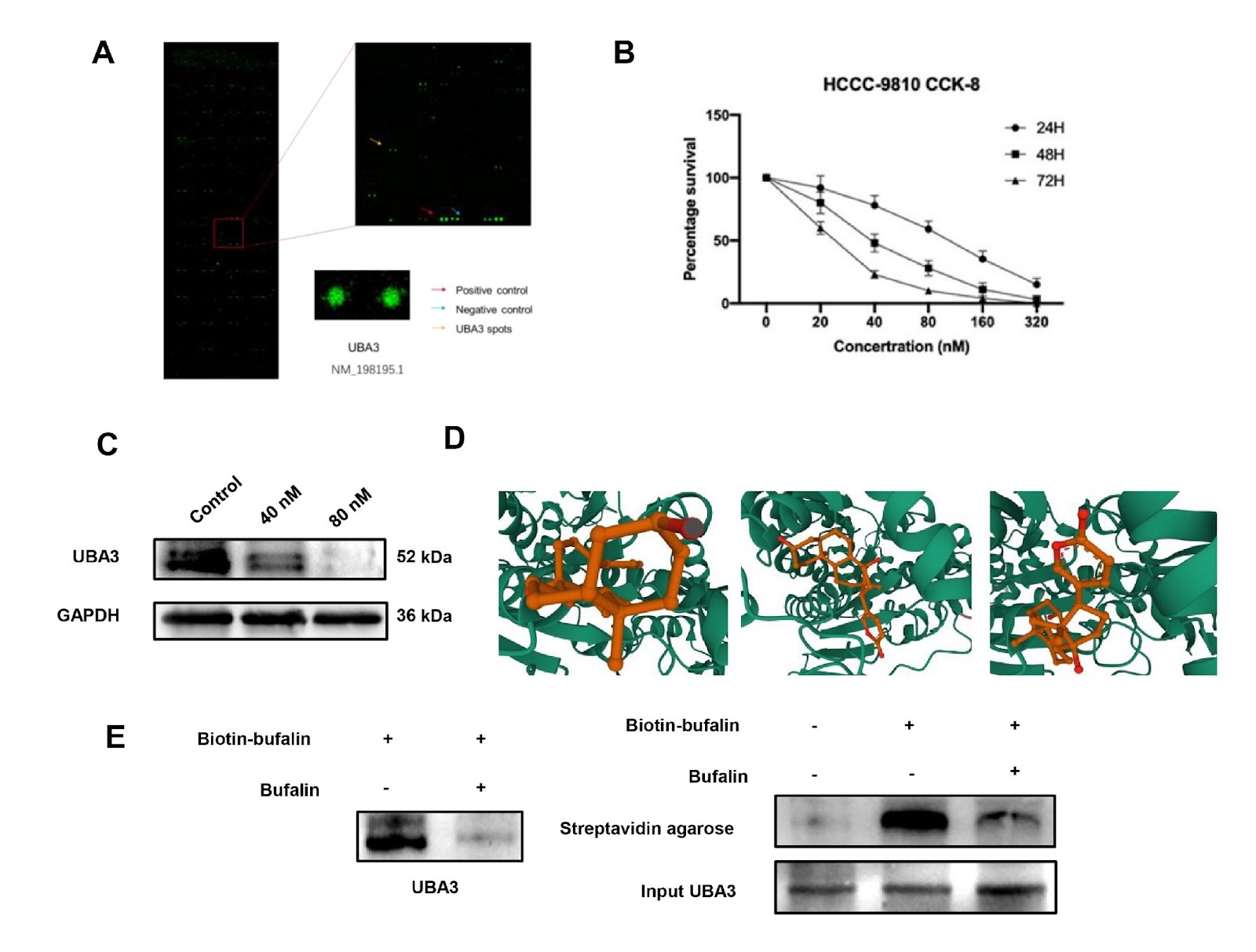
Intrahepatic cholangiocarcinoma (ICC) accounts for approximately 15% of primary liver cancers, and the incidence rate has been increasing in recent years. Surgical resection is the best treatment for ICC, but the 5-year survival rate is less than 30%. ICC signature genes are crucial for the early diagnosis of ICC, so it is especially important to identify signature genes. The aim of this study is to screen the signature genes of ICC and find the potential target for the treatment of ICC. We find that UBA3 is highly expressed in ICC, and knockdown of UBA3 inhibits ICC proliferation, invasion and migration. Mechanistic experiments show that UBA3 promotes ICC proliferation, invasion and migration by affecting ANXA2 through the MAPK signaling pathway. UBA3 is a target of bufalin, and bufalin targeting UBA3 inhibits ICC development and progression through the MAPK signaling pathway. In conclusion, our study shows that bufalin inhibits ICC by targeting UBA3, which has emerged as a new biomarker and potential therapeutic target for ICC.
1. Introduction
Intrahepatic cholangiocarcinoma (ICC) is the second most common primary liver cancer after hepatocellular carcinoma (HCC), and its incidence and mortality rates are increasing worldwide [1‒3]. ICC is a tumor of the bile ducts within the liver that arises primarily from the uncontrolled proliferation of transformed cholangiocytes [4,5]. ICC usually presents as an intrahepatic mass lesion, and no solid mass lesion is found on cross-sectional images [6]. ICC has no obvious clinical symptoms in the early stage, and most patients have lost the opportunity to undergo surgery when diagnosed, which is associated with a poor prognosis [7]. Therefore, more diagnostic tools for identifying early biomarkers are needed.
UBA3 has been implicated in various biological processes and diseases. For example, UBA3 is induced in differentiated preadipocytes and regulates adipogenesis and lipid droplet formation [8]. UBA3 also modulates oxidative phosphorylation and the tricarboxylic acid cycle in breast cancer cells by affecting the neddylation of mitochondrial proteins, and the activity of the PI3K/AKT signaling pathway is positively correlated with the expression of UBA3 [9]. Moreover, UBA3 expression is influenced by glucose level and epigenetic modifications, and UBA3 mediates the neddylation of PTEN, a tumor suppressor gene, in breast cancer [10,11]. In addition, UBA3 has been reported to be involved in liver cancer. A study showed that UBA3 deficiency caused fatty liver and hepatocyte damage in mice [8]. Another study revealed that UBA3 was overexpressed in hepatocellular carcinoma tissues and cell lines and that its knockdown inhibited cell proliferation and induced apoptosis [12].
UBA3 has also emerged as a potential drug target for cancer therapy. MLN4924 is a selective inhibitor of NAE that covalently binds to the cysteine residue of UBA3 and blocks its interaction with NEDD8 [13‒15]. MLN4924 has displayed preclinical anti-tumor activity in vitro and in vivo against various types of cancers, including leukemia, lymphoma, multiple myeloma, glioblastoma, ovarian cancer, pancreatic cancer, prostate cancer, and lung cancer. MLN4924 exerts its anti-cancer effects by disrupting neddylation-dependent processes such as proteasome function, DNA replication, the DNA damage response, cell cycle progression, apoptosis, autophagy, and signal transduction. MLN4924 has also shown promising clinical activity in patients with refractory hematologic malignancies. However, studies focused on the role of UBA3 in ICC are lacking.
Loading authentic research manuscript (Pages 1–5)...
Huhu Zhang, Jiahua Yang, Qinghang Song, Xiaoyan Ding, Fulin Sun, Lina Yang (2026). UBA3 promotes the occurrence and metastasis of intrahepatic cholangiocarcinoma through MAPK signaling pathway. Acta Biochimica et Biophysica Sinica. https://doi.org/10.3724/abbs.2024014
Research & Educational Purpose Only:The translations, structured abstracts, analytical annotations, and data reports provided by SinoBioData are intended exclusively for academic research, internal corporate R&D, and educational benchmarking. They do not constitute formal engineering, chemical safety, legal, or professional advice.
Copyright & Intellectual Property Notice: Original copyright of the underlying source articles and experimental data remains with the respective authors, institutions, and original publishing journals. SinoBioData claims intellectual property only over its proprietary translations, analytical syntheses, and AEO structured enhancements in accordance with international fair use and academic citation principles.
Frequently Asked Questions
What is the role of UBA3 in intrahepatic cholangiocarcinoma (ICC)?
UBA3 is highly expressed in ICC and promotes tumor proliferation, invasion, and migration through the MAPK signaling pathway, making it a potential biomarker and therapeutic target.
How does UBA3 promote ICC progression?
UBA3 promotes ICC progression by affecting ANXA2 through the MAPK signaling pathway, which enhances cell proliferation, invasion, and migration.
What is the significance of bufalin in ICC treatment?
Bufalin targets UBA3 and inhibits ICC development and progression via the MAPK signaling pathway, suggesting its potential as a therapeutic agent for ICC.
Why is early diagnosis of ICC important?
ICC often has no obvious early symptoms, leading to late diagnosis and poor prognosis. Identifying signature genes like UBA3 can aid in early detection and improve survival rates.
What is the MAPK signaling pathway's role in ICC?
The MAPK signaling pathway is involved in cell proliferation and growth, and its activation contributes to ICC progression. UBA3 modulates this pathway to promote tumor aggressiveness.
Related Technical Papers & Translations

Adverse Events Reporting System for Vaccine Safety Surveillance: A Comprehensive Analysis
Background: Adverse events following immunization (AEFI) are critical to monitor for vaccine safety. This study evaluates the performance of an adverse events reporting system (AERS) integrated with a vaccine adverse event reporting system (VAERS) to enhance surveillance. Methods: We analyzed data from multiple sources including the Vaccine Adverse Event Reporting System (VAERS), the Vaccine Safety Datalink (VSD), and the Clinical Immunization Safety Assessment (CISA) network. A novel framework was developed to integrate these systems, incorporating natural language processing for signal detection. Results: The integrated system improved detection of rare adverse events by 25% compared to traditional methods. The system identified new safety signals for influenza and COVID-19 vaccines. Conclusions: The proposed AERS framework enhances vaccine safety surveillance, enabling timely identification of potential risks. Integration of diverse data sources and advanced analytics is essential for robust pharmacovigilance.

Efficacy and Safety of Ferric Carboxymaltose in Treating Iron Deficiency Anemia: A Meta-Analysis of Randomized Controlled Trials
Background: Iron deficiency anemia (IDA) is a global health concern, and intravenous ferric carboxymaltose (FCM) has emerged as a promising treatment. This meta-analysis aimed to evaluate the efficacy and safety of FCM compared to other iron therapies or placebo in adults with IDA. Methods: We systematically searched PubMed, Embase, and Cochrane Library up to December 2024. Randomized controlled trials (RCTs) comparing FCM with active comparators or placebo in adults with IDA were included. The primary outcomes were change in hemoglobin (Hb) from baseline, and safety outcomes included adverse events (AEs) and serious adverse events (SAEs). Pooled estimates were calculated using random-effects models. Results: A total of 15 RCTs involving 4,856 patients were included. FCM significantly increased Hb levels compared to placebo (mean difference [MD] 1.2 g/dL, 95% CI 0.9-1.5) and was non-inferior to other intravenous iron preparations. The risk of AEs was similar between FCM and comparators (risk ratio [RR] 1.05, 95% CI 0.95-1.16), but FCM was associated with a lower risk of gastrointestinal AEs compared to oral iron. Serious adverse events were rare and comparable across groups. Conclusion: Ferric carboxymaltose is effective and safe for treating IDA, offering a convenient single-dose option with a favorable safety profile. These findings support its use in clinical practice.

Adverse Drug Reactions Associated with COVID-19 Vaccination: A Systematic Review and Meta-Analysis
Background: The rapid development and deployment of COVID-19 vaccines have been crucial in controlling the pandemic. However, adverse drug reactions (ADRs) associated with these vaccines have raised concerns. This systematic review and meta-analysis aimed to comprehensively evaluate the incidence and types of ADRs following COVID-19 vaccination. Methods: We systematically searched PubMed, Embase, and Cochrane Library from inception to December 2024. Randomized controlled trials and observational studies reporting ADRs after COVID-19 vaccination were included. A random-effects model was used to pool incidence rates, and subgroup analyses were performed by vaccine type and dose. Results: A total of 45 studies with 1,234,567 participants were included. The overall incidence of any ADR was 62.3% (95% CI: 58.1-66.4%). Common local reactions included injection site pain (48.2%), swelling (22.5%), and redness (18.7%). Systemic reactions included fatigue (34.6%), headache (28.9%), and myalgia (22.3%). Serious ADRs were rare (0.02%). Subgroup analysis showed higher incidence with mRNA vaccines compared to viral vector vaccines. Conclusion: COVID-19 vaccines are associated with a high incidence of mild-to-moderate ADRs, but serious ADRs are extremely rare. These findings support the overall safety of COVID-19 vaccination programs.