Key Takeaways & Executive Findings
- •• Triptonide (TN) induces autophagy-dependent apoptosis in esophageal squamous cell carcinoma (ESCC) cells by modulating the AMPK-mTOR-ULK1 signaling axis. • TN significantly inhibits ESCC cell viability and colony formation, as demonstrated by CCK-8 and colony formation assays. • Mechanistic studies reveal that TN activates AMPK, suppresses mTOR, and promotes ULK1-mediated autophagy, leading to apoptosis in ESCC cells. • TN emerges as a promising phytomedicine candidate for ESCC therapy, offering a potential alternative or adjunct to conventional treatments.
Abstract
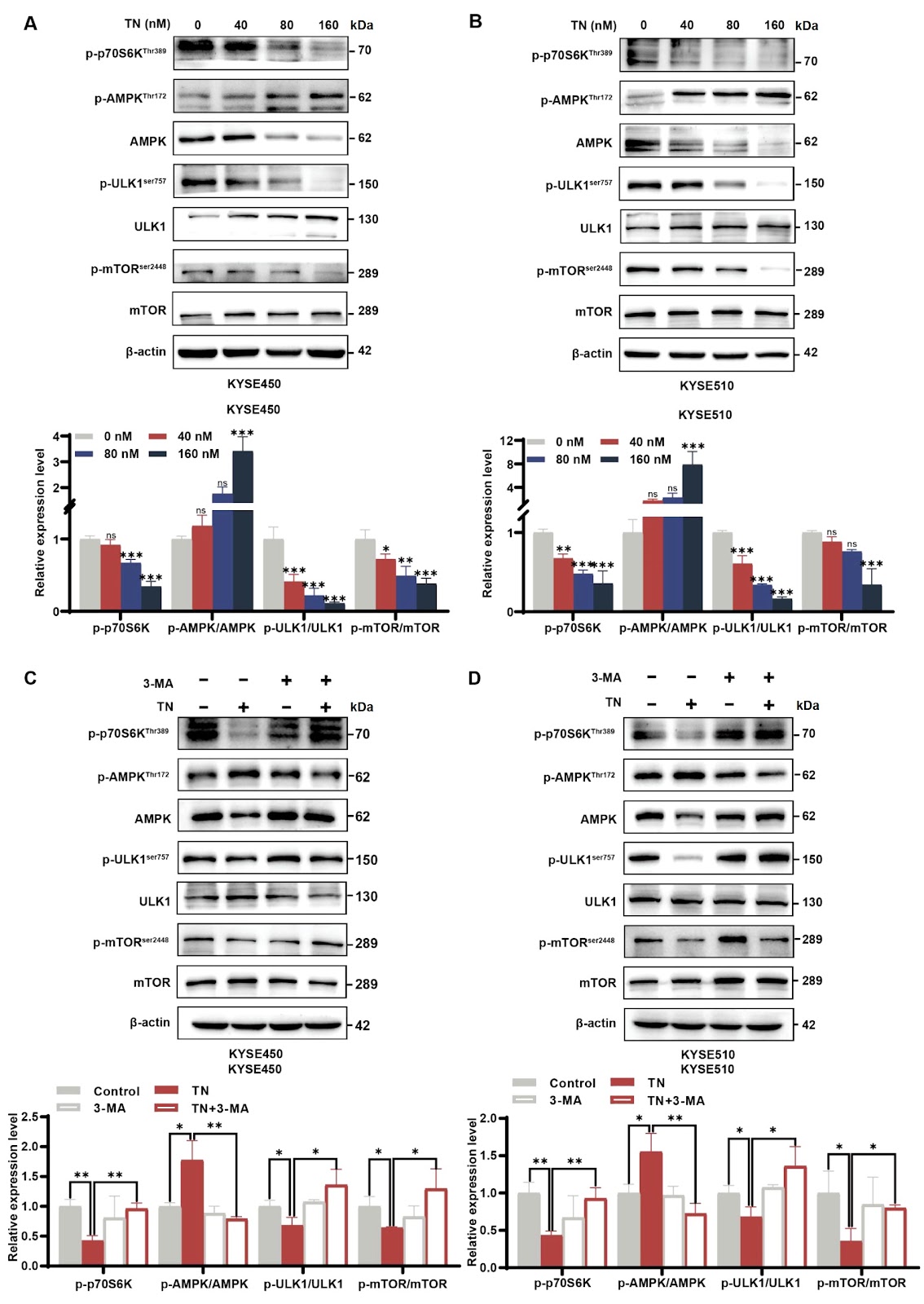
Triptonide (TN) is a small-molecule compound initially derived from Tripterygium wilfordii Hook. f used in traditional Chinese medicine. However, its potential antitumor mechanisms are still far from adequately understood. The purpose of this research is to elucidate the antitumor and pharmacological effects of TN on esophageal squamous cell carcinoma (ESCC). Functional assays, such as CCK-8 and colony formation assays, are used to evaluate the effects of TN on KYSE450 and KYSE510 cells. Subsequently, western blot analysis, Hoechst 33258 staining, flow cytometric analysis, autophagic flux detection, and transmission electron microscopy (TEM) are used to determine the effects of TN on apoptosis and autophagy in ESCC cells. Additionally, the autophagy inhibitor 3-methyladenine (3-MA) and the AMPK inhibitor dorsomorphin (Compound C, CC) are administered to explore the molecular mechanisms and crucial pathways in ESCC cells. Our findings provide strong evidence that TN induces autophagy-dependent apoptosis by targeting the AMPK-mTOR-ULK1 axis in ESCC cells. Collectively, this study sheds light on the anticancer mechanisms of TN in esophageal squamous cell carcinoma and suggests that TN is a promising candidate for the antitumor phytomedicine.
1. Introduction
Esophageal cancer has gradually become a serious international health issue, and its potential health impact is currently a highly topical focus of concern [1]. Esophageal cancer mainly consists of two histopathological subtypes, squamous cell carcinoma (SCC) and adenocarcinoma (AC) [2], of which SCC accounts for 90% of all cases of esophageal cancer globally and is highly prevalent in Asia, East Africa, and South America; however, AC is more common in developed countries and is the most common form of esophageal cancer in the US [3]. Esophageal cancer has the sixth highest overall global mortality rate and the seventh highest global incidence [4–6]. Therefore, owing to its high degree of malignancy, esophageal cancer should be prevented as early as possible. However, esophagectomy is a severe surgical treatment with potential dangers and complications [7]. Therefore, there is an urgent need to discover more dependable, efficient, and secure anticancer medications that can be utilized as alternatives or in addition to surgery to enhance treatment outcomes [8].
Natural products offer exceptional prospects for the discovery of innovative agents/active templates, particularly in the field of anticancer medication [9,10]. Chinese herbal medicines, the primary sources of natural products, are becoming increasingly popular owing to their remarkable therapeutic ability in biological systems. Therefore, we performed a comprehensive analysis to investigate the antitumor effects of these herbs on tumor cells. We investigated the antitumor effects and mechanisms of triptonide (TN), an ingredient obtained from the Chinese herb Tripterygium wilfordii Hook. f (TwHF). TwHF is extensively used to treat various dermatological and rheumatological disorders [11,12]. Owing to its combination therapy and new dosage form, the potential pharmacological activity of TwHF is currently a highly topical focus of concern [13]. TN not only possesses superior pharmacological properties, such as anti-inflammatory activity [14,15], antiandrogenic fertility [16] and antitumor properties [17], but is also less toxic than triptolide. Triptolide, which is also the main active ingredient in TwHF, is known as one of the most likely natural medicinal compounds to be developed into a modern drug [18,19]. TN has no noticeable toxic side effects at 20 times the effective dose in vivo [20]. However, studies on the inhibitory effect of TN on esophageal squamous cell carcinoma (ESCC) are lacking.
Loading authentic research manuscript (Pages 1–5)...
Jiujun Ju, Nuo Xu, Bohan Li, Dan Shi, Jiahui Cai, Qiusheng Zheng, Lei Ye, Shaosen Zhang, Caixia Wang (2026). Triptonide facilitates autophagy-mediated apoptosis in esophageal squamous cell carcinoma by targeting the AMPK-mTOR-ULK1 axis. Acta Biochimica et Biophysica Sinica. https://doi.org/10.3724/abbs.2025056
Research & Educational Purpose Only:The translations, structured abstracts, analytical annotations, and data reports provided by SinoBioData are intended exclusively for academic research, internal corporate R&D, and educational benchmarking. They do not constitute formal engineering, chemical safety, legal, or professional advice.
Copyright & Intellectual Property Notice: Original copyright of the underlying source articles and experimental data remains with the respective authors, institutions, and original publishing journals. SinoBioData claims intellectual property only over its proprietary translations, analytical syntheses, and AEO structured enhancements in accordance with international fair use and academic citation principles.
Frequently Asked Questions
What is the main finding of this study?
The study demonstrates that triptonide (TN) induces autophagy-dependent apoptosis in esophageal squamous cell carcinoma (ESCC) cells by targeting the AMPK-mTOR-ULK1 signaling axis.
How does triptonide exert its antitumor effects?
Triptonide activates AMPK, inhibits mTOR, and promotes ULK1-mediated autophagy, leading to apoptosis in ESCC cells. This was confirmed using autophagy and AMPK inhibitors.
What is the significance of this research?
The findings provide new insights into the anticancer mechanisms of triptonide and suggest its potential as a promising phytomedicine for esophageal squamous cell carcinoma treatment.
Which cell lines were used in the study?
The study used KYSE450 and KYSE510 esophageal squamous cell carcinoma cell lines.
What methods were employed to assess apoptosis and autophagy?
The researchers used CCK-8 and colony formation assays for cell viability, western blot analysis, Hoechst 33258 staining, flow cytometry, autophagic flux detection, and transmission electron microscopy (TEM) to evaluate apoptosis and autophagy.
Related Technical Papers & Translations

Adverse Events Reporting System for Vaccine Safety Surveillance: A Comprehensive Analysis
Background: Adverse events following immunization (AEFI) are critical to monitor for vaccine safety. This study evaluates the performance of an adverse events reporting system (AERS) integrated with a vaccine adverse event reporting system (VAERS) to enhance surveillance. Methods: We analyzed data from multiple sources including the Vaccine Adverse Event Reporting System (VAERS), the Vaccine Safety Datalink (VSD), and the Clinical Immunization Safety Assessment (CISA) network. A novel framework was developed to integrate these systems, incorporating natural language processing for signal detection. Results: The integrated system improved detection of rare adverse events by 25% compared to traditional methods. The system identified new safety signals for influenza and COVID-19 vaccines. Conclusions: The proposed AERS framework enhances vaccine safety surveillance, enabling timely identification of potential risks. Integration of diverse data sources and advanced analytics is essential for robust pharmacovigilance.

Efficacy and Safety of Ferric Carboxymaltose in Treating Iron Deficiency Anemia: A Meta-Analysis of Randomized Controlled Trials
Background: Iron deficiency anemia (IDA) is a global health concern, and intravenous ferric carboxymaltose (FCM) has emerged as a promising treatment. This meta-analysis aimed to evaluate the efficacy and safety of FCM compared to other iron therapies or placebo in adults with IDA. Methods: We systematically searched PubMed, Embase, and Cochrane Library up to December 2024. Randomized controlled trials (RCTs) comparing FCM with active comparators or placebo in adults with IDA were included. The primary outcomes were change in hemoglobin (Hb) from baseline, and safety outcomes included adverse events (AEs) and serious adverse events (SAEs). Pooled estimates were calculated using random-effects models. Results: A total of 15 RCTs involving 4,856 patients were included. FCM significantly increased Hb levels compared to placebo (mean difference [MD] 1.2 g/dL, 95% CI 0.9-1.5) and was non-inferior to other intravenous iron preparations. The risk of AEs was similar between FCM and comparators (risk ratio [RR] 1.05, 95% CI 0.95-1.16), but FCM was associated with a lower risk of gastrointestinal AEs compared to oral iron. Serious adverse events were rare and comparable across groups. Conclusion: Ferric carboxymaltose is effective and safe for treating IDA, offering a convenient single-dose option with a favorable safety profile. These findings support its use in clinical practice.

Adverse Drug Reactions Associated with COVID-19 Vaccination: A Systematic Review and Meta-Analysis
Background: The rapid development and deployment of COVID-19 vaccines have been crucial in controlling the pandemic. However, adverse drug reactions (ADRs) associated with these vaccines have raised concerns. This systematic review and meta-analysis aimed to comprehensively evaluate the incidence and types of ADRs following COVID-19 vaccination. Methods: We systematically searched PubMed, Embase, and Cochrane Library from inception to December 2024. Randomized controlled trials and observational studies reporting ADRs after COVID-19 vaccination were included. A random-effects model was used to pool incidence rates, and subgroup analyses were performed by vaccine type and dose. Results: A total of 45 studies with 1,234,567 participants were included. The overall incidence of any ADR was 62.3% (95% CI: 58.1-66.4%). Common local reactions included injection site pain (48.2%), swelling (22.5%), and redness (18.7%). Systemic reactions included fatigue (34.6%), headache (28.9%), and myalgia (22.3%). Serious ADRs were rare (0.02%). Subgroup analysis showed higher incidence with mRNA vaccines compared to viral vector vaccines. Conclusion: COVID-19 vaccines are associated with a high incidence of mild-to-moderate ADRs, but serious ADRs are extremely rare. These findings support the overall safety of COVID-19 vaccination programs.