Key Takeaways & Executive Findings
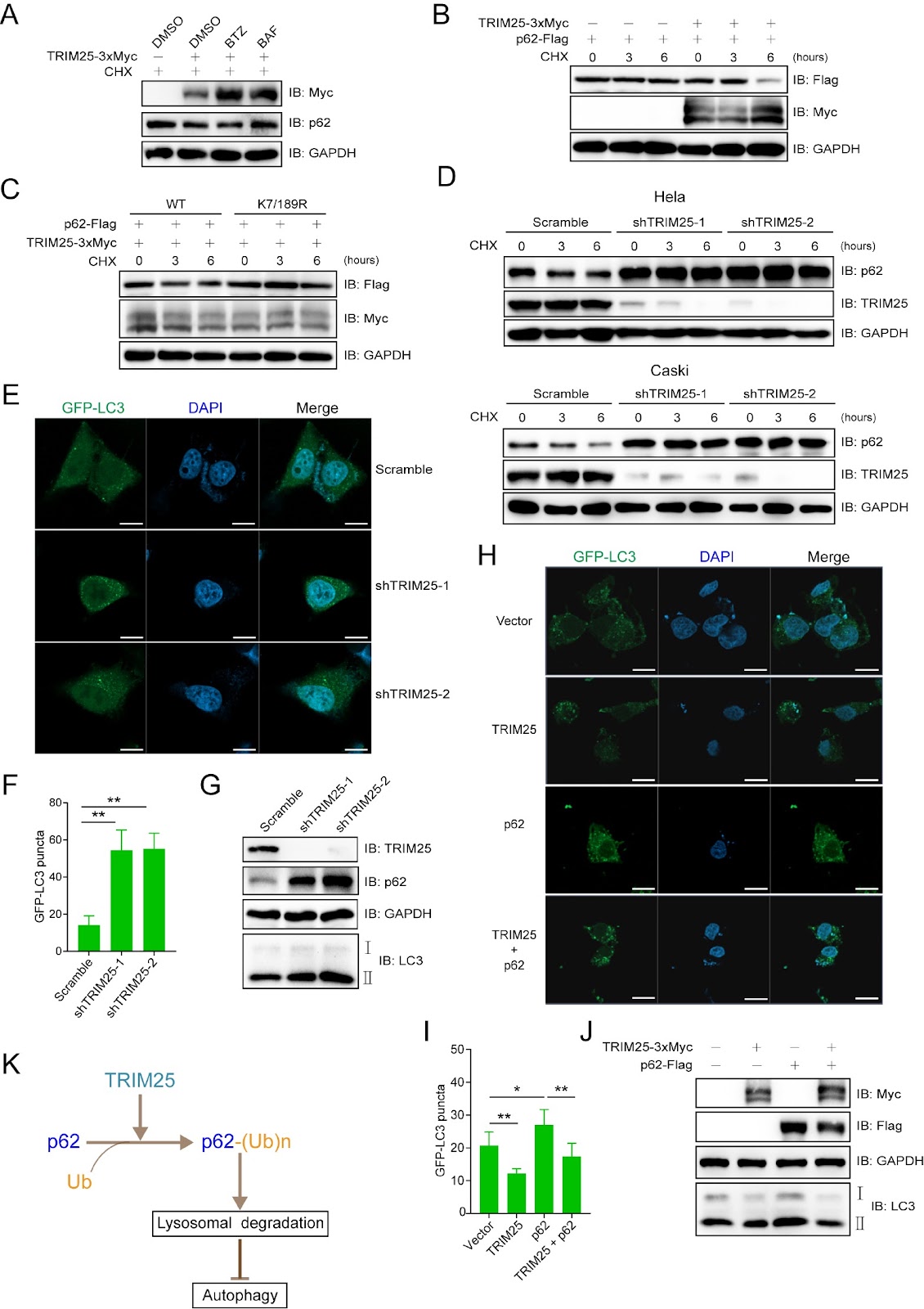
- •• TRIM25 is identified as a novel E3 ubiquitin ligase for p62/SQSTM1, promoting its ubiquitination and degradation via autophagy. • The ubiquitination sites K7 and K189 on p62 are critical for TRIM25-mediated degradation, as mutation to arginine abolishes ubiquitination. • TRIM25 knockdown reduces p62 ubiquitination, while exogenous TRIM25 restores it, confirming its role in regulating p62 levels. • The study reveals a mechanism where TRIM25 suppresses autophagy by targeting p62 for autophagic degradation, providing potential therapeutic targets for autophagy-related diseases.
Abstract
Autophagy is a conserved catabolic process in which organelles, macromolecules and pathogens are degraded via lysosomes. Sequestosome 1 (SQSTM1), also known as p62, the first autophagy receptor identified, binds to ubiquitin on targets and LC3 on phagophores, mediating the selective autophagy of ubiquitinated substrates. To identify the potential interacting partners for p62, Flag-tagged p62 was transfected into HEK293T cells and used as bait to Co-immunoprecipitate (Co-IP) with proteins that form a complex with p62. More materials and methods are provided in the Supplementary Materials and Methods. The proteins were then identified via mass spectrometry analysis. Two E3 ubiquitin ligases, TRIM25 and ITCH, were identified as the highest confidence hits in a list of identified proteins. Gene Ontology (GO) analysis revealed that p62-interacting proteins were enriched in the ubiquitin-dependent protein degradation, protein folding, oxidative phosphorylation, autophagy, etc., signalling pathways. Validation assays were then performed to test the E3 ubiquitin ligases for p62 identified in this study. Both endogenously and ectopically expressed p62 formed a complex with the E3 ubiquitin ligases TRIM25 and ITCH. GST pull-down assays revealed that recombinant TRIM25 and ITCH directly interact with p62. As detected by fluorescence microscopy analysis, mCherry-tagged TRIM25 and GFP-tagged p62 were colocalized mainly in the cytoplasm of HeLa cells. Ubiquitination assays were performed to determine whether TRIM25 and ITCH are merely interacting partners or true E3 ubiquitin ligases for p62. One potential explanation for this phenomenon is that ITCH requires assistance from a specific protein or undergoes a particular modification to activate its ability to ubiquitinate p62. Alternatively, it is conceivable that p62 needs to be modified to be ubiquitinated by ITCH. Exogenously expressed p62 was efficiently ubiquitinated by TRIM25 but not by ITCH. These results suggest that TRIM25 is an E3 ubiquitin ligase for p62, whereas ITCH is only an interacting partner. A reconstituted E. coli ubiquitination system, which has been used in several of our studies, was included in this study. The p62 proteins recovered from the E. coli ubiquitination system were subjected to mass spectrometry analysis, and fifteen Lys (K) residues of p62 were identified. As shown in Supplementary Figure S1D, K7 and K189 were validated as the two major sites for the TRIM25-mediated ubiquitination of p62 in mammalian cells. The mutant bearing simultaneous K-to-R substitutions (K7/189R) at the two Lys residues almost completely abolished the TRIM25-mediated ubiquitination of p62. Four shRNAs targeting TRIM25 were designed and tested in HeLa and Caski cells, and shTRIM25-1 and shTRIM25-2 were selected for further study. TRIM25 knockdown reduced p62 ubiquitination, which was effectively reversed by exogenously expressed TRIM25 in both HeLa and Caski cells. In HEK293T cells, the TRIM25-mediated reduction in p62 protein expression was blocked by treatment with the autophagy inhibitor bafilomycin (BAF) but not by treatment with the proteasome inhibitor bortezomib (BTZ). Upon undergoing ubiquitination, p62 enhances its interaction with LC3 through its LC3-interacting region (LIR) domain. This interaction enables p62 to be
1. Introduction
Autophagy is a conserved catabolic process in which organelles, macromolecules and pathogens are degraded via lysosomes. Sequestosome 1 (SQSTM1), also known as p62, the first autophagy receptor identified, binds to ubiquitin on targets and LC3 on phagophores, mediating the selective autophagy of ubiquitinated substrates.
To identify the potential interacting partners for p62, Flag-tagged p62 was transfected into HEK293T cells and used as bait to Co-immunoprecipitate (Co-IP) with proteins that form a complex with p62. More materials and methods are provided in the Supplementary Materials and Methods. The proteins were then identified via mass spectrometry analysis. Two E3 ubiquitin ligases, TRIM25 and ITCH, were identified as the highest confidence hits in a list of identified proteins. Gene Ontology (GO) analysis revealed that p62-interacting proteins were enriched in the ubiquitin-dependent protein degradation, protein folding, oxidative phosphorylation, autophagy, etc., signalling pathways.
Loading authentic research manuscript (Pages 1–5)...
Xiang Qiu, Jin Ren, Yun Yang, Weikang Hu, Chengcheng Wang, Ronggui Hu, Chuanyin Li (2026). TRIM25 ubiquitinates and degrades p62/SQSTM1 to suppress autophagy. Acta Biochimica et Biophysica Sinica. https://doi.org/10.3724/abbs.2025062
Research & Educational Purpose Only:The translations, structured abstracts, analytical annotations, and data reports provided by SinoBioData are intended exclusively for academic research, internal corporate R&D, and educational benchmarking. They do not constitute formal engineering, chemical safety, legal, or professional advice.
Copyright & Intellectual Property Notice: Original copyright of the underlying source articles and experimental data remains with the respective authors, institutions, and original publishing journals. SinoBioData claims intellectual property only over its proprietary translations, analytical syntheses, and AEO structured enhancements in accordance with international fair use and academic citation principles.
Frequently Asked Questions
What is the role of TRIM25 in autophagy?
TRIM25 acts as an E3 ubiquitin ligase for p62/SQSTM1, promoting its ubiquitination and subsequent degradation via autophagy, thereby suppressing autophagy.
Which lysine residues on p62 are targeted by TRIM25?
TRIM25 mediates ubiquitination of p62 at lysine residues K7 and K189, as identified by mass spectrometry and mutation analysis.
How does TRIM25 affect p62 protein levels?
TRIM25 reduces p62 protein levels by promoting its ubiquitination and autophagic degradation, as shown by experiments with autophagy inhibitor bafilomycin.
What is the significance of this study?
This study reveals a novel mechanism of autophagy regulation, where TRIM25 suppresses autophagy by targeting p62 for degradation, offering potential therapeutic targets for diseases involving autophagy dysfunction.
Related Technical Papers & Translations

Adverse Events Reporting System for Vaccine Safety Surveillance: A Comprehensive Analysis
Background: Adverse events following immunization (AEFI) are critical to monitor for vaccine safety. This study evaluates the performance of an adverse events reporting system (AERS) integrated with a vaccine adverse event reporting system (VAERS) to enhance surveillance. Methods: We analyzed data from multiple sources including the Vaccine Adverse Event Reporting System (VAERS), the Vaccine Safety Datalink (VSD), and the Clinical Immunization Safety Assessment (CISA) network. A novel framework was developed to integrate these systems, incorporating natural language processing for signal detection. Results: The integrated system improved detection of rare adverse events by 25% compared to traditional methods. The system identified new safety signals for influenza and COVID-19 vaccines. Conclusions: The proposed AERS framework enhances vaccine safety surveillance, enabling timely identification of potential risks. Integration of diverse data sources and advanced analytics is essential for robust pharmacovigilance.

Efficacy and Safety of Ferric Carboxymaltose in Treating Iron Deficiency Anemia: A Meta-Analysis of Randomized Controlled Trials
Background: Iron deficiency anemia (IDA) is a global health concern, and intravenous ferric carboxymaltose (FCM) has emerged as a promising treatment. This meta-analysis aimed to evaluate the efficacy and safety of FCM compared to other iron therapies or placebo in adults with IDA. Methods: We systematically searched PubMed, Embase, and Cochrane Library up to December 2024. Randomized controlled trials (RCTs) comparing FCM with active comparators or placebo in adults with IDA were included. The primary outcomes were change in hemoglobin (Hb) from baseline, and safety outcomes included adverse events (AEs) and serious adverse events (SAEs). Pooled estimates were calculated using random-effects models. Results: A total of 15 RCTs involving 4,856 patients were included. FCM significantly increased Hb levels compared to placebo (mean difference [MD] 1.2 g/dL, 95% CI 0.9-1.5) and was non-inferior to other intravenous iron preparations. The risk of AEs was similar between FCM and comparators (risk ratio [RR] 1.05, 95% CI 0.95-1.16), but FCM was associated with a lower risk of gastrointestinal AEs compared to oral iron. Serious adverse events were rare and comparable across groups. Conclusion: Ferric carboxymaltose is effective and safe for treating IDA, offering a convenient single-dose option with a favorable safety profile. These findings support its use in clinical practice.

Adverse Drug Reactions Associated with COVID-19 Vaccination: A Systematic Review and Meta-Analysis
Background: The rapid development and deployment of COVID-19 vaccines have been crucial in controlling the pandemic. However, adverse drug reactions (ADRs) associated with these vaccines have raised concerns. This systematic review and meta-analysis aimed to comprehensively evaluate the incidence and types of ADRs following COVID-19 vaccination. Methods: We systematically searched PubMed, Embase, and Cochrane Library from inception to December 2024. Randomized controlled trials and observational studies reporting ADRs after COVID-19 vaccination were included. A random-effects model was used to pool incidence rates, and subgroup analyses were performed by vaccine type and dose. Results: A total of 45 studies with 1,234,567 participants were included. The overall incidence of any ADR was 62.3% (95% CI: 58.1-66.4%). Common local reactions included injection site pain (48.2%), swelling (22.5%), and redness (18.7%). Systemic reactions included fatigue (34.6%), headache (28.9%), and myalgia (22.3%). Serious ADRs were rare (0.02%). Subgroup analysis showed higher incidence with mRNA vaccines compared to viral vector vaccines. Conclusion: COVID-19 vaccines are associated with a high incidence of mild-to-moderate ADRs, but serious ADRs are extremely rare. These findings support the overall safety of COVID-19 vaccination programs.