Key Takeaways & Executive Findings
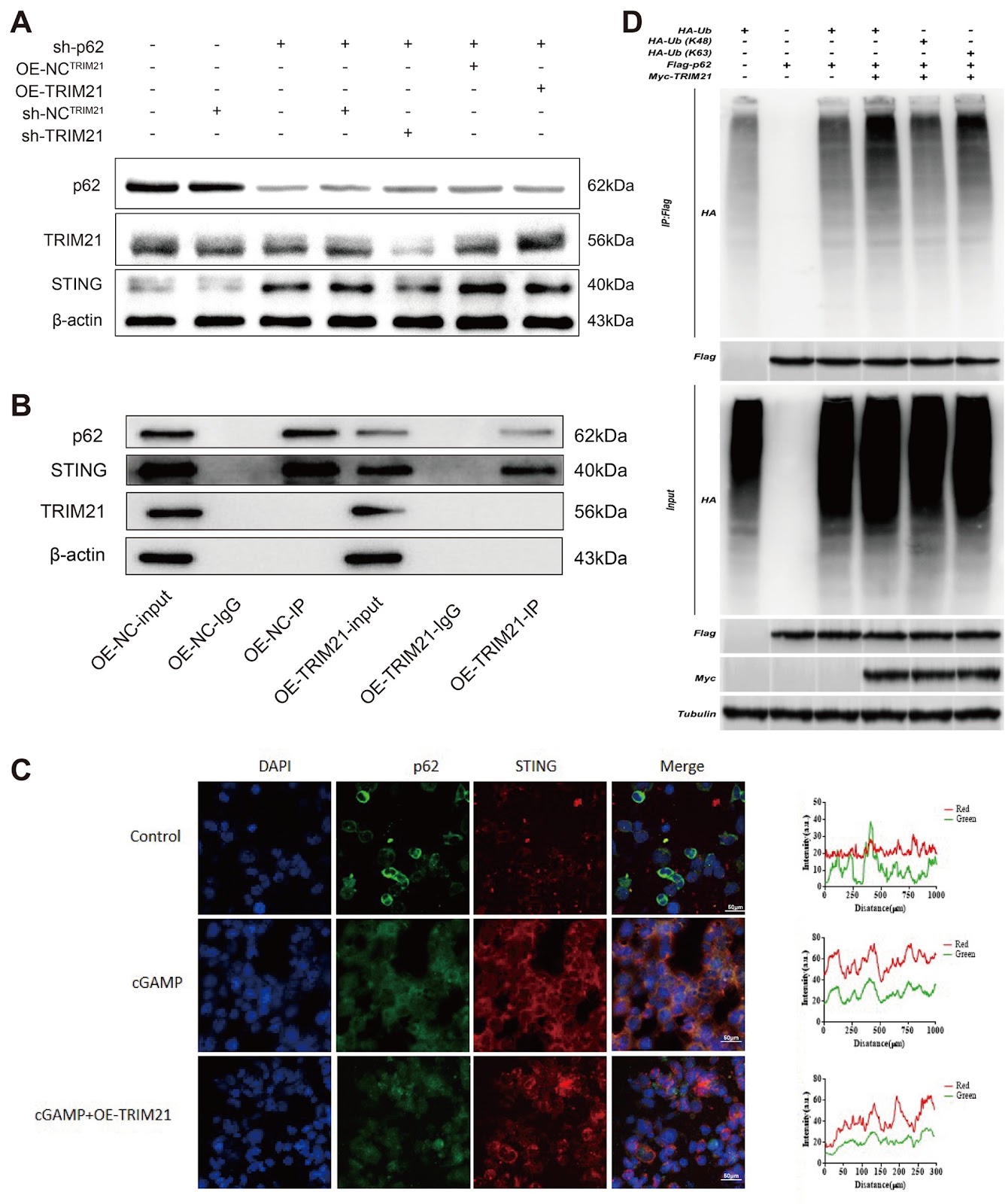
- •• TRIM21 is identified as a novel positive regulator of cGAS-STING signaling in SLE, stabilizing STING by inhibiting its autophagic degradation. • Mechanistically, TRIM21 catalyzes K63-linked polyubiquitylation of p62/SQSTM1, disrupting p62-STING interaction and preventing STING sequestration into autophagosomes. • The TRIM21-p62 axis amplifies type I interferon responses, highlighting a potential therapeutic target for STING-dependent autoimmune disorders. • This study reveals a cross-talk between ubiquitin signaling and autophagy in controlling STING turnover, offering new insights into innate immune regulation.
Abstract
The cGAS-STING signaling pathway serves as a pivotal surveillance mechanism for cytosolic double-stranded DNA (dsDNA) detection in mammalian systems. While STING-mediated type I interferon production is crucial for host defense, sustained activation of this pathway contributes to autoimmune pathologies, including systemic lupus erythematosus (SLE). Maintaining immune homeostasis requires precise regulation of STING activity to prevent hyperactivation. Our study identifies TRIM21 as a novel positive regulator of cGAS-STING signaling in SLE pathogenesis. Our results demonstrate that TRIM21 overexpression stabilizes STING by suppressing autophagic degradation, whereas TRIM21 depletion accelerates this clearance process. Mechanistically, TRIM21 catalyzes the K63-linked polyubiquitylation of the selective autophagy receptor p62/SQSTM1, disrupting its interaction with STING. This post-translational modification prevents the sequestration of STING into autophagosomes, thereby stabilizing the adaptor protein and amplifying downstream type I interferon responses. Our findings reveal a previously unrecognized regulatory circuit in which TRIM21 orchestrates cross-talk between ubiquitin signaling and autophagy to control STING turnover. The TRIM21-p62 axis represents a potential therapeutic target for attenuating pathological interferon production in STING-dependent autoimmune disorders. This work advances our understanding of immune regulation by demonstrating how E3 ligase-mediated ubiquitin modifications modulate cargo recognition in selective autophagy pathways. The identified mechanism provides new insights into the molecular interplay between protein ubiquitylation and autophagic degradation in maintaining the innate immune balance, offering novel perspectives for developing targeted therapies against interferonopathies associated with cGAS-STING hyperactivity.
1. Introduction
Systemic lupus erythematosus (SLE) is a complex multisystem autoimmune disorder characterized by aberrant immune activation, leading to widespread inflammation and heterogeneous clinical presentations [1]. Contemporary research has highlighted the pivotal role of type I interferon (IFN-I) dysregulation in SLE pathogenesis, where sustained IFN signaling perpetuates immune activation and maintains autoimmune processes [2]. Notably, the cGAS-STING signaling axis has emerged as a critical mediator of type I IFN production and proinflammatory cytokine secretion in innate immune responses [3–5].
The molecular cascade initiates when cytosolic double-stranded DNA (dsDNA) activates cyclic GMP-AMP synthase (cGAS), which catalyzes the synthesis of the second messenger 2′3′-cGAMP [6,7]. This cyclic dinucleotide subsequently binds to and activates stimulator of interferon genes (STING), triggering its translocation from the endoplasmic reticulum to the Golgi apparatus. At this site, STING recruits and phosphorylates TANK-binding kinase 1 (TBK1), which in turn activates interferon regulatory factor 3 (IRF3) through phosphorylation. The nuclear translocation of activated IRF3 ultimately drives the transcription of type I interferons and interferon-stimulated genes (ISGs) [6,8]. Mounting evidence suggests that STING, a central adaptor protein in the cGAS-STING signaling pathway, is involved in the pathogenesis of autoinflammatory and autoimmune disorders [9,10], such as systemic lupus erythematosus, Aicardi-Goutières syndrome (AGS), and STING-associated vasculopathy with onset in infancy (SAVI) [11–13]. This growing body of evidence underscores the critical need for precise regulation of STING activity to maintain immunological equilibrium and prevent autoimmune dysregulation. Importantly, while the involvement of STING in disease pathogenesis is well documented, the comprehensive regulatory network controlling its activation, trafficking, and downstream signaling remains incompletely characterized.
Autophagy serves as an essential cellular quality control mechanism that maintains homeostasis through the encapsulation of damaged organelles, misfolded proteins, and pathogens for lysosomal degradation. In the context of innate immunity, autophagy has been shown to modulate STING signaling by targeting STING for degradation, thereby limiting excessive interferon production. However, the precise molecular mechanisms that regulate STING turnover via autophagy are not fully understood. Our study uncovers a novel regulatory axis involving TRIM21 and p62/SQSTM1 that controls STING stability and type I interferon responses, providing new insights into the pathogenesis of SLE and potential therapeutic strategies.
Loading authentic research manuscript (Pages 1–5)...
Chen Li, Ang Ma, Yu Bai, Zitao Liu, Linghan Tian, Ziyuan Wang, Huaishun Ma, Zhengpu Chen, Zhengheng Gao, Shijie Feng, Ping Fu (2026). TRIM21 promotes type I interferon by inhibiting the autophagic degradation of STING via p62/SQSTM1 ubiquitination in systemic lupus erythematosus. Acta Biochimica et Biophysica Sinica. https://doi.org/10.3724/abbs.2025046
Research & Educational Purpose Only:The translations, structured abstracts, analytical annotations, and data reports provided by SinoBioData are intended exclusively for academic research, internal corporate R&D, and educational benchmarking. They do not constitute formal engineering, chemical safety, legal, or professional advice.
Copyright & Intellectual Property Notice: Original copyright of the underlying source articles and experimental data remains with the respective authors, institutions, and original publishing journals. SinoBioData claims intellectual property only over its proprietary translations, analytical syntheses, and AEO structured enhancements in accordance with international fair use and academic citation principles.
Frequently Asked Questions
What is the role of TRIM21 in SLE pathogenesis?
TRIM21 acts as a positive regulator of cGAS-STING signaling in SLE by stabilizing STING through inhibition of its autophagic degradation, thereby amplifying type I interferon responses.
How does TRIM21 inhibit autophagic degradation of STING?
TRIM21 catalyzes K63-linked polyubiquitylation of p62/SQSTM1, disrupting the interaction between p62 and STING, which prevents STING from being sequestered into autophagosomes for degradation.
What is the significance of the TRIM21-p62 axis?
The TRIM21-p62 axis represents a potential therapeutic target for attenuating pathological interferon production in STING-dependent autoimmune disorders, offering new avenues for targeted therapies.
What are the implications of this study for understanding innate immune regulation?
This study reveals a cross-talk between ubiquitin signaling and autophagy in controlling STING turnover, providing new insights into how E3 ligase-mediated ubiquitin modifications modulate cargo recognition in selective autophagy pathways.
How does this research contribute to the development of treatments for SLE?
By identifying TRIM21 as a key regulator of STING stability, this research suggests that targeting TRIM21 or its interaction with p62 could modulate type I interferon production, potentially leading to novel therapeutic strategies for SLE and other interferonopathies.
Related Technical Papers & Translations

Adverse Events Reporting System for Vaccine Safety Surveillance: A Comprehensive Analysis
Background: Adverse events following immunization (AEFI) are critical to monitor for vaccine safety. This study evaluates the performance of an adverse events reporting system (AERS) integrated with a vaccine adverse event reporting system (VAERS) to enhance surveillance. Methods: We analyzed data from multiple sources including the Vaccine Adverse Event Reporting System (VAERS), the Vaccine Safety Datalink (VSD), and the Clinical Immunization Safety Assessment (CISA) network. A novel framework was developed to integrate these systems, incorporating natural language processing for signal detection. Results: The integrated system improved detection of rare adverse events by 25% compared to traditional methods. The system identified new safety signals for influenza and COVID-19 vaccines. Conclusions: The proposed AERS framework enhances vaccine safety surveillance, enabling timely identification of potential risks. Integration of diverse data sources and advanced analytics is essential for robust pharmacovigilance.

Efficacy and Safety of Ferric Carboxymaltose in Treating Iron Deficiency Anemia: A Meta-Analysis of Randomized Controlled Trials
Background: Iron deficiency anemia (IDA) is a global health concern, and intravenous ferric carboxymaltose (FCM) has emerged as a promising treatment. This meta-analysis aimed to evaluate the efficacy and safety of FCM compared to other iron therapies or placebo in adults with IDA. Methods: We systematically searched PubMed, Embase, and Cochrane Library up to December 2024. Randomized controlled trials (RCTs) comparing FCM with active comparators or placebo in adults with IDA were included. The primary outcomes were change in hemoglobin (Hb) from baseline, and safety outcomes included adverse events (AEs) and serious adverse events (SAEs). Pooled estimates were calculated using random-effects models. Results: A total of 15 RCTs involving 4,856 patients were included. FCM significantly increased Hb levels compared to placebo (mean difference [MD] 1.2 g/dL, 95% CI 0.9-1.5) and was non-inferior to other intravenous iron preparations. The risk of AEs was similar between FCM and comparators (risk ratio [RR] 1.05, 95% CI 0.95-1.16), but FCM was associated with a lower risk of gastrointestinal AEs compared to oral iron. Serious adverse events were rare and comparable across groups. Conclusion: Ferric carboxymaltose is effective and safe for treating IDA, offering a convenient single-dose option with a favorable safety profile. These findings support its use in clinical practice.

Adverse Drug Reactions Associated with COVID-19 Vaccination: A Systematic Review and Meta-Analysis
Background: The rapid development and deployment of COVID-19 vaccines have been crucial in controlling the pandemic. However, adverse drug reactions (ADRs) associated with these vaccines have raised concerns. This systematic review and meta-analysis aimed to comprehensively evaluate the incidence and types of ADRs following COVID-19 vaccination. Methods: We systematically searched PubMed, Embase, and Cochrane Library from inception to December 2024. Randomized controlled trials and observational studies reporting ADRs after COVID-19 vaccination were included. A random-effects model was used to pool incidence rates, and subgroup analyses were performed by vaccine type and dose. Results: A total of 45 studies with 1,234,567 participants were included. The overall incidence of any ADR was 62.3% (95% CI: 58.1-66.4%). Common local reactions included injection site pain (48.2%), swelling (22.5%), and redness (18.7%). Systemic reactions included fatigue (34.6%), headache (28.9%), and myalgia (22.3%). Serious ADRs were rare (0.02%). Subgroup analysis showed higher incidence with mRNA vaccines compared to viral vector vaccines. Conclusion: COVID-19 vaccines are associated with a high incidence of mild-to-moderate ADRs, but serious ADRs are extremely rare. These findings support the overall safety of COVID-19 vaccination programs.