Key Takeaways & Executive Findings
- •• TF occupancy at the ICAM1 promoter limits DNA methylation, thereby promoting ICAM1 expression in breast cancer. • RELA and STATs recruit TET3 to counteract DNMT-mediated methylation, maintaining hypomethylation of the ICAM1 promoter CpG island. • ICAM1 expression correlates positively with DNMT and TET3 expression, suggesting a complex epigenetic regulatory network. • These findings provide novel insights into epigenetic regulation of ICAM1, potentially informing targeted therapies for breast cancer metastasis.
Abstract
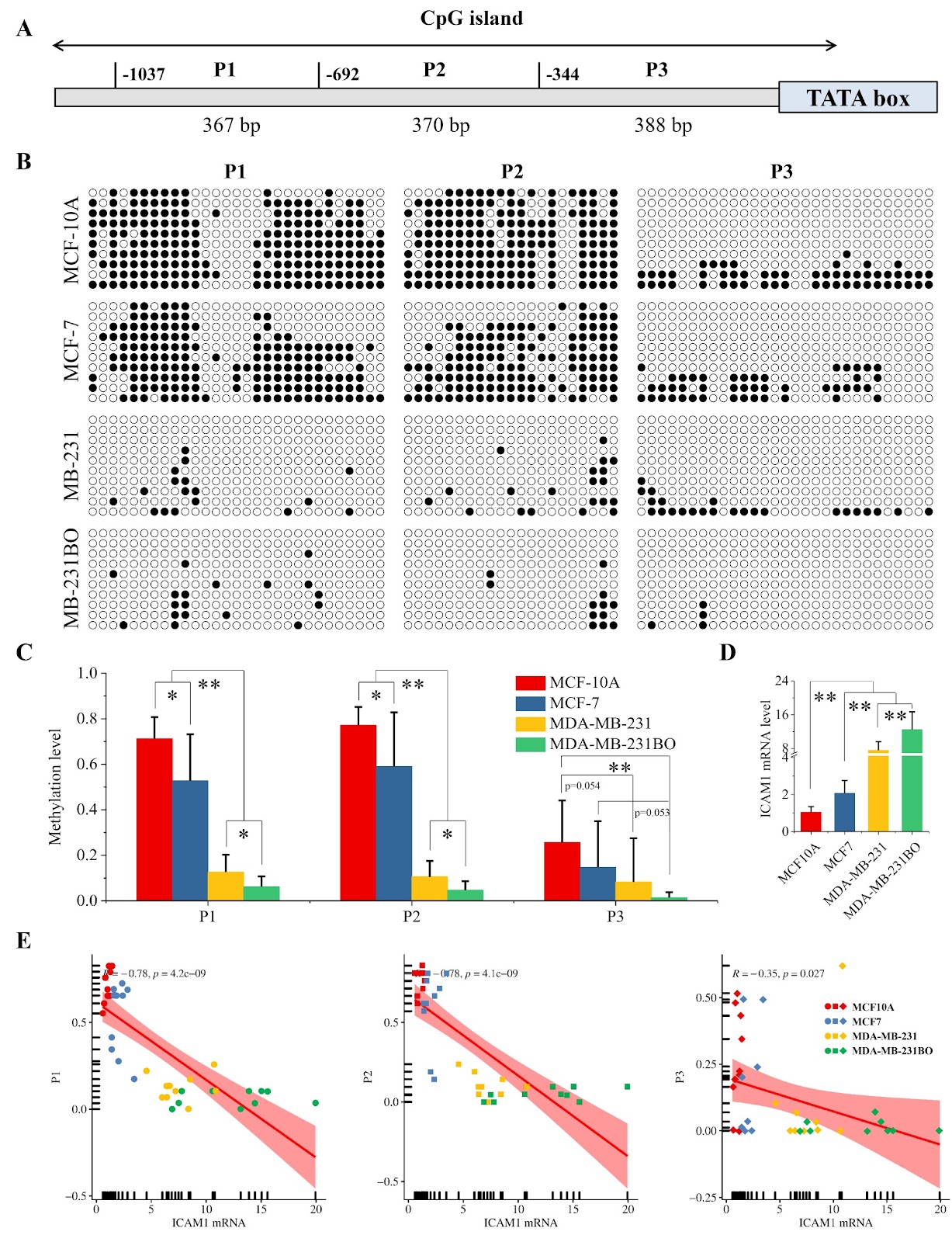
The interaction between TF binding and DNA methylation is increasingly recognized as a key player in the regulation of gene expression. However, the role of this interaction in regulating ICAM1 expression in breast cancer has not been elucidated. CpG methylation in the ICAM1 promoter is negatively correlated with ICAM1 expression, and ICAM1 expression is significantly positively correlated with DNMT and TET3 expression in breast cancer. TF binding attenuates ICAM1 promoter CpG methylation and promotes ICAM1 transcription. DNA methylation regulation enhances ICAM1 expression in breast cancer by promoting the transcription of transcription factors. In terms of mechanisms, RELA and STATs recruit TET3 to prevent DNMT-mediated DNA methylation, thereby maintaining CpG island hypomethylation in the ICAM1 promoter. Therefore, TF occupancy limits DNA methylation and affects ICAM1 expression in breast cancer.
1. Introduction
Intercellular adhesion molecule-1 (ICAM1) is a glycoprotein expressed on the cell membrane that mediates homotypic and heterotypic interactions between individual cells or between cells and the extracellular matrix. It plays crucial roles in various immune functions and in the development, progression, and metastasis of cancer [1–3]. ICAM1 expression is significantly higher in breast cancer patients than in healthy individuals. Additionally, it is more common in patients with triple-negative breast cancer (TNBC) than in patients with other molecular subtypes of breast cancer, such as hormone receptor (HR)-positive and Her2-positive breast cancer [4]. We previously reported that elevated ICAM1 expression in breast cancer cells aggravates cancer bone metastasis by interacting with integrins and activating the EMT pathway in a TGF-β-dependent manner in TNBC tumor-bearing mice [5]. Additionally, tumor-derived exosomal ICAM1 promotes TNBC bone metastasis by inducing CD8+ T-cell exhaustion [6]. Compared with non-TNBC (nTNBC) subtypes, ICAM1 also enhances the lung metastasis of TNBC in tumor-bearing mice through the formation of circulating tumor cell (CTC) clusters [7]. However, the molecular mechanism underlying the differences in ICAM1 expression across subtypes of breast cancer has not been elucidated.
An important epigenetic mechanism, DNA methylation, is a covalent modification of DNA sequences that plays a crucial role in gene expression and genome stability [8]. DNA methylation is catalyzed by DNA methyltransferases (DNMTs), which transfer a methyl group (CH3) from S-adenosyl methionine to the 5-carbon position of cytosine to generate 5-methylcytosine (5mC) [9]. The additional methyl group not only causes water molecules to bulge out around the DNA backbone but also leads to the loss of hydrogen bonds, which loosens the conformation and prevents desired interactions, thereby affecting the normal function of the DNA [10]. The CpG island in the promoter region is usually unmethylated, a state associated with active gene expression, whereas a methylated CpG island in the promoter and/or enhancer region is associated with gene suppression [11–13]. Numerous studies have reported a negative correlation between the degree of DNA methylation in the CpG island in the ICAM1 promoter and the ICAM gene expression level [11–18]. In noncancer diseases such as rheumatic heart valve disease and Graves’ disease, a high level of ICAM1 expression is negatively correlated with the DNA methylation level of its promoter [14–16]. Additionally, low temperatures can induce the hypomethylation of ICAM-1, leading to the overexpression of the ICAM-1 protein and an increased risk of cardiovascular events [17,18]. In patients with cancers such as prostate cancer and breast cancer, a similar negative correlation between the mRNA level of ICAM1 and the DNA methylation level in the ICAM1 promoter has been observed [19–21]. However, the mechanism by which DNA methylation regulates ICAM1 expression in breast cancer remains unclear.
Cell type-specific gene regulation depends on transcription factors (TFs) that directly bind to specific sequences in genomic DNA through their DNA-binding domains [22]. The ICAM1 promoter region contains multiple motifs, suggesting that it can be bound by various TFs that in turn regulate its transcription [23,24]. In fact, some TFs, such as NF-κB, ETS, and STAT, bind to the ICAM1 promoter region and activate its transcription [25,26]. The corresponding
Loading authentic research manuscript (Pages 1–5)...
Mingcang Chen, Ying Zhou, Zhengwei Fu, Chunyu Wu (2026). Transcription factor occupancy limits DNA methylation and determines ICAM1 expression in breast cancer. Acta Biochimica et Biophysica Sinica. https://doi.org/10.3724/abbs.2024237
Research & Educational Purpose Only:The translations, structured abstracts, analytical annotations, and data reports provided by SinoBioData are intended exclusively for academic research, internal corporate R&D, and educational benchmarking. They do not constitute formal engineering, chemical safety, legal, or professional advice.
Copyright & Intellectual Property Notice: Original copyright of the underlying source articles and experimental data remains with the respective authors, institutions, and original publishing journals. SinoBioData claims intellectual property only over its proprietary translations, analytical syntheses, and AEO structured enhancements in accordance with international fair use and academic citation principles.
Frequently Asked Questions
What is the role of transcription factor occupancy in ICAM1 expression in breast cancer?
Transcription factor occupancy at the ICAM1 promoter limits DNA methylation, thereby promoting ICAM1 transcription and expression in breast cancer.
How do RELA and STATs regulate DNA methylation at the ICAM1 promoter?
RELA and STATs recruit TET3 to the ICAM1 promoter, which prevents DNMT-mediated DNA methylation, maintaining CpG island hypomethylation and promoting gene expression.
What is the correlation between ICAM1 expression and DNMT/TET3 in breast cancer?
ICAM1 expression is significantly positively correlated with both DNMT and TET3 expression in breast cancer, indicating a complex interplay between methylation writers and erasers.
Why is ICAM1 expression higher in triple-negative breast cancer (TNBC)?
The study suggests that epigenetic regulation, specifically reduced DNA methylation at the ICAM1 promoter due to transcription factor occupancy, may contribute to higher ICAM1 expression in TNBC compared to other subtypes.
What are the potential clinical implications of this study?
Understanding the epigenetic regulation of ICAM1 could lead to novel therapeutic strategies targeting DNA methylation or transcription factor pathways to modulate ICAM1 expression and potentially reduce breast cancer metastasis.
Related Technical Papers & Translations

Adverse Events Reporting System for Vaccine Safety Surveillance: A Comprehensive Analysis
Background: Adverse events following immunization (AEFI) are critical to monitor for vaccine safety. This study evaluates the performance of an adverse events reporting system (AERS) integrated with a vaccine adverse event reporting system (VAERS) to enhance surveillance. Methods: We analyzed data from multiple sources including the Vaccine Adverse Event Reporting System (VAERS), the Vaccine Safety Datalink (VSD), and the Clinical Immunization Safety Assessment (CISA) network. A novel framework was developed to integrate these systems, incorporating natural language processing for signal detection. Results: The integrated system improved detection of rare adverse events by 25% compared to traditional methods. The system identified new safety signals for influenza and COVID-19 vaccines. Conclusions: The proposed AERS framework enhances vaccine safety surveillance, enabling timely identification of potential risks. Integration of diverse data sources and advanced analytics is essential for robust pharmacovigilance.

Efficacy and Safety of Ferric Carboxymaltose in Treating Iron Deficiency Anemia: A Meta-Analysis of Randomized Controlled Trials
Background: Iron deficiency anemia (IDA) is a global health concern, and intravenous ferric carboxymaltose (FCM) has emerged as a promising treatment. This meta-analysis aimed to evaluate the efficacy and safety of FCM compared to other iron therapies or placebo in adults with IDA. Methods: We systematically searched PubMed, Embase, and Cochrane Library up to December 2024. Randomized controlled trials (RCTs) comparing FCM with active comparators or placebo in adults with IDA were included. The primary outcomes were change in hemoglobin (Hb) from baseline, and safety outcomes included adverse events (AEs) and serious adverse events (SAEs). Pooled estimates were calculated using random-effects models. Results: A total of 15 RCTs involving 4,856 patients were included. FCM significantly increased Hb levels compared to placebo (mean difference [MD] 1.2 g/dL, 95% CI 0.9-1.5) and was non-inferior to other intravenous iron preparations. The risk of AEs was similar between FCM and comparators (risk ratio [RR] 1.05, 95% CI 0.95-1.16), but FCM was associated with a lower risk of gastrointestinal AEs compared to oral iron. Serious adverse events were rare and comparable across groups. Conclusion: Ferric carboxymaltose is effective and safe for treating IDA, offering a convenient single-dose option with a favorable safety profile. These findings support its use in clinical practice.

Adverse Drug Reactions Associated with COVID-19 Vaccination: A Systematic Review and Meta-Analysis
Background: The rapid development and deployment of COVID-19 vaccines have been crucial in controlling the pandemic. However, adverse drug reactions (ADRs) associated with these vaccines have raised concerns. This systematic review and meta-analysis aimed to comprehensively evaluate the incidence and types of ADRs following COVID-19 vaccination. Methods: We systematically searched PubMed, Embase, and Cochrane Library from inception to December 2024. Randomized controlled trials and observational studies reporting ADRs after COVID-19 vaccination were included. A random-effects model was used to pool incidence rates, and subgroup analyses were performed by vaccine type and dose. Results: A total of 45 studies with 1,234,567 participants were included. The overall incidence of any ADR was 62.3% (95% CI: 58.1-66.4%). Common local reactions included injection site pain (48.2%), swelling (22.5%), and redness (18.7%). Systemic reactions included fatigue (34.6%), headache (28.9%), and myalgia (22.3%). Serious ADRs were rare (0.02%). Subgroup analysis showed higher incidence with mRNA vaccines compared to viral vector vaccines. Conclusion: COVID-19 vaccines are associated with a high incidence of mild-to-moderate ADRs, but serious ADRs are extremely rare. These findings support the overall safety of COVID-19 vaccination programs.