Key Takeaways & Executive Findings
- •• tRNA dysregulation in cancer encompasses altered expression, modifications, aminoacylation, tdRs, and trafficking, collectively reprogramming the oncoproteome. • The tumor microenvironment actively shapes tRNA reprogramming to support adaptive survival, cancer stemness, and therapy resistance. • Therapeutic strategies targeting tRNA mechanisms include suppressor tRNAs, tdRs, inhibitors of tRNA-modifying enzymes, and ARS inhibitors, with varying stages of development. • This review systematically evaluates these approaches, highlighting safety considerations and future trajectories for clinical translation.
Abstract
Transfer RNA (tRNA) acts not only as an indispensable adaptor in protein synthesis but also as a key contributor to tumorigenesis when its regulation is disrupted. This review systematically summarizes aberrant tRNA-related mechanisms in cancer, including altered tRNA expression profiles, abnormal post-transcriptional modifications, dysregulated aminoacylation, production of tRNA-derived small RNAs (tdRs), and defects in tRNA trafficking and translational fidelity. Notably, the metabolically abnormal tumor microenvironment actively shapes tRNA reprogramming to facilitate adaptive survival, while dysregulated tRNA elements, such as specific modifications and tdRs, further drive cancer stem cell properties and therapeutic resistance. Collectively, these alterations reprogram the oncoproteome and signaling networks, thereby promoting tumor cell proliferation, metastasis, immune evasion, and drug resistance. Targeting these mechanisms represents a promising strategy for developing novel cancer therapies. Potential approaches include the use of suppressor tRNAs to restore tumor suppressor gene function, the employment of tdRs to modulate oncogenic signaling pathways, or direct inhibition of enzymes involved in tRNA biogenesis. These strategies aim to remodel the dysfunctional tRNA network in cancer and offer new avenues for innovative treatments.
1. Introduction
tRNA serves as a core molecular adaptor that decodes the genetic code and ensures accurate translation of mRNA into functional proteins. Although tRNA has been long viewed as a constitutive and passive housekeeping molecule, accumulating evidence demonstrates that it functions as a dynamic regulator of gene expression beyond its canonical role in translation [1]. Tight control of tRNA biology, including transcription, nuclear export, nucleotide modification, aminoacylation, and turnover, is essential for cellular homeostasis. Disruption of any of these processes can reshape the cellular proteome and contribute to disease.
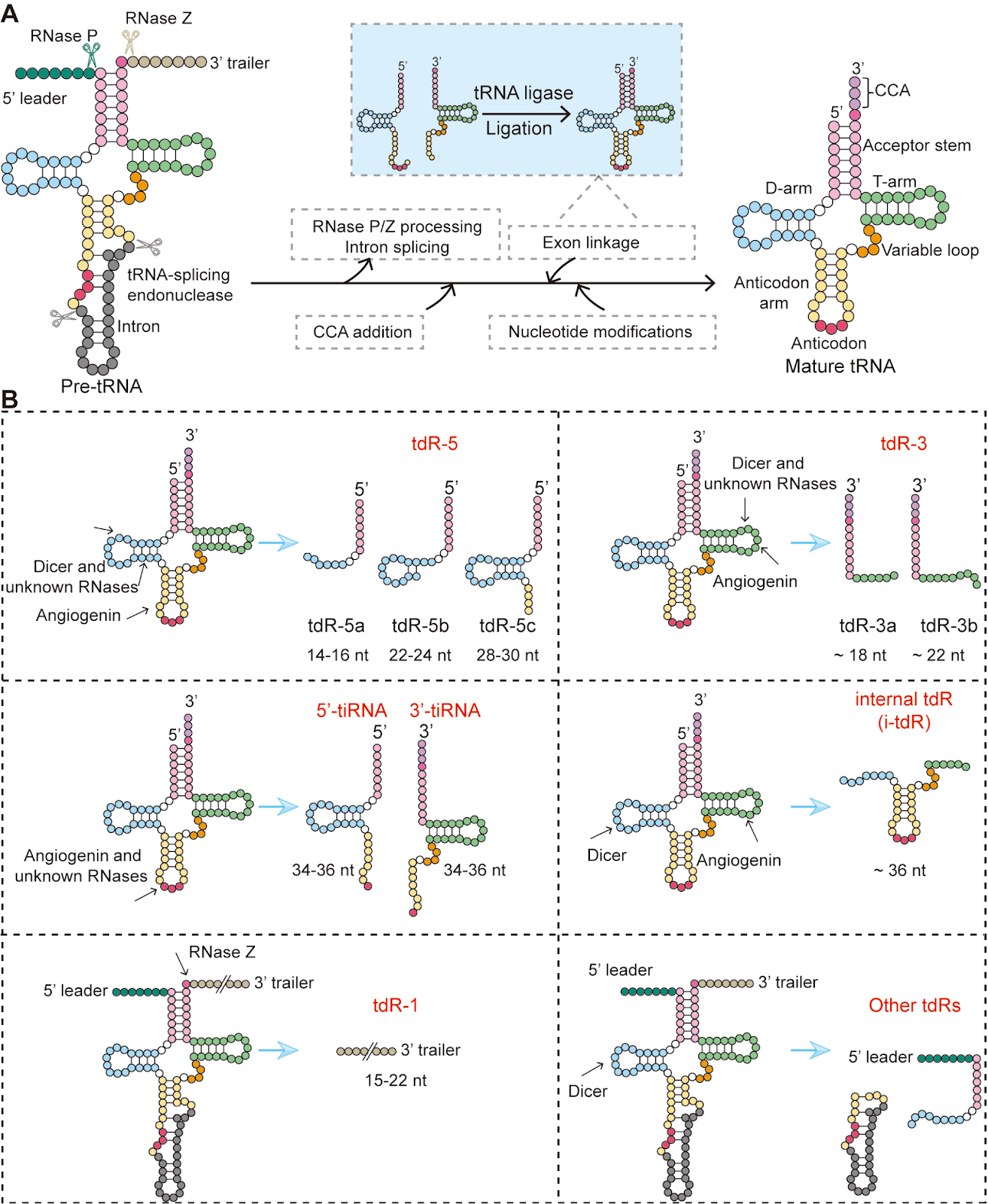
The human genome is predicted to encode 417 high-confidence tRNA genes, as identified using the tRNAscan-SE tool [2], many of which are present in multiple copies. Changes in the abundance or activity of specific tRNAs are strongly linked to pathological conditions, particularly cancer. Tumor cells actively exploit tRNA regulatory networks to sustain rapid growth, invasion, and survival. To satisfy elevated translational demands, cancer cells undergo both global and selective alterations in tRNA expression [3–5]. Abnormal epitranscriptomic tRNA modifications preferentially enhance the translation of codon-biased oncogenic mRNAs [6]. Dysregulated aminoacyl-tRNA synthetases (ARSs) increase tRNA charging efficiency [7] and may also acquire non-canonical oncogenic functions [8]. Errors in tRNA-mediated decoding promote tumor progression by increasing translational misreading [9]. In parallel, selective nuclear export of specific tRNA isoacceptors facilitates efficient translation of pro-tumorigenic transcripts [10]. Moreover, the production of functional tdRs enables post-transcriptional gene regulation in a manner similar to microRNAs [11]. Critically, such tRNA reprogramming is exacerbated under tumor microenvironmental stress, such as metabolic and oxidative stress, driving adaptive survival, while dysregulation of specific tRNAs and tdRs is instrumental in maintaining cancer stemness and fostering therapy resistance. Collectively, these mechanisms drive an extensive yet controlled rewiring of the cancer proteome, enabling tumor cells to adapt, evade apoptosis, shape an immunosuppressive milieu, and promote metastasis.
Loading authentic research manuscript (Pages 1–5)...
NI Jian, REN Han, HUANG Yingqi, MA Lijuan, ZHOU Yingchen, YU Libo, HUANG Weiren (2026). The tRNA Landscape in Cancer: From Pathogenesis to Therapeutic Interventions. Acta Biochimica et Biophysica Sinica. https://doi.org/10.3724/abbs.2026093
Research & Educational Purpose Only:The translations, structured abstracts, analytical annotations, and data reports provided by SinoBioData are intended exclusively for academic research, internal corporate R&D, and educational benchmarking. They do not constitute formal engineering, chemical safety, legal, or professional advice.
Copyright & Intellectual Property Notice: Original copyright of the underlying source articles and experimental data remains with the respective authors, institutions, and original publishing journals. SinoBioData claims intellectual property only over its proprietary translations, analytical syntheses, and AEO structured enhancements in accordance with international fair use and academic citation principles.
Frequently Asked Questions
What are the main tRNA-related mechanisms implicated in cancer?
The review highlights altered tRNA expression, abnormal post-transcriptional modifications, dysregulated aminoacylation, production of tRNA-derived small RNAs (tdRs), and defects in tRNA trafficking and translational fidelity as key mechanisms contributing to tumorigenesis.
How does the tumor microenvironment influence tRNA reprogramming?
The metabolically abnormal tumor microenvironment actively shapes tRNA reprogramming to facilitate adaptive survival, promoting cancer stem cell properties and therapeutic resistance.
What therapeutic strategies target tRNA in cancer?
Potential approaches include using suppressor tRNAs to restore tumor suppressor function, employing tdRs to modulate oncogenic signaling, inhibiting tRNA-modifying enzymes, and targeting aminoacyl-tRNA synthetases. These strategies aim to remodel the dysfunctional tRNA network in cancer.
What is the current stage of development for these tRNA-targeted therapies?
Suppressor tRNA therapy is nascent with safety hurdles; tdRs are in translational research; inhibitors of tRNA-modifying enzymes are preclinical; and ARS inhibitors have advanced to early-phase clinical trials for at least one candidate.
Why is tRNA considered a dynamic regulator in cancer beyond its canonical role?
tRNA functions as a dynamic regulator of gene expression by influencing translation efficiency and fidelity, and through the production of regulatory small RNAs (tdRs), thereby impacting oncogenic signaling and tumor progression.
Related Technical Papers & Translations

Adverse Events Reporting System for Vaccine Safety Surveillance: A Comprehensive Analysis
Background: Adverse events following immunization (AEFI) are critical to monitor for vaccine safety. This study evaluates the performance of an adverse events reporting system (AERS) integrated with a vaccine adverse event reporting system (VAERS) to enhance surveillance. Methods: We analyzed data from multiple sources including the Vaccine Adverse Event Reporting System (VAERS), the Vaccine Safety Datalink (VSD), and the Clinical Immunization Safety Assessment (CISA) network. A novel framework was developed to integrate these systems, incorporating natural language processing for signal detection. Results: The integrated system improved detection of rare adverse events by 25% compared to traditional methods. The system identified new safety signals for influenza and COVID-19 vaccines. Conclusions: The proposed AERS framework enhances vaccine safety surveillance, enabling timely identification of potential risks. Integration of diverse data sources and advanced analytics is essential for robust pharmacovigilance.

Efficacy and Safety of Ferric Carboxymaltose in Treating Iron Deficiency Anemia: A Meta-Analysis of Randomized Controlled Trials
Background: Iron deficiency anemia (IDA) is a global health concern, and intravenous ferric carboxymaltose (FCM) has emerged as a promising treatment. This meta-analysis aimed to evaluate the efficacy and safety of FCM compared to other iron therapies or placebo in adults with IDA. Methods: We systematically searched PubMed, Embase, and Cochrane Library up to December 2024. Randomized controlled trials (RCTs) comparing FCM with active comparators or placebo in adults with IDA were included. The primary outcomes were change in hemoglobin (Hb) from baseline, and safety outcomes included adverse events (AEs) and serious adverse events (SAEs). Pooled estimates were calculated using random-effects models. Results: A total of 15 RCTs involving 4,856 patients were included. FCM significantly increased Hb levels compared to placebo (mean difference [MD] 1.2 g/dL, 95% CI 0.9-1.5) and was non-inferior to other intravenous iron preparations. The risk of AEs was similar between FCM and comparators (risk ratio [RR] 1.05, 95% CI 0.95-1.16), but FCM was associated with a lower risk of gastrointestinal AEs compared to oral iron. Serious adverse events were rare and comparable across groups. Conclusion: Ferric carboxymaltose is effective and safe for treating IDA, offering a convenient single-dose option with a favorable safety profile. These findings support its use in clinical practice.

Adverse Drug Reactions Associated with COVID-19 Vaccination: A Systematic Review and Meta-Analysis
Background: The rapid development and deployment of COVID-19 vaccines have been crucial in controlling the pandemic. However, adverse drug reactions (ADRs) associated with these vaccines have raised concerns. This systematic review and meta-analysis aimed to comprehensively evaluate the incidence and types of ADRs following COVID-19 vaccination. Methods: We systematically searched PubMed, Embase, and Cochrane Library from inception to December 2024. Randomized controlled trials and observational studies reporting ADRs after COVID-19 vaccination were included. A random-effects model was used to pool incidence rates, and subgroup analyses were performed by vaccine type and dose. Results: A total of 45 studies with 1,234,567 participants were included. The overall incidence of any ADR was 62.3% (95% CI: 58.1-66.4%). Common local reactions included injection site pain (48.2%), swelling (22.5%), and redness (18.7%). Systemic reactions included fatigue (34.6%), headache (28.9%), and myalgia (22.3%). Serious ADRs were rare (0.02%). Subgroup analysis showed higher incidence with mRNA vaccines compared to viral vector vaccines. Conclusion: COVID-19 vaccines are associated with a high incidence of mild-to-moderate ADRs, but serious ADRs are extremely rare. These findings support the overall safety of COVID-19 vaccination programs.