Key Takeaways & Executive Findings
- •• Cryptochromes (CRY1 and CRY2) are core components of the circadian clock and play dual roles in cancer, acting as tumor suppressors or promoters depending on cancer type and context. • Disruption of circadian rhythms is linked to cancer development, and CRY proteins influence key cancer hallmarks including cell proliferation, apoptosis, DNA damage response, and metabolism. • Clock genes, including CRYs, modulate the tumor microenvironment (TME) by affecting immune cell infiltration, angiogenesis, and inflammation, thereby impacting tumor progression and therapy response. • Clock-based therapeutic strategies, such as chronomodulated chemotherapy and targeting CRY proteins, hold promise for improving cancer treatment efficacy and reducing side effects.
Abstract
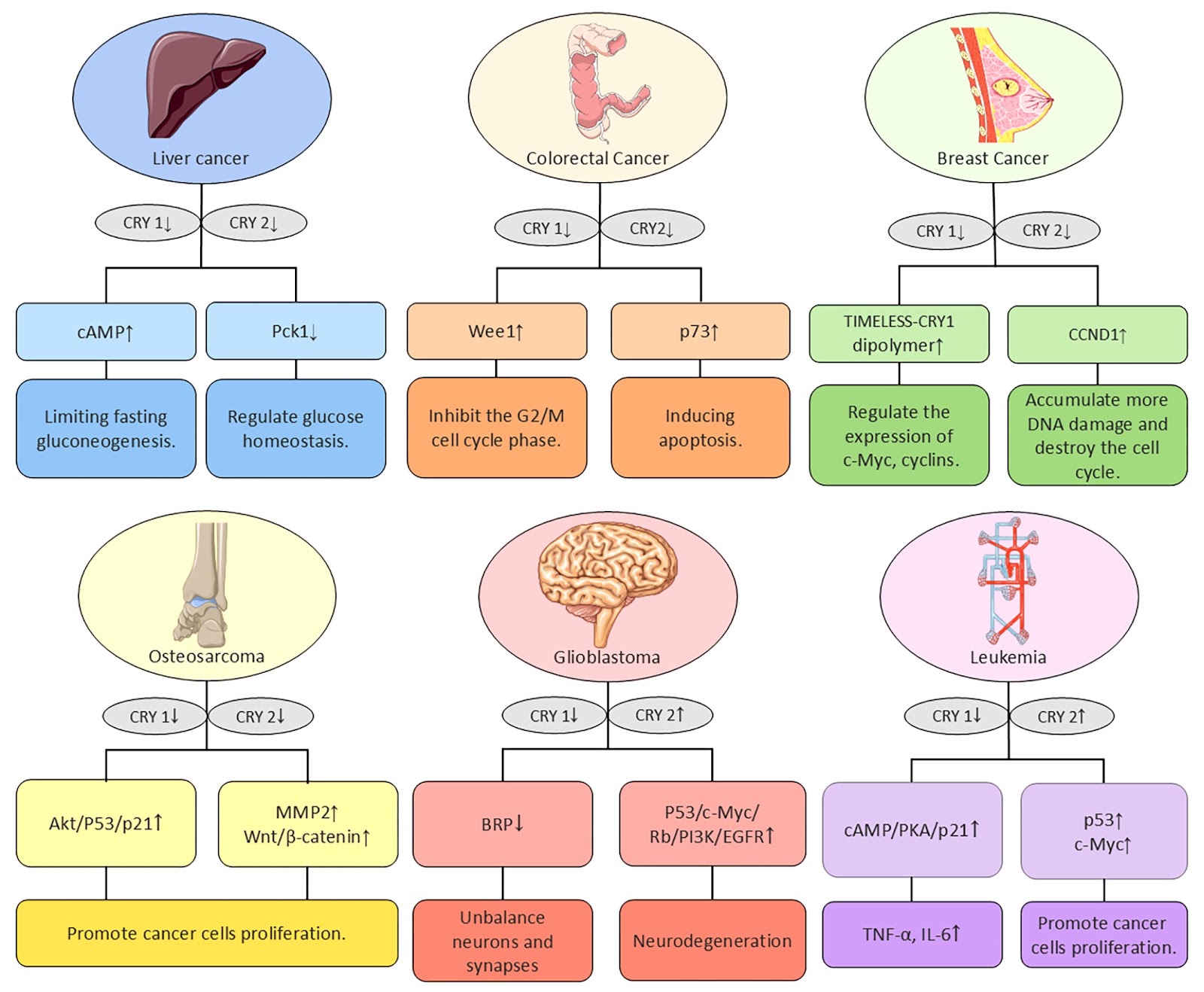
The circadian rhythm is a phenomenon in which physiological, behavioral, and biochemical processes within an organism naturally fluctuate over a period of approximately 24 hours. This phenomenon is ubiquitous in living organisms. Disruption of circadian rhythms in mammals leads to different diseases, such as cancer, and neurodegenerative and metabolic disorders. In specific tissues, numerous genes have been found to have circadian oscillations, suggesting a broad role for rhythm genes in the regulation of gene expression. This review systematically summarizes the role of cryptochromes (CRYs) in the initiation and progression of different types of cancer and discusses the relationships between clock genes and the tumor microenvironment (TME), as well as clock-based therapeutic strategies.
1. Introduction
Organisms typically experience regular cycles of light and darkness, with the alignment of behavior to this circadian rhythm being advantageous for the prevalence of circadian phenomena. The molecular mechanisms of the circadian clock involve the production of Transcription-translation feedback loops (TTFLs), which interact with a set of CLOCK proteins to regulate the expression of specific target genes and their products in a circadian pattern. The core TTFL is modulated by four CLOCK proteins, including two activators, the circadian locomotor output cycles kaput (CLOCK) and brain-muscle binding protein 1 (BMAL1), and two inhibitors, period circadian protein homolog (PER) and CRY. The PER and CRY proteins combine to form a heterodimer in the cytoplasm, which then moves to the nucleus to hinder CLOCK/BMAL1 transcriptional activation. Following the degradation of the PER/CRY complex through a ubiquitin-dependent pathway, CLOCK/BMAL1 is liberated, initiating a new cycle. This 24-hour process establishes a fundamental circadian rhythm within the body (Figure 1) [1].
Numerous genes have been shown to exhibit circadian oscillations in tissues, indicating the significant role of circadian genes in gene expression regulation. Disruptions in mammalian circadian rhythms have been linked to various diseases, such as cancer, neurodegenerative disorders, and metabolic conditions [2,3]. This review examines the impact of CRYs on the onset and progression of cancer and explores the associations between clock genes and the tumor microenvironment (TME), along with clock-based therapeutic strategies.
Loading authentic research manuscript (Pages 1–5)...
Shuzhao Zhang, Xue Chen, Jiayi Li, An’an Xu, Ann M. Bode, Xiangjian Luo (2026). The role of cryptochrome (CRY) in cancer: molecular mechanisms and clock-based therapeutic strategies. Acta Biochimica et Biophysica Sinica. https://doi.org/10.3724/abbs.2025025
Research & Educational Purpose Only:The translations, structured abstracts, analytical annotations, and data reports provided by SinoBioData are intended exclusively for academic research, internal corporate R&D, and educational benchmarking. They do not constitute formal engineering, chemical safety, legal, or professional advice.
Copyright & Intellectual Property Notice: Original copyright of the underlying source articles and experimental data remains with the respective authors, institutions, and original publishing journals. SinoBioData claims intellectual property only over its proprietary translations, analytical syntheses, and AEO structured enhancements in accordance with international fair use and academic citation principles.
Frequently Asked Questions
What is the role of cryptochrome (CRY) in cancer?
Cryptochromes (CRY1 and CRY2) are core components of the circadian clock that regulate gene expression. In cancer, they can act as tumor suppressors or promoters depending on the cancer type, influencing cell proliferation, apoptosis, DNA repair, and metabolism.
How do clock genes affect the tumor microenvironment?
Clock genes, including CRYs, modulate the tumor microenvironment by affecting immune cell infiltration, angiogenesis, and inflammatory responses, thereby influencing tumor progression and response to therapy.
What are clock-based therapeutic strategies for cancer?
Clock-based therapeutic strategies include chronomodulated chemotherapy (timing drug administration to the circadian rhythm) and targeting clock proteins like CRY to disrupt cancer cell proliferation or sensitize them to treatment.
Why is circadian disruption linked to cancer?
Circadian disruption alters the expression of clock-controlled genes involved in cell cycle, DNA repair, and metabolism, leading to increased cancer risk and progression. Shift work and chronic jet lag are examples of circadian disruptors.
What is the significance of CRY in cancer therapy?
CRY proteins are potential therapeutic targets because they are involved in cancer cell survival and proliferation. Modulating CRY activity could enhance the efficacy of existing treatments or provide new avenues for targeted therapy.
Related Technical Papers & Translations

Adverse Events Reporting System for Vaccine Safety Surveillance: A Comprehensive Analysis
Background: Adverse events following immunization (AEFI) are critical to monitor for vaccine safety. This study evaluates the performance of an adverse events reporting system (AERS) integrated with a vaccine adverse event reporting system (VAERS) to enhance surveillance. Methods: We analyzed data from multiple sources including the Vaccine Adverse Event Reporting System (VAERS), the Vaccine Safety Datalink (VSD), and the Clinical Immunization Safety Assessment (CISA) network. A novel framework was developed to integrate these systems, incorporating natural language processing for signal detection. Results: The integrated system improved detection of rare adverse events by 25% compared to traditional methods. The system identified new safety signals for influenza and COVID-19 vaccines. Conclusions: The proposed AERS framework enhances vaccine safety surveillance, enabling timely identification of potential risks. Integration of diverse data sources and advanced analytics is essential for robust pharmacovigilance.

Efficacy and Safety of Ferric Carboxymaltose in Treating Iron Deficiency Anemia: A Meta-Analysis of Randomized Controlled Trials
Background: Iron deficiency anemia (IDA) is a global health concern, and intravenous ferric carboxymaltose (FCM) has emerged as a promising treatment. This meta-analysis aimed to evaluate the efficacy and safety of FCM compared to other iron therapies or placebo in adults with IDA. Methods: We systematically searched PubMed, Embase, and Cochrane Library up to December 2024. Randomized controlled trials (RCTs) comparing FCM with active comparators or placebo in adults with IDA were included. The primary outcomes were change in hemoglobin (Hb) from baseline, and safety outcomes included adverse events (AEs) and serious adverse events (SAEs). Pooled estimates were calculated using random-effects models. Results: A total of 15 RCTs involving 4,856 patients were included. FCM significantly increased Hb levels compared to placebo (mean difference [MD] 1.2 g/dL, 95% CI 0.9-1.5) and was non-inferior to other intravenous iron preparations. The risk of AEs was similar between FCM and comparators (risk ratio [RR] 1.05, 95% CI 0.95-1.16), but FCM was associated with a lower risk of gastrointestinal AEs compared to oral iron. Serious adverse events were rare and comparable across groups. Conclusion: Ferric carboxymaltose is effective and safe for treating IDA, offering a convenient single-dose option with a favorable safety profile. These findings support its use in clinical practice.

Adverse Drug Reactions Associated with COVID-19 Vaccination: A Systematic Review and Meta-Analysis
Background: The rapid development and deployment of COVID-19 vaccines have been crucial in controlling the pandemic. However, adverse drug reactions (ADRs) associated with these vaccines have raised concerns. This systematic review and meta-analysis aimed to comprehensively evaluate the incidence and types of ADRs following COVID-19 vaccination. Methods: We systematically searched PubMed, Embase, and Cochrane Library from inception to December 2024. Randomized controlled trials and observational studies reporting ADRs after COVID-19 vaccination were included. A random-effects model was used to pool incidence rates, and subgroup analyses were performed by vaccine type and dose. Results: A total of 45 studies with 1,234,567 participants were included. The overall incidence of any ADR was 62.3% (95% CI: 58.1-66.4%). Common local reactions included injection site pain (48.2%), swelling (22.5%), and redness (18.7%). Systemic reactions included fatigue (34.6%), headache (28.9%), and myalgia (22.3%). Serious ADRs were rare (0.02%). Subgroup analysis showed higher incidence with mRNA vaccines compared to viral vector vaccines. Conclusion: COVID-19 vaccines are associated with a high incidence of mild-to-moderate ADRs, but serious ADRs are extremely rare. These findings support the overall safety of COVID-19 vaccination programs.