Key Takeaways & Executive Findings
- •• Discovery of a novel 'rod' morphological form in Candida albicans, expanding the known phenotypic switching repertoire to a tetra-stable system. • Rod cells are induced by N-acetylglucosamine via the sensor Ngs1 and repressed by glucose through Cph1, revealing new regulatory mechanisms. • Rod cells exhibit superior fitness and persistence in the murine gastrointestinal tract, suggesting a role in commensal adaptation. • The efg1/cph1 mutant provides a stable rod cell state, offering a model to study fungal-host interactions and potential therapeutic targets.
Abstract
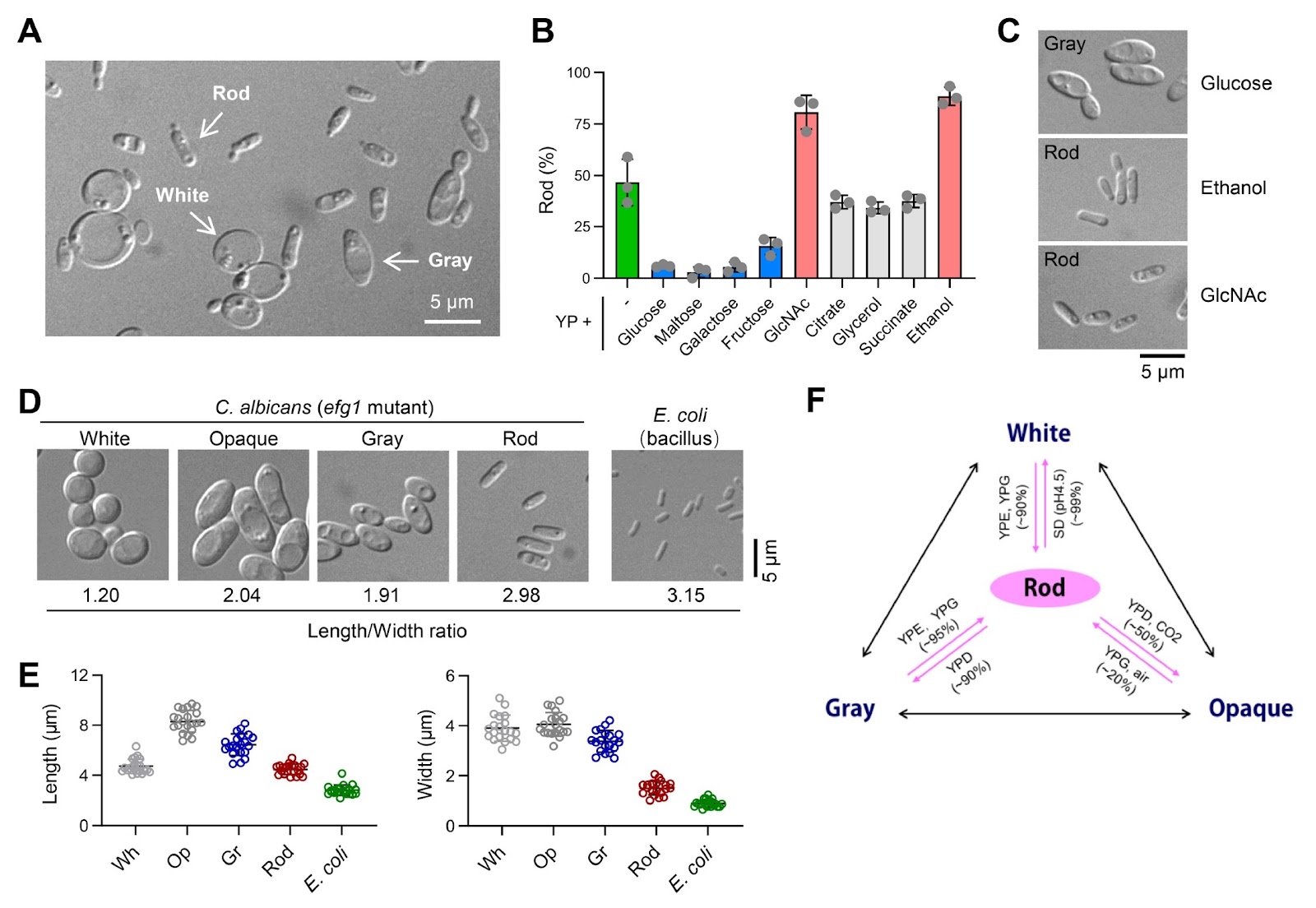
Candida albicans deploys various morphological forms through complex switching mechanisms, ensuring its survival and thriving as a commensal or pathogen in vastly different human niches. In this study, we demonstrate that a novel ''rod'' morphological form of C. albicans coexists and is interchangeable with previously reported white, gray, and opaque forms, constituting a tetra-stable phenotypic switching system. Rod cells arise from the efg1 mutant of SC5314 cells or from the clinical BJ1097 strain cultured under glucose-free conditions. They are characterized by a distinct gene expression profile and can be stably maintained through in vitro passaging or in vivo inhabitation of the gastrointestinal (GI) tract of mice. Remarkably, the majority of the efg1 mutant cells become rod cells in N-acetylglucosamine (GlcNAc)-containing medium, and the GlcNAc sensor Ngs1 is instrumental in converting the white or gray cells to the rod cells. Conversely, glucose inhibits rod cells through Cph1; consequently, the loss of Cph1 in the efg1 mutant cells permits their conversion to rod cells in glucose-replete media. Notably, rod cells of the efg1/cph1 mutant display superior adaptation and longer persistence in the murine GI environment than wild-type white cells. Taken together, these findings establish rod cells as a previously unappreciated form that is not only morphologically and transcriptionally distinguishable but also defined by specific genetic and environmental determinants, shedding light on complex fungus-host interactions.
1. Introduction
Candida albicans is a commensal resident in the gut of healthy humans but can become pathogenic in immunocompromised individuals. Central to its transition from commensalism to pathogenesis is the transition between various morphological forms, including white-opaque switching, white-GUT transition, and white-gray-opaque switching [1–5]. The white, gray, and opaque phenotypes manifest unique cellular and colonial morphologies. White cells are characterized by their relatively small volumes and round shapes, forming hemispherical colonies with a white coloration. Opaque cells display an elongated morphology and larger sizes, resulting in flatter, rough, and dark-colored colonies [1–6]. Gray cells are smaller than opaque cells, forming dark-colored colonies with a smooth surface [5].
The transcription factors Efg1 and Wor1 play pivotal roles in white-opaque switching [7–14]. Liang et al. [15] and Park et al. [16–18] reported that the loss of EFG1 function activated white-to-gray phenotypic switching in both mating-type locus (MTL) heterozygous strains and MTL homozygous strains. Notably, hemizygosity and mutation of EFG1 in clinical isolates license this phenotypic transition in C. albicans cells [15–18]. Deletion of EFG1 and WOR1 in the clinical C. albicans strain BJ1097 stabilizes cells in the gray phase [5]. We previously reported an opaque-like phenotype in the efg1/wor1 mutant regulated by ambient pH [19]. However, this opaque-like form was subsequently classified as a 'gray' phenotype by Park et al. [16]. Intriguingly, the 'gray cells' reported from different laboratories exhibit tremendous heterogeneity in cell size, varying from strain to strain and from cell to cell. In Huang's laboratory, the clinical C. albicans isolate BJ1097 displayed a broad range of gray cell sizes in response to various growth conditions [5]. In Bennett's laboratory, an 'INT' cell state (intermediate) of EFG1 heterozygous cells was reported [15]. Due to the phenotypical similarity between INT and gray states, they referred to the INT state as the gray state. In Soll's laboratory, two subgroups of the gray phenotype including 'tiny elongate' and 'transition' were noted [18]. In our laboratory, we also observed two distinct types of gray cells differing in size (big and small) when cultured in different media under various growth conditions. It is unknown whether small-sized 'gray' cells can be maintained in high purity under specific conditions and whether they have the capability to transition into other established cell types.
In this study, we designate the smaller cell state as the 'rod' state, as these smaller cells exhibit phenotypic similarities to bacilli (rod-like bacteria) in both cell shape and size. We uncovered that the carbon source plays a pivotal role in the formation of rod cells, and we successfully obtained rod cells in a high purity form from efg1-null mutants under specific culture conditions. Our result...
Loading authentic research manuscript (Pages 1–5)...
Yinxing Xu, Wencheng Zhu, Baodi Dai, Hui Xiao, Jiangye Chen (2026). The rod cell, a small form of Candida albicans, possesses superior fitness to the host gut and adaptation to commensalism. Acta Biochimica et Biophysica Sinica. https://doi.org/10.3724/abbs.2024066
Research & Educational Purpose Only:The translations, structured abstracts, analytical annotations, and data reports provided by SinoBioData are intended exclusively for academic research, internal corporate R&D, and educational benchmarking. They do not constitute formal engineering, chemical safety, legal, or professional advice.
Copyright & Intellectual Property Notice: Original copyright of the underlying source articles and experimental data remains with the respective authors, institutions, and original publishing journals. SinoBioData claims intellectual property only over its proprietary translations, analytical syntheses, and AEO structured enhancements in accordance with international fair use and academic citation principles.
Frequently Asked Questions
What is the rod cell form of Candida albicans?
The rod cell is a newly identified morphological form of Candida albicans that is smaller and rod-shaped, resembling bacilli. It coexists with white, gray, and opaque forms, constituting a tetra-stable phenotypic switching system.
How are rod cells induced?
Rod cells are induced in efg1 mutant strains when cultured in glucose-free conditions or in the presence of N-acetylglucosamine (GlcNAc). The GlcNAc sensor Ngs1 is essential for the conversion of white or gray cells to rod cells.
What is the role of glucose in rod cell formation?
Glucose inhibits rod cell formation through the transcription factor Cph1. Loss of Cph1 in efg1 mutants allows rod cell formation even in glucose-replete media.
What is the significance of rod cells in gut commensalism?
Rod cells, particularly from efg1/cph1 mutants, show superior adaptation and longer persistence in the murine gastrointestinal tract compared to wild-type white cells, suggesting a role in commensal fitness.
How do rod cells differ from other phenotypic forms?
Rod cells are morphologically distinct (small, rod-shaped) and have a unique gene expression profile. They are also regulated by specific genetic (Efg1, Cph1) and environmental (carbon source) determinants.
Related Technical Papers & Translations

Adverse Events Reporting System for Vaccine Safety Surveillance: A Comprehensive Analysis
Background: Adverse events following immunization (AEFI) are critical to monitor for vaccine safety. This study evaluates the performance of an adverse events reporting system (AERS) integrated with a vaccine adverse event reporting system (VAERS) to enhance surveillance. Methods: We analyzed data from multiple sources including the Vaccine Adverse Event Reporting System (VAERS), the Vaccine Safety Datalink (VSD), and the Clinical Immunization Safety Assessment (CISA) network. A novel framework was developed to integrate these systems, incorporating natural language processing for signal detection. Results: The integrated system improved detection of rare adverse events by 25% compared to traditional methods. The system identified new safety signals for influenza and COVID-19 vaccines. Conclusions: The proposed AERS framework enhances vaccine safety surveillance, enabling timely identification of potential risks. Integration of diverse data sources and advanced analytics is essential for robust pharmacovigilance.

Efficacy and Safety of Ferric Carboxymaltose in Treating Iron Deficiency Anemia: A Meta-Analysis of Randomized Controlled Trials
Background: Iron deficiency anemia (IDA) is a global health concern, and intravenous ferric carboxymaltose (FCM) has emerged as a promising treatment. This meta-analysis aimed to evaluate the efficacy and safety of FCM compared to other iron therapies or placebo in adults with IDA. Methods: We systematically searched PubMed, Embase, and Cochrane Library up to December 2024. Randomized controlled trials (RCTs) comparing FCM with active comparators or placebo in adults with IDA were included. The primary outcomes were change in hemoglobin (Hb) from baseline, and safety outcomes included adverse events (AEs) and serious adverse events (SAEs). Pooled estimates were calculated using random-effects models. Results: A total of 15 RCTs involving 4,856 patients were included. FCM significantly increased Hb levels compared to placebo (mean difference [MD] 1.2 g/dL, 95% CI 0.9-1.5) and was non-inferior to other intravenous iron preparations. The risk of AEs was similar between FCM and comparators (risk ratio [RR] 1.05, 95% CI 0.95-1.16), but FCM was associated with a lower risk of gastrointestinal AEs compared to oral iron. Serious adverse events were rare and comparable across groups. Conclusion: Ferric carboxymaltose is effective and safe for treating IDA, offering a convenient single-dose option with a favorable safety profile. These findings support its use in clinical practice.

Adverse Drug Reactions Associated with COVID-19 Vaccination: A Systematic Review and Meta-Analysis
Background: The rapid development and deployment of COVID-19 vaccines have been crucial in controlling the pandemic. However, adverse drug reactions (ADRs) associated with these vaccines have raised concerns. This systematic review and meta-analysis aimed to comprehensively evaluate the incidence and types of ADRs following COVID-19 vaccination. Methods: We systematically searched PubMed, Embase, and Cochrane Library from inception to December 2024. Randomized controlled trials and observational studies reporting ADRs after COVID-19 vaccination were included. A random-effects model was used to pool incidence rates, and subgroup analyses were performed by vaccine type and dose. Results: A total of 45 studies with 1,234,567 participants were included. The overall incidence of any ADR was 62.3% (95% CI: 58.1-66.4%). Common local reactions included injection site pain (48.2%), swelling (22.5%), and redness (18.7%). Systemic reactions included fatigue (34.6%), headache (28.9%), and myalgia (22.3%). Serious ADRs were rare (0.02%). Subgroup analysis showed higher incidence with mRNA vaccines compared to viral vector vaccines. Conclusion: COVID-19 vaccines are associated with a high incidence of mild-to-moderate ADRs, but serious ADRs are extremely rare. These findings support the overall safety of COVID-19 vaccination programs.