Key Takeaways & Executive Findings
- •• Single-cell RNA sequencing identifies a novel CCI-induced neuronal population (CIP) marked by Atf3 that emerges at day 3 post-injury and expresses high levels of regeneration-associated genes. • CIP neurons exhibit a pro-regenerative transcriptomic signature and are enriched in regeneration-related GO terms, suggesting they play a key role in early nerve regeneration. • Intercellular communication analysis reveals that CIP neurons specifically transmit strong Fgf3-Fgfr1 signaling to satellite glial cells, potentially initiating regenerative transcriptional changes in these glial cells. • Immunohistochemistry confirms that ATF3 expression increases at 3 days post-CCI and decreases by 1 month, indicating that regenerative processes are active at the early stage of nerve injury.
Abstract
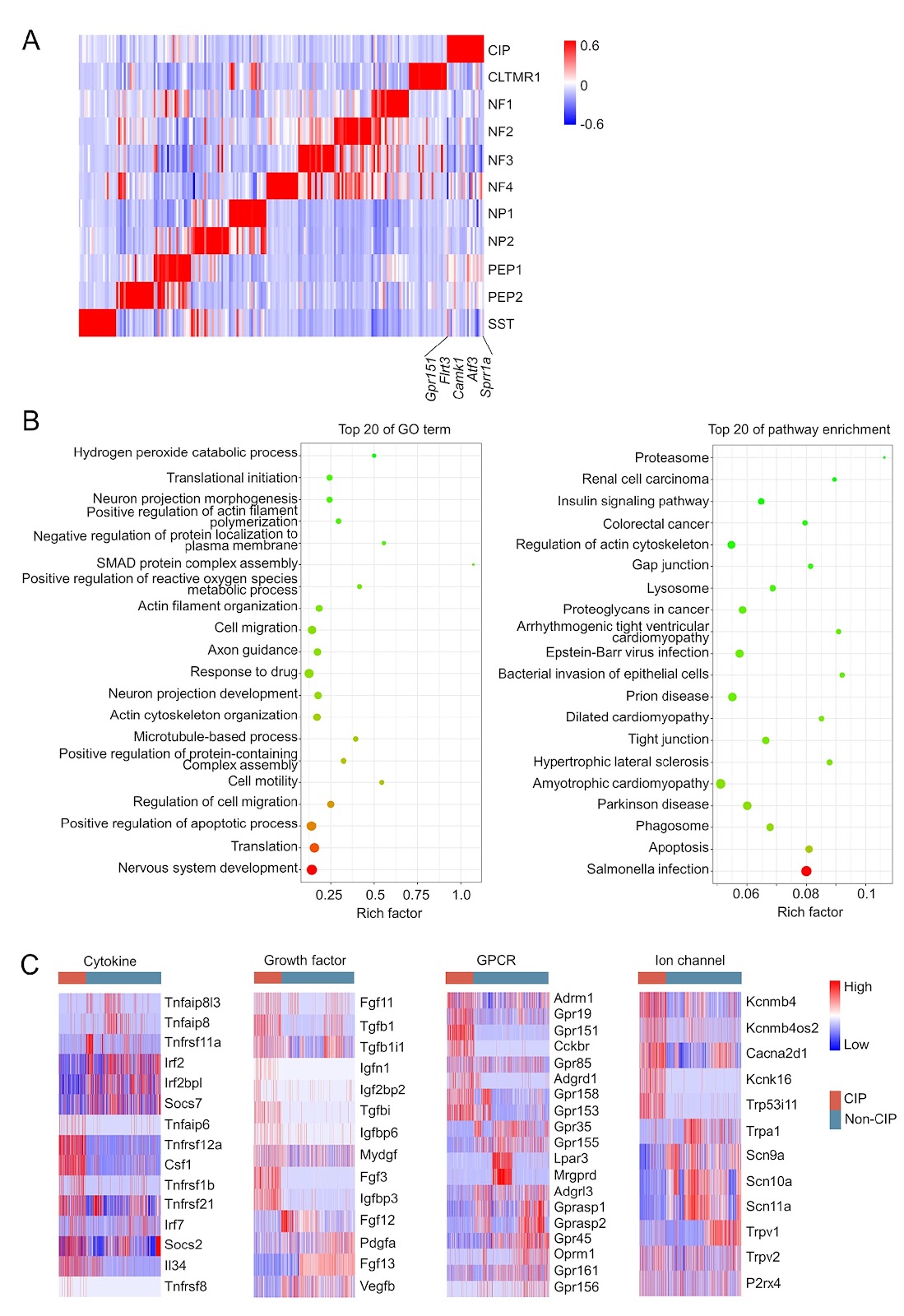
Peripheral nerve injury (PNI) can transform primary somatosensory neurons to a regenerative state. However, the details of the transcriptomic changes associated with the nerve regeneration of somatosensory neurons remain unclear. In this study, single-cell RNA sequencing (scRNA-seq) is conducted on mouse dorsal root ganglion (DRG) cells after the early stage of nerve injury on day 3 after chronic constriction injury (CCI). We observe that a novel CCI-induced neuronal population (CIP) emerge and express high levels of activating transcription factor (Atf3), a neuronal injury marker. CIP neurons highly express regeneration-associated genes (RAGs) and are enriched in regeneration-related gene ontology (GO) terms, suggesting that these neurons can constitute a pro-regenerative population. Moreover, intercellular communication networks show that CIP neurons closely communicate with satellite glial cells (SGCs) and specifically transmit strong Fgf3-Fgfr1 signaling to SGCs, which could initiate regeneration-associated transcriptional changes in SGCs. We also confirm that regenerative progress occurs at the early stage of nerve injury because immunohistochemistry shows that the expression of ATF3 is significantly increased beginning at 3 days post-CCI and decreased at 1 month post-CCI. Our bioinformatics analysis at single-cell resolution advances the knowledge of regenerative dynamic transcriptional changes in DRG cells after injury and the underlying molecular mechanisms involved.
1. Introduction
Peripheral nerve injury (PNI) can result in motor and sensory disorders such as neuropathic pain, which affect 7%–10% of the general population and seriously reduce people’s quality of life [1,2]. Neuronal functional recovery requires axonal regrowth [3]. In contrast to the central nervous system (CNS), the peripheral nervous system (PNS) has intrinsic regeneration and repair abilities [3]. Currently, the preferred treatments are meticulous microsurgical repair by the use of tensionless epineurial sutures and autologous nerve grafting, which requires more extensive procedures and sacrifices the supply of healthy nerves and donor nerves [1,4]. However, although the understanding of neuropathophysiology has greatly improved, the principles of clinical treatment for nerve injury have not changed, and accordingly, clinical outcomes remain poor [5]. Therefore, a deeper understanding of the molecular and cellular mechanisms of nerve regeneration is urgently needed to explore new possibilities for treating nerve injury.
Many molecules and signaling pathways involved in regeneration have been investigated. For example, a previous report indicated that collapsin response mediator protein 4 (CRMP4) plays dual roles in the proximal and distal axon segments of severed DRG neurons to promote axon regeneration [6]. Another study suggested that the Klf2-Vav1-Rac1 axis induced by retrograde Ca2+ signaling from injured axons facilitates axon regeneration through activating Rac1 GTPase in adult DRG neurons [7]. Nevertheless, comprehensive insights into nerve regeneration remain unclear. Single-cell RNA sequencing (scRNA-seq) is a powerful technology for characterizing the transcriptome of individual cells and clarifying biological mechanisms at the cellular level. Recently, scRNA-seq has been used to study transcriptomic perturbations in DRG neurons following nerve injury [8,9]. However, there are still many important questions that have not been adequately addressed, especially the identification of nerve regeneration-associated neuronal subtypes and their mechanisms. CCI is a well-established model that includes compression, ischemia, inflammation, and axonal demyelination [10] and mimics the etiology of clinical conditions and causes symptoms similar to those of posttraumatic neuropathic pain in humans [11].
Loading authentic research manuscript (Pages 1–5)...
Li Liu, Junhui Chen, Wen Yin, Po Gao, Yinghui Fan, Daxiang Wen, Yingfu Jiao, Weifeng Yu (2026). The peripheral Atf3+ neuronal population is responsible for nerve regeneration at the early stage of nerve injury revealed by single-cell RNA sequencing. Acta Biochimica et Biophysica Sinica. https://doi.org/10.3724/abbs.2024169
Research & Educational Purpose Only:The translations, structured abstracts, analytical annotations, and data reports provided by SinoBioData are intended exclusively for academic research, internal corporate R&D, and educational benchmarking. They do not constitute formal engineering, chemical safety, legal, or professional advice.
Copyright & Intellectual Property Notice: Original copyright of the underlying source articles and experimental data remains with the respective authors, institutions, and original publishing journals. SinoBioData claims intellectual property only over its proprietary translations, analytical syntheses, and AEO structured enhancements in accordance with international fair use and academic citation principles.
Frequently Asked Questions
What is the main finding of this study?
The study identifies a novel Atf3+ neuronal population (CIP) that emerges at day 3 after chronic constriction injury and is characterized by high expression of regeneration-associated genes, suggesting it plays a key role in early nerve regeneration.
How was the study conducted?
The study used single-cell RNA sequencing on mouse dorsal root ganglion cells at day 3 post-CCI, followed by bioinformatics analysis of gene regulatory networks and intercellular communication, and validated ATF3 expression via immunohistochemistry.
What is the significance of the Fgf3-Fgfr1 signaling?
The study found that CIP neurons specifically transmit strong Fgf3-Fgfr1 signaling to satellite glial cells, which may initiate regeneration-associated transcriptional changes in these glial cells, highlighting a novel neuron-glia communication mechanism.
What are the clinical implications of this research?
The findings provide a basis for developing targeted therapies for nerve regeneration by identifying specific neuronal subtypes and signaling pathways that could be modulated to improve recovery after peripheral nerve injury.
What is the time course of ATF3 expression?
Immunohistochemistry showed that ATF3 expression significantly increases at 3 days post-CCI and decreases by 1 month, indicating that regenerative processes are active at the early stage of nerve injury.
Related Technical Papers & Translations

Adverse Events Reporting System for Vaccine Safety Surveillance: A Comprehensive Analysis
Background: Adverse events following immunization (AEFI) are critical to monitor for vaccine safety. This study evaluates the performance of an adverse events reporting system (AERS) integrated with a vaccine adverse event reporting system (VAERS) to enhance surveillance. Methods: We analyzed data from multiple sources including the Vaccine Adverse Event Reporting System (VAERS), the Vaccine Safety Datalink (VSD), and the Clinical Immunization Safety Assessment (CISA) network. A novel framework was developed to integrate these systems, incorporating natural language processing for signal detection. Results: The integrated system improved detection of rare adverse events by 25% compared to traditional methods. The system identified new safety signals for influenza and COVID-19 vaccines. Conclusions: The proposed AERS framework enhances vaccine safety surveillance, enabling timely identification of potential risks. Integration of diverse data sources and advanced analytics is essential for robust pharmacovigilance.

Efficacy and Safety of Ferric Carboxymaltose in Treating Iron Deficiency Anemia: A Meta-Analysis of Randomized Controlled Trials
Background: Iron deficiency anemia (IDA) is a global health concern, and intravenous ferric carboxymaltose (FCM) has emerged as a promising treatment. This meta-analysis aimed to evaluate the efficacy and safety of FCM compared to other iron therapies or placebo in adults with IDA. Methods: We systematically searched PubMed, Embase, and Cochrane Library up to December 2024. Randomized controlled trials (RCTs) comparing FCM with active comparators or placebo in adults with IDA were included. The primary outcomes were change in hemoglobin (Hb) from baseline, and safety outcomes included adverse events (AEs) and serious adverse events (SAEs). Pooled estimates were calculated using random-effects models. Results: A total of 15 RCTs involving 4,856 patients were included. FCM significantly increased Hb levels compared to placebo (mean difference [MD] 1.2 g/dL, 95% CI 0.9-1.5) and was non-inferior to other intravenous iron preparations. The risk of AEs was similar between FCM and comparators (risk ratio [RR] 1.05, 95% CI 0.95-1.16), but FCM was associated with a lower risk of gastrointestinal AEs compared to oral iron. Serious adverse events were rare and comparable across groups. Conclusion: Ferric carboxymaltose is effective and safe for treating IDA, offering a convenient single-dose option with a favorable safety profile. These findings support its use in clinical practice.

Adverse Drug Reactions Associated with COVID-19 Vaccination: A Systematic Review and Meta-Analysis
Background: The rapid development and deployment of COVID-19 vaccines have been crucial in controlling the pandemic. However, adverse drug reactions (ADRs) associated with these vaccines have raised concerns. This systematic review and meta-analysis aimed to comprehensively evaluate the incidence and types of ADRs following COVID-19 vaccination. Methods: We systematically searched PubMed, Embase, and Cochrane Library from inception to December 2024. Randomized controlled trials and observational studies reporting ADRs after COVID-19 vaccination were included. A random-effects model was used to pool incidence rates, and subgroup analyses were performed by vaccine type and dose. Results: A total of 45 studies with 1,234,567 participants were included. The overall incidence of any ADR was 62.3% (95% CI: 58.1-66.4%). Common local reactions included injection site pain (48.2%), swelling (22.5%), and redness (18.7%). Systemic reactions included fatigue (34.6%), headache (28.9%), and myalgia (22.3%). Serious ADRs were rare (0.02%). Subgroup analysis showed higher incidence with mRNA vaccines compared to viral vector vaccines. Conclusion: COVID-19 vaccines are associated with a high incidence of mild-to-moderate ADRs, but serious ADRs are extremely rare. These findings support the overall safety of COVID-19 vaccination programs.