Key Takeaways & Executive Findings
- •• DANCR is significantly upregulated in breast cancer brain metastases (BCBM) and correlates with poor prognosis, serving as a potential prognostic biomarker. • DANCR promotes breast cancer cell proliferation, migration, and invasion both in vitro and in vivo, with PTGS2 identified as a key downstream effector. • Mechanistically, DANCR acts as a competing endogenous RNA (ceRNA) by sponging miR-758-3p, thereby relieving miR-758-3p-mediated suppression of PTGS2 and DANCR itself. • The DANCR/miR-758-3p/PTGS2 axis offers a promising therapeutic target for BCBM, with potential for developing novel treatment strategies.
Abstract
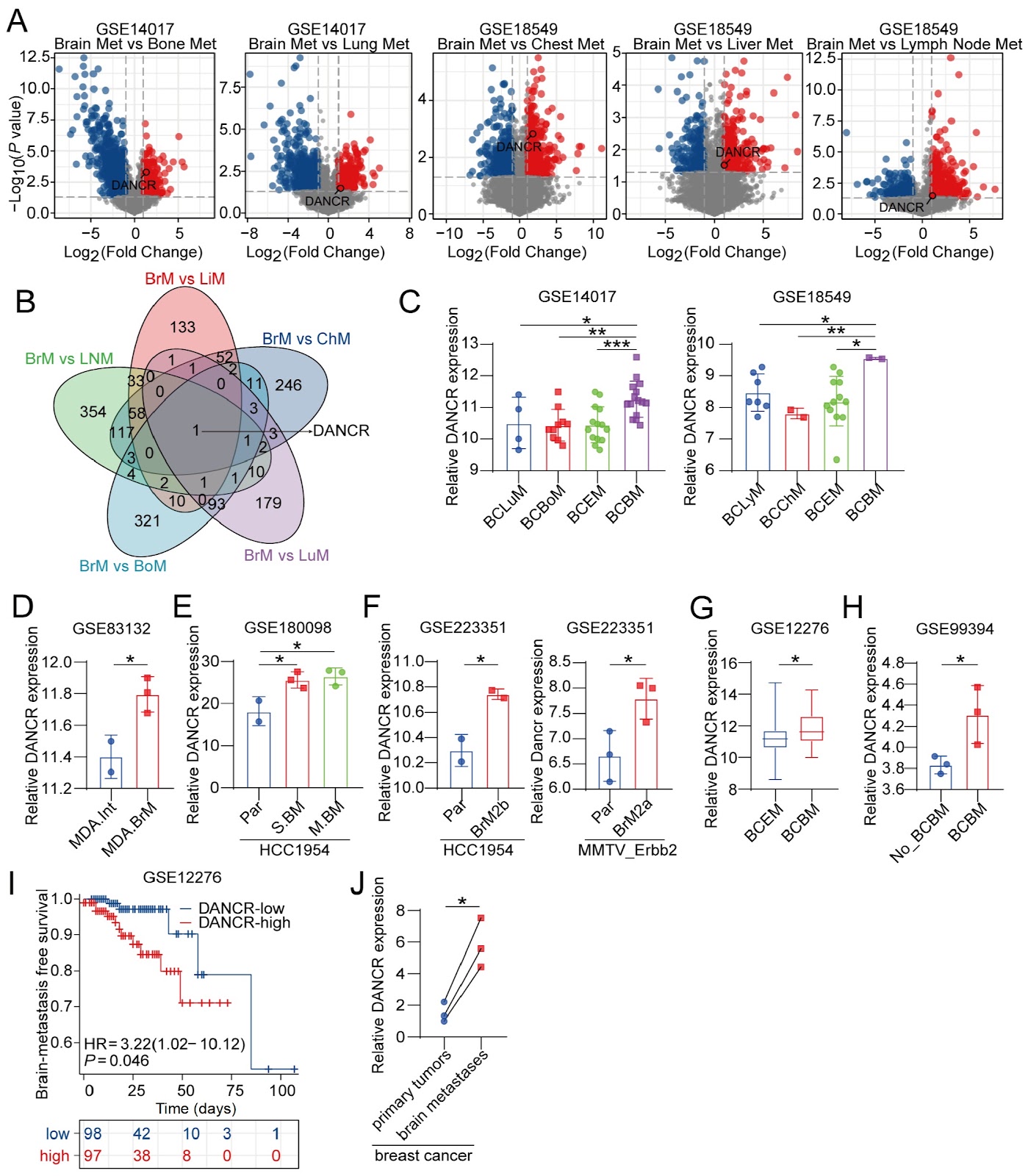
Brain metastases in breast cancer patients are correlated with markedly lower survival rates than extracranial metastases, highlighting the critical necessity for identifying novel therapeutic targets. The functional involvement of differentiation antagonizing nonprotein coding RNA (DANCR) in the pathogenesis of breast cancer brain metastases (BCBMs) has yet to be fully elucidated. Bioinformatics analyses identify DANCR as a potential specific prognostic biomarker of BCBM. CCK-8, transwell, and wound healing assays are performed to examine the effects of DANCR on the proliferation, migration, and invasion of tumors, along with in vivo assays. Mechanistic insights are obtained through quantitative real-time polymerase chain reaction (qRT-PCR), western blot analysis, and dual-luciferase reporter assays. DANCR is markedly upregulated in BCBM and specifically correlates with the prognostic risk of BCBM. DANCR overexpression significantly enhances breast cancer cell proliferation, migration, and invasion. According to low-throughput screening, only the expression of prostaglandin-endoperoxide synthase 2 (PTGS2) consistently varies in parallel with that of DANCR, and PTGS2 silencing reverses DANCR-induced protumor effects in vitro. Additionally, in brain metastatic lesions, PTGS2 expression is also elevated in patients with increased DANCR expression. Mechanistically, DANCR and PTGS2 possess a conserved miR-758-3p response element. DANCR directly binds to and sequesters miR-758-3p, thereby alleviating the suppressive effects of miR-758-3p on both DANCR and PTGS2. When the miR-758-3p binding site on DANCR is mutated, this interaction is completely abolished. DANCR drives BCBM by functioning as a miR-758-3p sponge to upregulate PTGS2. Targeting the DANCR/miR-758-3p/PTGS2 axis represents a promising therapeutic approach.
1. Introduction
Breast cancer is the most common malignancy among women worldwide. Compared with other types of extracranial metastases, brain metastasis, one of the most severe complications of breast cancer, is associated with a significantly poorer prognosis [1]. With advances in systemic therapies and prolonged survival of breast cancer patients, the incidence of brain metastases has also increased [2,3]. Current estimates indicate that approximately 15% to 30% of breast cancer patients will develop brain metastases [4]. The introduction of anti-erb-b2 receptor tyrosine kinase 2 (HER2) therapies has significantly improved outcomes for patients with HER2-positive breast cancer and brain metastases, extending the median overall survival to 34.4 months [5–7]. However, treatment options for triple-negative BCBM remain limited, with ongoing research focusing on combinations of chemotherapy, immune checkpoint inhibitors, and novel targeted therapies [8–12].
Through analyses of brain metastasis samples and preclinical models, researchers have identified a number of potential therapeutic targets implicated in BCBM. Elevated expression of vascular endothelial growth factor A (VEGFA), epidermal growth factor receptor (EGFR), and Rous sarcoma oncogene (SRC) enhances the metastatic potential of breast cancer cells to the brain [13–19]. In addition, multiple proteins, including ST6 N-acetylgalactosaminide alpha-2,6-sialyltransferase 5 (ST6GALNAC5), PTGS2, heparin-binding EGF-like growth factor (HBEGF), cathepsin S (CTSS), angiopoietin-2 (ANGPT2), cell migration-inducing hyaluronidase 1 (CEMIP), matrix metallopeptidase 1 (MMP1), cell migration-inducing hyaluronidase 2 (MMP2), sphingosine-1-phosphate receptor 3 (S1P3), and syndecan 1 (SDC1), have been shown to facilitate the transmigration of breast cancer cells across the blood-brain barrier (BBB) [19–27]. Furthermore, protocadherin 7 (PCDH7) and YTH N6-methyladenosine RNA binding protein F3 (YTHDF3) play crucial roles in mediating interactions between metastatic breast cancer cells and astrocytes within the brain microenvironment [18,28]. Despite these advances, effective treatment of BCBM remains a major clinical challenge, and the identification of additional therapeutic targets is urgently needed.
Recent studies have highlighted the significant regulatory roles of long non-coding RNAs (lncRNAs) in tumor progression and metastasis through diverse mechanisms. For example, lncRNA associated with BCBM (Lnc-BM) promotes BCBM by enhancing communication between breast cancer cells and the brain microenvironment [29]. Our previous work demonstrated that lncRNA-cardiac conduction regulatory RNA (CCRR) promotes the formation of gap junctions between metastatic breast cancer cells and astrocytes by upregulating gap junction protein alpha 1 (CX43) expression [30]. Moreover, the exosome-derived lncRNA GS1-600G8.5 has been shown to facilitate BCBM by compromising the integrity of the BBB [31]. In this study, through bioinformatics analyses and experimental validation, we identify DANCR as a novel lncRNA involved in BCBM and elucidate its molecular mechanism, providing a potential therapeutic target for this devastating disease.
Loading authentic research manuscript (Pages 1–5)...
Sen Li, Yuechao Yang, Zhisu Wang, Liangdong Li, Yang Gao, Yiqun Cao (2026). The lncRNA DANCR promotes breast cancer brain metastasis by acting as a ceRNA for miR-758-3p to regulate PTGS2 expression. Acta Biochimica et Biophysica Sinica. https://doi.org/10.3724/abbs.2025082
Research & Educational Purpose Only:The translations, structured abstracts, analytical annotations, and data reports provided by SinoBioData are intended exclusively for academic research, internal corporate R&D, and educational benchmarking. They do not constitute formal engineering, chemical safety, legal, or professional advice.
Copyright & Intellectual Property Notice: Original copyright of the underlying source articles and experimental data remains with the respective authors, institutions, and original publishing journals. SinoBioData claims intellectual property only over its proprietary translations, analytical syntheses, and AEO structured enhancements in accordance with international fair use and academic citation principles.
Frequently Asked Questions
What is the role of lncRNA DANCR in breast cancer brain metastasis?
DANCR is significantly upregulated in breast cancer brain metastases (BCBM) and promotes cancer cell proliferation, migration, and invasion. It acts as a competing endogenous RNA (ceRNA) by sponging miR-758-3p, thereby upregulating PTGS2 expression, which drives BCBM progression.
How does DANCR regulate PTGS2 expression?
DANCR directly binds to and sequesters miR-758-3p, a microRNA that suppresses PTGS2 expression. By acting as a molecular sponge, DANCR relieves miR-758-3p-mediated inhibition of PTGS2, leading to increased PTGS2 levels and enhanced metastatic potential.
What is the clinical significance of the DANCR/miR-758-3p/PTGS2 axis?
The axis represents a promising therapeutic target for breast cancer brain metastasis. Targeting this pathway could potentially inhibit tumor progression and improve patient outcomes, especially for those with limited treatment options.
What experimental methods were used in this study?
The study employed bioinformatics analyses, CCK-8, transwell, and wound healing assays for functional studies, along with in vivo assays. Mechanistic insights were obtained through qRT-PCR, western blot analysis, and dual-luciferase reporter assays.
Is DANCR a potential prognostic biomarker for breast cancer brain metastasis?
Yes, bioinformatics analyses identified DANCR as a potential specific prognostic biomarker for BCBM. Its expression is markedly upregulated in BCBM and correlates with prognostic risk, suggesting its utility as a biomarker.
Related Technical Papers & Translations

Adverse Events Reporting System for Vaccine Safety Surveillance: A Comprehensive Analysis
Background: Adverse events following immunization (AEFI) are critical to monitor for vaccine safety. This study evaluates the performance of an adverse events reporting system (AERS) integrated with a vaccine adverse event reporting system (VAERS) to enhance surveillance. Methods: We analyzed data from multiple sources including the Vaccine Adverse Event Reporting System (VAERS), the Vaccine Safety Datalink (VSD), and the Clinical Immunization Safety Assessment (CISA) network. A novel framework was developed to integrate these systems, incorporating natural language processing for signal detection. Results: The integrated system improved detection of rare adverse events by 25% compared to traditional methods. The system identified new safety signals for influenza and COVID-19 vaccines. Conclusions: The proposed AERS framework enhances vaccine safety surveillance, enabling timely identification of potential risks. Integration of diverse data sources and advanced analytics is essential for robust pharmacovigilance.

Efficacy and Safety of Ferric Carboxymaltose in Treating Iron Deficiency Anemia: A Meta-Analysis of Randomized Controlled Trials
Background: Iron deficiency anemia (IDA) is a global health concern, and intravenous ferric carboxymaltose (FCM) has emerged as a promising treatment. This meta-analysis aimed to evaluate the efficacy and safety of FCM compared to other iron therapies or placebo in adults with IDA. Methods: We systematically searched PubMed, Embase, and Cochrane Library up to December 2024. Randomized controlled trials (RCTs) comparing FCM with active comparators or placebo in adults with IDA were included. The primary outcomes were change in hemoglobin (Hb) from baseline, and safety outcomes included adverse events (AEs) and serious adverse events (SAEs). Pooled estimates were calculated using random-effects models. Results: A total of 15 RCTs involving 4,856 patients were included. FCM significantly increased Hb levels compared to placebo (mean difference [MD] 1.2 g/dL, 95% CI 0.9-1.5) and was non-inferior to other intravenous iron preparations. The risk of AEs was similar between FCM and comparators (risk ratio [RR] 1.05, 95% CI 0.95-1.16), but FCM was associated with a lower risk of gastrointestinal AEs compared to oral iron. Serious adverse events were rare and comparable across groups. Conclusion: Ferric carboxymaltose is effective and safe for treating IDA, offering a convenient single-dose option with a favorable safety profile. These findings support its use in clinical practice.

Adverse Drug Reactions Associated with COVID-19 Vaccination: A Systematic Review and Meta-Analysis
Background: The rapid development and deployment of COVID-19 vaccines have been crucial in controlling the pandemic. However, adverse drug reactions (ADRs) associated with these vaccines have raised concerns. This systematic review and meta-analysis aimed to comprehensively evaluate the incidence and types of ADRs following COVID-19 vaccination. Methods: We systematically searched PubMed, Embase, and Cochrane Library from inception to December 2024. Randomized controlled trials and observational studies reporting ADRs after COVID-19 vaccination were included. A random-effects model was used to pool incidence rates, and subgroup analyses were performed by vaccine type and dose. Results: A total of 45 studies with 1,234,567 participants were included. The overall incidence of any ADR was 62.3% (95% CI: 58.1-66.4%). Common local reactions included injection site pain (48.2%), swelling (22.5%), and redness (18.7%). Systemic reactions included fatigue (34.6%), headache (28.9%), and myalgia (22.3%). Serious ADRs were rare (0.02%). Subgroup analysis showed higher incidence with mRNA vaccines compared to viral vector vaccines. Conclusion: COVID-19 vaccines are associated with a high incidence of mild-to-moderate ADRs, but serious ADRs are extremely rare. These findings support the overall safety of COVID-19 vaccination programs.