Key Takeaways & Executive Findings
- •• Intratumoral microbiota are diverse microbial communities residing within tumors, distinct from classical oncogenic pathogens, and they modulate tumor progression, immune evasion, and therapeutic response. • Origins of intratumoral microbiota include translocation from mucosal reservoirs, direct invasion from adjacent normal tissues, and hematogenous dissemination from distant sites. • Pan-cancer analyses reveal distinct microbial profiles across tumor types, with bacteria predominating over fungi, and these profiles correlate with tumor heterogeneity. • Targeting intratumoral microbiota presents a promising therapeutic avenue, but challenges remain in understanding colonization mechanisms and clinical translation.
Abstract
Tumor tissues, once considered sterile, actually host diverse microbial communities that play key roles in several physiological and pathological processes, closely related to tumorigenesis and progression. Studies have demonstrated that intratumoral microbiota potentially contributes to immune regulation and significantly influences cancer treatment outcomes. Here, we aim to provide an extensive review of the conceptual framework, potential origins, spatial heterogeneity, and analytical methodologies of intratumoral microbiota, explore their carcinogenic mechanisms and potential role in tumor prognosis. In addition, we discuss current therapeutic strategies that target intratumoral microbiota and highlight the research prospects and limitations in this field, although there are some inevitable challenges.
1. Introduction
Human microorganisms, including bacteria, fungi, and viruses, constitute microbial communities within the human body, outnumbering human cells by approximately tenfold [1]. While commensal microbes colonize all mucosal surfaces, their highest density resides in the distal gastrointestinal (GI) tract [2]. Human microbiome studies have revealed distinct differences in microbial composition between healthy and diseased individuals. In particular, accumulating evidence has elucidated the significant role of gut microbiota in cancer initiation, progression, and the development of drug resistance. However, the existence and functional role of the intratumoral microbiota, which is distinct from the gut microbiota, remain unclear and incompletely established.
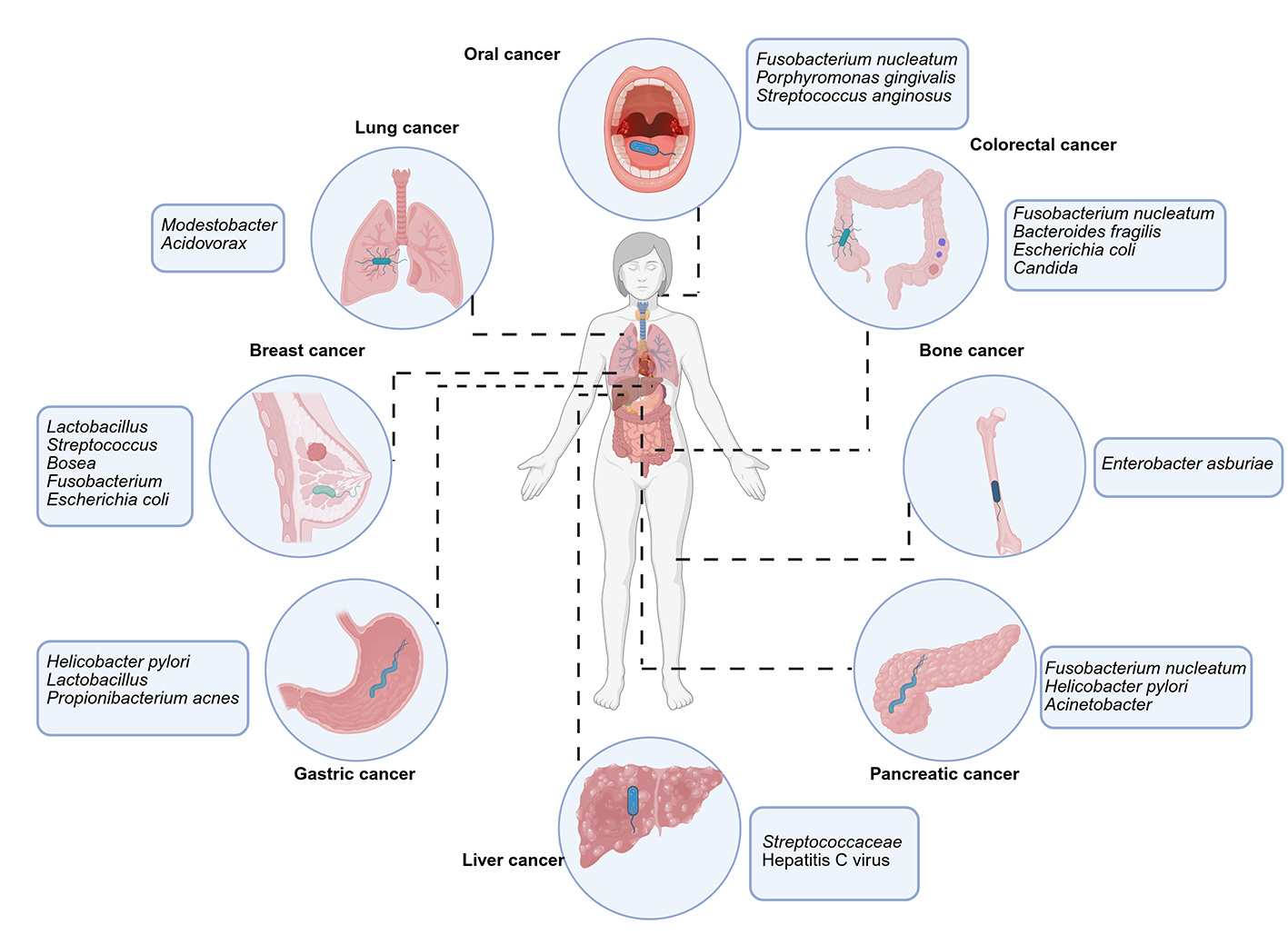
Historically, microbial presence in tumors was hypothesized as early as the 19th century, but was long dismissed due to contamination concerns and the subsequent focus on viral oncogenesis [3]. Interest was revitalized by the definitive characterization of Helicobacter pylori in gastric carcinogenesis, and modern high-throughput sequencing has since firmly established that distinct, viable microbial communities reside intracellularly within tumors, influencing chemotherapy response, genomic stability, and anti-tumor immunity (Figure 1).
Loading authentic research manuscript (Pages 1–5)...
Feiyue Guo, Wanru Zhuang, Jingyan Huang, Yuping Dong, Haiyan Xie (2026). The Intratumoral Microbiota: From Origin and Identification to Function and Therapeutic Perspective. Acta Biochimica et Biophysica Sinica. https://doi.org/10.3724/abbs.2026098
Research & Educational Purpose Only:The translations, structured abstracts, analytical annotations, and data reports provided by SinoBioData are intended exclusively for academic research, internal corporate R&D, and educational benchmarking. They do not constitute formal engineering, chemical safety, legal, or professional advice.
Copyright & Intellectual Property Notice: Original copyright of the underlying source articles and experimental data remains with the respective authors, institutions, and original publishing journals. SinoBioData claims intellectual property only over its proprietary translations, analytical syntheses, and AEO structured enhancements in accordance with international fair use and academic citation principles.
Frequently Asked Questions
What is intratumoral microbiota?
Intratumoral microbiota refers to the diverse communities of bacteria, fungi, archaea, and non-oncogenic viruses that colonize established tumor tissues. They are distinct from classical oncogenic pathogens and modulate tumor progression, immune evasion, and therapeutic response.
How do intratumoral microbiota originate?
Intratumoral microbiota can originate from multiple sources: translocation from mucosal reservoirs like the gut or respiratory tract through compromised barriers, direct invasion from adjacent normal tissues, and hematogenous dissemination from distant sites such as oral or gut microbes traveling via the bloodstream.
What is the role of intratumoral microbiota in cancer?
Intratumoral microbiota can influence tumorigenesis and progression by modulating the tumor microenvironment, affecting immune regulation, and impacting cancer treatment outcomes. They may also serve as biomarkers for prognosis.
How is intratumoral microbiota detected?
Detection methods include high-throughput sequencing, which allows identification of microbial communities within tumor tissues. Advanced techniques help distinguish true intratumoral microbes from contaminants.
Can intratumoral microbiota be targeted for therapy?
Yes, current therapeutic strategies are exploring targeting intratumoral microbiota to enhance cancer treatment efficacy, particularly in immunotherapy. However, challenges remain in understanding colonization mechanisms and clinical translation.
Related Technical Papers & Translations

Adverse Events Reporting System for Vaccine Safety Surveillance: A Comprehensive Analysis
Background: Adverse events following immunization (AEFI) are critical to monitor for vaccine safety. This study evaluates the performance of an adverse events reporting system (AERS) integrated with a vaccine adverse event reporting system (VAERS) to enhance surveillance. Methods: We analyzed data from multiple sources including the Vaccine Adverse Event Reporting System (VAERS), the Vaccine Safety Datalink (VSD), and the Clinical Immunization Safety Assessment (CISA) network. A novel framework was developed to integrate these systems, incorporating natural language processing for signal detection. Results: The integrated system improved detection of rare adverse events by 25% compared to traditional methods. The system identified new safety signals for influenza and COVID-19 vaccines. Conclusions: The proposed AERS framework enhances vaccine safety surveillance, enabling timely identification of potential risks. Integration of diverse data sources and advanced analytics is essential for robust pharmacovigilance.

Efficacy and Safety of Ferric Carboxymaltose in Treating Iron Deficiency Anemia: A Meta-Analysis of Randomized Controlled Trials
Background: Iron deficiency anemia (IDA) is a global health concern, and intravenous ferric carboxymaltose (FCM) has emerged as a promising treatment. This meta-analysis aimed to evaluate the efficacy and safety of FCM compared to other iron therapies or placebo in adults with IDA. Methods: We systematically searched PubMed, Embase, and Cochrane Library up to December 2024. Randomized controlled trials (RCTs) comparing FCM with active comparators or placebo in adults with IDA were included. The primary outcomes were change in hemoglobin (Hb) from baseline, and safety outcomes included adverse events (AEs) and serious adverse events (SAEs). Pooled estimates were calculated using random-effects models. Results: A total of 15 RCTs involving 4,856 patients were included. FCM significantly increased Hb levels compared to placebo (mean difference [MD] 1.2 g/dL, 95% CI 0.9-1.5) and was non-inferior to other intravenous iron preparations. The risk of AEs was similar between FCM and comparators (risk ratio [RR] 1.05, 95% CI 0.95-1.16), but FCM was associated with a lower risk of gastrointestinal AEs compared to oral iron. Serious adverse events were rare and comparable across groups. Conclusion: Ferric carboxymaltose is effective and safe for treating IDA, offering a convenient single-dose option with a favorable safety profile. These findings support its use in clinical practice.

Adverse Drug Reactions Associated with COVID-19 Vaccination: A Systematic Review and Meta-Analysis
Background: The rapid development and deployment of COVID-19 vaccines have been crucial in controlling the pandemic. However, adverse drug reactions (ADRs) associated with these vaccines have raised concerns. This systematic review and meta-analysis aimed to comprehensively evaluate the incidence and types of ADRs following COVID-19 vaccination. Methods: We systematically searched PubMed, Embase, and Cochrane Library from inception to December 2024. Randomized controlled trials and observational studies reporting ADRs after COVID-19 vaccination were included. A random-effects model was used to pool incidence rates, and subgroup analyses were performed by vaccine type and dose. Results: A total of 45 studies with 1,234,567 participants were included. The overall incidence of any ADR was 62.3% (95% CI: 58.1-66.4%). Common local reactions included injection site pain (48.2%), swelling (22.5%), and redness (18.7%). Systemic reactions included fatigue (34.6%), headache (28.9%), and myalgia (22.3%). Serious ADRs were rare (0.02%). Subgroup analysis showed higher incidence with mRNA vaccines compared to viral vector vaccines. Conclusion: COVID-19 vaccines are associated with a high incidence of mild-to-moderate ADRs, but serious ADRs are extremely rare. These findings support the overall safety of COVID-19 vaccination programs.