Key Takeaways & Executive Findings
- •• Liver-specific KHK deletion alleviates hepatic steatosis and injury in high-fructose-fed mice, reducing plasma and liver triglycerides and key enzyme markers. • Hepatic KHK deficiency lowers uric acid levels and xanthine oxidase activity in plasma, urine, liver, and kidneys, indicating systemic metabolic benefits. • Deletion of liver KHK reduces fructose-stimulated expression of fructose transporters and metabolizing enzymes in intestine and kidneys, suggesting inhibited fructose absorption and metabolism. • Liver-specific KHK deletion improves adipose tissue remodeling and reduces inflammation, protecting against fructose-induced metabolic syndrome.
Abstract
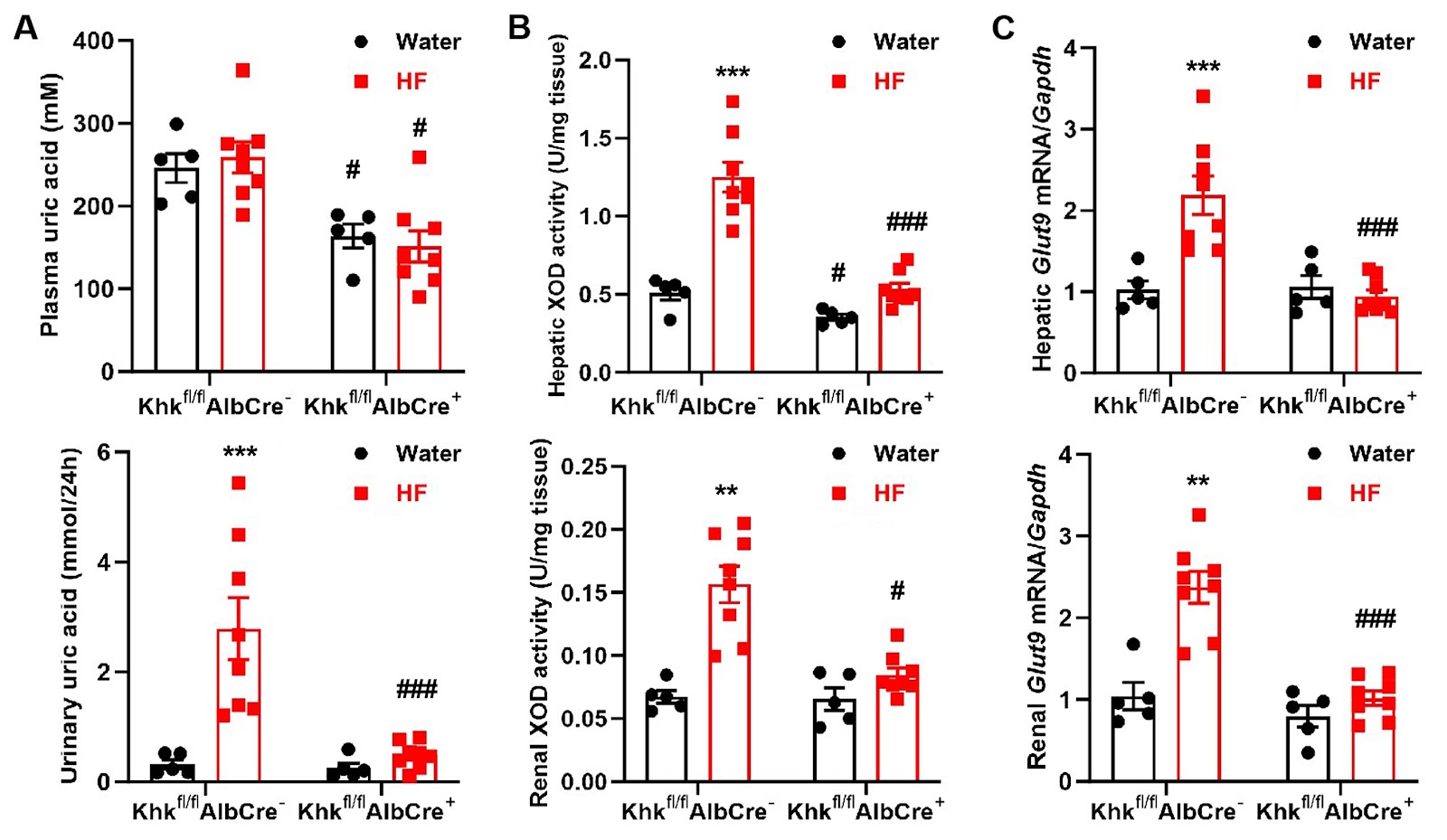
The liver is a crucial site for fructose uptake and metabolism, a function intricately linked to fructose-associated pathologies. This study examines the role of hepatic ketohexokinase (KHK) in metabolic syndrome induced solely by high-fructose intake. Liver-specific Khk-deficient mice are generated and fed with a 20% fructose solution for 3 months, after which the features of metabolic syndrome are examined. Compared with fructose-fed floxed controls, fructose-fed liver-specific Khk-deficient mice present alleviated liver injury and hepatic steatosis, along with lower triglyceride levels in the plasma and liver, plasma aspartate transaminase and alanine transaminase levels, and mRNA levels of genes related to triglyceride and fatty acid synthesis. Liver-specific Khk deficiency also leads to lower uric acid levels in the plasma and urine, as well as xanthine oxidase activity and Glut9 mRNA levels in the liver and kidneys of fructose-fed mice. Although intestinal villus length and epithelial barrier integrity remain unaffected, the deletion of liver Khk significantly reduces fructose-stimulated KHK, Glut2, Glut5, and aldolase B expression in the intestine and kidneys, suggesting inhibited fructose absorption and metabolism in these tissues. In the adipose tissue, fructose-induced increases in adipocyte size and tumor necrosis factor-α and interleukin-6 mRNA levels are blocked by liver-specific Khk deficiency, indicating improved remodeling of adipose tissue and reduced inflammation in adipocytes. Overall, liver-specific Khk deletion is sufficient to protect against metabolic syndrome induced by excessive fructose intake. Our findings underscore the critical role of liver KHK-mediated fructose metabolism in driving the physiological and pathological consequences associated with fructose consumption along the intestinal-liver-kidney axis.
1. Introduction
Although dietary fructose is derived primarily from vegetables and fruits, the consumption of fructose in the form of sugar and high-fructose (HF) corn syrup, two major commercially added sweeteners, has increased dramatically over the past few decades. This rise coincides with a marked global increase in metabolic diseases, including metabolic dysfunction-associated steatotic liver disease [1]. In animal models, HF consumption has been shown to induce all the features of metabolic syndrome, such as weight gain, hepatic steatosis, fatty liver, glucose intolerance, hyperinsulinemia, and insulin resistance [2–4]. Similarly, robust evidence from human studies has revealed a strong association between the consumption of HF-containing beverages and the development of key metabolic syndrome components, including obesity, fatty liver, and insulin resistance [5,6].
Ketohexokinase (KHK, also known as fructokinase), an initial enzyme for fructose metabolism, catalyzes the phosphorylation of fructose to generate uric acid (UA) and fructose 1-phosphate. The latter is further converted by aldolase B (AldoB) into dihydroxyacetone phosphate and glyceraldehyde, precursors for triglyceride synthesis [7]. KHK exists in two isoforms: KHK-A, a slow-acting fructose metabolizer ubiquitously expressed across multiple tissues, and KHK-C, a rapid metabolizer primarily expressed in the liver, small intestine, and kidney [8]. Growing evidence from animal studies has implicated KHK-mediated fructose metabolism in the pathogenesis of fructose-related metabolic syndrome. Notably, in fructose-fed mice, systemic deficiency of KHK-A/C [9–13] or the administration of KHK-specific inhibitors (e.g., PF-06835919 [14–16] and compound 14 [17]) has been shown to significantly mitigate various metabolic syndrome phenotypes associated with fructose overconsumption. However, highlighting the divergent roles of KHK-A and KHK-C is critical: systemic deletion of Khk-a exacerbated, whereas global knockout of Khk-c improved, fructose-induced metabolic syndrome in murine models [10,18]. Collectively, these findings consistently support the targeting of KHK as a promising therapeutic strategy for fructose-induced metabolic syndrome.
In the liver, fructose is primarily transported via glucose transporter (GLUT) 2 from the portal circulation into hepatocytes [19], where KHK and AldoB sequentially metabolize fructose to generate UA and triglycerides [7]. Notably, liver-specific Khk knockdown via N-acetylgalactosamine (GalNAc)-conjugated Khk siRNA significantly improved glucose tolerance and attenuated hepatic steatosis in mice fed with a high-fat diet with [20] or without [16] fructose drinking, providing direct evidence for the critical role of hepatic KHK in the development of fructose-related metabolic syndrome. This conclusion was further corroborated by studies from Andres-Hernando et al., which demonstrated that liver-specific KHK-A/C deficiency...
Loading authentic research manuscript (Pages 1–5)...
Huiru Yang, Xiaoli Yi, Shanshan Song, Mulan Wang, Wenting Tan, Ying Zhu, Jun Yu, Chuanming Xu (2026). The effect of liver-specific ketohexokinase deletion on the intestinal-liver-kidney axis in high-fructose-induced metabolic syndrome mice. Acta Biochimica et Biophysica Sinica. https://doi.org/10.3724/abbs.2025191
Research & Educational Purpose Only:The translations, structured abstracts, analytical annotations, and data reports provided by SinoBioData are intended exclusively for academic research, internal corporate R&D, and educational benchmarking. They do not constitute formal engineering, chemical safety, legal, or professional advice.
Copyright & Intellectual Property Notice: Original copyright of the underlying source articles and experimental data remains with the respective authors, institutions, and original publishing journals. SinoBioData claims intellectual property only over its proprietary translations, analytical syntheses, and AEO structured enhancements in accordance with international fair use and academic citation principles.
Frequently Asked Questions
What is the role of liver-specific ketohexokinase (KHK) in fructose-induced metabolic syndrome?
Liver-specific KHK deletion protects against metabolic syndrome induced by high-fructose intake by alleviating liver injury, hepatic steatosis, and reducing triglyceride and uric acid levels, while also improving adipose tissue remodeling and reducing inflammation.
How does liver-specific KHK deficiency affect fructose absorption and metabolism in other tissues?
Liver-specific KHK deficiency reduces fructose-stimulated expression of KHK, Glut2, Glut5, and aldolase B in the intestine and kidneys, suggesting inhibited fructose absorption and metabolism in these tissues.
What are the key findings of this study on the intestinal-liver-kidney axis?
The study demonstrates that liver KHK-mediated fructose metabolism drives physiological and pathological consequences along the intestinal-liver-kidney axis, and its deletion in the liver is sufficient to protect against fructose-induced metabolic syndrome.
What is the significance of this research for treating metabolic syndrome?
The findings highlight liver KHK as a promising therapeutic target for fructose-induced metabolic syndrome, as its inhibition may alleviate hepatic steatosis, hyperuricemia, and systemic inflammation.
How was the study conducted?
Liver-specific Khk-deficient mice were generated and fed a 20% fructose solution for 3 months. Features of metabolic syndrome were then compared with fructose-fed floxed controls, including liver injury, triglyceride levels, uric acid, gene expression, and adipose tissue characteristics.
Related Technical Papers & Translations

Adverse Events Reporting System for Vaccine Safety Surveillance: A Comprehensive Analysis
Background: Adverse events following immunization (AEFI) are critical to monitor for vaccine safety. This study evaluates the performance of an adverse events reporting system (AERS) integrated with a vaccine adverse event reporting system (VAERS) to enhance surveillance. Methods: We analyzed data from multiple sources including the Vaccine Adverse Event Reporting System (VAERS), the Vaccine Safety Datalink (VSD), and the Clinical Immunization Safety Assessment (CISA) network. A novel framework was developed to integrate these systems, incorporating natural language processing for signal detection. Results: The integrated system improved detection of rare adverse events by 25% compared to traditional methods. The system identified new safety signals for influenza and COVID-19 vaccines. Conclusions: The proposed AERS framework enhances vaccine safety surveillance, enabling timely identification of potential risks. Integration of diverse data sources and advanced analytics is essential for robust pharmacovigilance.

Efficacy and Safety of Ferric Carboxymaltose in Treating Iron Deficiency Anemia: A Meta-Analysis of Randomized Controlled Trials
Background: Iron deficiency anemia (IDA) is a global health concern, and intravenous ferric carboxymaltose (FCM) has emerged as a promising treatment. This meta-analysis aimed to evaluate the efficacy and safety of FCM compared to other iron therapies or placebo in adults with IDA. Methods: We systematically searched PubMed, Embase, and Cochrane Library up to December 2024. Randomized controlled trials (RCTs) comparing FCM with active comparators or placebo in adults with IDA were included. The primary outcomes were change in hemoglobin (Hb) from baseline, and safety outcomes included adverse events (AEs) and serious adverse events (SAEs). Pooled estimates were calculated using random-effects models. Results: A total of 15 RCTs involving 4,856 patients were included. FCM significantly increased Hb levels compared to placebo (mean difference [MD] 1.2 g/dL, 95% CI 0.9-1.5) and was non-inferior to other intravenous iron preparations. The risk of AEs was similar between FCM and comparators (risk ratio [RR] 1.05, 95% CI 0.95-1.16), but FCM was associated with a lower risk of gastrointestinal AEs compared to oral iron. Serious adverse events were rare and comparable across groups. Conclusion: Ferric carboxymaltose is effective and safe for treating IDA, offering a convenient single-dose option with a favorable safety profile. These findings support its use in clinical practice.

Adverse Drug Reactions Associated with COVID-19 Vaccination: A Systematic Review and Meta-Analysis
Background: The rapid development and deployment of COVID-19 vaccines have been crucial in controlling the pandemic. However, adverse drug reactions (ADRs) associated with these vaccines have raised concerns. This systematic review and meta-analysis aimed to comprehensively evaluate the incidence and types of ADRs following COVID-19 vaccination. Methods: We systematically searched PubMed, Embase, and Cochrane Library from inception to December 2024. Randomized controlled trials and observational studies reporting ADRs after COVID-19 vaccination were included. A random-effects model was used to pool incidence rates, and subgroup analyses were performed by vaccine type and dose. Results: A total of 45 studies with 1,234,567 participants were included. The overall incidence of any ADR was 62.3% (95% CI: 58.1-66.4%). Common local reactions included injection site pain (48.2%), swelling (22.5%), and redness (18.7%). Systemic reactions included fatigue (34.6%), headache (28.9%), and myalgia (22.3%). Serious ADRs were rare (0.02%). Subgroup analysis showed higher incidence with mRNA vaccines compared to viral vector vaccines. Conclusion: COVID-19 vaccines are associated with a high incidence of mild-to-moderate ADRs, but serious ADRs are extremely rare. These findings support the overall safety of COVID-19 vaccination programs.