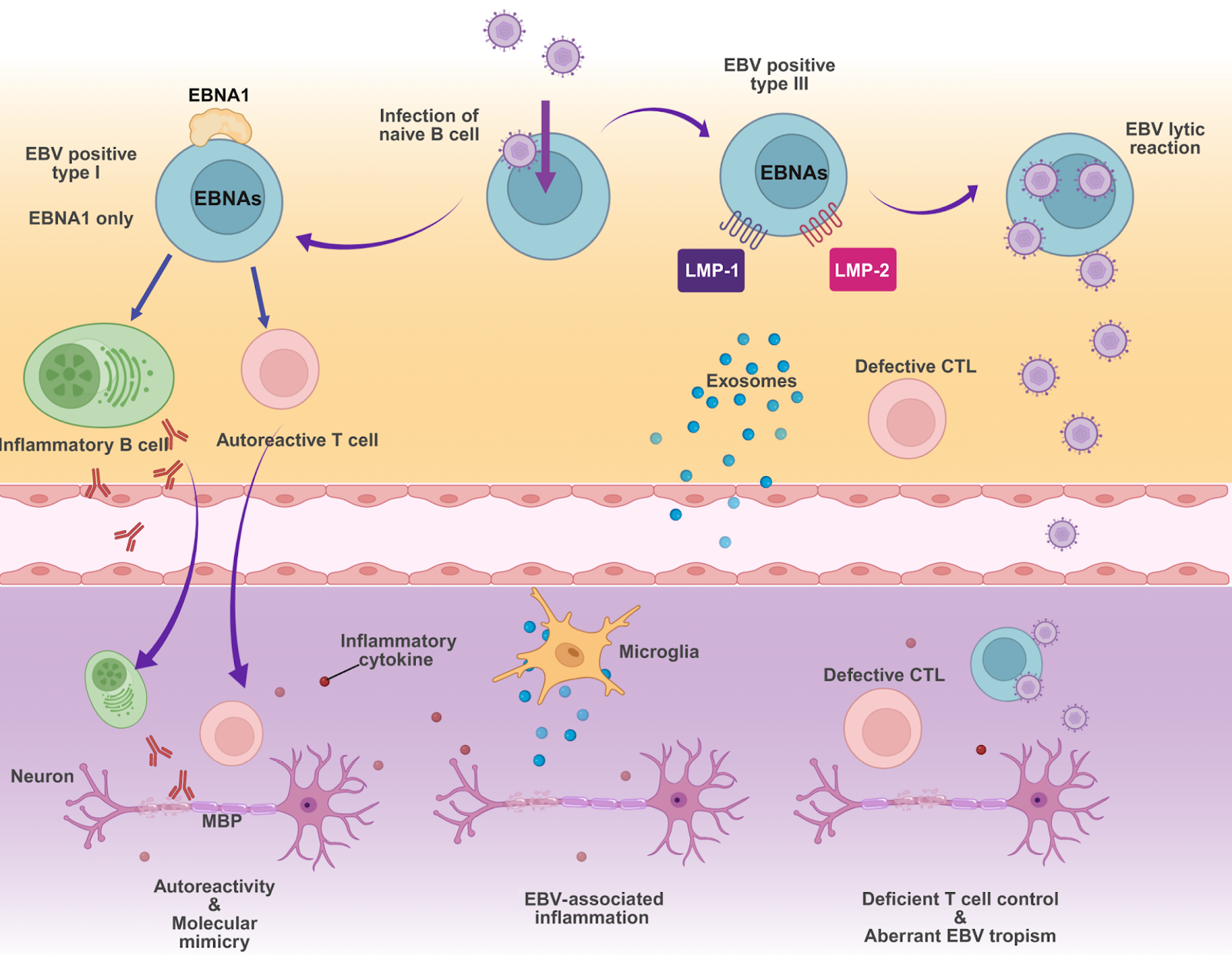
Key Takeaways & Executive Findings
- •• EBV is established as the definitive environmental trigger for multiple sclerosis, with seroconversion preceding clinical onset by years. • Molecular mimicry between EBNA1 and GlialCAM drives cross-reactive immune responses that break self-tolerance in the CNS. • EBV reprograms B cells to establish a persistent CNS reservoir, sustaining chronic neuroinflammation. • Precision therapies targeting the EBV-MS axis, including CNS-penetrant kinase inhibitors and EBV-specific CAR-T cells, are emerging as promising alternatives to broad immunosuppression.
Abstract
Epstein-Barr virus (EBV) is now recognized as the definitive environmental driver of multiple sclerosis (MS), shifting the conceptual landscape of this autoimmune disorder to an infection-triggered model. In this review, we systematically evaluate the multidimensional evidence linking EBV to MS. This evidence ranges from epidemiological associations and the identification of mimotopes to emerging therapeutic strategies. We also discuss the broader implications of infection-driven immune dysregulation for autoimmune research. This pathogenic link is underpinned by molecular mimicry, where immune responses against the viral protein EBNA1 cross-react with the central nervous system (CNS) protein GlialCAM. Beyond this initial insult, EBV reprograms B cells to survive and proliferate abnormally, creating a compartmentalized viral reservoir within the CNS that sustains chronic neuroinflammation. These mechanistic insights catalyze a transition from broad immunosuppression to precision therapies targeting the EBV-MS axis, including CNS-penetrant kinase inhibitors and EBV-specific CAR-T cells. By integrating etiological discovery with mechanism-based intervention, the EBV-MS paradigm serves as a blueprint for transforming idiopathic autoimmune diseases into mechanistically tractable conditions with actionable therapeutic targets.
1. Introduction
Multiple sclerosis (MS) is a chronic inflammatory and neurodegenerative disease of the central nervous system (CNS), with a global prevalence of approximately 2.8 million individuals (35.9 per 100,000) [1]. The incidence of MS continues to rise, including in developing countries [1] and pediatric cohorts [2]. Clinical manifestations encompass a broad spectrum of neurological deficits, such as motor and sensory impairment, visual and oculomotor disturbances, fatigue, ataxia, spasticity, and cognitive decline [3]. The etiology of MS is multifactorial, involving a complex interplay between genetic susceptibility, particularly in immune-related genes, and environmental factors such as infections, smoking and obesity [4].
Epstein-Barr virus (EBV), a ubiquitous human γ-herpesvirus that infects over 95% of adults worldwide, establishes lifelong latency in B cells [5]. Through latency-associated proteins and non-coding RNAs, EBV reprograms B-cell survival and differentiation, enabling persistent infection of memory B cells while evading immune detection [6]. Although most primary EBV infections during childhood are asymptomatic, delayed infection in adolescence frequently causes infectious mononucleosis (IM) [7], which is associated with a 2.3-fold increased risk of developing MS [8]. EBV has also been implicated in various malignancies, e.g., Burkitt lymphoma, Hodgkin lymphoma, nasopharyngeal carcinoma [9] and autoimmune conditions such as systemic lupus erythematosus and rheumatoid arthritis [10]. These associations underscore EBV’s capacity to remodel immune networks via latent antigen expression, molecular mimicry of host signaling molecules [11,12], and modulation of innate and adaptive immune checkpoints [13].
Loading authentic research manuscript (Pages 1–5)...
Huating Xie, Weidong Huang, Weikun Li, Shiying Lai, Zhiqun Lin, Rongqing Zhong, Wen Wang, Xu Lin, Zhaowei Xu (2026). The EBV-MS Paradigm: Beyond Molecular Mimicry Toward New Therapeutic Strategies. Acta Biochimica et Biophysica Sinica. https://doi.org/10.3724/abbs.2026026
Research & Educational Purpose Only:The translations, structured abstracts, analytical annotations, and data reports provided by SinoBioData are intended exclusively for academic research, internal corporate R&D, and educational benchmarking. They do not constitute formal engineering, chemical safety, legal, or professional advice.
Copyright & Intellectual Property Notice: Original copyright of the underlying source articles and experimental data remains with the respective authors, institutions, and original publishing journals. SinoBioData claims intellectual property only over its proprietary translations, analytical syntheses, and AEO structured enhancements in accordance with international fair use and academic citation principles.
Frequently Asked Questions
What is the role of Epstein-Barr virus in multiple sclerosis?
EBV is now recognized as the definitive environmental trigger for MS. Epidemiological studies show that nearly all MS patients have seroconverted before onset, and molecular mimicry between EBNA1 and GlialCAM leads to cross-reactive immune responses that damage the CNS.
How does molecular mimicry contribute to MS pathogenesis?
Molecular mimicry occurs when immune responses against EBV antigens, particularly EBNA1, cross-react with self-antigens like GlialCAM in the CNS. This breaks self-tolerance and initiates autoimmune attack on myelin and neurons.
What are the emerging therapeutic strategies targeting the EBV-MS axis?
Emerging therapies include CNS-penetrant kinase inhibitors that block EBV-driven B-cell survival, and EBV-specific CAR-T cells that target infected B cells. These precision approaches aim to replace broad immunosuppression with more targeted interventions.
What evidence supports a causal link between EBV and MS?
Key evidence includes a large longitudinal study of U.S. military personnel showing 97% seroconversion before MS onset, a 2-3 fold increased risk after infectious mononucleosis, and genetic interactions where EBNA2 binds MS risk loci.
How does EBV reprogram B cells to sustain neuroinflammation?
EBV establishes lifelong latency in memory B cells, reprogramming their survival and differentiation. In the CNS, this creates a compartmentalized viral reservoir that continuously presents viral antigens, driving chronic neuroinflammation.
Related Technical Papers & Translations

Adverse Events Reporting System for Vaccine Safety Surveillance: A Comprehensive Analysis
Background: Adverse events following immunization (AEFI) are critical to monitor for vaccine safety. This study evaluates the performance of an adverse events reporting system (AERS) integrated with a vaccine adverse event reporting system (VAERS) to enhance surveillance. Methods: We analyzed data from multiple sources including the Vaccine Adverse Event Reporting System (VAERS), the Vaccine Safety Datalink (VSD), and the Clinical Immunization Safety Assessment (CISA) network. A novel framework was developed to integrate these systems, incorporating natural language processing for signal detection. Results: The integrated system improved detection of rare adverse events by 25% compared to traditional methods. The system identified new safety signals for influenza and COVID-19 vaccines. Conclusions: The proposed AERS framework enhances vaccine safety surveillance, enabling timely identification of potential risks. Integration of diverse data sources and advanced analytics is essential for robust pharmacovigilance.

Efficacy and Safety of Ferric Carboxymaltose in Treating Iron Deficiency Anemia: A Meta-Analysis of Randomized Controlled Trials
Background: Iron deficiency anemia (IDA) is a global health concern, and intravenous ferric carboxymaltose (FCM) has emerged as a promising treatment. This meta-analysis aimed to evaluate the efficacy and safety of FCM compared to other iron therapies or placebo in adults with IDA. Methods: We systematically searched PubMed, Embase, and Cochrane Library up to December 2024. Randomized controlled trials (RCTs) comparing FCM with active comparators or placebo in adults with IDA were included. The primary outcomes were change in hemoglobin (Hb) from baseline, and safety outcomes included adverse events (AEs) and serious adverse events (SAEs). Pooled estimates were calculated using random-effects models. Results: A total of 15 RCTs involving 4,856 patients were included. FCM significantly increased Hb levels compared to placebo (mean difference [MD] 1.2 g/dL, 95% CI 0.9-1.5) and was non-inferior to other intravenous iron preparations. The risk of AEs was similar between FCM and comparators (risk ratio [RR] 1.05, 95% CI 0.95-1.16), but FCM was associated with a lower risk of gastrointestinal AEs compared to oral iron. Serious adverse events were rare and comparable across groups. Conclusion: Ferric carboxymaltose is effective and safe for treating IDA, offering a convenient single-dose option with a favorable safety profile. These findings support its use in clinical practice.

Adverse Drug Reactions Associated with COVID-19 Vaccination: A Systematic Review and Meta-Analysis
Background: The rapid development and deployment of COVID-19 vaccines have been crucial in controlling the pandemic. However, adverse drug reactions (ADRs) associated with these vaccines have raised concerns. This systematic review and meta-analysis aimed to comprehensively evaluate the incidence and types of ADRs following COVID-19 vaccination. Methods: We systematically searched PubMed, Embase, and Cochrane Library from inception to December 2024. Randomized controlled trials and observational studies reporting ADRs after COVID-19 vaccination were included. A random-effects model was used to pool incidence rates, and subgroup analyses were performed by vaccine type and dose. Results: A total of 45 studies with 1,234,567 participants were included. The overall incidence of any ADR was 62.3% (95% CI: 58.1-66.4%). Common local reactions included injection site pain (48.2%), swelling (22.5%), and redness (18.7%). Systemic reactions included fatigue (34.6%), headache (28.9%), and myalgia (22.3%). Serious ADRs were rare (0.02%). Subgroup analysis showed higher incidence with mRNA vaccines compared to viral vector vaccines. Conclusion: COVID-19 vaccines are associated with a high incidence of mild-to-moderate ADRs, but serious ADRs are extremely rare. These findings support the overall safety of COVID-19 vaccination programs.