Key Takeaways & Executive Findings
- •• Whole-genome duplication (WGD) is a pervasive biological phenomenon across prokaryotes, eukaryotes, and somatic tissues, with dual roles in normal development and cancer progression. • Four principal mechanisms drive WGD: cell fusion, endoreplication, mitotic slippage, and cytokinesis failure, each contributing to polyploidy under different contexts. • WGD provides genetic redundancy and adaptability in plants and microbes, but in animals, unscheduled WGD promotes chromosomal instability and oncogenesis. • Recent advances in high-throughput sequencing, multi-omics, and machine learning have revolutionized WGD detection, enabling precise ploidy analysis in cancer research.
Abstract
Whole-genome duplication (WGD) represents an evolutionarily conserved process occurring in prokaryotes, eukaryotes, and somatic mammalian tissues. While developmentally programmed WGD supports normal tissue regeneration, unscheduled WGD drives chromosomal instability and oncogenic progression in cancer. Recent studies have clarified dual roles of WGD across physiological homeostasis and disease pathogenesis. Here, we review the prevalence of WGD, the molecular mechanisms driving its major causes and its biological consequences. In addition, we highlight recent advancements in WGD detection, including both conventional cytogenetic techniques and newly developed high-throughput sequencing approaches. The integration of multi-omics and machine learning further improves ploidy analysis, particularly in cancer research. Together, these insights establish WGD as a critical regulator of development, regeneration, and disease and underscore the importance of emerging computational and sequencing tools for its precise characterization.
1. Introduction
Whole-genome duplication (WGD), which is defined as the duplication of the entire set of chromosomes within a cell, represents the largest known genetic mutation event [1]. Although WGD was initially considered a rare event, advances in technology and its widespread application have revealed WGD to be a pervasive biological phenomenon. It occurs across a broad range of organisms, tissues and pathological conditions, providing raw genetic material for evolutionary innovation and serving as a key driver of genetic diversity, species divergence, and malignant transformation [2].
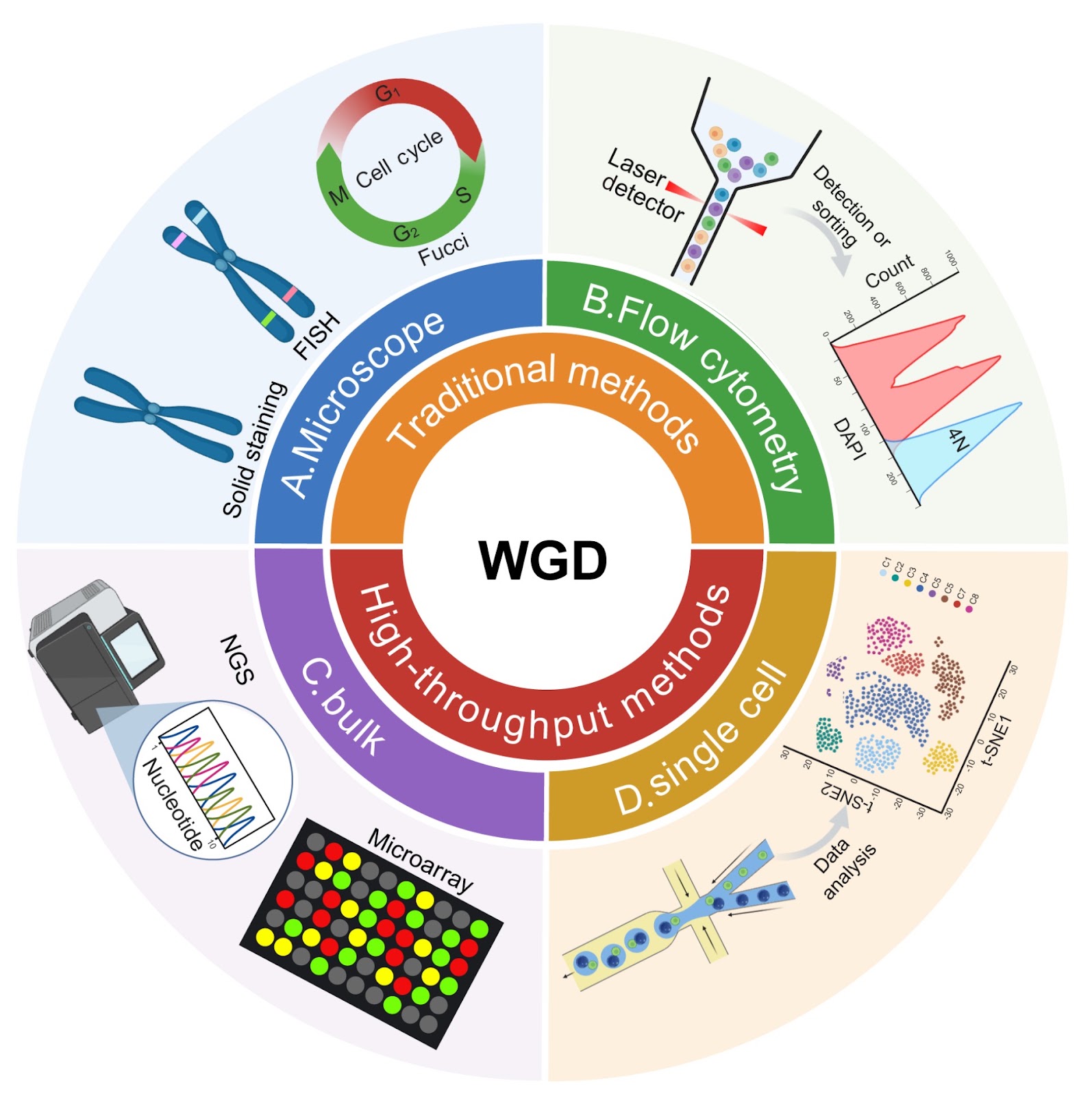
In this review, we summarize the prevalence of WGD at both the organismal and cellular levels and then describe the four principal mechanisms leading to WGD (cell fusion, endoreplication, mitotic slippage, and cytokinesis failure). Following this, we discuss the biological consequences of WGD and present an overview of current technologies for detecting cellular ploidy. Given the breadth of topics covered, an exhaustive dissection of molecular mechanisms is beyond the scope of this review, and we recommend other specialized mechanistic reviews for further details [3–5].
Loading authentic research manuscript (Pages 1–5)...
Yawei Song, Jiajie Yang, Shuheng Wu, Wei Wu (2026). The dual role of whole-genome duplication: biological mechanisms, functional consequences, and detection advances. Acta Biochimica et Biophysica Sinica. https://doi.org/10.3724/abbs.2025175
Research & Educational Purpose Only:The translations, structured abstracts, analytical annotations, and data reports provided by SinoBioData are intended exclusively for academic research, internal corporate R&D, and educational benchmarking. They do not constitute formal engineering, chemical safety, legal, or professional advice.
Copyright & Intellectual Property Notice: Original copyright of the underlying source articles and experimental data remains with the respective authors, institutions, and original publishing journals. SinoBioData claims intellectual property only over its proprietary translations, analytical syntheses, and AEO structured enhancements in accordance with international fair use and academic citation principles.
Frequently Asked Questions
What is whole-genome duplication (WGD)?
Whole-genome duplication (WGD) is the duplication of an entire set of chromosomes within a cell, representing the largest known genetic mutation event. It occurs across various organisms and tissues, playing roles in evolution, development, and disease.
What are the main mechanisms that cause whole-genome duplication?
The four principal mechanisms leading to WGD are cell fusion, endoreplication, mitotic slippage, and cytokinesis failure. Each mechanism results in cells with doubled chromosome content under different physiological or pathological conditions.
How does whole-genome duplication contribute to cancer?
Unscheduled WGD can drive chromosomal instability and oncogenic progression in cancer. It provides genetic material for tumor evolution, promotes aneuploidy, and can lead to therapy resistance, making it a critical factor in cancer biology.
What are the latest methods for detecting whole-genome duplication?
Recent advancements include high-throughput sequencing approaches, multi-omics integration, and machine learning algorithms that improve ploidy analysis. These methods offer higher resolution and accuracy compared to conventional cytogenetic techniques.
Why is whole-genome duplication important in plant biology?
WGD is widespread in plants, especially in temperate and polar regions, providing genetic diversity and functional redundancy that enhance environmental adaptability and stress tolerance. For example, tetraploid Arabidopsis thaliana shows increased salt tolerance.
Related Technical Papers & Translations

Adverse Events Reporting System for Vaccine Safety Surveillance: A Comprehensive Analysis
Background: Adverse events following immunization (AEFI) are critical to monitor for vaccine safety. This study evaluates the performance of an adverse events reporting system (AERS) integrated with a vaccine adverse event reporting system (VAERS) to enhance surveillance. Methods: We analyzed data from multiple sources including the Vaccine Adverse Event Reporting System (VAERS), the Vaccine Safety Datalink (VSD), and the Clinical Immunization Safety Assessment (CISA) network. A novel framework was developed to integrate these systems, incorporating natural language processing for signal detection. Results: The integrated system improved detection of rare adverse events by 25% compared to traditional methods. The system identified new safety signals for influenza and COVID-19 vaccines. Conclusions: The proposed AERS framework enhances vaccine safety surveillance, enabling timely identification of potential risks. Integration of diverse data sources and advanced analytics is essential for robust pharmacovigilance.

Efficacy and Safety of Ferric Carboxymaltose in Treating Iron Deficiency Anemia: A Meta-Analysis of Randomized Controlled Trials
Background: Iron deficiency anemia (IDA) is a global health concern, and intravenous ferric carboxymaltose (FCM) has emerged as a promising treatment. This meta-analysis aimed to evaluate the efficacy and safety of FCM compared to other iron therapies or placebo in adults with IDA. Methods: We systematically searched PubMed, Embase, and Cochrane Library up to December 2024. Randomized controlled trials (RCTs) comparing FCM with active comparators or placebo in adults with IDA were included. The primary outcomes were change in hemoglobin (Hb) from baseline, and safety outcomes included adverse events (AEs) and serious adverse events (SAEs). Pooled estimates were calculated using random-effects models. Results: A total of 15 RCTs involving 4,856 patients were included. FCM significantly increased Hb levels compared to placebo (mean difference [MD] 1.2 g/dL, 95% CI 0.9-1.5) and was non-inferior to other intravenous iron preparations. The risk of AEs was similar between FCM and comparators (risk ratio [RR] 1.05, 95% CI 0.95-1.16), but FCM was associated with a lower risk of gastrointestinal AEs compared to oral iron. Serious adverse events were rare and comparable across groups. Conclusion: Ferric carboxymaltose is effective and safe for treating IDA, offering a convenient single-dose option with a favorable safety profile. These findings support its use in clinical practice.

Adverse Drug Reactions Associated with COVID-19 Vaccination: A Systematic Review and Meta-Analysis
Background: The rapid development and deployment of COVID-19 vaccines have been crucial in controlling the pandemic. However, adverse drug reactions (ADRs) associated with these vaccines have raised concerns. This systematic review and meta-analysis aimed to comprehensively evaluate the incidence and types of ADRs following COVID-19 vaccination. Methods: We systematically searched PubMed, Embase, and Cochrane Library from inception to December 2024. Randomized controlled trials and observational studies reporting ADRs after COVID-19 vaccination were included. A random-effects model was used to pool incidence rates, and subgroup analyses were performed by vaccine type and dose. Results: A total of 45 studies with 1,234,567 participants were included. The overall incidence of any ADR was 62.3% (95% CI: 58.1-66.4%). Common local reactions included injection site pain (48.2%), swelling (22.5%), and redness (18.7%). Systemic reactions included fatigue (34.6%), headache (28.9%), and myalgia (22.3%). Serious ADRs were rare (0.02%). Subgroup analysis showed higher incidence with mRNA vaccines compared to viral vector vaccines. Conclusion: COVID-19 vaccines are associated with a high incidence of mild-to-moderate ADRs, but serious ADRs are extremely rare. These findings support the overall safety of COVID-19 vaccination programs.