Key Takeaways & Executive Findings
- •• Identified a sub-cluster of Cryptococcus gattii VGI strains with distinct virulence profiles, highlighting the role of CAT2 in pathogenicity. • Demonstrated that CAT2 knockout increases susceptibility to oxidative stress and antifungal drugs, and reduces virulence in a mouse model. • Comparative transcriptomics revealed CAT2's involvement in oxidative stress response, metabolism, and sugar transport, providing mechanistic insights. • Findings suggest potential for genotype-specific targeted therapies against cryptococcosis caused by C. gattii VGI.
Abstract
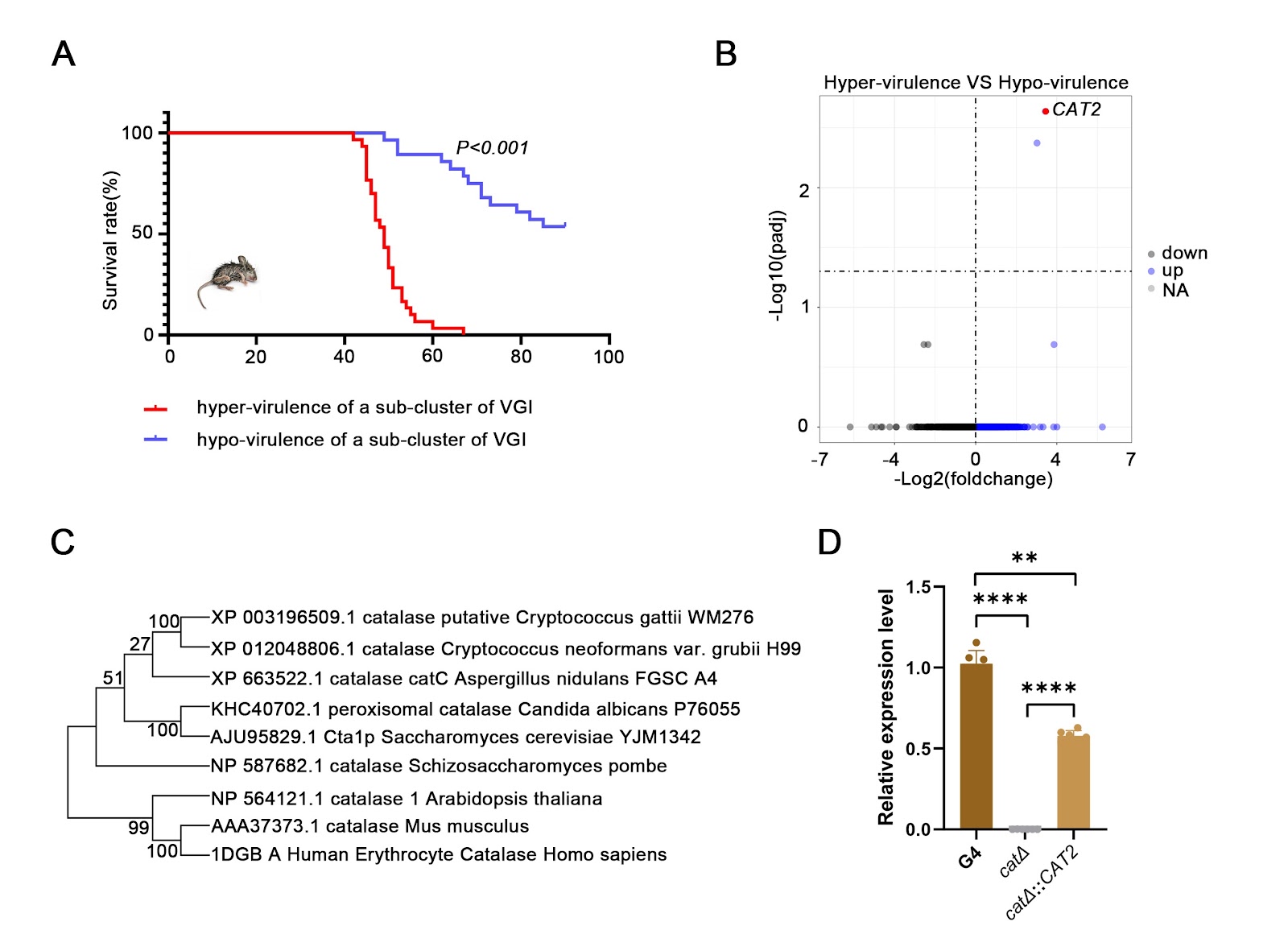
Cryptococcus gattii causes cryptococcosis and life-threatening cryptococcal meningitis. Currently, the pathogenic virulence mechanisms of C. gattii remain a significant area of ongoing research with considerable unexplored aspects. On the basis of our established research, a sub-cluster of strains with independent evolutionary relationships from WM276 in the phylogenetic analysis of VGI-type strains is identified. In vivo infection experiments on this sub-branch of strains reveal that there are hypervirulent strains and hypovirulent strains among these strains, and the virulence differences are significant (P < 0.001). Bioinformatic interrogation of differentially expressed genes reveals that the catalase-encoding gene CGB_J0620W, CAT2, is a pivotal virulence-associated gene. The hypervirulent clinical isolate G4 (G4-WT) is selected as the parental strain, from which an isogenic CAT2-knockout mutant (cat2Δ) is constructed via homologous recombination, which shows increased sensitivity to oxidative stress, as well as growth defects in response to hyperosmosis, 5-fluorocytosine, fluconazole and amphotericin B. The cat2Δ::CAT2 strain exhibits phenotypic restoration to wild type (WT). In the mouse experiments, significant differences in survival (P < 0.001), pulmonary fungal burden (P < 0.01), and alveolar structural damage are observed between the WT and cat2Δ strains, which are completely different from C. neoformans. Moreover, comparative transcriptome analysis is performed on the WT and cat2Δ strains, which reveals that enzymes encoded by CAT2 may be involved in oxidative stress, metabolism and sugar transport. In conclusion, this study may explain the differences in virulence among different genetic evolutionary processes of a sub-cluster of the VGI geneotype of C. gattii and provide a theoretical basis for targeted therapy in a specific genotype population in the future.
1. Introduction
Cryptococcus gattii mainly infects immunocompetent populations, and its degree of harm is greater than that of C. neoformans. It is divided into four gene types: VGI, VGII, VGIII and VGIV. Among them, VGI-type strains are the main epidemic genotypes in China and even in Asia [1–3]. In the past, research on VGI-type strains has focused mainly on the standard strain WM276. However, in our previous studies [4], we found a sub-cluster of strains with independent evolutionary relationships from WM276 (eight strains in total) in the phylogenetic analysis of VGI-type strains.
To understand the key genes that cause virulence differences in these strains and the impact of these genes on strain cell function, pathogenesis in vivo, and transcription differences, we established an in vivo mouse model and conducted transcriptomic analysis on these strains to identify candidate virulence genes.
Loading authentic research manuscript (Pages 1–5)...
Yemei Huang, Hengyu Deng, Xuelei Zang, Enqi Zhao, Yan Zhuo, Wencong He, Chen Wang, Yangyu Zhou, Jiahui Huang, Rui Liu, Tingyue Tian, Chen Yang, Jing Liu, Ping Zhang, Liye Zhang, Xinying Xue (2026). The catalase gene CAT2 and its role in the virulence of one sub-cluster of Cryptococcus gattii VGI clinical isolates. Acta Biochimica et Biophysica Sinica. https://doi.org/10.3724/abbs.2025170
Research & Educational Purpose Only:The translations, structured abstracts, analytical annotations, and data reports provided by SinoBioData are intended exclusively for academic research, internal corporate R&D, and educational benchmarking. They do not constitute formal engineering, chemical safety, legal, or professional advice.
Copyright & Intellectual Property Notice: Original copyright of the underlying source articles and experimental data remains with the respective authors, institutions, and original publishing journals. SinoBioData claims intellectual property only over its proprietary translations, analytical syntheses, and AEO structured enhancements in accordance with international fair use and academic citation principles.
Frequently Asked Questions
What is the main finding of this study?
The study identifies the catalase gene CAT2 as a key virulence factor in a sub-cluster of Cryptococcus gattii VGI clinical isolates, showing that its deletion reduces virulence and increases susceptibility to oxidative stress and antifungal drugs.
How was the CAT2 gene studied?
The researchers constructed a CAT2 knockout mutant in a hypervirulent clinical isolate (G4) via homologous recombination and compared its phenotype, virulence in mice, and transcriptome with the wild-type strain.
What are the implications of this research?
The findings may explain virulence differences among C. gattii strains and provide a basis for developing targeted therapies for infections caused by specific genotypes.
What methods were used in the study?
The study used phylogenetic analysis, in vivo mouse infection models, gene knockout, phenotypic assays (oxidative stress, drug susceptibility), and comparative transcriptomics.
What is the significance of the CAT2 gene?
CAT2 encodes a catalase that helps the fungus combat oxidative stress, and its absence leads to reduced virulence and increased sensitivity to antifungal drugs, highlighting its potential as a therapeutic target.
Related Technical Papers & Translations

Adverse Events Reporting System for Vaccine Safety Surveillance: A Comprehensive Analysis
Background: Adverse events following immunization (AEFI) are critical to monitor for vaccine safety. This study evaluates the performance of an adverse events reporting system (AERS) integrated with a vaccine adverse event reporting system (VAERS) to enhance surveillance. Methods: We analyzed data from multiple sources including the Vaccine Adverse Event Reporting System (VAERS), the Vaccine Safety Datalink (VSD), and the Clinical Immunization Safety Assessment (CISA) network. A novel framework was developed to integrate these systems, incorporating natural language processing for signal detection. Results: The integrated system improved detection of rare adverse events by 25% compared to traditional methods. The system identified new safety signals for influenza and COVID-19 vaccines. Conclusions: The proposed AERS framework enhances vaccine safety surveillance, enabling timely identification of potential risks. Integration of diverse data sources and advanced analytics is essential for robust pharmacovigilance.

Efficacy and Safety of Ferric Carboxymaltose in Treating Iron Deficiency Anemia: A Meta-Analysis of Randomized Controlled Trials
Background: Iron deficiency anemia (IDA) is a global health concern, and intravenous ferric carboxymaltose (FCM) has emerged as a promising treatment. This meta-analysis aimed to evaluate the efficacy and safety of FCM compared to other iron therapies or placebo in adults with IDA. Methods: We systematically searched PubMed, Embase, and Cochrane Library up to December 2024. Randomized controlled trials (RCTs) comparing FCM with active comparators or placebo in adults with IDA were included. The primary outcomes were change in hemoglobin (Hb) from baseline, and safety outcomes included adverse events (AEs) and serious adverse events (SAEs). Pooled estimates were calculated using random-effects models. Results: A total of 15 RCTs involving 4,856 patients were included. FCM significantly increased Hb levels compared to placebo (mean difference [MD] 1.2 g/dL, 95% CI 0.9-1.5) and was non-inferior to other intravenous iron preparations. The risk of AEs was similar between FCM and comparators (risk ratio [RR] 1.05, 95% CI 0.95-1.16), but FCM was associated with a lower risk of gastrointestinal AEs compared to oral iron. Serious adverse events were rare and comparable across groups. Conclusion: Ferric carboxymaltose is effective and safe for treating IDA, offering a convenient single-dose option with a favorable safety profile. These findings support its use in clinical practice.

Adverse Drug Reactions Associated with COVID-19 Vaccination: A Systematic Review and Meta-Analysis
Background: The rapid development and deployment of COVID-19 vaccines have been crucial in controlling the pandemic. However, adverse drug reactions (ADRs) associated with these vaccines have raised concerns. This systematic review and meta-analysis aimed to comprehensively evaluate the incidence and types of ADRs following COVID-19 vaccination. Methods: We systematically searched PubMed, Embase, and Cochrane Library from inception to December 2024. Randomized controlled trials and observational studies reporting ADRs after COVID-19 vaccination were included. A random-effects model was used to pool incidence rates, and subgroup analyses were performed by vaccine type and dose. Results: A total of 45 studies with 1,234,567 participants were included. The overall incidence of any ADR was 62.3% (95% CI: 58.1-66.4%). Common local reactions included injection site pain (48.2%), swelling (22.5%), and redness (18.7%). Systemic reactions included fatigue (34.6%), headache (28.9%), and myalgia (22.3%). Serious ADRs were rare (0.02%). Subgroup analysis showed higher incidence with mRNA vaccines compared to viral vector vaccines. Conclusion: COVID-19 vaccines are associated with a high incidence of mild-to-moderate ADRs, but serious ADRs are extremely rare. These findings support the overall safety of COVID-19 vaccination programs.