Key Takeaways & Executive Findings
- •• Crystal structure of TGP-Sb92 complex reveals precise epitope, enabling rational design of covalent nanobody binders. • Disulfide engineering creates two bridged complexes (TGP A18C-Sb44 V100C and TGP E118C-Sb92 S57C) with enhanced binding. • The TGP-Sb92 disulfide pair exhibits high resistance to reducing agents, indicating robust covalent linkage. • This work expands the molecular toolkit for ultra-thermostable GFP, facilitating its broader application in biotechnology.
Abstract
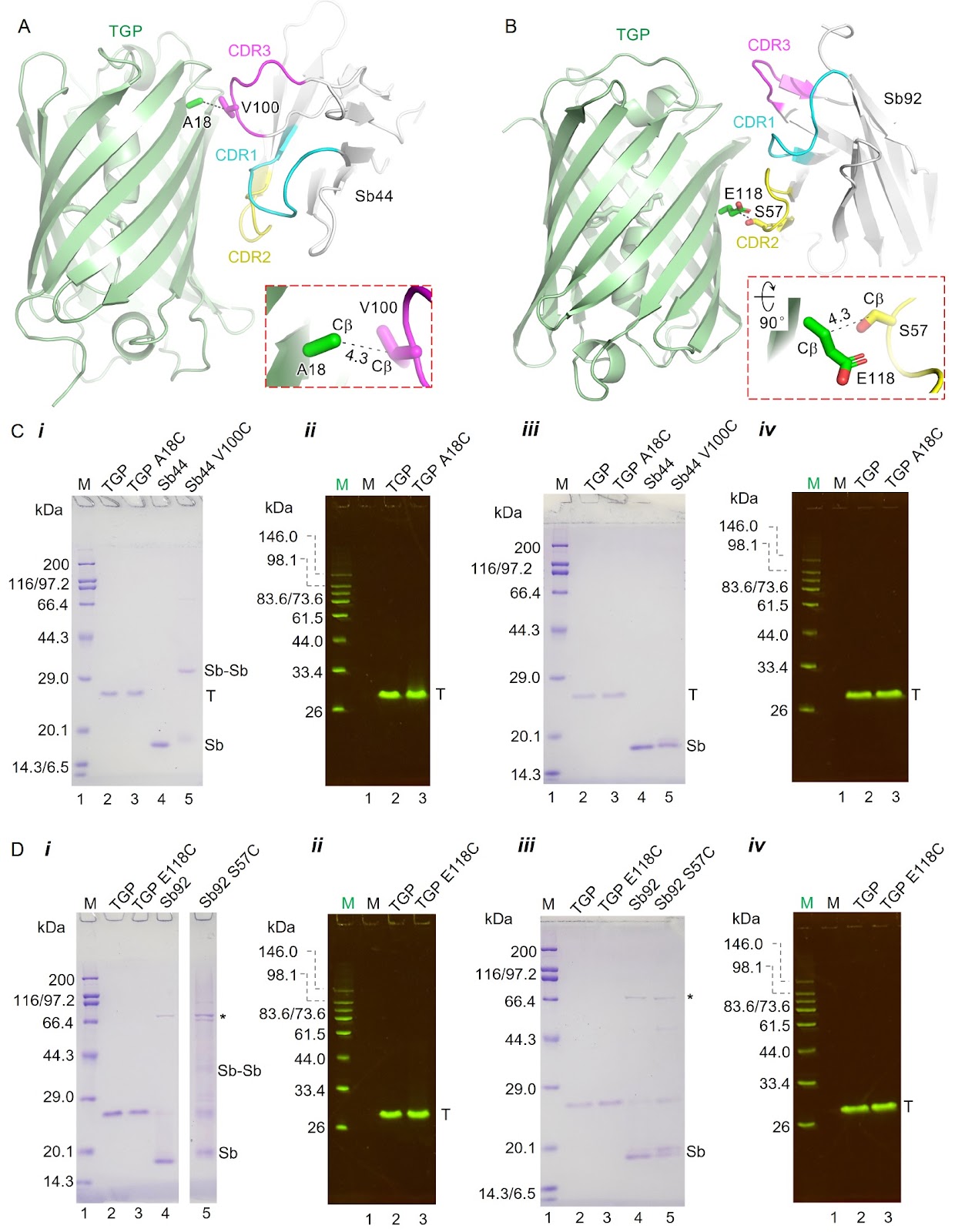
The use of green fluorescence protein (GFP) has advanced numerous areas of life sciences. An ultra-thermostable GFP (TGP), engineered from a coral GFP, offers potential advantages over traditional jellyfish-derived GFP because of its high stability. However, owing to its later discovery, TGP lacks the extensive toolsets available for GFP, such as heavy chain-only antibody binders known as nanobodies. In this study, we report the crystal structure of TGP in complex with Sb92, a synthetic nanobody identified from a previous in vitro screening, revealing Sb92’s precise three-dimensional epitope. This structural insight, alongside the previously characterized Sb44-TGP complex, allows us to rationally design disulfide bonds between the antigen and the antibody for tighter interactions. Using biochemical analysis, we identify two bridged complexes (TGP A18C-Sb44 V100C and TGP E118C-Sb92 S57C), with the TGP-Sb92 disulfide pair showing high resistance to reducing agents. Our study expands the toolkit available for TGP and should encourage its wider applications.
1. Introduction
It is difficult to find a research field of biosciences without the contribution of fluorescence proteins (FPs). In cell biology, FPs allow researchers to pinpoint protein locations [1–3], observe protein-protein interactions [4–6], and track biological processes at the cellular [7], tissue [8], organ [9], and whole-body levels [10]. In biochemistry, FPs enable convenient characterization of fusion partners, including their expression and purification yield [11] and stability [12–16], without requiring pure samples. This is particularly beneficial for challenging-to-purify proteins, such as membrane proteins. FPs can also be engineered as reporters for cellular activities. For example, fusion proteins that combine circularly permutated green FP (GFP), calmodulin, and its binding peptide can track intracellular calcium changes by linking Ca2+-induced binding with improved GFP folding [17]. Split FPs are widely used to detect protein-protein interactions [18], monitor inter-compartment protein translocation [19], and tether protein termini for crystallization [20,21]. Split GFP variants with an inverted topology between the two halves have been used as sensors to detect specific protease activities, such as caspases, within cells [22,23].
As a class, FPs are among the most extensively engineered proteins. The jellyfish GFP, for example, has undergone modifications to improve brightness, maturation speed, folding efficiency, and color variation [24]. A particularly interesting GFP variant, Azami Green [25], originates from coral and has attracted considerable attention because of its unique properties. Azami Green shares only 27% sequence identity with the jellyfish GFP, containing a Gln-Tyr-Gly chromophore that is different from that of the jellyfish GFP (Ser/Thr-Tyr-Gly). Nevertheless, both retain a similar β-barrel structure known as a β-can [26]. Owing to its homology with red fluorescent proteins, Azami Green was the first GFP to be engineered to emit red fluorescence [27]. By applying consensus mutagenesis, the Bradbury group created a variant named CGP (consensus green protein), which is expressed with higher yield and brightness than Azami Green [28]. Through recursive cycles of introducing and removing destabilizing elements combined with directed evolution, the same group developed an extremely stable CGP variant called eCGP123, which retains full fluorescence even after overnight heating at 80°C [29]. Additionally, eCGP123 maintains over 80% fluorescence in 6 M guanidine hydrochloride (GuHCl), a chaotropic condition typically disruptive to secondary structures. To address its tendency to aggregate, structure-guided mutations led to an even more stable variant, TGP (thermostable green protein) [26], which retains fluorescence after 50 days at 85°C. The melting temperature (Tm) of TGP is approximately 95°C (with 20 min of heating), which is approximately 20°C higher than that of the superfold GFP [15].
TGP has proven to be a superior fusion partner for membrane proteins, offering expression levels up to 30 times higher than those of conventional GFP fusions in widely used systems such as Escherichia coli, Saccharomyces cerevisiae, baculovirus, and mammalian cells [15]. Its extreme stability also enables thermostability assessments of fusion membrane proteins across a wide temperature range using fluorescence-detection size-exclusion chromatography. In this approach, the fluorescen...
Loading authentic research manuscript (Pages 1–5)...
Zhihao Yue, Yanfang Li, Hongmin Cai, Hebang Yao, Dianfan Li, Aimin Ni, Tingting Li (2026). Structure-based design of covalent nanobody binders for a thermostable green fluorescence protein. Acta Biochimica et Biophysica Sinica. https://doi.org/10.3724/abbs.2024233
Research & Educational Purpose Only:The translations, structured abstracts, analytical annotations, and data reports provided by SinoBioData are intended exclusively for academic research, internal corporate R&D, and educational benchmarking. They do not constitute formal engineering, chemical safety, legal, or professional advice.
Copyright & Intellectual Property Notice: Original copyright of the underlying source articles and experimental data remains with the respective authors, institutions, and original publishing journals. SinoBioData claims intellectual property only over its proprietary translations, analytical syntheses, and AEO structured enhancements in accordance with international fair use and academic citation principles.
Frequently Asked Questions
What is the main achievement of this study?
The study reports the crystal structure of TGP in complex with a synthetic nanobody Sb92 and uses this structural information to rationally design disulfide bonds between TGP and nanobodies, creating covalent binders with enhanced stability and resistance to reducing agents.
What is TGP and why is it important?
TGP (thermostable green protein) is an ultra-stable variant of green fluorescent protein engineered from coral. It retains fluorescence after 50 days at 85°C and has a melting temperature around 95°C, making it a superior fusion partner for membrane proteins and enabling thermostability assessments.
How were the covalent nanobody binders designed?
The design was based on the crystal structures of TGP in complex with nanobodies Sb92 and Sb44. By introducing cysteine mutations at specific positions (TGP A18C-Sb44 V100C and TGP E118C-Sb92 S57C), disulfide bonds were formed between the antigen and antibody, creating covalent linkages.
What are the potential applications of this work?
The covalent nanobody binders expand the toolkit for TGP, enabling tighter and more stable interactions. This could facilitate applications such as protein purification, imaging, and biosensing, especially under harsh conditions where non-covalent binders might fail.
Which disulfide pair showed high resistance to reducing agents?
The TGP-Sb92 disulfide pair (TGP E118C-Sb92 S57C) showed high resistance to reducing agents, indicating a robust covalent linkage that can withstand reducing environments.
Related Technical Papers & Translations

Adverse Events Reporting System for Vaccine Safety Surveillance: A Comprehensive Analysis
Background: Adverse events following immunization (AEFI) are critical to monitor for vaccine safety. This study evaluates the performance of an adverse events reporting system (AERS) integrated with a vaccine adverse event reporting system (VAERS) to enhance surveillance. Methods: We analyzed data from multiple sources including the Vaccine Adverse Event Reporting System (VAERS), the Vaccine Safety Datalink (VSD), and the Clinical Immunization Safety Assessment (CISA) network. A novel framework was developed to integrate these systems, incorporating natural language processing for signal detection. Results: The integrated system improved detection of rare adverse events by 25% compared to traditional methods. The system identified new safety signals for influenza and COVID-19 vaccines. Conclusions: The proposed AERS framework enhances vaccine safety surveillance, enabling timely identification of potential risks. Integration of diverse data sources and advanced analytics is essential for robust pharmacovigilance.

Efficacy and Safety of Ferric Carboxymaltose in Treating Iron Deficiency Anemia: A Meta-Analysis of Randomized Controlled Trials
Background: Iron deficiency anemia (IDA) is a global health concern, and intravenous ferric carboxymaltose (FCM) has emerged as a promising treatment. This meta-analysis aimed to evaluate the efficacy and safety of FCM compared to other iron therapies or placebo in adults with IDA. Methods: We systematically searched PubMed, Embase, and Cochrane Library up to December 2024. Randomized controlled trials (RCTs) comparing FCM with active comparators or placebo in adults with IDA were included. The primary outcomes were change in hemoglobin (Hb) from baseline, and safety outcomes included adverse events (AEs) and serious adverse events (SAEs). Pooled estimates were calculated using random-effects models. Results: A total of 15 RCTs involving 4,856 patients were included. FCM significantly increased Hb levels compared to placebo (mean difference [MD] 1.2 g/dL, 95% CI 0.9-1.5) and was non-inferior to other intravenous iron preparations. The risk of AEs was similar between FCM and comparators (risk ratio [RR] 1.05, 95% CI 0.95-1.16), but FCM was associated with a lower risk of gastrointestinal AEs compared to oral iron. Serious adverse events were rare and comparable across groups. Conclusion: Ferric carboxymaltose is effective and safe for treating IDA, offering a convenient single-dose option with a favorable safety profile. These findings support its use in clinical practice.

Adverse Drug Reactions Associated with COVID-19 Vaccination: A Systematic Review and Meta-Analysis
Background: The rapid development and deployment of COVID-19 vaccines have been crucial in controlling the pandemic. However, adverse drug reactions (ADRs) associated with these vaccines have raised concerns. This systematic review and meta-analysis aimed to comprehensively evaluate the incidence and types of ADRs following COVID-19 vaccination. Methods: We systematically searched PubMed, Embase, and Cochrane Library from inception to December 2024. Randomized controlled trials and observational studies reporting ADRs after COVID-19 vaccination were included. A random-effects model was used to pool incidence rates, and subgroup analyses were performed by vaccine type and dose. Results: A total of 45 studies with 1,234,567 participants were included. The overall incidence of any ADR was 62.3% (95% CI: 58.1-66.4%). Common local reactions included injection site pain (48.2%), swelling (22.5%), and redness (18.7%). Systemic reactions included fatigue (34.6%), headache (28.9%), and myalgia (22.3%). Serious ADRs were rare (0.02%). Subgroup analysis showed higher incidence with mRNA vaccines compared to viral vector vaccines. Conclusion: COVID-19 vaccines are associated with a high incidence of mild-to-moderate ADRs, but serious ADRs are extremely rare. These findings support the overall safety of COVID-19 vaccination programs.