Key Takeaways & Executive Findings
- •• High-resolution crystal structure of FOXM1-DBD bound to dsDNA reveals a canonical winged-helix fold with α3 inserted into the major groove. • Asn283, Arg286, and His287 form an essential triad for sequence-specific DNA recognition via hydrogen bonds and hydrophobic interactions. • Structure-guided mutagenesis and biophysical assays (ITC, EMSA) confirm the functional importance of these residues and reveal position-dependent tolerance to base substitutions in the FKH motif. • FOXM1 overexpression promotes cell proliferation and upregulates target gene transcription in a DBD-dependent manner, linking structural recognition to oncogenic function.
Abstract
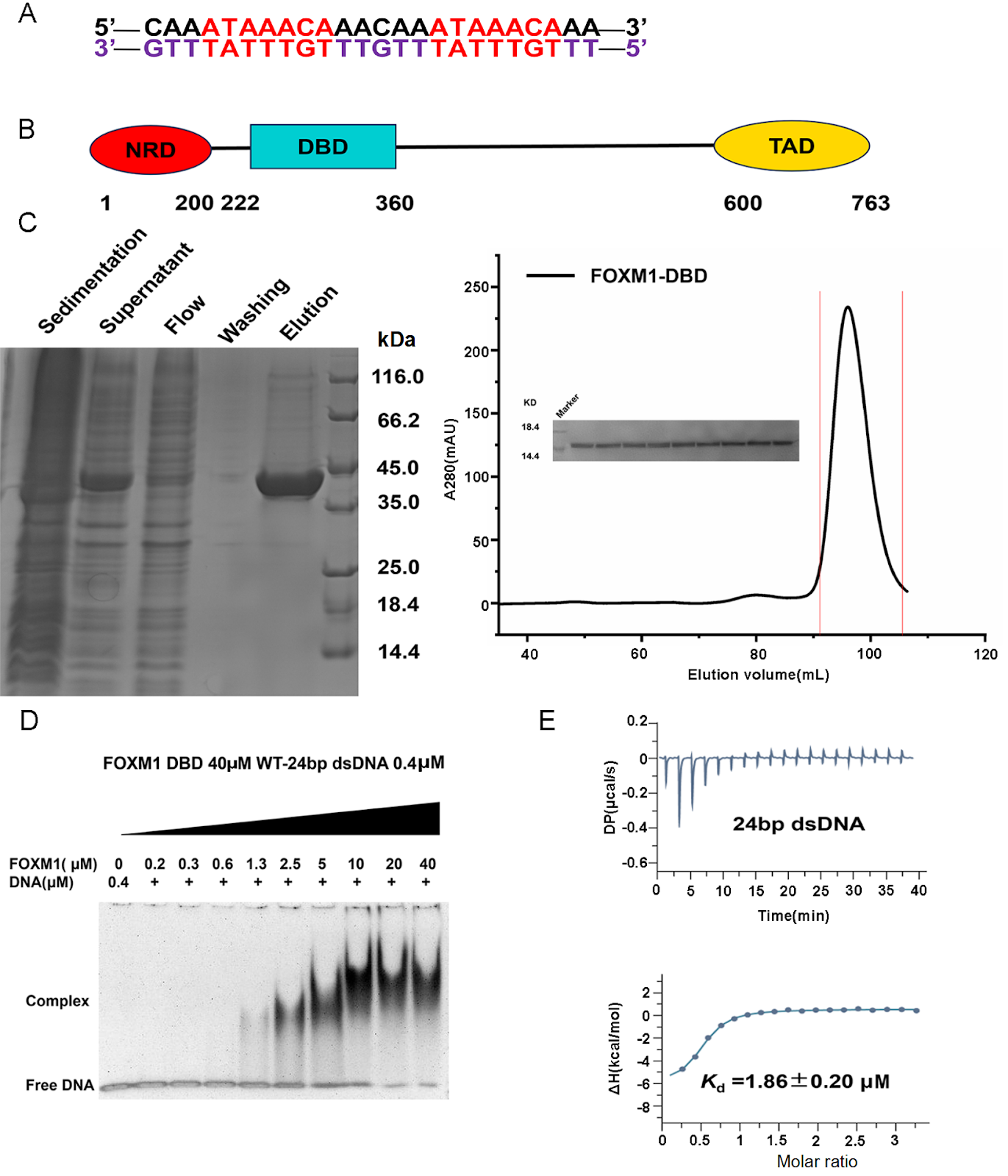
Forkhead box protein M1 (FOXM1) is a key transcription factor that regulates cell cycle progression and is frequently overexpressed in human cancers, driving tumor proliferation and therapy resistance. FOXM1 recognizes the canonical forkhead response element (FKH motif, RYAAAYA) through its conserved DNA-binding domain (DBD). Here, we report the high-resolution crystal structure of the FOXM1-DBD in complex with a double-stranded DNA substrate containing two FKH motifs. The structure reveals that FOXM1-DBD adopts the canonical winged-helix fold, with the third α-helix (α3) inserted into the DNA major groove to mediate sequence-specific recognition. Within this helix, Asn283, Arg286, and His287 form an essential triad that engages DNA bases through specific hydrogen bonds and hydrophobic interactions. Using structure-guided mutagenesis of key DNA-interacting residues combined with biophysical validation by isothermal titration calorimetry (ITC) and DNA binding assessment via electrophoretic mobility shift assay (EMSA), we confirm the functional importance of these residues and uncover position-dependent tolerance to base substitutions within the FKH motif. Furthermore, we demonstrate that FOXM1 overexpression promotes cell proliferation and upregulates the transcription of target genes in a DBD-dependent manner. Our findings provide a structural basis for understanding the DNA recognition mechanism of FOXM1 and offer mechanistic insights into how FOXM1 selectively binds to its genomic targets to regulate transcription.
1. Introduction
The precise regulation of cell cycle progression is fundamental to cellular homeostasis, and its dysregulation underlies the pathogenesis of numerous human diseases [1,2]. In eukaryotes, this process is governed by an integrated network of cyclins, cyclin-dependent kinases (CDKs), checkpoint signaling pathways, and ubiquitin-mediated regulatory mechanisms [3,4]. When this sophisticated control system is compromised, it contributes not only to cancer development but also to a spectrum of other pathological conditions, including cardiovascular disorders, inflammatory diseases, and neurodegenerative processes [2]. Understanding the molecular mechanisms that maintain cell cycle-metabolic coordination is therefore essential for elucidating fundamental biological processes such as differentiation and aging while also providing critical insights for addressing disease mechanisms.
Within this regulatory framework, transcription factors (TFs) serve as crucial intermediaries that translate cell cycle signals into specific gene expression programs [5,6]. As sequence-specific DNA-binding proteins, TFs recognize distinct regulatory elements to establish phase-dependent gene expression patterns essential for orderly cell cycle progression [7,8]. This regulatory system features intricate feedback mechanisms, as many TFs themselves exhibit cell cycle-dependent expression or activity, creating sophisticated regulatory circuits with CDK/cyclin complexes [9,10]. Through these reciprocal interactions, TFs coordinate the sequential activation of genes governing critical cell cycle transitions while simultaneously integrating extracellular signals to ensure that division occurs only under appropriate conditions. The crucial role of TFs in cell cycle control is frequently exploited in cancer pathogenesis [11]. Malignant cells commonly overexpress specific TFs to drive proliferation and increase survival [12]. Notably, many cancers are dependent on lineage-specific TFs that normally regulate cell fate decisions and differentiation programs [5,13]. This appropriation of developmental regulatory mechanisms represents a fundamental strategy by which cancer cells maintain their proliferative advantage and survival capacity.
Loading authentic research manuscript (Pages 1–5)...
Mingxuan Sun, Lei Wang, Jing Cui, Liang Zhang, Yunyu Shi, Chao Xu, Wanwan Zhou, Mengqi Lv (2026). Structural basis for the FOXM1 DNA binding domain to specific dsDNA substrate. Acta Biochimica et Biophysica Sinica. https://doi.org/10.3724/abbs.2026036
Research & Educational Purpose Only:The translations, structured abstracts, analytical annotations, and data reports provided by SinoBioData are intended exclusively for academic research, internal corporate R&D, and educational benchmarking. They do not constitute formal engineering, chemical safety, legal, or professional advice.
Copyright & Intellectual Property Notice: Original copyright of the underlying source articles and experimental data remains with the respective authors, institutions, and original publishing journals. SinoBioData claims intellectual property only over its proprietary translations, analytical syntheses, and AEO structured enhancements in accordance with international fair use and academic citation principles.
Frequently Asked Questions
What is the structural basis for FOXM1 DNA binding specificity?
The crystal structure of FOXM1-DBD bound to dsDNA reveals that the third α-helix (α3) inserts into the DNA major groove, with residues Asn283, Arg286, and His287 forming an essential triad that engages DNA bases through specific hydrogen bonds and hydrophobic interactions, conferring sequence-specific recognition of the FKH motif.
How does FOXM1 recognize the canonical forkhead response element?
FOXM1 recognizes the canonical forkhead response element (RYAAAYA) through its conserved DNA-binding domain. The α3 helix of the winged-helix fold fits into the major groove, and key residues (Asn283, Arg286, His287) make base-specific contacts, as confirmed by mutagenesis and biophysical assays.
What methods were used to validate the functional importance of DNA-interacting residues?
Structure-guided mutagenesis of key DNA-interacting residues was combined with isothermal titration calorimetry (ITC) to measure binding affinities and electrophoretic mobility shift assays (EMSA) to assess DNA binding, confirming the essential roles of Asn283, Arg286, and His287.
What are the implications of this study for understanding FOXM1's role in cancer?
The study demonstrates that FOXM1 overexpression promotes cell proliferation and upregulates target gene transcription in a DBD-dependent manner, providing mechanistic insights into how FOXM1 selectively binds genomic targets to regulate transcription, which is relevant to its oncogenic functions.
How does FOXM1's DNA-binding domain compare to other FOX family members?
FOXM1-DBD adopts the canonical winged-helix fold shared by FOX family members, but the precise interaction networks and wing region conformations vary, contributing to distinct DNA-binding affinities and specificities across subfamilies.
Related Technical Papers & Translations

Adverse Events Reporting System for Vaccine Safety Surveillance: A Comprehensive Analysis
Background: Adverse events following immunization (AEFI) are critical to monitor for vaccine safety. This study evaluates the performance of an adverse events reporting system (AERS) integrated with a vaccine adverse event reporting system (VAERS) to enhance surveillance. Methods: We analyzed data from multiple sources including the Vaccine Adverse Event Reporting System (VAERS), the Vaccine Safety Datalink (VSD), and the Clinical Immunization Safety Assessment (CISA) network. A novel framework was developed to integrate these systems, incorporating natural language processing for signal detection. Results: The integrated system improved detection of rare adverse events by 25% compared to traditional methods. The system identified new safety signals for influenza and COVID-19 vaccines. Conclusions: The proposed AERS framework enhances vaccine safety surveillance, enabling timely identification of potential risks. Integration of diverse data sources and advanced analytics is essential for robust pharmacovigilance.

Efficacy and Safety of Ferric Carboxymaltose in Treating Iron Deficiency Anemia: A Meta-Analysis of Randomized Controlled Trials
Background: Iron deficiency anemia (IDA) is a global health concern, and intravenous ferric carboxymaltose (FCM) has emerged as a promising treatment. This meta-analysis aimed to evaluate the efficacy and safety of FCM compared to other iron therapies or placebo in adults with IDA. Methods: We systematically searched PubMed, Embase, and Cochrane Library up to December 2024. Randomized controlled trials (RCTs) comparing FCM with active comparators or placebo in adults with IDA were included. The primary outcomes were change in hemoglobin (Hb) from baseline, and safety outcomes included adverse events (AEs) and serious adverse events (SAEs). Pooled estimates were calculated using random-effects models. Results: A total of 15 RCTs involving 4,856 patients were included. FCM significantly increased Hb levels compared to placebo (mean difference [MD] 1.2 g/dL, 95% CI 0.9-1.5) and was non-inferior to other intravenous iron preparations. The risk of AEs was similar between FCM and comparators (risk ratio [RR] 1.05, 95% CI 0.95-1.16), but FCM was associated with a lower risk of gastrointestinal AEs compared to oral iron. Serious adverse events were rare and comparable across groups. Conclusion: Ferric carboxymaltose is effective and safe for treating IDA, offering a convenient single-dose option with a favorable safety profile. These findings support its use in clinical practice.

Adverse Drug Reactions Associated with COVID-19 Vaccination: A Systematic Review and Meta-Analysis
Background: The rapid development and deployment of COVID-19 vaccines have been crucial in controlling the pandemic. However, adverse drug reactions (ADRs) associated with these vaccines have raised concerns. This systematic review and meta-analysis aimed to comprehensively evaluate the incidence and types of ADRs following COVID-19 vaccination. Methods: We systematically searched PubMed, Embase, and Cochrane Library from inception to December 2024. Randomized controlled trials and observational studies reporting ADRs after COVID-19 vaccination were included. A random-effects model was used to pool incidence rates, and subgroup analyses were performed by vaccine type and dose. Results: A total of 45 studies with 1,234,567 participants were included. The overall incidence of any ADR was 62.3% (95% CI: 58.1-66.4%). Common local reactions included injection site pain (48.2%), swelling (22.5%), and redness (18.7%). Systemic reactions included fatigue (34.6%), headache (28.9%), and myalgia (22.3%). Serious ADRs were rare (0.02%). Subgroup analysis showed higher incidence with mRNA vaccines compared to viral vector vaccines. Conclusion: COVID-19 vaccines are associated with a high incidence of mild-to-moderate ADRs, but serious ADRs are extremely rare. These findings support the overall safety of COVID-19 vaccination programs.