Key Takeaways & Executive Findings
- •• SPP1 is significantly elevated in sorafenib-resistant HCC and correlates with poor prognosis. • SPP1 promotes sorafenib resistance by upregulating aerobic glycolysis in endothelial cells, leading to lactate production. • Lactate derived from HUVECs activates BRAF/ERK and HIF-1α signaling in HepG2 cells, conferring resistance. • Silencing SPP1 inhibits proliferation and invasion of sorafenib-resistant HCC cells, suggesting a potential therapeutic target.
Abstract
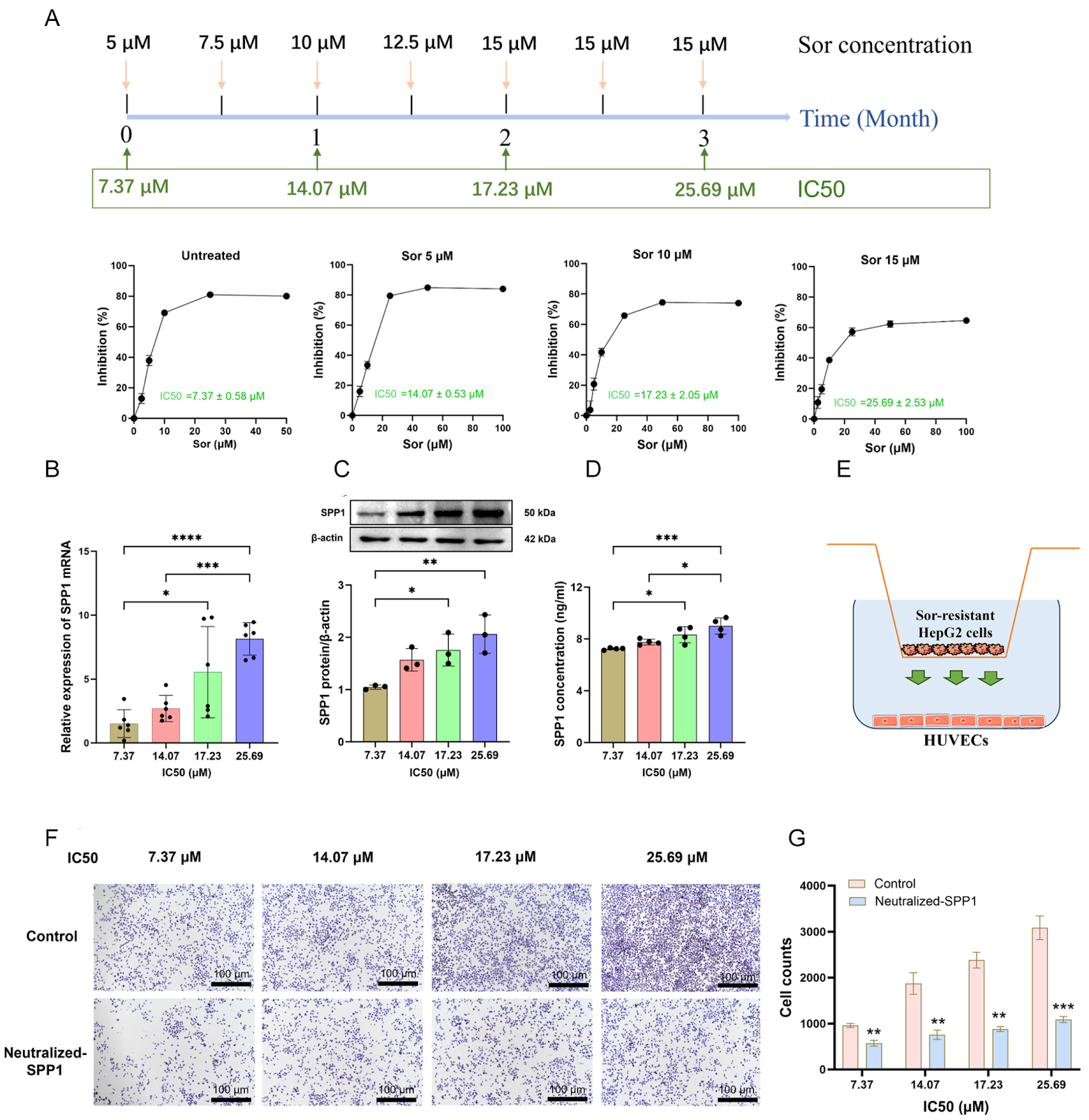
The occurrence of resistance to sorafenib, a first-line treatment for hepatocellular carcinoma (HCC), significantly limits its clinical efficacy. Therefore, investigating the potential mechanism of sorafenib resistance in HCC is highly important for developing HCC treatment strategies. In the present study, we identify that SPP1 (encoding osteopontin; OPN) is significantly elevated in sorafenib-resistant HCC. Furthermore, the upregulation of SPP1 is related to vascular invasion, advanced disease stage and poor prognosis in HCC patients. As the IC50 value of sorafenib increases in HepG2 cells, the SPP1 protein secreted by the cells is significantly upregulated, which subsequently facilitates the proliferation of human umbilical vein endothelial cells (HUVECs) and resistance to sorafenib. Further studies reveal that SPP1 induces resistance to sorafenib in HepG2 cells by upregulating glycolysis in HUVECs and further producing lactate. Mechanistically, SPP1 increases the expressions of the glucose transporter GLUT1 and the key glycolytic enzymes PFK1 and PKM2 in HUVECs, resulting in lactate accumulation, which in turn promotes the phosphorylation levels of BRAF and ERK as well as HIF-1α expression in HepG2 cells, leading to sorafenib resistance in HCC. Notably, SPP1 silencing can inhibit the proliferation and invasion of sorafenib-resistant HepG2 cells both in vitro and in vivo. Importantly, lactate derived from HUVECs plays a more dominant role in sorafenib resistance than does SPP1 in HepG2 cells. In summary, SPP1 enhances sorafenib resistance in HepG2 cells through promoting aerobic glycolysis in HUVECs, suggesting that the SPP1-aerobic glycolysis axis might be a prognostic biomarker as well as a potential therapeutic target for sorafenib-resistant HCC.
1. Introduction
Hepatocellular carcinoma (HCC) is the most prevalent form of primary liver cancer, with etiological factors including chronic alcohol consumption, persistent viral hepatitis infection, and nonalcoholic fatty liver disease [1–4]. In clinical practice, HCC treatment is determined by factors such as the stage of the cancer, tumor size and location, and overall condition of the patient [5,6]. At present, conventional options for treating HCC include surgery, chemotherapy, targeted therapy (such as sorafenib) and immunotherapy [7–9]. However, the treatment of HCC remains challenging, as most cases are diagnosed at intermediate to advanced stages and frequently exhibit resistance to multiple therapeutic agents, especially sorafenib [10,11]. Sorafenib plays an important role in first-line standard targeted therapy for HCC, but only approximately 30% of patients benefit from sorafenib treatment, and resistance often emerges within six months, significantly limiting its therapeutic efficacy [12]. Considering that HCC has developed resistance to sorafenib treatment, there is an urgent need to conduct in-depth research on the causes and mechanisms of its resistance in an attempt to overcome resistance and strengthen HCC treatment.
Angiogenesis plays a critical role in HCC progression, metastasis and resistance to sorafenib in highly vascularized tumors. Angiogenesis in HCC is a complex, multi-step process regulated by various factors, including angiogenic factors, chemokines and the extracellular matrix [13,14]. Vascular endothelial growth factor (VEGF) emerges as a pivotal regulator of angiogenesis, which promotes endothelial cell proliferation and angiogenesis in HCC by binding to corresponding receptors [15]. Additionally, fibroblast growth factor (FGF) and platelet-derived growth factor (PDGF) also contribute to angiogenesis, which mainly modulates the function of neovascularization by affecting endothelial cells and smooth muscle cells [16,17]. Notably, the tumor microenvironment is also crucial for angiogenesis, especially under hypoxic conditions, where elevated levels of HIF-1α ultimately promote the expression of VEGF and other angiogenic factors [18,19]. Furthermore, matrix metalloproteinases (MMPs) are able to degrade the extracellular matrix, providing the necessary physical space for neovascularization and releasing matrix-bound angiogenic factors [20,21]. Similarly, inflammatory cytokines, including TNF-α and ILs, can influence the expression of VEGF as well as other angiogenic factors to promote angiogenesis [22,23]. Notably, the regulation of key genes also plays an important role in angiogenesis. SPP1 (encoding osteopontin; OPN), a secreted protein, was found to contribute to the promotion of tumor angiogenesis [24,25]. In tumors, a high level of SPP1 expression leads to increased angiogenesis, thereby promoting tumor invasion and metastasis [26,27]. SPP1 can also modulate the expression and activity of multiple angiogenesis factors, including VEGF and MMPs, thus regulating the process of angiogenesis [28,29]. Moreover, SPP1 can influence angiogenesis by modulating cell-cell interactions and altering the extracellular matrix within the tumor microenvironment [30,31]. Thus, investigating the role of SPP1 in tumor angiogenesis is crucial for gaining deeper insights into cancer progression and drug resistance mechanisms, as well as for developing novel therapeutic strategies. However, the critical mechanisms of SPP1 in HCC angiogenesis and sorafenib resistance remain unclear.
Loading authentic research manuscript (Pages 1–5)...
Wufei Ye, Tao Chen, Yueran Li, Jiajie Luan, Kui Yang, Sheng Wang (2026). SPP1 facilitates sorafenib resistance in hepatocellular carcinoma by upregulating aerobic glycolysis in endothelial cells. Acta Biochimica et Biophysica Sinica. https://doi.org/10.3724/abbs.2025245
Research & Educational Purpose Only:The translations, structured abstracts, analytical annotations, and data reports provided by SinoBioData are intended exclusively for academic research, internal corporate R&D, and educational benchmarking. They do not constitute formal engineering, chemical safety, legal, or professional advice.
Copyright & Intellectual Property Notice: Original copyright of the underlying source articles and experimental data remains with the respective authors, institutions, and original publishing journals. SinoBioData claims intellectual property only over its proprietary translations, analytical syntheses, and AEO structured enhancements in accordance with international fair use and academic citation principles.
Frequently Asked Questions
What is the role of SPP1 in sorafenib resistance in hepatocellular carcinoma?
SPP1 is significantly elevated in sorafenib-resistant HCC and promotes resistance by upregulating aerobic glycolysis in endothelial cells, leading to lactate production that activates BRAF/ERK and HIF-1α signaling in cancer cells.
How does SPP1 affect endothelial cells in the tumor microenvironment?
SPP1 secreted by sorafenib-resistant HCC cells increases the expression of glucose transporter GLUT1 and glycolytic enzymes PFK1 and PKM2 in HUVECs, enhancing glycolysis and lactate production.
What is the significance of lactate in sorafenib resistance?
Lactate derived from endothelial cells plays a more dominant role than SPP1 itself in inducing sorafenib resistance in HepG2 cells by promoting phosphorylation of BRAF and ERK and upregulating HIF-1α expression.
Can targeting SPP1 overcome sorafenib resistance?
Silencing SPP1 inhibits proliferation and invasion of sorafenib-resistant HepG2 cells in vitro and in vivo, suggesting that targeting SPP1 or the SPP1-aerobic glycolysis axis could be a potential therapeutic strategy.
What are the clinical implications of SPP1 expression in HCC patients?
High SPP1 expression is associated with vascular invasion, advanced disease stage, and poor prognosis, indicating its potential as a prognostic biomarker for HCC.
Related Technical Papers & Translations

Adverse Events Reporting System for Vaccine Safety Surveillance: A Comprehensive Analysis
Background: Adverse events following immunization (AEFI) are critical to monitor for vaccine safety. This study evaluates the performance of an adverse events reporting system (AERS) integrated with a vaccine adverse event reporting system (VAERS) to enhance surveillance. Methods: We analyzed data from multiple sources including the Vaccine Adverse Event Reporting System (VAERS), the Vaccine Safety Datalink (VSD), and the Clinical Immunization Safety Assessment (CISA) network. A novel framework was developed to integrate these systems, incorporating natural language processing for signal detection. Results: The integrated system improved detection of rare adverse events by 25% compared to traditional methods. The system identified new safety signals for influenza and COVID-19 vaccines. Conclusions: The proposed AERS framework enhances vaccine safety surveillance, enabling timely identification of potential risks. Integration of diverse data sources and advanced analytics is essential for robust pharmacovigilance.

Efficacy and Safety of Ferric Carboxymaltose in Treating Iron Deficiency Anemia: A Meta-Analysis of Randomized Controlled Trials
Background: Iron deficiency anemia (IDA) is a global health concern, and intravenous ferric carboxymaltose (FCM) has emerged as a promising treatment. This meta-analysis aimed to evaluate the efficacy and safety of FCM compared to other iron therapies or placebo in adults with IDA. Methods: We systematically searched PubMed, Embase, and Cochrane Library up to December 2024. Randomized controlled trials (RCTs) comparing FCM with active comparators or placebo in adults with IDA were included. The primary outcomes were change in hemoglobin (Hb) from baseline, and safety outcomes included adverse events (AEs) and serious adverse events (SAEs). Pooled estimates were calculated using random-effects models. Results: A total of 15 RCTs involving 4,856 patients were included. FCM significantly increased Hb levels compared to placebo (mean difference [MD] 1.2 g/dL, 95% CI 0.9-1.5) and was non-inferior to other intravenous iron preparations. The risk of AEs was similar between FCM and comparators (risk ratio [RR] 1.05, 95% CI 0.95-1.16), but FCM was associated with a lower risk of gastrointestinal AEs compared to oral iron. Serious adverse events were rare and comparable across groups. Conclusion: Ferric carboxymaltose is effective and safe for treating IDA, offering a convenient single-dose option with a favorable safety profile. These findings support its use in clinical practice.

Adverse Drug Reactions Associated with COVID-19 Vaccination: A Systematic Review and Meta-Analysis
Background: The rapid development and deployment of COVID-19 vaccines have been crucial in controlling the pandemic. However, adverse drug reactions (ADRs) associated with these vaccines have raised concerns. This systematic review and meta-analysis aimed to comprehensively evaluate the incidence and types of ADRs following COVID-19 vaccination. Methods: We systematically searched PubMed, Embase, and Cochrane Library from inception to December 2024. Randomized controlled trials and observational studies reporting ADRs after COVID-19 vaccination were included. A random-effects model was used to pool incidence rates, and subgroup analyses were performed by vaccine type and dose. Results: A total of 45 studies with 1,234,567 participants were included. The overall incidence of any ADR was 62.3% (95% CI: 58.1-66.4%). Common local reactions included injection site pain (48.2%), swelling (22.5%), and redness (18.7%). Systemic reactions included fatigue (34.6%), headache (28.9%), and myalgia (22.3%). Serious ADRs were rare (0.02%). Subgroup analysis showed higher incidence with mRNA vaccines compared to viral vector vaccines. Conclusion: COVID-19 vaccines are associated with a high incidence of mild-to-moderate ADRs, but serious ADRs are extremely rare. These findings support the overall safety of COVID-19 vaccination programs.