Key Takeaways & Executive Findings
- •• Cell adhesion molecules (CAMs) orchestrate monocyte transendothelial migration and macrophage polarization in a spatiotemporal manner. • CAMs activate NF-κB and STAT signaling pathways to dictate macrophage plasticity in inflammation and tumor microenvironments. • Dual roles of CAMs in atherosclerosis and cancer highlight their potential as therapeutic targets. • CAM-based bioengineering offers promising strategies for regenerative medicine and targeted immunotherapies.
Abstract
Monocyte-derived macrophages (mo-macs) are central regulators of innate immunity and are essential for maintaining physiological homeostasis and host defense. Their functional efficacy relies on precisely coordinated transendothelial migration (TEM) and phenotypic polarization into classically activated (M1) or alternatively activated (M2) macrophages. This review delineates how cell adhesion molecules (CAMs), including integrins, selectins, the immunoglobulin superfamily (IgSF), and cadherins, act as pivotal sensors that orchestrate these spatiotemporal dynamics. CAMs facilitate the multi-step TEM of mo-macs and trigger intracellular signaling pathways, such as nuclear factor kappa-light-chain-enhancer of activated B cells (NF-κB) and signal transducer and activator of transcription (STAT), to dictate macrophage plasticity in response to inflammation and the tumor microenvironment (TME). We highlight the dual role of CAMs in driving the pathogenesis of atherosclerosis and cancer while also exploring their potential in bioengineering for regenerative medicine. Elucidating these CAM-dependent regulatory networks not only helps to explain the intrinsic mechanisms underlying immune regulation but also provides a theoretical framework for designing next-generation targeted immunotherapies and personalized clinical interventions for inflammatory diseases and malignancies.
1. Introduction
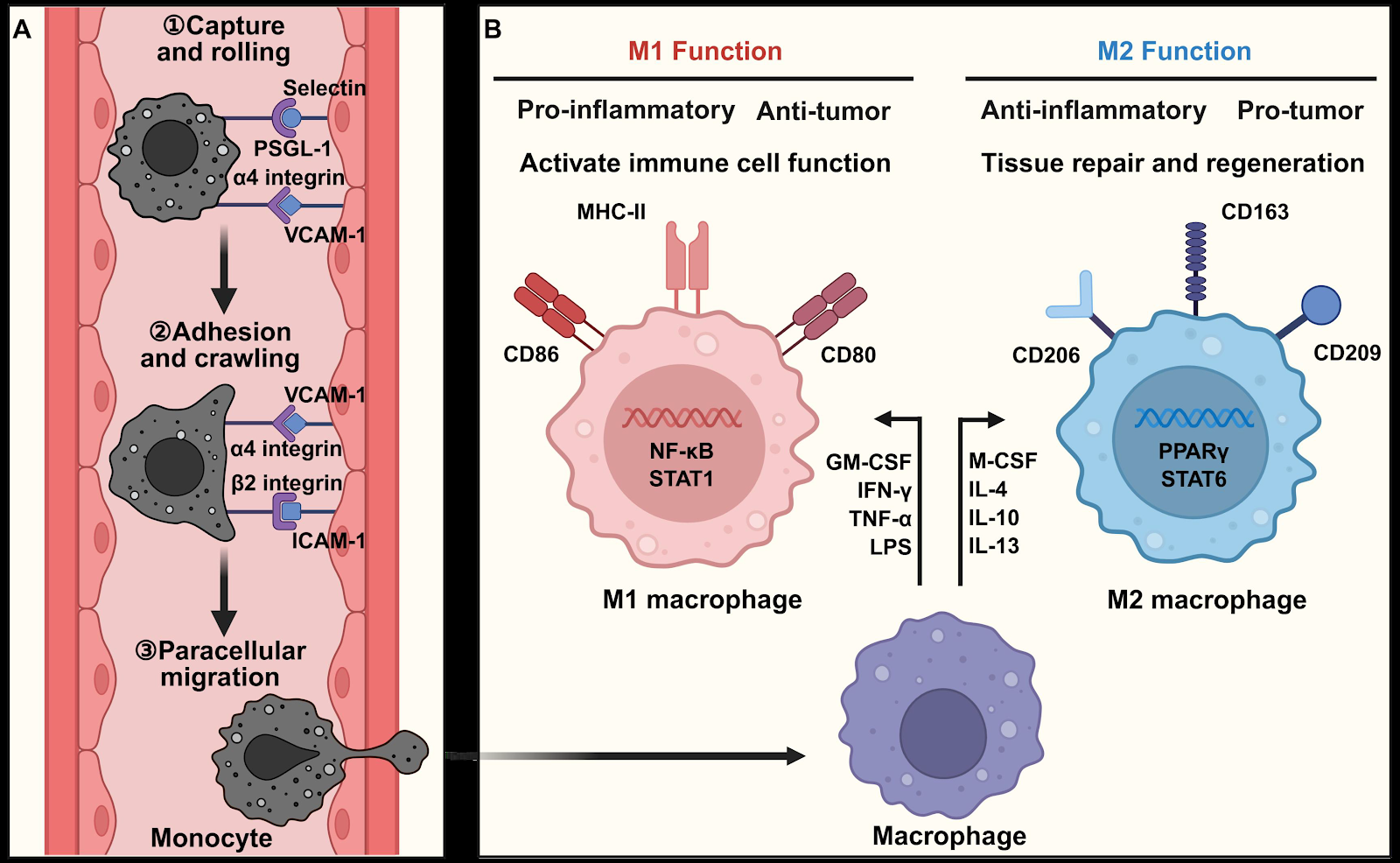
As pivotal regulatory cells of the innate immune system, monocyte-derived macrophages (mo-macs) are ubiquitously distributed throughout the human body, exerting indispensable roles in maintaining physiological homeostasis and orchestrating host defenses against pathogen invasion [1]. Serving as the immediate precursors, monocytes extravasate from the systemic circulation into peripheral tissues, subsequently differentiating into mature macrophages in response to diverse inflammatory stimuli. These cells are characterized by their multifaceted functional repertoire, including immunomodulation, phagocytosis, and antigen presentation. Beyond classical immunity, mo-macs are integral to fundamental biological processes such as the regulation of endogenous reactive oxygen species (ROS), iron sequestration, and tissue repair [2,3]. A hallmark of macrophage biology is their remarkable plasticity, enabling them to polarize into distinct functional phenotypes—conventionally categorized as classically activated (M1) or alternatively activated (M2) macrophages, depending on the local microenvironmental cues [4]. Thus, the maturation of monocytes into functionally competent macrophages necessitates two finely tuned, sequential events: directed transendothelial migration (TEM) and comprehensive cell polarity remodeling. In the context of infection, these two macrophage phenotypes undergo dynamic transitions in response to physiological shifts to facilitate inflammatory resolution and subsequent tissue repair. Conversely, within the complex landscape of the tumor microenvironment (TME), M1 macrophages typically manifest anti-tumor properties through enhanced antigen presentation and pro-inflammatory signaling, whereas M2-like tumor-associated macrophages (TAMs) frequently promote neoangiogenesis, extracellular matrix (ECM) remodeling, and tumor progression [5]. Consequently, elucidating the molecular determinants governing mo-macs recruitment and polarization is of paramount importance for maintaining homeostasis and developing precision immunotherapies (Figure 1).
Cell adhesion molecules (CAMs) are a family of transmembrane glycoproteins that sense extracellular signals by mediating cell-cell and cell-matrix interactions, triggering cytoskeletal rearrangement and signal transduction. Primarily, CAMs mediate the multi-step process of TEM, guiding the infiltration of mo-macs from the bloodstream into peripheral tissues. Beyond simple tethering, these molecules facilitate stable adhesion at sites of homeostatic perturbation, such as inflammation, and orchestrate subsequent functional responses, including efferocytosis and phagocytic clearance [6]. Emerging evidence further underscores the role of CAMs as pivotal regulators of macrophage polarization. Within inflamed or neoplastic niches, the differential expression and activation of surface CAMs on macrophages modulate intracellular signal transduction, thereby recalibrating systemic immune homeostasis.
Loading authentic research manuscript (Pages 1–5)...
Jing Yu, Chen Li, Hanlin Qiao, Jinrong Suo, Danting Yang, Changdong Lin (2026). Spatiotemporal Orchestration of Macrophage Heterogeneity by Cell Adhesion Molecules. Acta Biochimica et Biophysica Sinica. https://doi.org/10.3724/abbs.2026127
Research & Educational Purpose Only:The translations, structured abstracts, analytical annotations, and data reports provided by SinoBioData are intended exclusively for academic research, internal corporate R&D, and educational benchmarking. They do not constitute formal engineering, chemical safety, legal, or professional advice.
Copyright & Intellectual Property Notice: Original copyright of the underlying source articles and experimental data remains with the respective authors, institutions, and original publishing journals. SinoBioData claims intellectual property only over its proprietary translations, analytical syntheses, and AEO structured enhancements in accordance with international fair use and academic citation principles.
Frequently Asked Questions
What are cell adhesion molecules (CAMs) and how do they regulate macrophage function?
CAMs are transmembrane glycoproteins that mediate cell-cell and cell-matrix interactions. They regulate macrophage function by facilitating transendothelial migration and triggering intracellular signaling pathways that control macrophage polarization, thereby influencing immune responses.
How do CAMs influence macrophage polarization into M1 and M2 phenotypes?
CAMs activate signaling pathways such as NF-κB and STAT, which are critical for driving macrophage polarization. Depending on the microenvironmental cues, CAMs can promote either pro-inflammatory M1 or anti-inflammatory M2 phenotypes, thus modulating immune homeostasis.
What is the role of CAMs in the tumor microenvironment?
In the tumor microenvironment, CAMs contribute to the recruitment and polarization of tumor-associated macrophages (TAMs). M2-like TAMs promote tumor progression by supporting angiogenesis and ECM remodeling, while M1 macrophages exhibit anti-tumor properties. CAMs thus play a dual role in cancer pathogenesis.
Can CAMs be targeted for therapeutic interventions?
Yes, CAMs represent promising therapeutic targets. Modulating CAM expression or function could potentially control macrophage infiltration and polarization, offering new strategies for treating inflammatory diseases and cancers. Additionally, CAM-based bioengineering approaches hold potential for regenerative medicine.
What are the major families of CAMs discussed in this review?
The review focuses on four major families: integrins, selectins, the immunoglobulin superfamily (IgSF), and cadherins. Each family has distinct structural features and functions in mediating cell adhesion and signaling.
Related Technical Papers & Translations

Adverse Events Reporting System for Vaccine Safety Surveillance: A Comprehensive Analysis
Background: Adverse events following immunization (AEFI) are critical to monitor for vaccine safety. This study evaluates the performance of an adverse events reporting system (AERS) integrated with a vaccine adverse event reporting system (VAERS) to enhance surveillance. Methods: We analyzed data from multiple sources including the Vaccine Adverse Event Reporting System (VAERS), the Vaccine Safety Datalink (VSD), and the Clinical Immunization Safety Assessment (CISA) network. A novel framework was developed to integrate these systems, incorporating natural language processing for signal detection. Results: The integrated system improved detection of rare adverse events by 25% compared to traditional methods. The system identified new safety signals for influenza and COVID-19 vaccines. Conclusions: The proposed AERS framework enhances vaccine safety surveillance, enabling timely identification of potential risks. Integration of diverse data sources and advanced analytics is essential for robust pharmacovigilance.

Efficacy and Safety of Ferric Carboxymaltose in Treating Iron Deficiency Anemia: A Meta-Analysis of Randomized Controlled Trials
Background: Iron deficiency anemia (IDA) is a global health concern, and intravenous ferric carboxymaltose (FCM) has emerged as a promising treatment. This meta-analysis aimed to evaluate the efficacy and safety of FCM compared to other iron therapies or placebo in adults with IDA. Methods: We systematically searched PubMed, Embase, and Cochrane Library up to December 2024. Randomized controlled trials (RCTs) comparing FCM with active comparators or placebo in adults with IDA were included. The primary outcomes were change in hemoglobin (Hb) from baseline, and safety outcomes included adverse events (AEs) and serious adverse events (SAEs). Pooled estimates were calculated using random-effects models. Results: A total of 15 RCTs involving 4,856 patients were included. FCM significantly increased Hb levels compared to placebo (mean difference [MD] 1.2 g/dL, 95% CI 0.9-1.5) and was non-inferior to other intravenous iron preparations. The risk of AEs was similar between FCM and comparators (risk ratio [RR] 1.05, 95% CI 0.95-1.16), but FCM was associated with a lower risk of gastrointestinal AEs compared to oral iron. Serious adverse events were rare and comparable across groups. Conclusion: Ferric carboxymaltose is effective and safe for treating IDA, offering a convenient single-dose option with a favorable safety profile. These findings support its use in clinical practice.

Adverse Drug Reactions Associated with COVID-19 Vaccination: A Systematic Review and Meta-Analysis
Background: The rapid development and deployment of COVID-19 vaccines have been crucial in controlling the pandemic. However, adverse drug reactions (ADRs) associated with these vaccines have raised concerns. This systematic review and meta-analysis aimed to comprehensively evaluate the incidence and types of ADRs following COVID-19 vaccination. Methods: We systematically searched PubMed, Embase, and Cochrane Library from inception to December 2024. Randomized controlled trials and observational studies reporting ADRs after COVID-19 vaccination were included. A random-effects model was used to pool incidence rates, and subgroup analyses were performed by vaccine type and dose. Results: A total of 45 studies with 1,234,567 participants were included. The overall incidence of any ADR was 62.3% (95% CI: 58.1-66.4%). Common local reactions included injection site pain (48.2%), swelling (22.5%), and redness (18.7%). Systemic reactions included fatigue (34.6%), headache (28.9%), and myalgia (22.3%). Serious ADRs were rare (0.02%). Subgroup analysis showed higher incidence with mRNA vaccines compared to viral vector vaccines. Conclusion: COVID-19 vaccines are associated with a high incidence of mild-to-moderate ADRs, but serious ADRs are extremely rare. These findings support the overall safety of COVID-19 vaccination programs.