Key Takeaways & Executive Findings
- •• Developed a novel protocol using a small molecule cocktail to generate pancreatic ductal organoids (PDOs) with high initiation efficiency and enrichment of ductal cells. • PDOs derived from Sox9-positive ductal cells exhibit remarkable stability and support long-term expansion, enabling high-throughput drug screening. • Organoids recapitulate exocrine cell composition and reflect cellular plasticity between ductal and acinar cells, providing a valuable platform for studying pancreatic diseases like PDAC. • This efficient model offers a promising tool for understanding disease mechanisms and facilitating drug development for pancreatic disorders.
Abstract
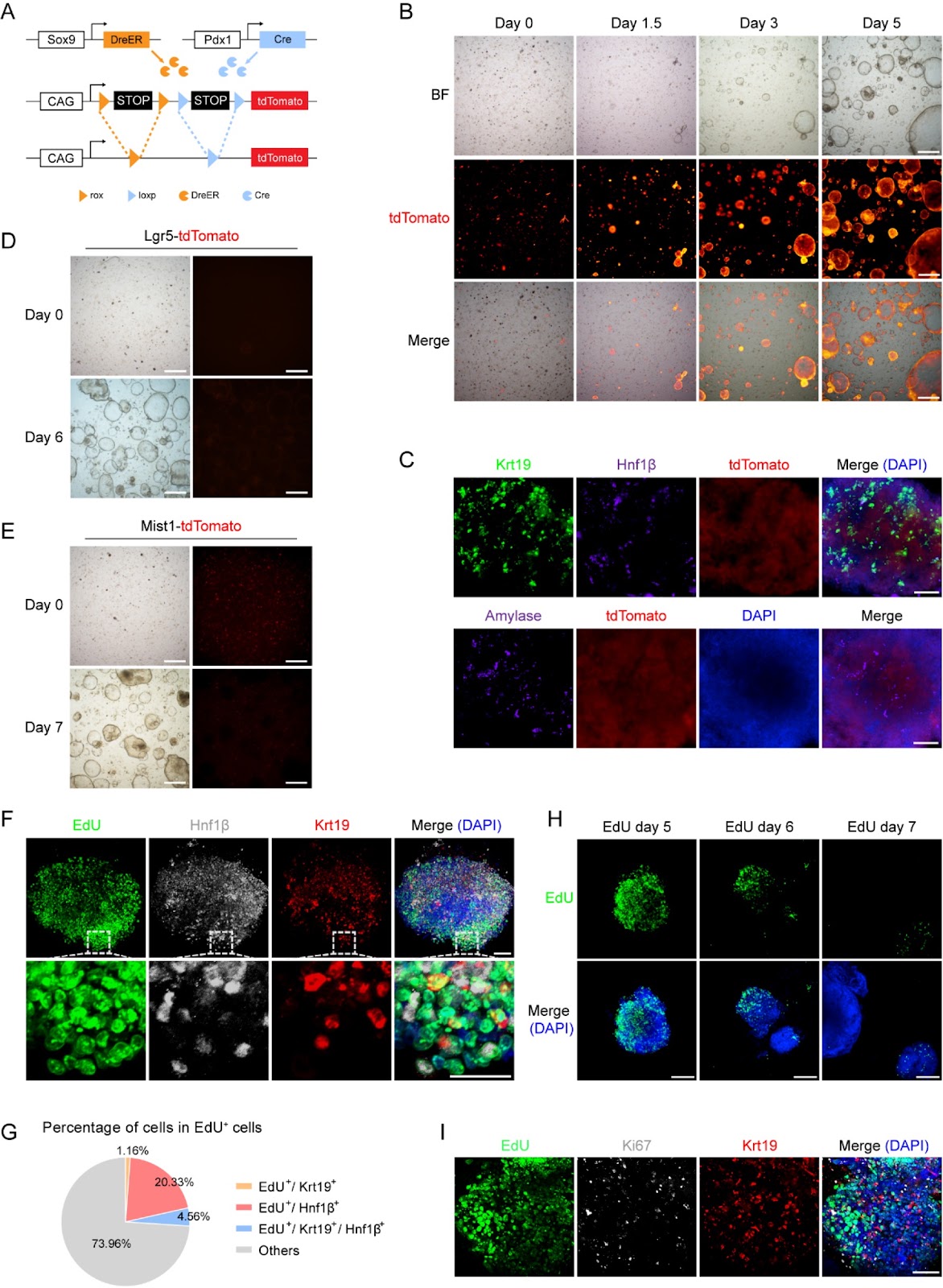
Advancements in three-dimensional (3D) organoid cultures have created more physiologically relevant models for pancreatic disease research, but efficiently generating mature pancreatic ductal cells remains challenging. In this study, we develop a novel protocol to generate pancreatic ductal organoids (PDOs) with high initiation efficiency and an enrichment of pancreatic ductal cells. By utilizing a cocktail of small molecules, we optimize the culture conditions to improve organoid formation. Our findings demonstrate that this protocol facilitates the formation and expansion of PDOs derived from Sox9-positive ductal cells, including heterogeneous ductal cells and acinar cells. These organoid cultures exhibit remarkable stability, supporting long-term expansion. This system provides an efficient model with potential applications in high-throughput drug screening. Moreover, these organoids recapitulate the exocrine cell composition and may reflect the cellular plasticity between ductal and acinar cells, providing a valuable platform for investigating pancreatic diseases such as pancreatic ductal adenocarcinoma (PDAC). The model presents a promising tool for future research aimed at understanding disease mechanisms and potentially helping drug development for pancreatic disorders.
1. Introduction
The pancreas is a vital organ with dual functionality, consisting of endocrine and exocrine compartments. The endocrine compartment comprises islets containing alpha, beta, delta, epsilon and PP cells, which regulate blood glucose level by secreting hormones such as insulin and glucagon [1]. The exocrine compartment comprises acinar cells that produce digestive enzymes and ductal cells that transport these enzymes to the gastrointestinal tract for nutrient absorption [2]. Studies have shown that pancreatic ducts, which include various ductal cell types, such as large ducts, small ducts, terminal ducts, intrapancreatic ducts, and pancreaticobiliary ducts, are heterogeneous [3]. Additionally, Krt19-, Hnf1β-, and Sox9-positive cells exist in dynamic equilibrium and represent different ductal subsets [4].
Despite its critical role, the pancreas is susceptible to numerous diseases. PDAC, which primarily originates from ductal cells, is one of the most lethal malignancies due to its late diagnosis and rapid progression [5]. Cystic fibrosis affects the pancreas by altering ductal cell function [6], resulting in thick mucus that obstructs enzyme flow [7]. Pancreatitis, often triggered by enzyme blockage within ducts, causes severe inflammation and damage to both exocrine and endocrine tissues [8]. Studying the detailed mechanisms by which diseases affect pancreatic cell types is crucial for developing effective diagnostics and treatments [9,10], which require model systems that faithfully mimic pancreatic biology.
The emergence of 3D organoid cultures offers a promising new model for studying pancreatic diseases [11,12], particularly those involving ductal cell dysfunction [13]. Pancreatic organoids, engineered to mimic the cellular composition, structure, and function of the pancreas, are derived from pluripotent stem cells, embryonic pancreatic progenitors, and adult pancreatic cells [14–20]. These organoids provide a controlled, physiologically relevant model system that surpasses traditional in vitro and animal models in probing complex disease mechanisms and assessing therapeutic efficacy [21]. During organogenesis, multiple signaling pathways work in concert to regulate cell differentiation and development. Epidermal growth factor (EGF) supports normal pancreatic growth by modulating cell proliferation and development [22,23]. The precise regulation of various signaling pathways ensures proper pancreatic development [24,25]. Small molecule compounds offer targeted intervention by selectively modulating specific pathways [26,27]. Consequently, the combination of small molecule compounds with organoid culture techniques facilitates the precise reconstruction of organ-like structures in vitro, closely replicating in vivo [28,29].
Loading authentic research manuscript (Pages 1–5)...
Yuwei Liao, Zhifan Lin, Siyu Li, Xiaolei Yin (2026). Small molecules enhance the high-efficiency generation of pancreatic ductal organoids. Acta Biochimica et Biophysica Sinica. https://doi.org/10.3724/abbs.2024218
Research & Educational Purpose Only:The translations, structured abstracts, analytical annotations, and data reports provided by SinoBioData are intended exclusively for academic research, internal corporate R&D, and educational benchmarking. They do not constitute formal engineering, chemical safety, legal, or professional advice.
Copyright & Intellectual Property Notice: Original copyright of the underlying source articles and experimental data remains with the respective authors, institutions, and original publishing journals. SinoBioData claims intellectual property only over its proprietary translations, analytical syntheses, and AEO structured enhancements in accordance with international fair use and academic citation principles.
Frequently Asked Questions
What is the main achievement of this study?
The study develops a novel protocol using a small molecule cocktail to generate pancreatic ductal organoids (PDOs) with high initiation efficiency and enrichment of ductal cells, supporting long-term expansion.
What are the potential applications of these pancreatic ductal organoids?
These organoids can be used for high-throughput drug screening and as a platform for investigating pancreatic diseases such as pancreatic ductal adenocarcinoma (PDAC), potentially aiding drug development.
How do the organoids reflect pancreatic biology?
The organoids recapitulate the exocrine cell composition and may reflect cellular plasticity between ductal and acinar cells, providing a physiologically relevant model.
What is the significance of using small molecules in this protocol?
Small molecules allow targeted modulation of specific signaling pathways, optimizing culture conditions to improve organoid formation and stability.
What are the limitations of current pancreatic organoid models addressed by this study?
Current models often have low efficiency (0.24% to 1.7%), heterogeneity, and difficulty in long-term maintenance; this protocol improves efficiency and stability.
Related Technical Papers & Translations

Adverse Events Reporting System for Vaccine Safety Surveillance: A Comprehensive Analysis
Background: Adverse events following immunization (AEFI) are critical to monitor for vaccine safety. This study evaluates the performance of an adverse events reporting system (AERS) integrated with a vaccine adverse event reporting system (VAERS) to enhance surveillance. Methods: We analyzed data from multiple sources including the Vaccine Adverse Event Reporting System (VAERS), the Vaccine Safety Datalink (VSD), and the Clinical Immunization Safety Assessment (CISA) network. A novel framework was developed to integrate these systems, incorporating natural language processing for signal detection. Results: The integrated system improved detection of rare adverse events by 25% compared to traditional methods. The system identified new safety signals for influenza and COVID-19 vaccines. Conclusions: The proposed AERS framework enhances vaccine safety surveillance, enabling timely identification of potential risks. Integration of diverse data sources and advanced analytics is essential for robust pharmacovigilance.

Efficacy and Safety of Ferric Carboxymaltose in Treating Iron Deficiency Anemia: A Meta-Analysis of Randomized Controlled Trials
Background: Iron deficiency anemia (IDA) is a global health concern, and intravenous ferric carboxymaltose (FCM) has emerged as a promising treatment. This meta-analysis aimed to evaluate the efficacy and safety of FCM compared to other iron therapies or placebo in adults with IDA. Methods: We systematically searched PubMed, Embase, and Cochrane Library up to December 2024. Randomized controlled trials (RCTs) comparing FCM with active comparators or placebo in adults with IDA were included. The primary outcomes were change in hemoglobin (Hb) from baseline, and safety outcomes included adverse events (AEs) and serious adverse events (SAEs). Pooled estimates were calculated using random-effects models. Results: A total of 15 RCTs involving 4,856 patients were included. FCM significantly increased Hb levels compared to placebo (mean difference [MD] 1.2 g/dL, 95% CI 0.9-1.5) and was non-inferior to other intravenous iron preparations. The risk of AEs was similar between FCM and comparators (risk ratio [RR] 1.05, 95% CI 0.95-1.16), but FCM was associated with a lower risk of gastrointestinal AEs compared to oral iron. Serious adverse events were rare and comparable across groups. Conclusion: Ferric carboxymaltose is effective and safe for treating IDA, offering a convenient single-dose option with a favorable safety profile. These findings support its use in clinical practice.

Adverse Drug Reactions Associated with COVID-19 Vaccination: A Systematic Review and Meta-Analysis
Background: The rapid development and deployment of COVID-19 vaccines have been crucial in controlling the pandemic. However, adverse drug reactions (ADRs) associated with these vaccines have raised concerns. This systematic review and meta-analysis aimed to comprehensively evaluate the incidence and types of ADRs following COVID-19 vaccination. Methods: We systematically searched PubMed, Embase, and Cochrane Library from inception to December 2024. Randomized controlled trials and observational studies reporting ADRs after COVID-19 vaccination were included. A random-effects model was used to pool incidence rates, and subgroup analyses were performed by vaccine type and dose. Results: A total of 45 studies with 1,234,567 participants were included. The overall incidence of any ADR was 62.3% (95% CI: 58.1-66.4%). Common local reactions included injection site pain (48.2%), swelling (22.5%), and redness (18.7%). Systemic reactions included fatigue (34.6%), headache (28.9%), and myalgia (22.3%). Serious ADRs were rare (0.02%). Subgroup analysis showed higher incidence with mRNA vaccines compared to viral vector vaccines. Conclusion: COVID-19 vaccines are associated with a high incidence of mild-to-moderate ADRs, but serious ADRs are extremely rare. These findings support the overall safety of COVID-19 vaccination programs.