Key Takeaways & Executive Findings
- •• Single-cell transcriptomics reveals higher glutamine metabolism activity in epithelial cells from early gastric cancer (EGC) compared to chronic atrophic gastritis (CAG), with a specific epithelial subpopulation (cluster_4) showing the most pronounced activity. • ERO1LB is identified as a key marker gene of the metabolically active epithelial subpopulation and is overexpressed in human gastric cancer tissues. • Functional experiments demonstrate that ERO1LB overexpression enhances glutamine metabolism, promotes cell growth and migration, and inhibits apoptosis in gastric cancer cells, while knockdown has opposite effects. • The study provides a comprehensive single-cell atlas of glutamine metabolism in premalignant and malignant gastric lesions, offering potential biomarkers for gastric cancer prevention and insights into pathogenesis.
Abstract
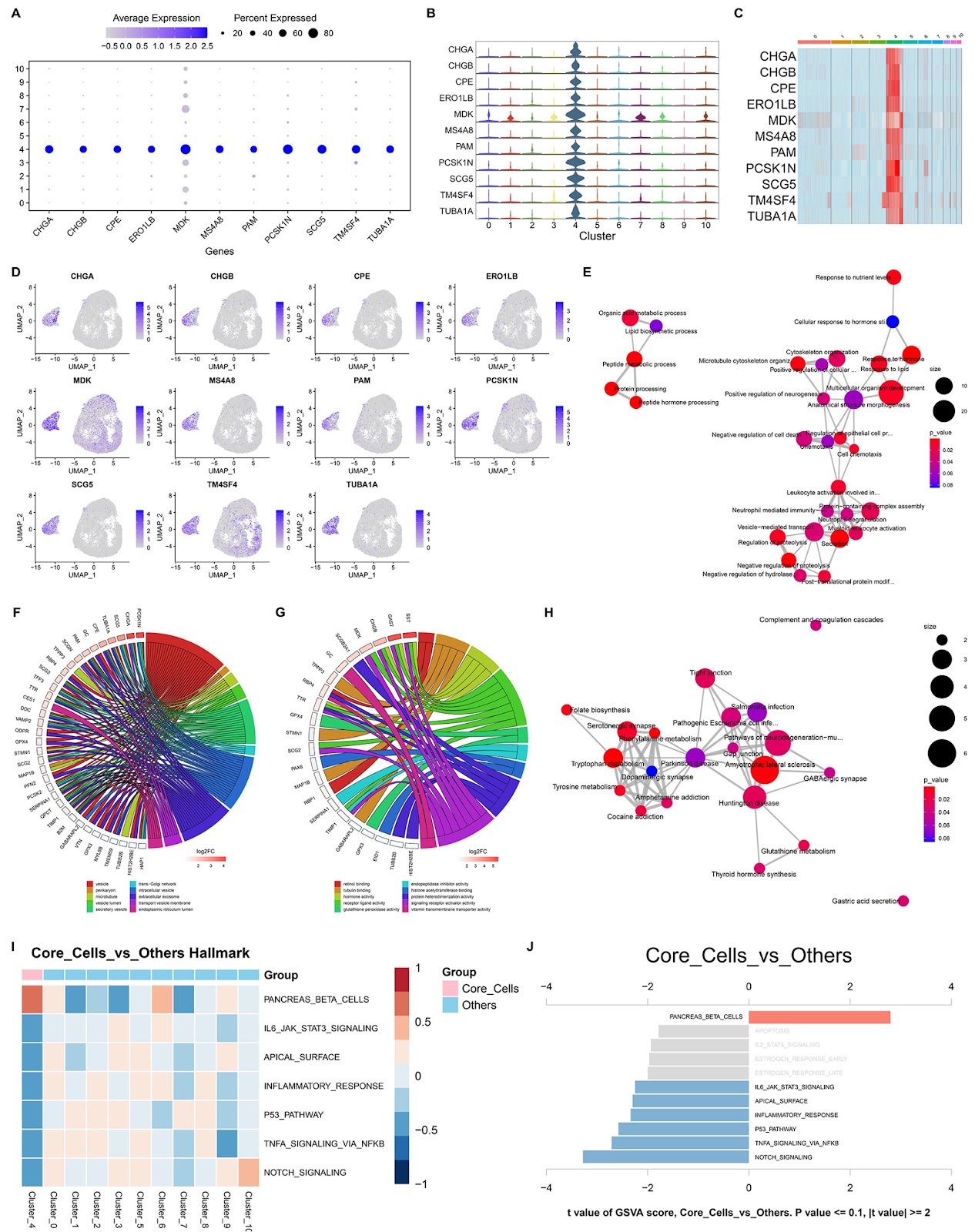
Glutamine metabolism is a hallmark of cancer metabolism. This study aims to perform a comprehensive and systematic single-cell profile of glutamine metabolism in premalignant and malignant gastric lesions. We use single-cell transcriptomics data from chronic atrophic gastritis (CAG) and early gastric cancer (EGC) lesions and investigate glutamine metabolism features at the single-cell level. Experiments are implemented to validate the expression and biological role of ERO1LB in gastric cancer (GC). A single-cell atlas based on 22511 cells from premalignant and early-malignant gastric lesions is established. Among these cells, epithelial cells constitute the dominant cell population in both CAG and EGC lesions. The activity of glutamine metabolism is higher in epithelial cells from EGC lesions than in those from CAG lesions. Among the epithelial cell subpopulations, glutamine metabolism is more active in the epithelial cell subpopulation cluster_4 in EGCs than in CAG lesions. As a key marker gene of this subpopulation, ERO1LB is experimentally proven to be overexpressed in human GC tissue lesions. In both in vitro and in vivo experiments, overexpression of ERO1LB in GC cells increases glutamine metabolism, facilitates cell growth and migration and prevents cell apoptosis, and vice versa. This study provides insight into the cellular heterogeneity of glutamine metabolism within the gastric mucosa in premalignant and malignant gastric lesions and identifies ERO1LB as a key orchestrator of glutamine metabolism, which may help to identify markers for GC prevention and contribute to our understanding of GC pathogenesis.
1. Introduction
Chronic atrophic gastritis (CAG) is a gastric precancerous condition with an independent risk of developing into gastric cancer (GC) and constitutes the background for dysplasia and adenocarcinoma together with intestinal metaplasia and dysplasia [1,2]. This disease presents chronic inflammation of the gastric mucosa, accompanied by the loss of gastric glandular cells and replacement by intestinal-type epithelium, pyloric-type glands, or fibrous tissue [3]. Among patients with CAG, the annual incidence (person-year) of GC is 0.1%–0.5% [4], and the cumulative 5-year incidence is 0.7%–10% [5]. Cell type changes play an essential role in the cascade from precancerous to malignant lesions. Nonetheless, the full spectrum of diverse cell types and their molecular features remain to be characterized in gastric premalignant and malignant lesions, hampering investigations of their roles in GC pathogenesis.
Glutamine metabolism is a hallmark of cancer metabolism [6,7]. Proliferating cancer cells depend largely upon glutamine for survival and proliferation [8,9]. Glutamine is the most abundant circulating amino acid in the blood and muscle and is essential for distinct basic cellular functions of tumor cells, e.g., the synthesis of metabolites maintaining mitochondrial metabolism; antioxidant production for eliminating reactive oxygen species; the synthesis of non-essential amino acids, purines, pyrimidines and fatty acid components for cell replication; and the activation of cell signals [10–13]. Glutamine metabolism has been shown to mediate CAG-induced carcinogenesis, but the molecular mechanisms governing this process remain to be explored [14]. Given the pleiotropic roles of glutamine in tumor cells, an in-depth understanding of glutamine metabolism is critical for the discovery of metabolism-based treatments for GC. Identification of the cells responsible for gastric tumorigenesis is important for understanding the molecular underpinnings of tumor evolution. Single-cell transcriptomics is a powerful tool for deciphering the cellular and molecular landscape at single-cell resolution, unlike bulk transcriptomics, which provides averaged data [15]. The application of single-cell transcriptomics has revolutionized our understanding of the biological features and dynamics within tumor lesions [16–18]. Hence, this study presents a single-cell map of glutamine metabolism in the gastric mucosa of patients with premalignant and malignant gastric lesions and reveals that ERO1LB is a key orchestrator that modulates glutamine metabolism.
Loading authentic research manuscript (Pages 1–5)...
Qingfeng Ni, Jiawei Yu, Yuanjie Niu, Zhenwei Han, Boyang Hu, Yang Wang, Jianwei Zhu (2026). Single-cell transcriptomic data reveal the cellular heterogeneity of glutamine metabolism in gastric premalignant lesions and early gastric cancer. Acta Biochimica et Biophysica Sinica. https://doi.org/10.3724/abbs.2025061
Research & Educational Purpose Only:The translations, structured abstracts, analytical annotations, and data reports provided by SinoBioData are intended exclusively for academic research, internal corporate R&D, and educational benchmarking. They do not constitute formal engineering, chemical safety, legal, or professional advice.
Copyright & Intellectual Property Notice: Original copyright of the underlying source articles and experimental data remains with the respective authors, institutions, and original publishing journals. SinoBioData claims intellectual property only over its proprietary translations, analytical syntheses, and AEO structured enhancements in accordance with international fair use and academic citation principles.
Frequently Asked Questions
What is the main finding of this study?
The study reveals cellular heterogeneity in glutamine metabolism within gastric premalignant and early cancerous lesions, identifying ERO1LB as a key orchestrator that promotes glutamine metabolism, cell growth, and migration while inhibiting apoptosis in gastric cancer cells.
How was the single-cell analysis performed?
Single-cell transcriptomic data from chronic atrophic gastritis (CAG) and early gastric cancer (EGC) samples were obtained from the GSE134520 dataset and analyzed to profile glutamine metabolism at single-cell resolution.
What is the role of ERO1LB in gastric cancer?
ERO1LB is overexpressed in gastric cancer tissues and functionally enhances glutamine metabolism, promotes cell proliferation and migration, and suppresses apoptosis, as demonstrated by in vitro and in vivo experiments.
What are the clinical implications of this research?
The findings may help identify biomarkers for gastric cancer prevention and provide insights into the pathogenesis of gastric cancer, potentially leading to metabolism-based therapeutic strategies.
Which cell populations show the highest glutamine metabolism activity?
Epithelial cells, particularly a subpopulation designated cluster_4, exhibit higher glutamine metabolism activity in early gastric cancer lesions compared to chronic atrophic gastritis lesions.
Related Technical Papers & Translations

Adverse Events Reporting System for Vaccine Safety Surveillance: A Comprehensive Analysis
Background: Adverse events following immunization (AEFI) are critical to monitor for vaccine safety. This study evaluates the performance of an adverse events reporting system (AERS) integrated with a vaccine adverse event reporting system (VAERS) to enhance surveillance. Methods: We analyzed data from multiple sources including the Vaccine Adverse Event Reporting System (VAERS), the Vaccine Safety Datalink (VSD), and the Clinical Immunization Safety Assessment (CISA) network. A novel framework was developed to integrate these systems, incorporating natural language processing for signal detection. Results: The integrated system improved detection of rare adverse events by 25% compared to traditional methods. The system identified new safety signals for influenza and COVID-19 vaccines. Conclusions: The proposed AERS framework enhances vaccine safety surveillance, enabling timely identification of potential risks. Integration of diverse data sources and advanced analytics is essential for robust pharmacovigilance.

Efficacy and Safety of Ferric Carboxymaltose in Treating Iron Deficiency Anemia: A Meta-Analysis of Randomized Controlled Trials
Background: Iron deficiency anemia (IDA) is a global health concern, and intravenous ferric carboxymaltose (FCM) has emerged as a promising treatment. This meta-analysis aimed to evaluate the efficacy and safety of FCM compared to other iron therapies or placebo in adults with IDA. Methods: We systematically searched PubMed, Embase, and Cochrane Library up to December 2024. Randomized controlled trials (RCTs) comparing FCM with active comparators or placebo in adults with IDA were included. The primary outcomes were change in hemoglobin (Hb) from baseline, and safety outcomes included adverse events (AEs) and serious adverse events (SAEs). Pooled estimates were calculated using random-effects models. Results: A total of 15 RCTs involving 4,856 patients were included. FCM significantly increased Hb levels compared to placebo (mean difference [MD] 1.2 g/dL, 95% CI 0.9-1.5) and was non-inferior to other intravenous iron preparations. The risk of AEs was similar between FCM and comparators (risk ratio [RR] 1.05, 95% CI 0.95-1.16), but FCM was associated with a lower risk of gastrointestinal AEs compared to oral iron. Serious adverse events were rare and comparable across groups. Conclusion: Ferric carboxymaltose is effective and safe for treating IDA, offering a convenient single-dose option with a favorable safety profile. These findings support its use in clinical practice.

Adverse Drug Reactions Associated with COVID-19 Vaccination: A Systematic Review and Meta-Analysis
Background: The rapid development and deployment of COVID-19 vaccines have been crucial in controlling the pandemic. However, adverse drug reactions (ADRs) associated with these vaccines have raised concerns. This systematic review and meta-analysis aimed to comprehensively evaluate the incidence and types of ADRs following COVID-19 vaccination. Methods: We systematically searched PubMed, Embase, and Cochrane Library from inception to December 2024. Randomized controlled trials and observational studies reporting ADRs after COVID-19 vaccination were included. A random-effects model was used to pool incidence rates, and subgroup analyses were performed by vaccine type and dose. Results: A total of 45 studies with 1,234,567 participants were included. The overall incidence of any ADR was 62.3% (95% CI: 58.1-66.4%). Common local reactions included injection site pain (48.2%), swelling (22.5%), and redness (18.7%). Systemic reactions included fatigue (34.6%), headache (28.9%), and myalgia (22.3%). Serious ADRs were rare (0.02%). Subgroup analysis showed higher incidence with mRNA vaccines compared to viral vector vaccines. Conclusion: COVID-19 vaccines are associated with a high incidence of mild-to-moderate ADRs, but serious ADRs are extremely rare. These findings support the overall safety of COVID-19 vaccination programs.