Key Takeaways & Executive Findings
- •• RNF126 is identified as the E3 ubiquitin ligase for MIDN, catalyzing its ubiquitination at non-canonical cysteine, serine, and threonine residues. • Non-lysine ubiquitination of MIDN targets it for 26S proteasomal degradation, revealing a novel regulatory mechanism. • The RNF126-MIDN axis controls EGR1 abundance, thereby modulating tumor-suppressor proteins PTEN and p53. • The RNF126-MIDN ubiquitination cascade represents a potential therapeutic target in testicular germ-cell tumors (TGCTs).
Abstract
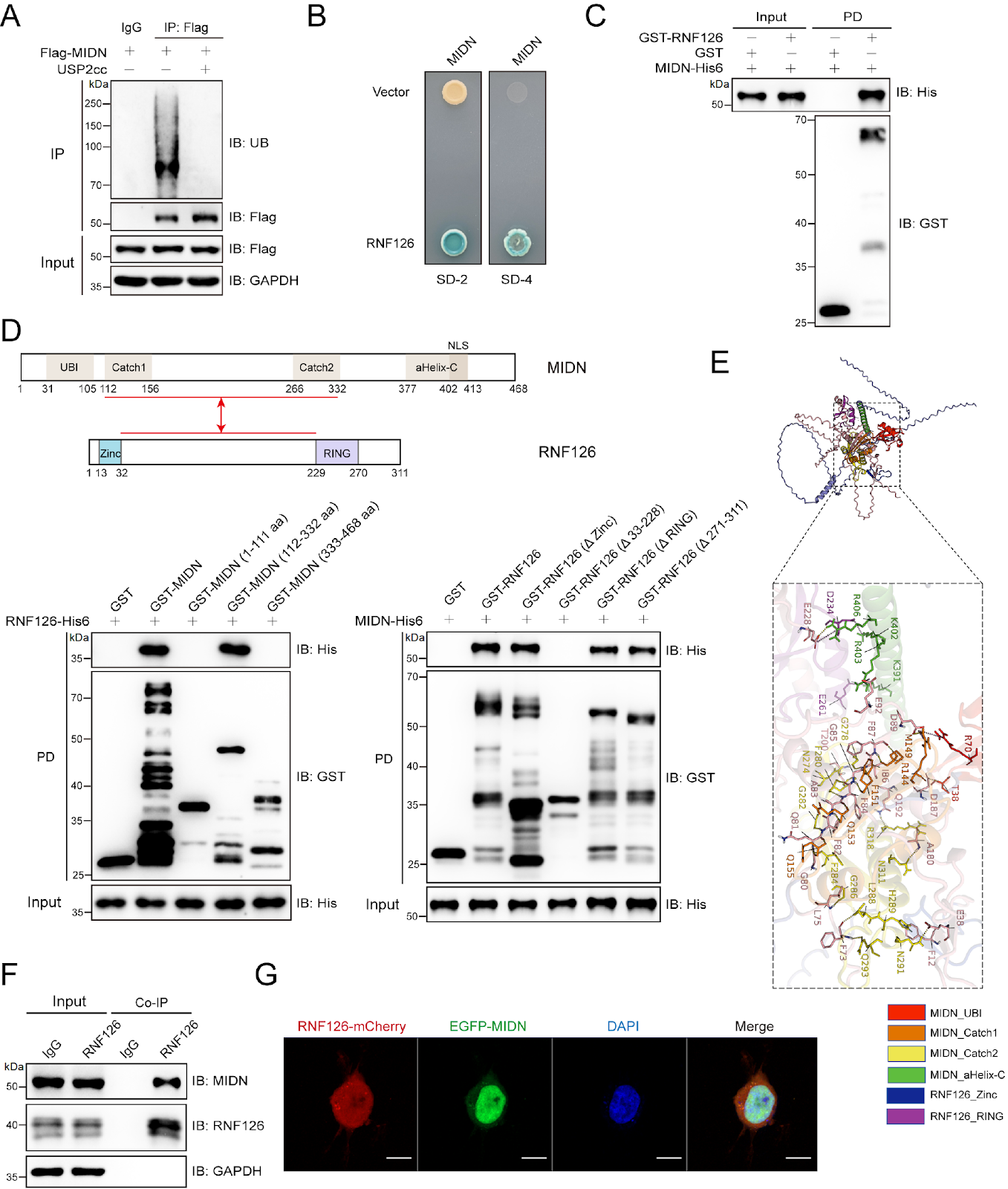
Midnolin (MIDN) is a newly recognized master regulator that drives ubiquitin-independent proteasomal degradation, yet the mechanisms governing its own turnover remain enigmatic. Here, we demonstrate that MIDN is ubiquitinated and identify RNF126 as the cognate E3 ligase. RNF126 physically associates with MIDN and catalyzes its ubiquitination, and mass spectrometry mapping reveals that this process occurs primarily at non-canonical cysteine, serine, and threonine residues (C230, C236, S237, T239, and S241) rather than at lysine residues. This non-classical ubiquitination targets MIDN for 26S-proteasomal degradation. In vivo dissection of the RNF126-MIDN axis shows that it governs EGR1 abundance and, consequently, the tumor-suppressor proteins PTEN and p53, thereby restraining the progression of testicular germ-cell tumors (TGCTs). Our findings reveal an unappreciated layer of MIDN regulation and identify the RNF126-MIDN ubiquitination cascade as a potential therapeutic vulnerability in TGCTs and related malignancies.
1. Introduction
Protein homeostasis underpins every cellular decision—whether division, differentiation, stress adaptation, or death—by maintaining the proteome in precise balance across its abundance, quality, spatial distribution, and temporal dynamics [1–5]. Its dysregulation underpins a spectrum of human diseases, including cancers and diverse neurological disorders [6–12]. The ubiquitin-proteasome system (UPS) is the principal engine of proteostasis in eukaryotes. By covalently attaching the 76-amino-acid protein ubiquitin to internal lysine residues of substrate proteins, E3 ubiquitin ligases generate a combinatorial code (mono-, multi or polyubiquitin chains of varying linkage topology) that is decoded by proteasomal receptors, de-ubiquitinating enzymes and other effectors [2,13]. Canonical K48-linked polyubiquitin chains are the best-characterized signal for 26S proteasomal degradation, but noncanonical linkages (K11, K63, M1, etc.) and non-lysine acceptor sites are increasingly recognized as vital layers of regulatory complexity [2,14,15].
Midnolin (MIDN) has recently emerged as a fascinating nexus between transcriptional regulation and protein stability. Initially annotated as a nucleolar protein, MIDN unexpectedly drives the 26S proteasomal degradation of a select cohort of transcription factors (e.g., EGR1, FosB, and NR4A1) in a ubiquitination-independent manner [16,17]. Through this ubiquitination-independent proteasomal activity, MIDN governs distinct developmental and pathological programs—neuronal lineage progression, T-cell immune responses, and oncogenic signaling by selectively targeting discrete substrate transcription factors in each context [18–20]. Given the inherently short half-life of MIDN, its intracellular abundance must be stringently controlled; however, the molecular machinery underpinning this regulation remains to be elucidated.
Loading authentic research manuscript (Pages 1–5)...
Yun Yang, Jin Ren, Xiang Qiu, Yanlin Liu, Shilin Yuan, Ronggui Hu, Zhixiong Xia, Chuanyin Li (2026). RNF126 writes a non-canonical ubiquitin code on midnolin to tune protein stability. Acta Biochimica et Biophysica Sinica. https://doi.org/10.3724/abbs.2025232
Research & Educational Purpose Only:The translations, structured abstracts, analytical annotations, and data reports provided by SinoBioData are intended exclusively for academic research, internal corporate R&D, and educational benchmarking. They do not constitute formal engineering, chemical safety, legal, or professional advice.
Copyright & Intellectual Property Notice: Original copyright of the underlying source articles and experimental data remains with the respective authors, institutions, and original publishing journals. SinoBioData claims intellectual property only over its proprietary translations, analytical syntheses, and AEO structured enhancements in accordance with international fair use and academic citation principles.
Frequently Asked Questions
What is the role of RNF126 in the regulation of MIDN?
RNF126 is identified as the E3 ubiquitin ligase for MIDN, catalyzing its ubiquitination at non-canonical cysteine, serine, and threonine residues, which targets MIDN for proteasomal degradation.
How does MIDN ubiquitination affect downstream signaling?
The RNF126-MIDN axis regulates EGR1 abundance, which in turn modulates tumor-suppressor proteins PTEN and p53, thereby restraining the progression of testicular germ-cell tumors (TGCTs).
What are the specific non-canonical ubiquitination sites on MIDN?
Mass spectrometry mapping revealed that ubiquitination occurs primarily at cysteine, serine, and threonine residues: C230, C236, S237, T239, and S241.
What is the significance of non-lysine ubiquitination in this context?
Non-lysine ubiquitination expands the regulatory complexity of the ubiquitin-proteasome system, and this study provides a clear example where non-canonical sites are used to control protein stability.
What are the potential therapeutic implications of this study?
The RNF126-MIDN ubiquitination cascade represents a potential therapeutic vulnerability in testicular germ-cell tumors and related malignancies, offering a new target for intervention.
Related Technical Papers & Translations

Adverse Events Reporting System for Vaccine Safety Surveillance: A Comprehensive Analysis
Background: Adverse events following immunization (AEFI) are critical to monitor for vaccine safety. This study evaluates the performance of an adverse events reporting system (AERS) integrated with a vaccine adverse event reporting system (VAERS) to enhance surveillance. Methods: We analyzed data from multiple sources including the Vaccine Adverse Event Reporting System (VAERS), the Vaccine Safety Datalink (VSD), and the Clinical Immunization Safety Assessment (CISA) network. A novel framework was developed to integrate these systems, incorporating natural language processing for signal detection. Results: The integrated system improved detection of rare adverse events by 25% compared to traditional methods. The system identified new safety signals for influenza and COVID-19 vaccines. Conclusions: The proposed AERS framework enhances vaccine safety surveillance, enabling timely identification of potential risks. Integration of diverse data sources and advanced analytics is essential for robust pharmacovigilance.

Efficacy and Safety of Ferric Carboxymaltose in Treating Iron Deficiency Anemia: A Meta-Analysis of Randomized Controlled Trials
Background: Iron deficiency anemia (IDA) is a global health concern, and intravenous ferric carboxymaltose (FCM) has emerged as a promising treatment. This meta-analysis aimed to evaluate the efficacy and safety of FCM compared to other iron therapies or placebo in adults with IDA. Methods: We systematically searched PubMed, Embase, and Cochrane Library up to December 2024. Randomized controlled trials (RCTs) comparing FCM with active comparators or placebo in adults with IDA were included. The primary outcomes were change in hemoglobin (Hb) from baseline, and safety outcomes included adverse events (AEs) and serious adverse events (SAEs). Pooled estimates were calculated using random-effects models. Results: A total of 15 RCTs involving 4,856 patients were included. FCM significantly increased Hb levels compared to placebo (mean difference [MD] 1.2 g/dL, 95% CI 0.9-1.5) and was non-inferior to other intravenous iron preparations. The risk of AEs was similar between FCM and comparators (risk ratio [RR] 1.05, 95% CI 0.95-1.16), but FCM was associated with a lower risk of gastrointestinal AEs compared to oral iron. Serious adverse events were rare and comparable across groups. Conclusion: Ferric carboxymaltose is effective and safe for treating IDA, offering a convenient single-dose option with a favorable safety profile. These findings support its use in clinical practice.

Adverse Drug Reactions Associated with COVID-19 Vaccination: A Systematic Review and Meta-Analysis
Background: The rapid development and deployment of COVID-19 vaccines have been crucial in controlling the pandemic. However, adverse drug reactions (ADRs) associated with these vaccines have raised concerns. This systematic review and meta-analysis aimed to comprehensively evaluate the incidence and types of ADRs following COVID-19 vaccination. Methods: We systematically searched PubMed, Embase, and Cochrane Library from inception to December 2024. Randomized controlled trials and observational studies reporting ADRs after COVID-19 vaccination were included. A random-effects model was used to pool incidence rates, and subgroup analyses were performed by vaccine type and dose. Results: A total of 45 studies with 1,234,567 participants were included. The overall incidence of any ADR was 62.3% (95% CI: 58.1-66.4%). Common local reactions included injection site pain (48.2%), swelling (22.5%), and redness (18.7%). Systemic reactions included fatigue (34.6%), headache (28.9%), and myalgia (22.3%). Serious ADRs were rare (0.02%). Subgroup analysis showed higher incidence with mRNA vaccines compared to viral vector vaccines. Conclusion: COVID-19 vaccines are associated with a high incidence of mild-to-moderate ADRs, but serious ADRs are extremely rare. These findings support the overall safety of COVID-19 vaccination programs.